
Introduction
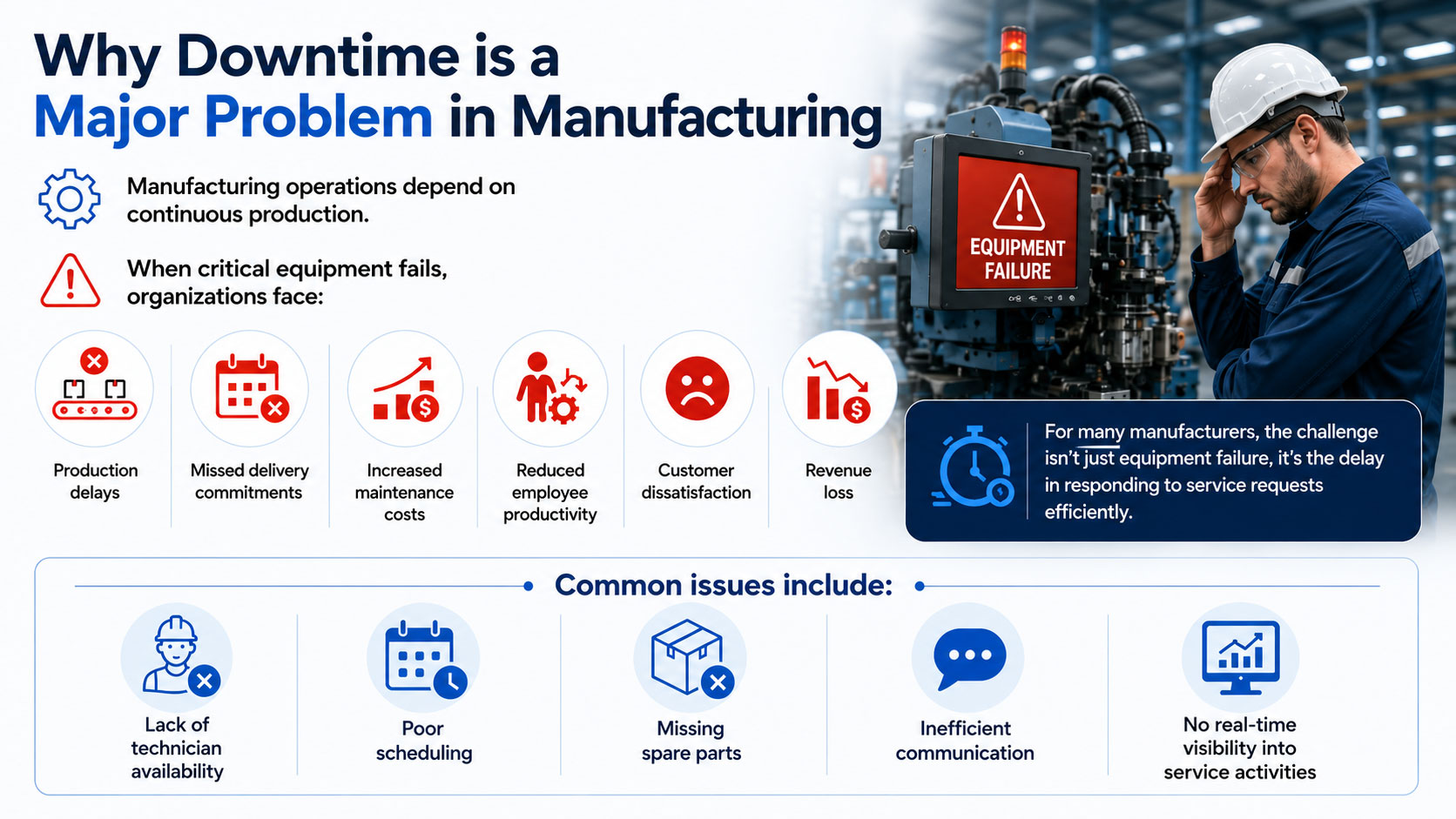
In manufacturing, every minute of downtime costs money.
Whether it’s a machine breakdown, delayed maintenance, unavailable technicians, or inefficient service scheduling, operational disruptions directly impact production targets, customer satisfaction, and profitability.
According to industry studies, unplanned downtime can cost manufacturers thousands or even millions of dollars annually, depending on plant size and production volume. As manufacturing becomes increasingly connected and customer expectations continue to rise, organizations need smarter ways to manage field service operations.
This is where Salesforce Field Service Lightning (FSL) comes in.
Salesforce FSL helps manufacturers optimize field service operations, improve technician productivity, reduce equipment downtime, and deliver faster service resolutions.
In this guide, we’ll explore how Salesforce FSL for manufacturing helps organizations improve operational efficiency, reduce downtime, and create a proactive service model that supports long-term growth.
What is Salesforce Field Service Lightning (FSL)?
Salesforce Field Service Lightning (FSL) is a field service management solution built on Salesforce that helps organizations manage:
- Work orders
- Service appointments
- Technician scheduling
- Asset maintenance
- Inventory management
- Customer communication
- Mobile workforce operations
Instead of manually assigning technicians and tracking service activities through spreadsheets, manufacturers can manage the entire service lifecycle through a single platform.
How Salesforce FSL Reduces Manufacturing Downtime
1. Intelligent Technician Scheduling
One of the biggest causes of service delays is assigning the wrong technician or inefficient scheduling.
Salesforce FSL uses intelligent scheduling capabilities to automatically match service requests with the most qualified technician based on:
- Skills
- Certifications
- Location
- Availability
- Priority level
Example
A manufacturing plant experiences a CNC machine failure.
Without FSL:
- Service request is manually assigned.
- Technician availability is checked manually.
- Delays occur.
With FSL:
- The system automatically identifies the nearest qualified technician.
- The work order is assigned instantly.
- Service begins faster.
Result:
- Reduced response time.
- Faster issue resolution.
2. Real-Time Work Order Management
Manufacturing companies often struggle to track maintenance requests across multiple facilities.
Salesforce FSL centralizes all work orders in one system.
Managers can:
- Track open requests
- Monitor service progress
- View technician status
- Prioritize critical issues
This visibility helps prevent maintenance backlogs and ensures urgent repairs receive immediate attention.
3. Predictive Maintenance Capabilities
Traditional maintenance is reactive.
Equipment breaks first. Service happens later.
Modern manufacturers are moving toward predictive maintenance.
When Salesforce FSL integrates with IoT sensors and connected equipment, organizations can:
- Monitor machine health
- Detect anomalies early
- Schedule maintenance proactively
- Avoid unexpected failures
Mini Case Example
A manufacturing company monitors machine vibration levels through IoT sensors.
When abnormal readings are detected:
- A work order is automatically created.
- A technician is scheduled.
- Maintenance occurs before failure.
Result:
- Reduced unplanned downtime.
- Increased equipment lifespan.
4. Mobile Workforce Enablement
Field technicians need information immediately.
Salesforce FSL provides a mobile application that gives technicians access to:
- Work orders
- Equipment history
- Customer information
- Service manuals
- Asset records
- Spare part inventory
Technicians arrive prepared with the right information before reaching the site.
Benefits Include:
- Faster diagnosis
- Higher first-time fix rates
- Reduced repeat visits
Improving Service Efficiency with Salesforce FSL
Reducing downtime is only one part of the equation.
Manufacturers also need to improve service efficiency.
1. Increased First-Time Fix Rate
The first-time fix rate measures how often technicians resolve issues during their first visit.
Higher first-time fix rates mean:
- Lower service costs
- Reduced travel expenses
- Better customer satisfaction
- Less equipment downtime
Salesforce FSL improves first-time fix rates by providing:
- Asset history
- Knowledge articles
- Service records
- Inventory visibility
2. Optimized Resource Utilization
Many organizations have highly skilled technicians who spend excessive time traveling or waiting for assignments.
FSL optimizes workforce utilization by:
- Minimizing travel time
- Balancing workloads
- Automating scheduling
This allows service teams to complete more jobs daily without increasing headcount.
3. Better Inventory Management
Service delays often occur because required spare parts are unavailable.
Salesforce FSL helps manufacturers:
- Track inventory levels
- Monitor part availability
- Reserve critical components
- Replenish stock proactively
Technicians can verify parts before arriving on-site.
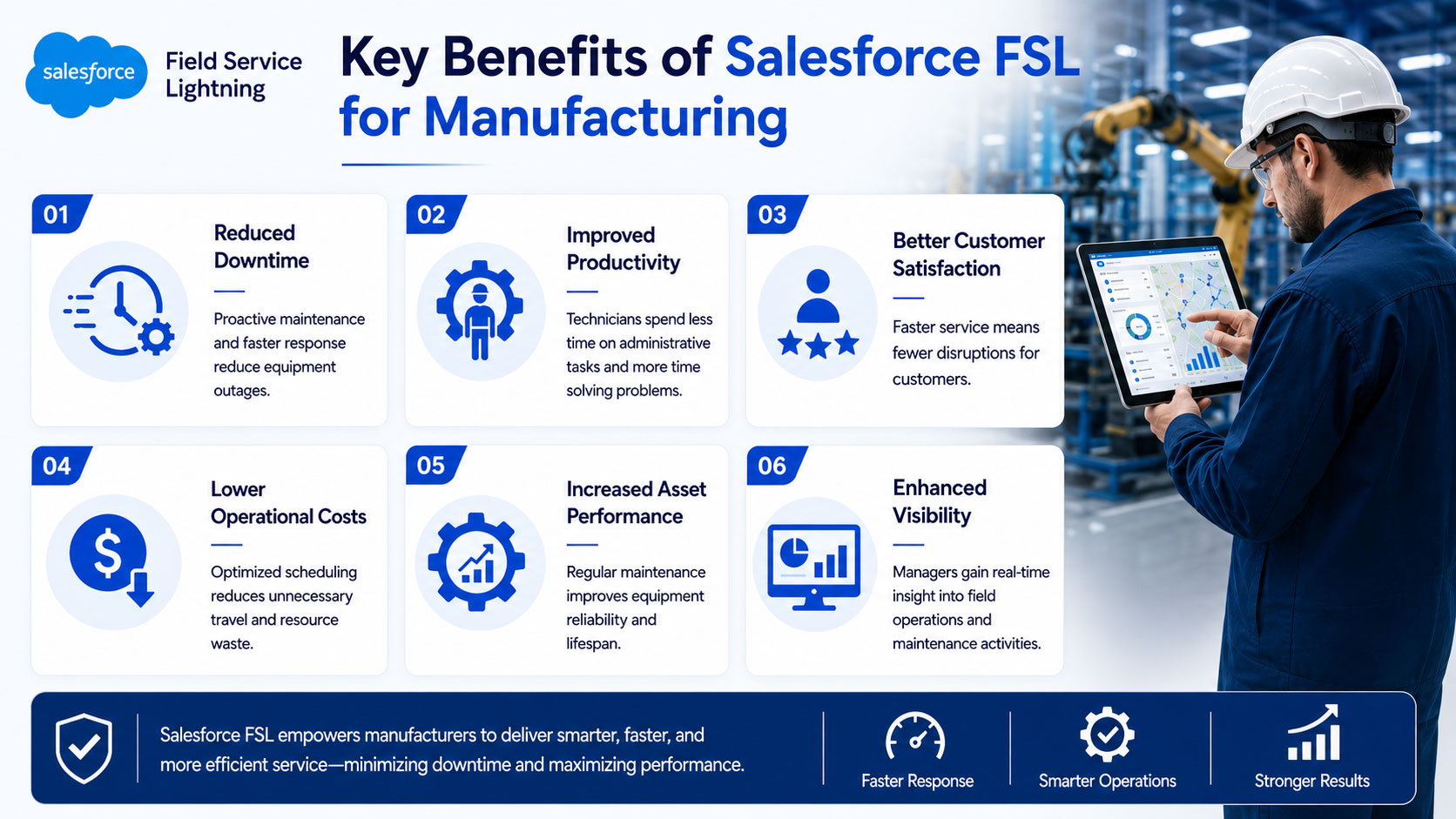
Real-World Manufacturing Scenario
Consider a manufacturing company operating five production facilities.
Before Salesforce FSL
- Maintenance requests handled via email.
- Manual technician assignment.
- Limited visibility into service activities.
- Average repair time: 12 hours.
After Salesforce FSL
- Automated work order creation.
- Intelligent technician scheduling.
- Mobile access to service records.
- Real-time service monitoring.
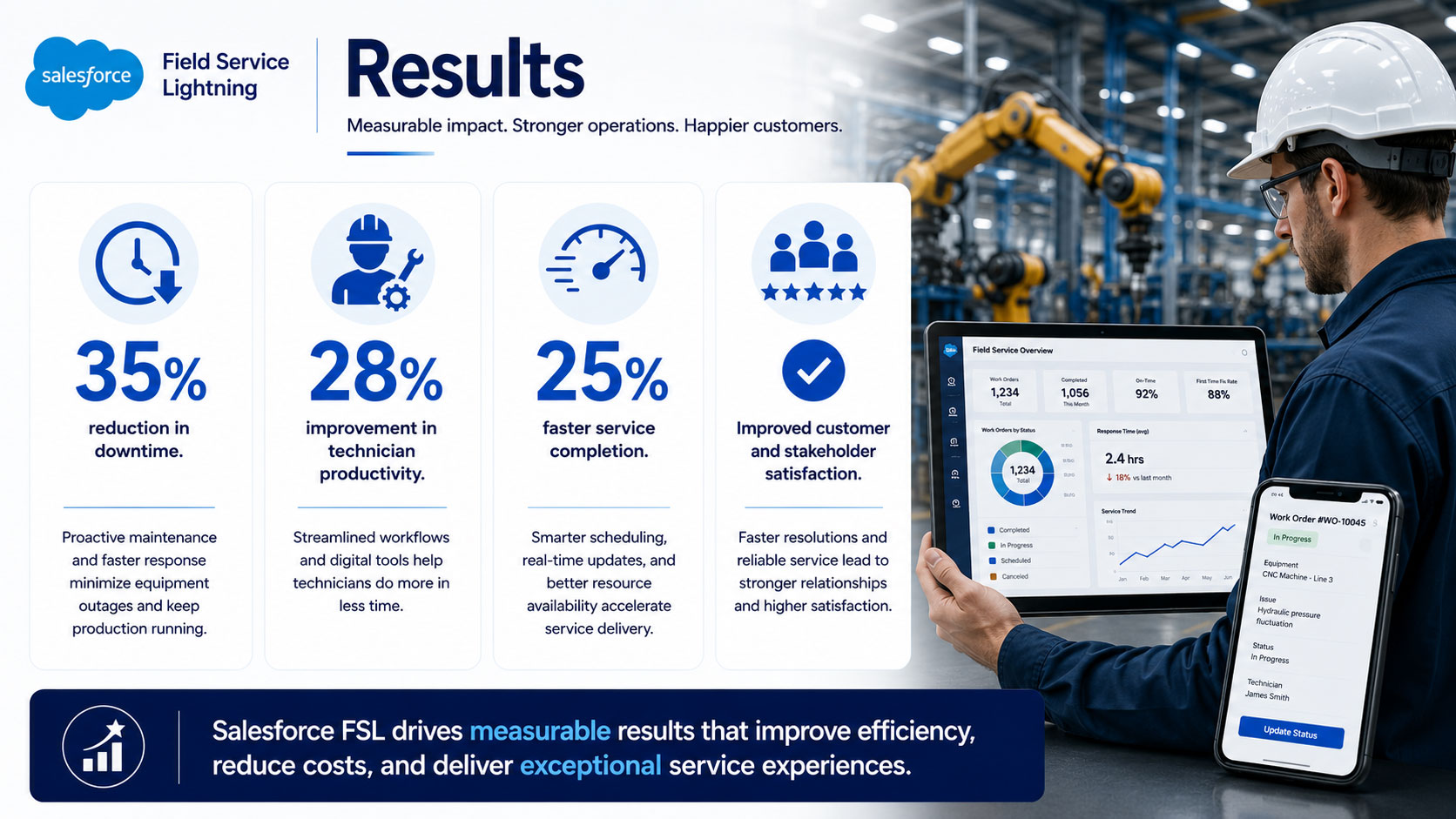
Salesforce FSL delivers measurable manufacturing outcomes by reducing downtime, increasing technician productivity, accelerating service completion, and improving customer satisfaction through real-time field service management.
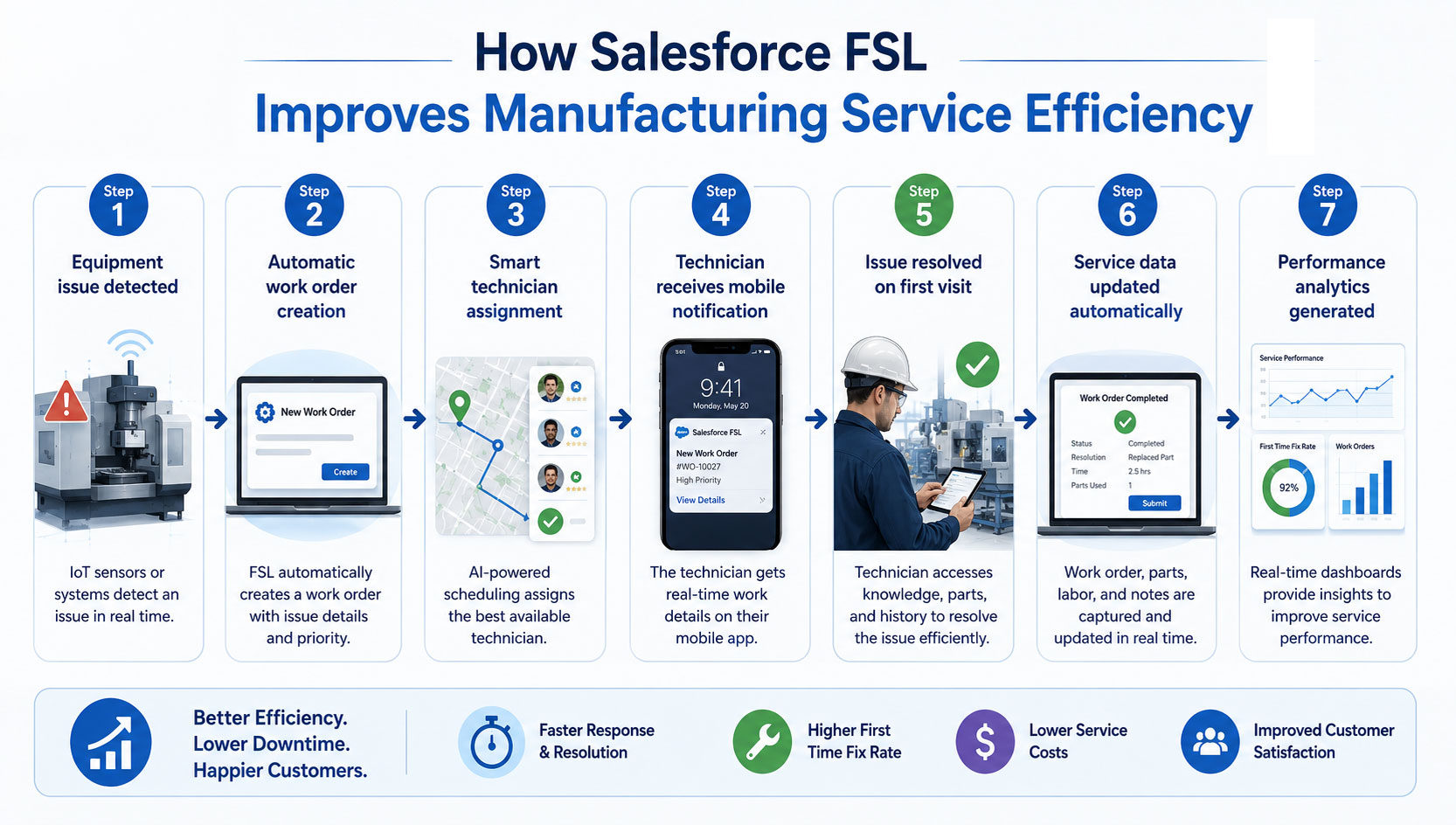
How NSIQ INFOTECH Helps Manufacturers Implement Salesforce FSL
Implementing Salesforce FSL successfully requires more than software deployment.
At NSIQ INFOTECH, we help manufacturers:
- Design field service workflows
- Configure intelligent scheduling
- Integrate IoT systems
- Optimize maintenance operations
- Build custom dashboards
- Train service teams
- Improve service performance metrics
Our focus is on helping organizations achieve measurable business outcomes through efficient field service management.

1. What is Salesforce FSL in manufacturing?
Salesforce FSL is a field service management solution that helps manufacturers manage maintenance, scheduling, technicians, and service operations.
2. How does Salesforce FSL reduce manufacturing downtime?
It enables proactive maintenance, intelligent scheduling, and faster service response.
3. Can Salesforce FSL integrate with IoT devices?
Yes, Salesforce FSL can integrate with IoT platforms for predictive maintenance.
4. What is the biggest benefit of Salesforce FSL?
Reduced equipment downtime and improved service efficiency.
5. Does Salesforce FSL improve technician productivity?
Yes, by automating scheduling and providing mobile access to service information.
6. Is Salesforce FSL suitable for large manufacturing companies?
Yes, it is highly scalable and supports enterprise-level operations.
7. Can FSL help manage multiple manufacturing facilities?
Yes, it provides centralized visibility across locations.
8. How does FSL improve first-time fix rates?
By providing technicians with complete asset and service history.
9. Does Salesforce FSL support mobile devices?
Yes, technicians can access work orders and service data through the mobile app.
10. Can FSL track spare parts inventory?
Yes, inventory management is one of its key capabilities.
11. What industries use Salesforce FSL?
Manufacturing, healthcare, utilities, telecommunications, and service organizations.
12. How long does Salesforce FSL implementation take?
Implementation timelines vary based on business complexity and customization needs.
Conclusion
Manufacturers can no longer afford inefficient service operations and costly downtime.
As production environments become more complex, organizations need smarter ways to manage maintenance, field technicians, and service delivery.
Salesforce Field Service Lightning (FSL) helps manufacturers move from reactive maintenance to proactive service management by improving scheduling, increasing technician productivity, reducing downtime, and enhancing overall operational efficiency.
For plant managers, COOs, and operations leaders, Salesforce FSL is not just a service management platform it is a strategic investment that helps drive productivity, profitability, and long-term operational excellence.
If your organization is looking to reduce manufacturing downtime and improve service efficiency, now is the ideal time to explore how Salesforce FSL can transform your field service operations.