
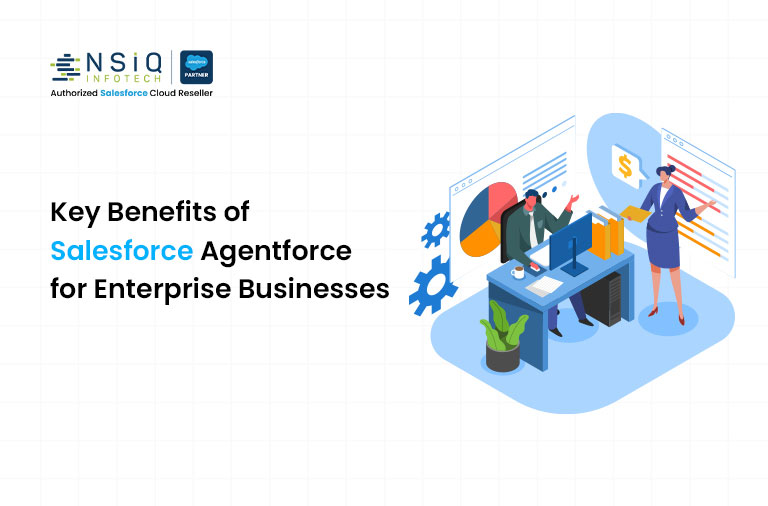
Introduction: Why Enterprise Leaders Are Paying Attention to Agentforce
Imagine your sales team closing deals while an AI handles follow-up emails. Your support team resolving 60% of cases — without lifting a finger. Your operations running around the clock, even when your team is offline.
This is not a future scenario. It’s happening right now, inside enterprises that have deployed Salesforce Agentforce.
If you’re a CIO, VP of Sales, or COO, you’re probably asking the same questions: Can AI actually deliver real ROI — not just hype? Will it integrate with what we already have? Is it safe and scalable?
This blog answers all of that. We’ll walk through what Salesforce Agentforce actually does, the key benefits of Agentforce for enterprise businesses, and real-world results companies are seeing today.
What Is Salesforce Agentforce? (A Quick, Clear Overview)
Salesforce Agentforce is an AI-powered digital labor platform that lets businesses build, deploy, and manage autonomous AI agents across every department — sales, service, marketing, operations, and HR.
Unlike a simple chatbot that follows a script, Agentforce agents can reason through complex situations, take multi-step actions, access your CRM data in real time, and hand off to a human when needed. Think of it as giving every team in your enterprise a tireless, intelligent digital co-worker.
Salesforce launched Agentforce in October 2024 and has since released multiple major versions — Agentforce 2, 2dx, 3, and most recently Agentforce 360 — with each release adding deeper reasoning, better integrations, and tighter enterprise governance.
Key Statistic #1
According to a Valoir study (2025), organizations using Agentforce went from strategy to full deployment in just 4.8 months — compared to 75.5 months for teams building agentic AI from scratch.
What this means for you:
You don’t have to spend years building AI infrastructure. Agentforce gets you to value, fast.
Who Should Read This? (Audience Context)
This blog is written specifically for:
- CIOs evaluating enterprise AI platforms and worried about governance, security, and integration complexity
- VP of Sales looking to scale pipeline, reduce manual work, and close deals faster
- COOs focused on operational efficiency, cost reduction, and cross-department automation
If you sit in any of these roles, this is your practical guide to understanding what the benefits of Agentforce actually look like in practice.
1. 24/7 Customer Support — Without Scaling Headcount
One of the most immediate and measurable Agentforce enterprise benefits is what happens to your customer support operations.
Agentforce AI agents can handle thousands of customer conversations simultaneously — answering questions, updating records, resolving tickets, and escalating to human agents only when truly needed.
Real Example:
Reddit deployed Agentforce and deflected 46% of support cases while cutting resolution times by 84%. Their average response time dropped from 8.9 minutes to 1.4 minutes — and advertiser satisfaction improved by 20%.
Real Example:
Adecco, the global staffing firm, used Agentforce to handle 51% of candidate conversations outside of standard working hours — without adding a single headcount.
Actionable Tip:
Start by identifying your top 10 most common support queries. These are your fastest wins for AI agent deployment.
2. Sales Acceleration and Pipeline Efficiency
For VP of Sales, the Salesforce Agentforce features that matter most are the ones that help your reps spend less time on admin and more time closing.
Agentforce Sales Agents can:
- Automatically send personalized follow-up emails after demos or webinars
- Schedule meetings and update CRM records instantly
- Coach reps in real time during calls by pulling in relevant data
- Prioritize leads based on live behavioral signals from Data Cloud
A sales rep who was spending 3 hours a day on follow-up emails can now focus entirely on building relationships and advancing conversations.
Actionable Tip:
Set up an Agentforce Sales Agent to handle all post-meeting follow-ups within your Salesforce CRM — it’s one of the fastest-to-deploy and highest-ROI use cases.
3. Operational Efficiency Across Every Department
When COOs think about AI, the real question is: Can this reduce operational drag at scale?
The answer, with Agentforce, is yes.
Agentforce agents work across departments — not just customer-facing ones. They can process HR requests, manage IT tickets, run compliance checks, handle finance queries, and trigger workflows across systems using MuleSoft integrations.
Real Example:
The IRS deployed Agentforce internally and saved up to 98% of manual activities in one department, reducing the time to open tax court cases from 10 days to just 30 minutes. Another division saved approximately 50,000 minutes per year.
Real Example:
1-800Accountant used Agentforce to autonomously resolve 70% of administrative chat engagements during peak tax season — their most stressful operational period.
Key Statistic #2
Salesforce’s Agentic Enterprise Index (2025) found that employee interactions with AI agents grew at an average monthly rate of 65% in the first half of 2025, with agent-triggered actions growing 76% month-over-month.
What this means:
Adoption isn’t just growing — it’s accelerating. Enterprises that move now will have a significant head start.
4. Deep CRM Integration and Real-Time Data Context
One reason enterprises choose Salesforce Agentforce over standalone AI tools is the native integration with the entire Salesforce ecosystem — Sales Cloud, Service Cloud, Marketing Cloud, Data Cloud, and Slack.
This means your agents always have context. They’re not operating with generic knowledge — they’re pulling from your actual customer data, deal history, support tickets, and behavioral signals in real time.
With Agentforce 360’s Data 360 layer, agents use Intelligent Context to understand unstructured data and turn it into actionable intelligence — so a support agent knows a customer’s entire history before saying hello.
For CIOs: This also means you don’t need a separate data pipeline or AI infrastructure. Agentforce sits on top of what you already have in Salesforce.
Related Read:
Salesforce Data Cloud vs. Traditional CRM Data: What Enterprise Leaders Need to Know
5. Enterprise-Grade Security and Governance
Security is a non-negotiable for enterprise deployments. This is where Salesforce Agentforce features that matter to CIOs come in.
Agentforce is built inside Salesforce’s Einstein Trust Layer, which means:
- Customer data is never used to train public AI models
- All agent actions are logged and auditable
- Sensitive data is masked before being sent to any language model
- Governance controls allow you to define what agents can and cannot do
Agentforce 3 also introduced a Command Center — a dedicated observability dashboard where teams can monitor agent performance, track conversations, and adjust agent behavior in real time.
Additionally, for regulated industries, Agentforce now supports Anthropic’s Claude Sonnet model hosted via Amazon Bedrock within the Salesforce trust boundary — meeting strict compliance requirements in healthcare, finance, and government.
Actionable Tip:
Before deployment, define your agent guardrails clearly — what topics they handle, when they escalate, and what data they can access. Agentforce’s policy engine makes this straightforward to configure.
6. Rapid Deployment — Not Years, Months
Enterprise AI projects have a reputation for being slow, complex, and over-budget. Agentforce was built to break that pattern.
The Agentforce Builder lets your teams (technical and non-technical alike) create AI agents through a conversational interface — no extensive coding required. At Dreamforce 2024, attendees built more than 10,000 AI agents in just three days.
The platform also ships with pre-built agent templates for common enterprise use cases in sales, service, HR, and finance — so you’re not starting from scratch.
Real Example:
Organizations using Agentforce achieved full deployment in under 5 months on average, compared to building a custom agentic stack that takes over 6 years.
Key Statistic #3
According to Salesforce’s own metrics, 84% of Agentforce customers say AI has improved both customer satisfaction and ROI. The platform has over 18,000 customers across 124 countries.
What this means:
This isn’t experimental. It’s enterprise-proven at global scale.
Related Read:
How to Build Your First AI Agent in Salesforce Agentforce: A Step-by-Step Guide
7. Scalability Without Linear Cost Growth
Traditional scaling means hiring more people. With Agentforce, scaling means deploying more agents — which doesn’t require salaries, training, or benefits.
Agentforce uses an Agentic Work Unit (AWU) pricing model, which means you pay for discrete tasks completed by AI agents, not for seats or licenses per user. This makes cost predictable and scalable.
For a COO managing tight margins, this is transformative: you can handle 10x the volume of customer interactions or operational tasks without 10x the cost.
Real Example:
SharkNinja managed 250,000 customer conversations using Agentforce — at a scale that would have been economically impossible with a purely human team.
8. Cross-Cloud and Third-Party Interoperability
Enterprises run on more than just Salesforce. Agentforce is designed for this reality.
Through MuleSoft’s Anypoint Platform, agents can connect to external systems — ERPs, legacy databases, third-party APIs — without rebuilding your backend. This means your AI agents can take action across your entire technology stack, not just inside Salesforce.
Agentforce 360 also introduced multi-agent orchestration, where multiple AI agents collaborate with each other to complete complex workflows. One agent handles customer identity, another processes the order, a third updates the logistics system — all coordinated without human intervention.
Ready to Explore Agentforce for Your Enterprise?
Stop waiting for AI to become “ready for enterprise.” It already is — and your competitors may already be using it.
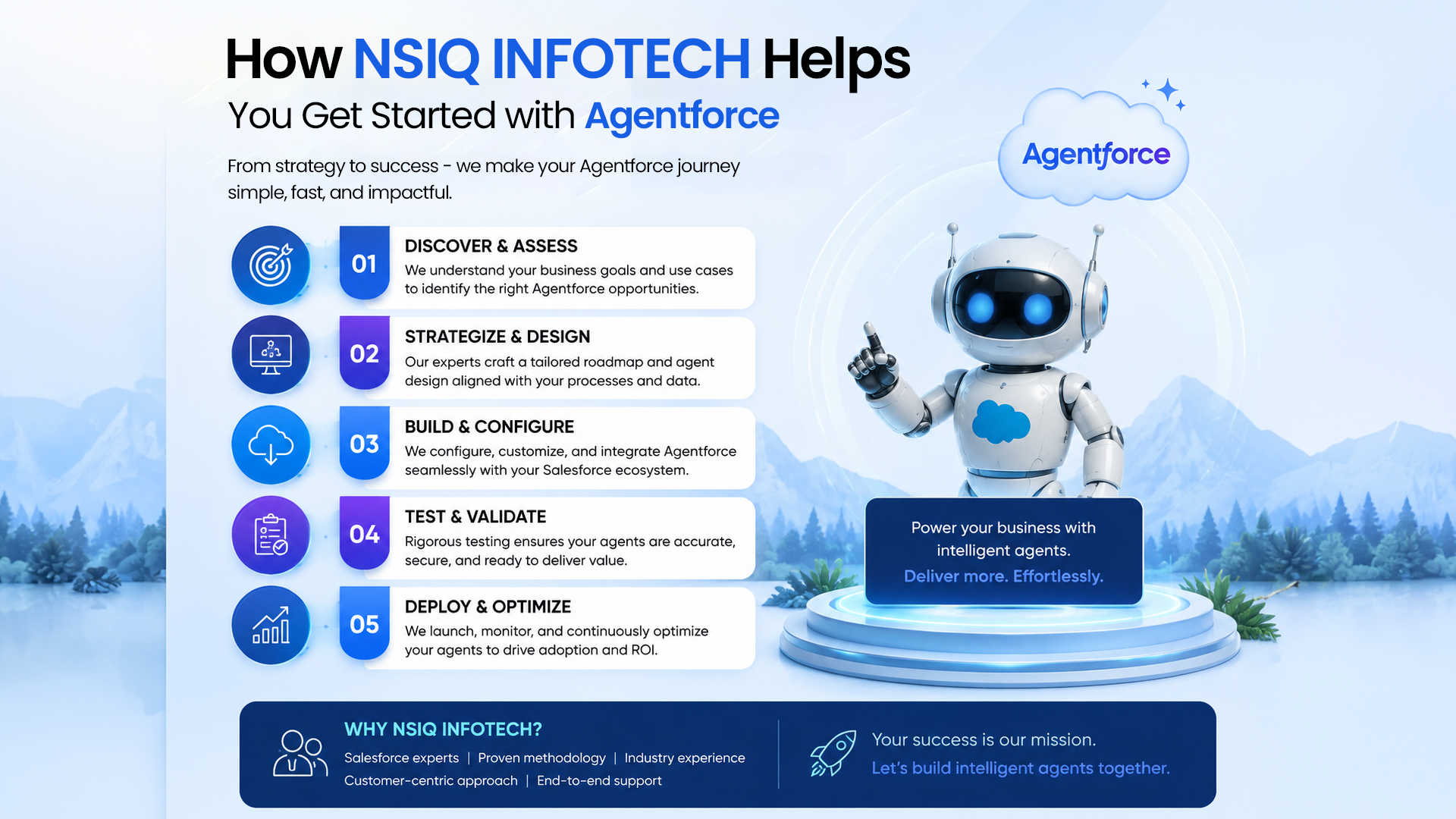
Book a free Agentforce consultation with NSIQ INFOTECH today. Our Salesforce-certified experts will walk you through a customized assessment and help you identify your fastest path to ROI.
Book Your Free Consultation Now — no commitment, just clarity.
Related Reads
- How to Build Your First AI Agent in Salesforce Agentforce: A Step-by-Step Guide
- Salesforce Data Cloud vs. Traditional CRM Data: What Enterprise Leaders Need to Know
Internal Links
- Our Salesforce Implementation Services
- Salesforce Data Cloud Integration Guide
Q. 1: What are the main benefits of Agentforce for enterprise businesses?
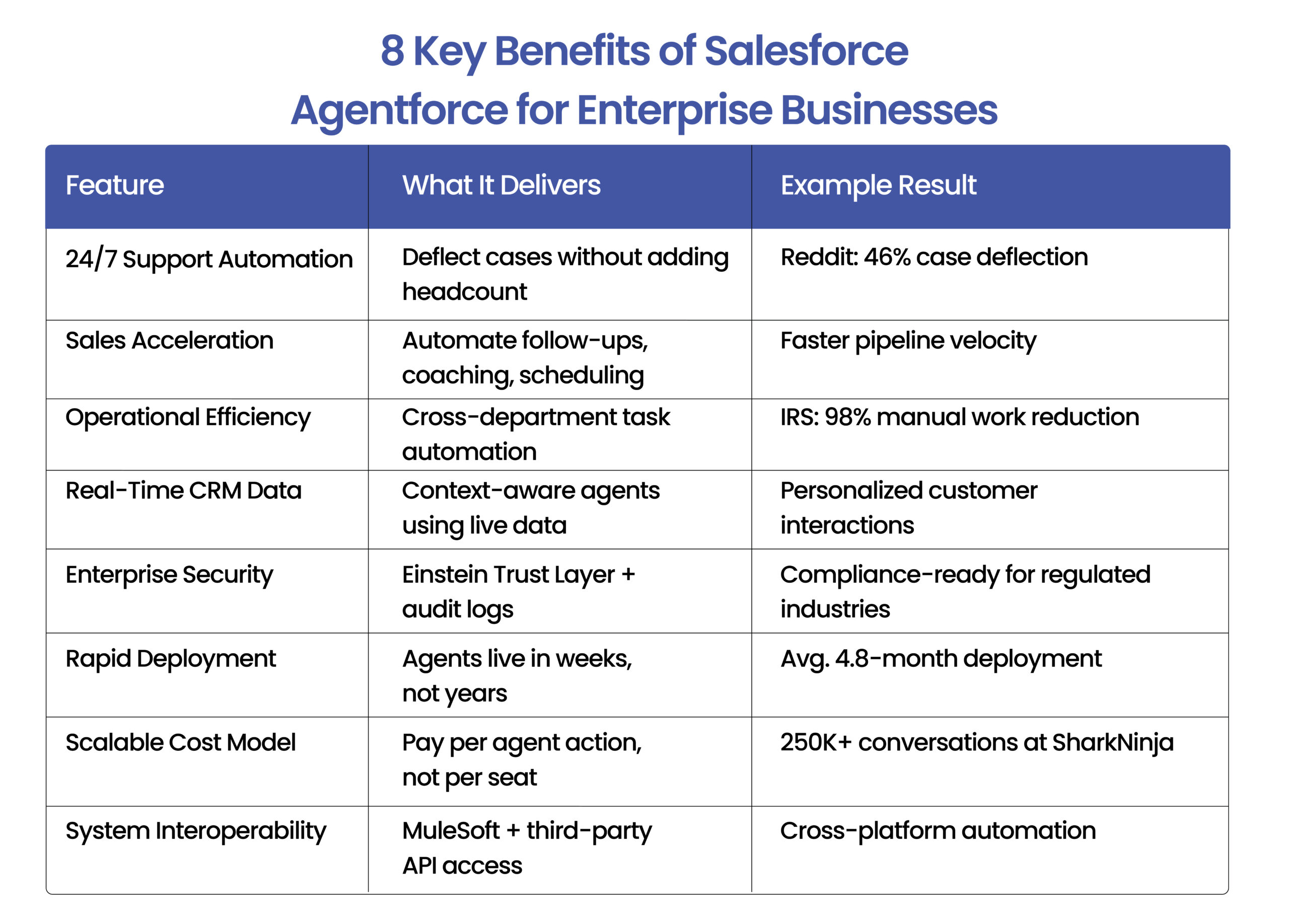
The main benefits of Agentforce for enterprises include 24/7 support automation, sales acceleration, operational efficiency across departments, real-time CRM data access, enterprise-grade security, rapid deployment, scalable pricing, and cross-system integration. Enterprises across industries have reported measurable improvements in resolution times, cost savings, and productivity.
Q. 2: What are the key Salesforce Agentforce features for large companies?
Key Salesforce Agentforce features for enterprises include the Atlas Reasoning Engine for complex decision-making, the Einstein Trust Layer for secure AI operations, MuleSoft integration for third-party system connectivity, the Agentforce Command Center for agent observability, multi-agent orchestration, and a no-code/low-code Agent Builder for fast deployment.
Q. 3: How is Salesforce Agentforce different from a regular chatbot?
Unlike a chatbot that follows a fixed script, Agentforce agents can reason through multi-step tasks, access live CRM data, take action inside Salesforce and connected systems, and hand off to human agents intelligently. They learn from context, not just keywords.
Q. 4: Is Salesforce Agentforce secure for enterprise use?
Yes. Agentforce is built on Salesforce’s Einstein Trust Layer, which ensures customer data is never used to train public AI models, all actions are auditable, and sensitive data is masked. It supports compliance requirements for regulated industries including healthcare, finance, and government.
Q. 5: What are the Agentforce enterprise benefits for a VP of Sales?
For a VP of Sales, Agentforce automates lead follow-ups, schedules meetings, provides real-time call coaching, prioritizes leads using Data Cloud insights, and keeps CRM records updated — allowing reps to focus entirely on closing deals and building relationships.
Q. 6: How long does it take to deploy Salesforce Agentforce in an enterprise?
According to a Valoir study (2025), organizations using Agentforce achieved full deployment in an average of 4.8 months — significantly faster than building a custom agentic AI stack, which averages over 6 years.
Q. 7: What does “Salesforce Agentforce benefits” mean in terms of ROI?
ROI from Agentforce comes from multiple directions: reduced support costs (fewer agents needed for the same volume), faster sales cycles, lower operational overhead, and improved customer satisfaction scores. 84% of Agentforce customers report AI has improved both satisfaction and ROI.
Q. 8: Can Agentforce integrate with non-Salesforce systems?
Yes. Through MuleSoft’s Anypoint Platform and the External Services feature, Agentforce agents can connect to third-party ERPs, databases, APIs, and legacy systems — without requiring a full backend rebuild.
Q. 9: What industries benefit most from Salesforce Agentforce?
Agentforce has seen strong adoption across financial services, retail, healthcare, travel and hospitality, government, and staffing. Any industry that deals with high volumes of customer interactions or repetitive back-office tasks is a strong candidate.
Q. 10: How does Agentforce handle situations it can’t resolve?
Agentforce agents are designed to escalate to human agents when they encounter topics outside their guardrails or when conversation complexity exceeds their scope. The human handoff is seamless and includes full conversation context so the human rep doesn’t have to start over.
Q. 11: What is the Agentforce Command Center?
The Agentforce Command Center, introduced in Agentforce 3, is an observability dashboard that allows enterprise teams to monitor agent performance, track conversations in real time, identify gaps, and adjust agent behavior — giving CIOs and operations leaders full visibility into their AI workforce.
Q. 12: Can Agentforce agents work together on complex tasks?
Yes. Agentforce 360 supports multi-agent orchestration, where multiple specialized AI agents collaborate on complex workflows — for example, one agent handling customer authentication, another processing a return request, and a third updating logistics records, all automatically.
Q. 13: What is the pricing model for Salesforce Agentforce?
Agentforce uses an Agentic Work Unit (AWU) model — you pay per discrete task completed by an AI agent, not per user seat. This makes costs predictable and directly tied to the value generated, making it easier for COOs and finance teams to justify the investment.
Q. 14: Is Agentforce suitable for a company that is new to Salesforce?
Agentforce works best for organizations already using Salesforce CRM, but it can integrate with external systems. Companies new to Salesforce often implement core CRM first, then layer in Agentforce. An implementation partner like NSIQ INFOTECH can help you sequence this correctly.
Q. 15: How does Agentforce protect sensitive customer data?
Agentforce’s Einstein Trust Layer uses data masking to prevent sensitive information (like PII, financial data, or health records) from being exposed to underlying AI models. All interactions are logged, and access controls ensure agents only see data relevant to their defined tasks.
Conclusion: The Enterprise AI Shift Is Already Happening
The question for enterprise leaders is no longer should we explore AI agents? it’s how fast can we get started?
Salesforce Agentforce represents a mature, proven platform for doing exactly that. With thousands of global deployments, measurable ROI across industries, and enterprise-grade security built in from day one, it’s the most complete agentic AI solution available to enterprises today.
The benefits of Agentforce go beyond automation. They represent a fundamental shift in how enterprises operate — where AI agents handle the volume, routine, and repetition, and your best people focus on strategy, creativity, and relationships.
Whether you’re a CIO evaluating AI platforms, a VP of Sales looking to accelerate pipeline, or a COO focused on efficiency — Agentforce has a compelling case to make.