
Imagine having a team of intelligent assistants that never sleep, never get overwhelmed, and can handle complex customer interactions, internal workflows, and sales processes all on their own. That’s not science fiction anymore. That’s Salesforce Agentforce.
In 2026, enterprise leaders CIOs, Digital Heads, and CEOs are under constant pressure to do more with less: reduce operational costs, improve customer experience, and scale faster without proportionally scaling headcount. Agentforce is the answer many of them have been waiting for.
This guide breaks down what Agentforce actually is, how it works, what makes it different from everything that came before, and why so many forward-thinking companies are deploying it right now.
What Is Salesforce Agentforce?
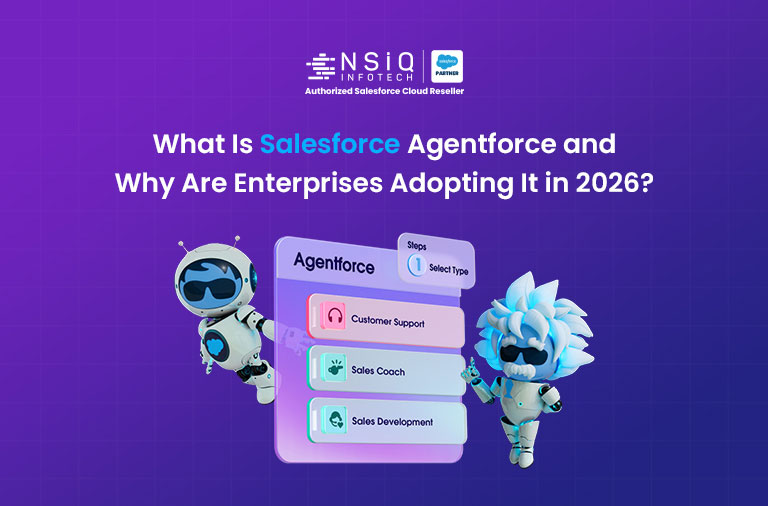
Salesforce Agentforce is an AI-powered platform that lets businesses build, deploy, and manage autonomous AI agents — digital workers that can understand natural language, make decisions, take action, and collaborate with human teams, all within the Salesforce ecosystem.
Unlike simple chatbots or rule-based automation, Agentforce agents don’t just respond to inputs. They reason. They look at available data, decide what the best next action is, and then execute it — whether that’s resolving a customer service case, updating a CRM record, routing a sales opportunity, or escalating a complex issue to a human employee.
Think of it this way: a traditional chatbot follows a script. An Agentforce agent reads the room.
Salesforce officially introduced Agentforce at Dreamforce 2024, and by 2026 it has become one of the most adopted enterprise AI platforms globally, sitting at the center of Salesforce’s broader “agentic enterprise” strategy.
How Does Agentforce Actually Work?
Understanding the architecture behind Agentforce helps explain why it’s so powerful. Here’s how the platform works at a high level.
The Five Core Building Blocks
Role
Role defines what the agent is there to do. Is it a customer service agent? A sales development representative? An IT support assistant? You define the role and the agent focuses on it.
Data
Data is sourced from Salesforce Data Cloud — the unified data layer that pulls in information from CRM, third-party apps, real-time events, and enterprise databases. The agent only acts on real, current, and trusted data.
Actions
Actions are the tasks the agent is authorized to perform. This could be sending an email, updating a record, generating a quote, raising a ticket, or triggering a workflow. You control what each agent is allowed to do.
Guardrails
Guardrails define the boundaries. You decide what the agent cannot do — for example, it cannot process a refund above a certain threshold without human approval. This keeps the agent safe and compliant.
Einstein Trust Layer
The Einstein Trust Layer is Salesforce’s built-in security framework. It ensures that no customer data leaves your trusted environment when interacting with AI models, which is a critical concern for regulated industries like banking, healthcare, and insurance.
All five components work together to create agents that are powerful but controlled — autonomous but accountable.
This is one of the most common questions enterprise leaders ask. Here’s a clear answer.
Agentforce vs. Traditional Automation (RPA)
Traditional Robotic Process Automation (RPA) tools follow rigid, pre-defined rules. They’re great for repetitive, structured tasks — like copying data from one system to another. But the moment something unexpected happens, they break.
Agentforce agents don’t follow a script. They understand context, handle ambiguity, and adapt to new situations. If a customer’s case doesn’t fit neatly into a predefined category, the agent doesn’t fail — it reasons through the situation.
Agentforce vs. Salesforce Einstein
Salesforce Einstein AI is embedded intelligence that makes predictions and suggestions within Salesforce. It might suggest the next best action to a sales rep or score a lead. But a human still has to decide and act.
Agentforce takes the next step: the agent acts. It’s the difference between a GPS giving you directions and a self-driving car that actually takes you there.
Agentforce vs. Basic Chatbots
Chatbots are reactive. They answer questions in a conversation. Agentforce agents are proactive. They can initiate processes, juggle multiple workflows simultaneously, hand off tasks to other agents, and loop in humans when needed — all without being prompted.
Key Statistics Every Enterprise Leader Should Know
Stat 1
According to McKinsey & Company, organizations deploying AI agents report an average 20–30% reduction in operational costs within the first year.
This proves enterprise AI ROI is already measurable in production environments.
Stat 2
Salesforce reports that Agentforce handled over 1 billion agent interactions in the first six months after its global rollout.
This demonstrates that enterprises are deploying Agentforce at massive scale — not just experimenting.
Stat 3
Gartner predicts that by 2028, 33% of enterprise software applications will include agentic AI capabilities, up from less than 1% in 2024.
For CIOs and Digital Heads, this signals a major market shift toward autonomous enterprise AI.
Why Are Enterprises Adopting Agentforce in 2026?
The CX Expectation Gap Has Reached a Breaking Point
Customers expect instant, personalized, 24/7 support. Hiring enough people to meet those expectations is expensive and difficult. Agentforce helps close this gap without sacrificing service quality.
The “Do More With Less” Mandate Is Everywhere
Enterprise leaders are being asked to improve efficiency and increase growth without adding proportional headcount. Autonomous AI agents directly support both goals.
The Trust Problem Has Been Solved
Previous AI tools raised concerns around:
- Data privacy
- Hallucinations
- Security risks
- Compliance issues
Salesforce’s Einstein Trust Layer addresses these challenges directly.
Salesforce Is Already the System of Record
For many enterprises, Salesforce already contains:
- Customer profiles
- Sales pipelines
- Service histories
- Business workflows
Because Agentforce is built natively into Salesforce, organizations avoid expensive data integration projects.
Actionable Tips: How to Get Started with Agentforce
Step 1 — Identify a High-Volume Repetitive Task
Start with a process your team handles repeatedly every week.
Step 2 — Audit Your Salesforce Data
AI agents depend on clean and reliable CRM data.
Step 3 — Define Guardrails Early
Decide exactly what agents are allowed — and not allowed — to do independently.
Step 4 — Start Small and Scale Gradually
Launch one focused pilot, measure ROI carefully, and expand strategically.
Conclusion
Salesforce Agentforce represents one of the most significant shifts in enterprise software since the move to the cloud.
It transforms Salesforce from a system that records activity into a platform that autonomously takes action — securely, intelligently, and at enterprise scale.
For CIOs and Digital Heads, the strategic case is clear:
Organizations deploying autonomous AI agents in 2026 will operate faster, improve customer experience, and outperform competitors still relying on fully manual processes.
The question is no longer whether to adopt Agentforce — it’s how quickly you can implement it responsibly and effectively.
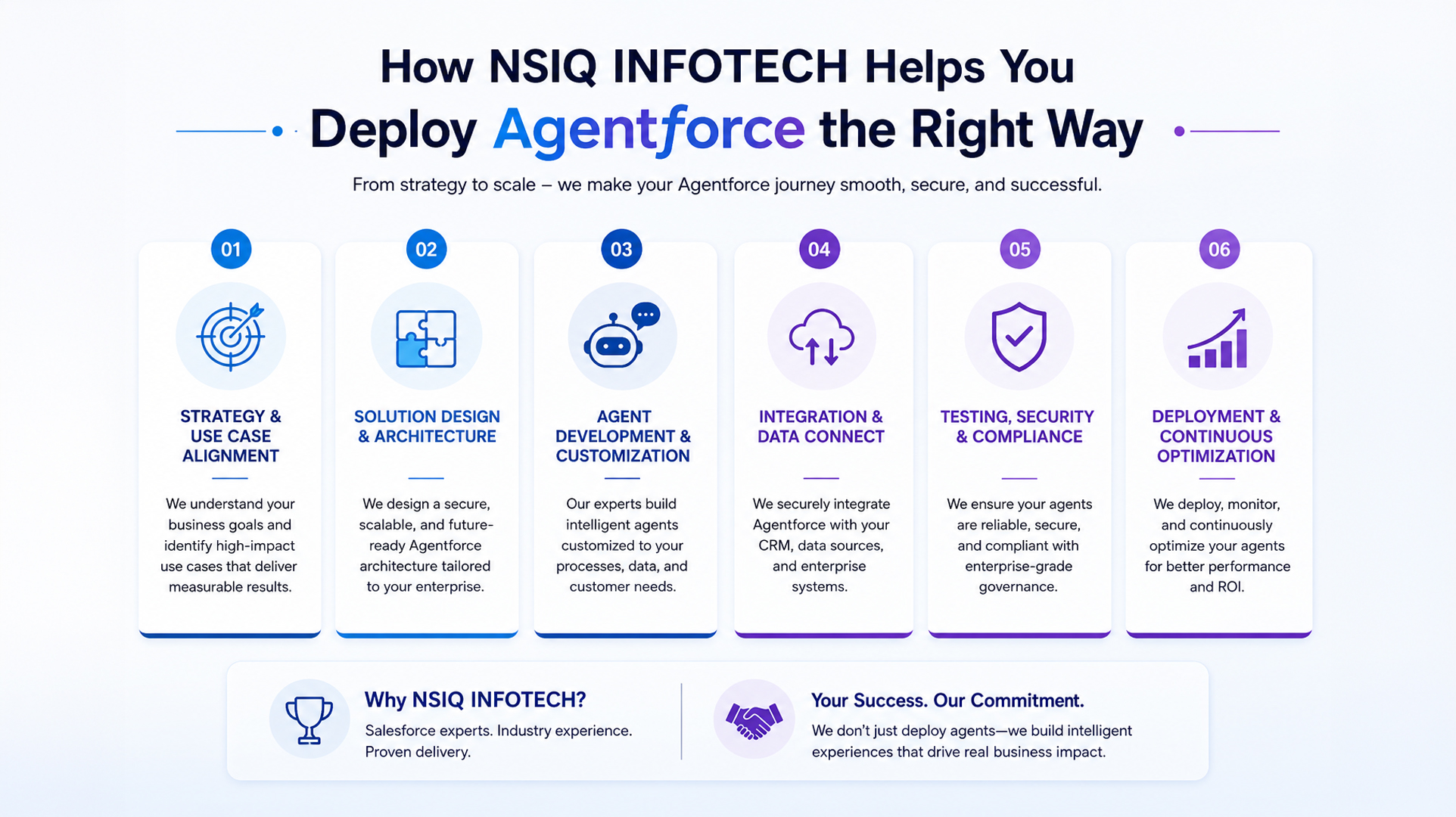
At NSIQ INFOTECH, we help enterprises confidently build their agentic future with Salesforce Agentforce.
Q. 1: What is Salesforce Agentforce in simple terms?
Agentforce is a Salesforce platform that lets businesses create autonomous AI agents that handle tasks like customer support, CRM updates, and workflow management automatically.
Q. 2: How is Agentforce different from a regular chatbot?
Chatbots follow scripts. Agentforce agents reason through situations, take action across systems, and manage workflows proactively.
Q. 3: What are the main Agentforce use cases?
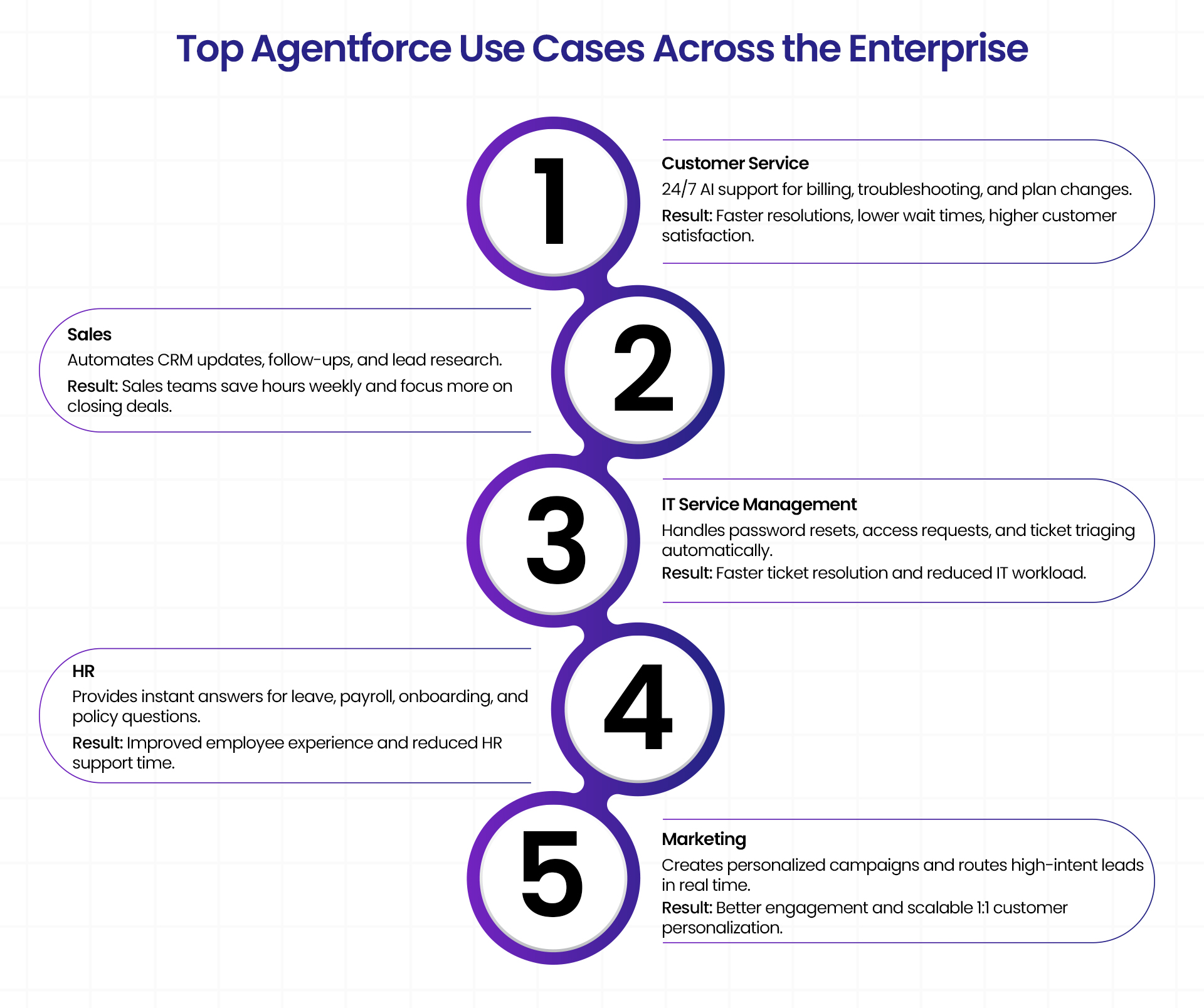
Popular use cases include customer service automation, AI-assisted sales, IT help desk automation, HR self-service, and marketing personalization.
Q. 4: Is Agentforce secure for enterprise use?
Yes. Salesforce’s Einstein Trust Layer protects enterprise data and ensures compliance and security controls remain intact.
Q. 5: Does Agentforce require coding?
Not always. Many deployments use Salesforce’s low-code and no-code tools, though advanced implementations may require Apex or API integrations.
Q. 6: What is the agentic enterprise?
An agentic enterprise uses autonomous AI agents to handle large portions of operational and customer-facing work.
Q. 7: How do Agentforce AI agents make decisions?
They use Salesforce Data Cloud data, reasoning models, configured rules, and authorized actions to determine the best next step.
Q. 8: Which industries are adopting Agentforce fastest?
Financial services, retail, telecom, manufacturing, healthcare, and technology are leading adopters.
Q. 9: Can Agentforce integrate with non-Salesforce systems?
Yes. Through MuleSoft and APIs, Agentforce can connect with ERP systems, databases, and third-party enterprise applications.
Q. 10: What is the Einstein Trust Layer?
It’s Salesforce’s AI security framework that protects sensitive data and ensures compliant AI interactions.
Q. 11: How long does deployment take?
A pilot deployment may take 4–8 weeks, while enterprise-wide rollouts often take 3–6 months.
Q. 12: What is the difference between Agentforce and Salesforce Flow?
Salesforce Flow automates rule-based workflows. Agentforce handles dynamic situations requiring natural language understanding and decision-making.
Q. 13: Will Agentforce replace employees?
Most organizations use Agentforce to eliminate repetitive work so employees can focus on strategic and higher-value activities.
Q. 14: What does Salesforce Agentforce cost?
Pricing depends on usage, deployment scale, and Salesforce licensing requirements.
Q. 15: How can NSIQ INFOTECH help?
NSIQ INFOTECH provides complete Agentforce implementation services, including consulting, configuration, integrations, testing, deployment, and support.