

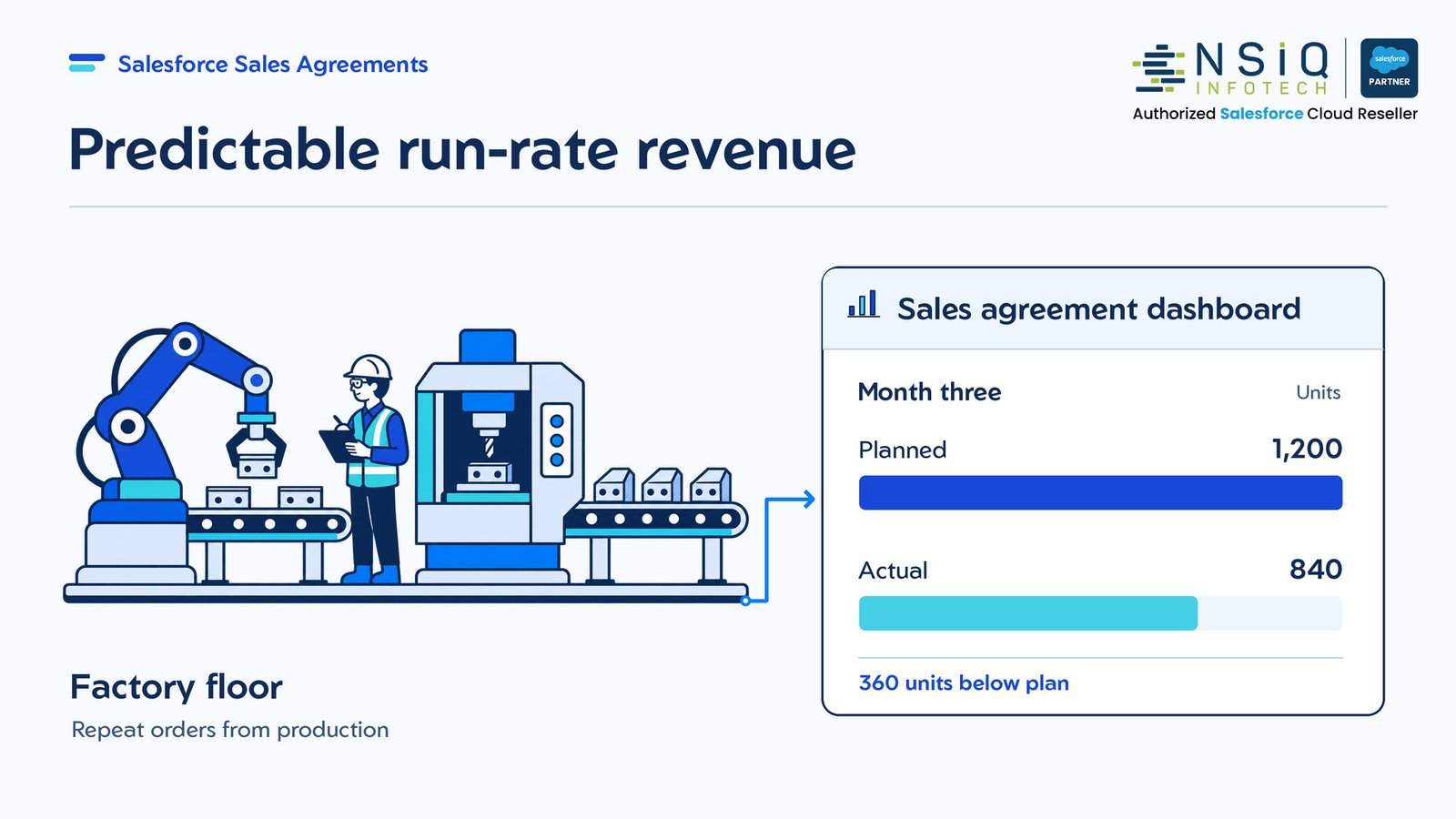
Picture a Monday review call. A regional sales lead says a long-standing distributor is “on track.” Finance asks what that means in units and dollars. Nobody has the answer ready, so someone disappears into a contract folder and last quarter’s order export.
If that sounds familiar, you’ve run into the real weakness of run-rate business: the revenue is dependable, but the visibility isn’t. Orders arrive month after month, yet the plan behind them sits in one document and the results sit in another system.
This guide explains how Salesforce Sales Agreements in Manufacturing Cloud close that gap. Manufacturing Cloud is now part of what Salesforce calls Agentforce Manufacturing. You’ll learn what a sales agreement is, how planned and actual numbers are compared, what it does for run-rate business forecasting, and how to roll it out without a big-bang project. It’s written for VPs of Sales, Sales Ops leaders and CFOs who need numbers they can defend.
Why Is Run-Rate Business Hard to Forecast?
Run-rate business is the repeat revenue that comes from customers who have already agreed to buy. Think of a distributor who takes the same set of parts every month, or an OEM that pulls a steady volume all year. It’s the quiet backbone of most manufacturers’ revenue.
The trouble is that most CRM processes were designed around opportunities: a deal opens, moves through stages and closes. Repeat business doesn’t follow that path. Nothing “closes” in month five, yet money still arrives.
-
The Agreement Lives in One Place and the Orders in Another
The pricing and volume terms are usually in a signed contract. The actual orders sit in the ERP. The sales team works in the CRM. That’s three systems with three views, and nobody connecting them.
-
The Forecast Fills the Gap With Guesswork
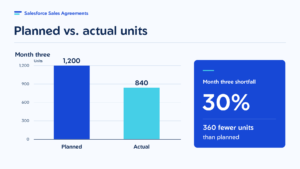
When the link is missing, forecasts lean on last year’s totals and a rep’s instinct. That feels fine until a customer quietly slows down. A dip in orders in month three rarely raises an alarm, so the shortfall tends to surface at quarter end, when it’s too late to act.
What Are Salesforce Sales Agreements?
A sales agreement in Manufacturing Cloud is a record of the commercial deal you’ve reached with an account. It holds the products, the expected quantities, the prices and the period the deal covers. In other words, it brings the contract into the system your team already works in every day.
-
Terms and Schedules
The agreement isn’t a single yearly number. It’s broken into schedules, so you can see the plan month by month for each product. That time-phased view is what makes later comparisons possible.
-
Planned, Actual and Forecast Side by Side
Salesforce tracks several metrics for each product, including planned quantity, actual quantity, forecasted quantity and the matching revenue amounts. Admins can group these metrics, for example one group for revenue and another for quantity, so the screen stays readable.
-
How Actuals Are Calculated
Actuals tell you what really happened. According to Salesforce’s Trailhead training, admins choose one of three ways to calculate them:
- Automatically from direct orders: actuals come from orders placed against the agreement.
- Automatically from orders through contracts: actuals are drawn from orders linked through contracts.
- Manually through API upload: useful when order data lives in an outside system such as an ERP.
Salesforce’s training material notes that actuals are refreshed by a job that runs at midnight, and users can also recalculate them on demand when they need fresh figures sooner.
-
Renewals and Mid-Term Changes
Agreements don’t stay frozen. Admins can set how many days before an agreement ends that renewal can begin. Salesforce’s own training example uses 240 days, which gives account managers about eight months of lead time. When volumes change, a mass update lets you adjust planned quantities across schedules in one step instead of editing each line by hand.
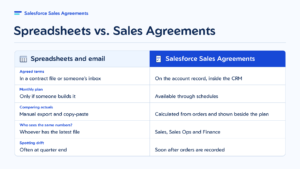
Spreadsheets vs. Sales Agreements at a Glance
| Question | Spreadsheets and email | Salesforce Sales Agreements |
| Where are the agreed terms? | In a contract file or someone’s inbox | On the account record, inside the CRM |
| Can you see the plan by month? | Only if someone builds it | Yes, through schedules |
| How are actuals compared? | Manual export and copy-paste | Calculated from orders and shown beside the plan |
| Who sees the same numbers? | Whoever has the latest file | Sales, Sales Ops and Finance |
| When do you spot drift? | Often at quarter end | Soon after orders are recorded |
What the Forecasting Data Says
Forecasting trouble isn’t unique to manufacturers. Three data points show how common it is:
- 79% of sales organizations miss their forecast by more than 10%. This is SiriusDecisions research, now part of Forrester. A miss that size can throw off production plans and cash flow.
- 55% of sales leaders lack a high degree of confidence in their forecast accuracy. This comes from a 2020 Gartner report, as cited by Clari. When leaders doubt the number, they pad it, and padded numbers lead to over- or under-stocking.
- Only 7% of sales organizations reach 90% forecast accuracy, and the median sits around 70% to 79%. This is Gartner research as reported by Outreach. Even strong teams usually carry a meaningful error.
None of these figures is specific to Salesforce or to manufacturing, so treat them as context, not a promise. The takeaway is simple: a forecast built on documented commitments gives you a firmer starting line than one built on instinct.
Who Benefits and How
-
VP Sales
You can show the board which part of next quarter’s revenue is already committed and which part still has to be won. You can also see which accounts need a rep’s attention first, instead of waiting for a complaint.
-
Heads of Sales Ops
Agreements follow one structure, so reporting no longer depends on how each rep chooses to record things. That means less cleanup, fewer reconciliation calls and dashboards that people trust.
-
CFOs
Revenue projections rest on documented commitments and real buying behavior. That makes production, inventory and cash planning less of a gamble, and it makes run-rate business forecasting something you can explain in a board meeting.
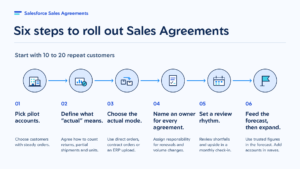
A Six-Step Rollout Plan
Nobody needs to convert every account at once.
- Pick pilot accounts. Choose 10 to 20 repeat customers with steady buying patterns and a real share of revenue.
- Define what “actual” means. Decide how returns, cancellations, partial shipments and unit-of-measure differences are treated. If teams can’t agree on actuals, they can’t agree on anything else.
- Choose the actual mode. Match the calculation method to where your order data lives: direct orders, orders through contracts, or an API upload from the ERP.
- Name an owner for every agreement. Someone must be responsible for keeping terms current, especially around renewals and volume changes.
- Set a review rhythm. A 15-minute monthly check on the biggest gaps between plan and actual is often enough. Flag two kinds of exceptions: shortfall risk and upside.
- Feed the forecast, then expand. Once the numbers are trusted, use them as the base of your forecast and add more accounts in waves.
Common Mistakes to Avoid
- Loading every account on day one. A big-bang rollout buries the team in data cleanup. Start small and prove the value first.
- Leaving “actual” undefined. If Sales and Finance count orders differently, the dashboard will start arguments instead of ending them.
- Treating the agreement as set and forget. Volumes and prices change. Someone has to keep the record current.
- Skipping the review habit. The data only helps if a person looks at the gaps and calls the customer.
- Ignoring data quality. Messy product names or missing order links lead to wrong comparisons, so fix the basics early.
How NSIQ Infotech Can Help
Setting up Sales Agreements is part configuration and part process design. At NSIQ Infotech, we work with sales and operations teams to plan the setup, decide how actuals should flow in, connect order data and shape the dashboards people will actually open. If you’d like a second pair of eyes before you begin, we’re happy to talk it through with no pressure.
Frequently Asked Questions
-
What are Salesforce Sales Agreements?
They are records of the commercial terms agreed with an account: products, quantities, prices and the period covered. They’re broken into schedules, so you can compare plans and actuals month by month.
-
How are actuals calculated in Manufacturing Cloud Sales Agreements?
Admins pick one of three modes: automatically from direct orders, automatically from orders through contracts, or manually through an API upload.
-
Can Sales Agreements connect to our ERP?
Yes. If your orders live in an external system, the API upload mode lets you bring actuals into Salesforce. Salesforce’s training also describes importing outside data such as inventory levels into agreement metrics.
-
How do renewals work in Salesforce Sales Agreements?
Admins set how many days before the end date renewal can start. Account managers can then create the next agreement with updated quantities and prices.
-
What should we measure first?
Start with committed versus actual variance by account and month. It’s simple, and it shows quickly where action is needed.
Conclusion
For many manufacturers, run-rate business quietly pays the bills, yet it gets the least structured attention. Salesforce Sales Agreements bring it into view: what was promised, what has been ordered and where the two are drifting apart.
The key insights are easy to remember. Capture agreed terms in the CRM, compare them with actual orders, review the gaps on a regular rhythm and let those numbers anchor your forecast. Start with a handful of accounts and grow from there.
If more predictable revenue is on your list, this is a sensible place to begin. Book a consultation with NSIQ Infotech and we’ll help you map the first steps for your team.