
Introduction
In an era where customers expect brands to know them instantly across every touchpoint, channel, and moment generic messaging is no longer a missed opportunity. It is an active liability.
Salesforce Data 360 changes the calculus entirely, turning fragmented data estates into a unified, real-time engine for personalisation at enterprise scale.
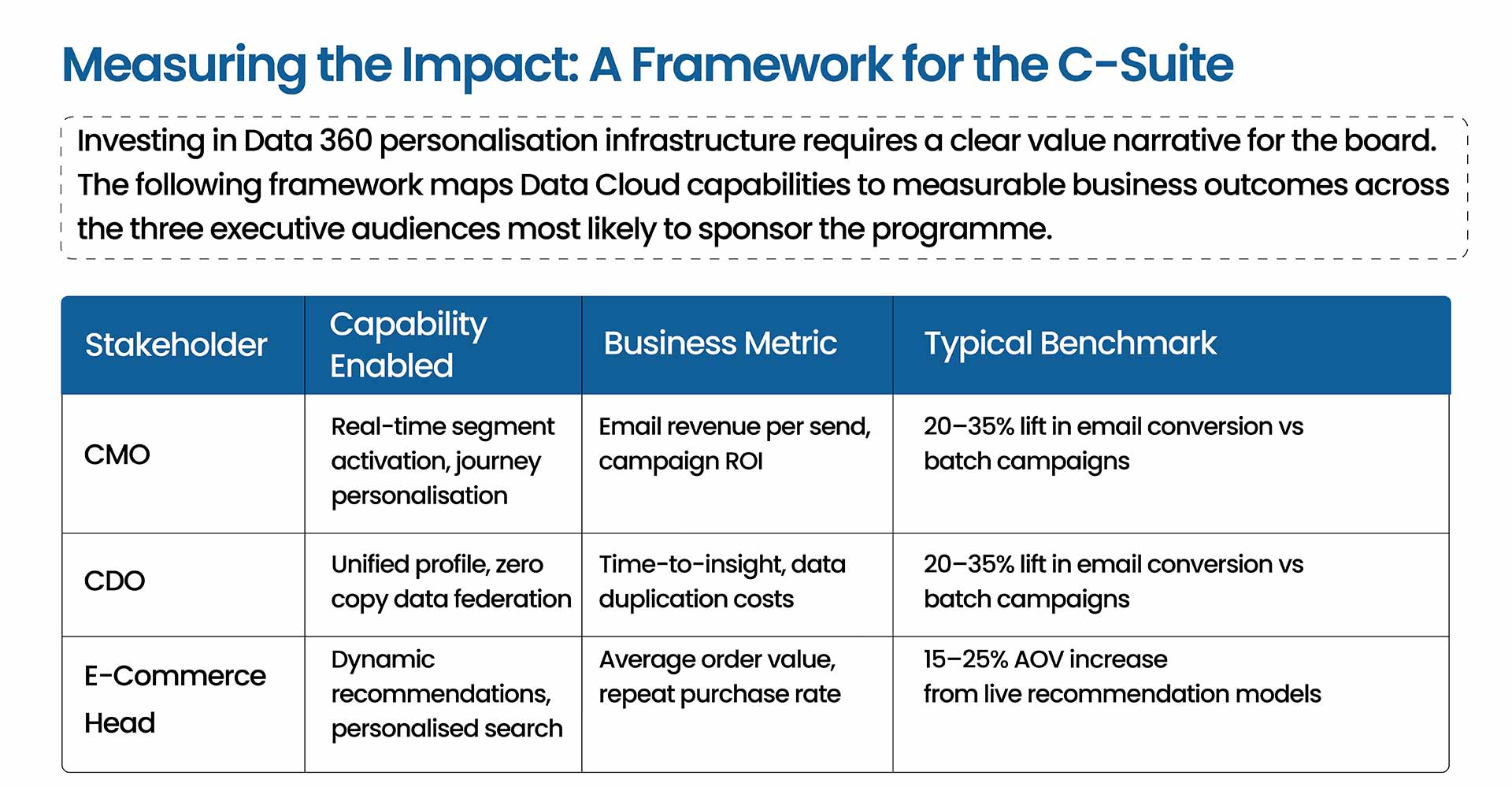
CMOs, CDOs, and E-Commerce leaders are under increasing pressure to deliver measurable outcomes from their data and AI investments.
Yet despite significant spending on technology, many organisations continue to struggle with a familiar problem.
Their customer data is fragmented, inconsistent, and incomplete.
According to McKinsey & Company, companies that excel at personalisation generate 40% more revenue from those activities than average players. And Salesforce’s own State of the Connected Customer report confirms: 73% of customers expect companies to understand their unique needs yet only 32% say companies actually treat them as individuals.
The gap between expectation and delivery is not a strategy problem. It is a data infrastructure problem.
In this guide, we will explore how Salesforce Data 360, anchored by Salesforce Data Cloud, gives enterprise teams the real-time data foundation to close that gap and deliver personalisation at scale.
The Personalisation Problem at Scale
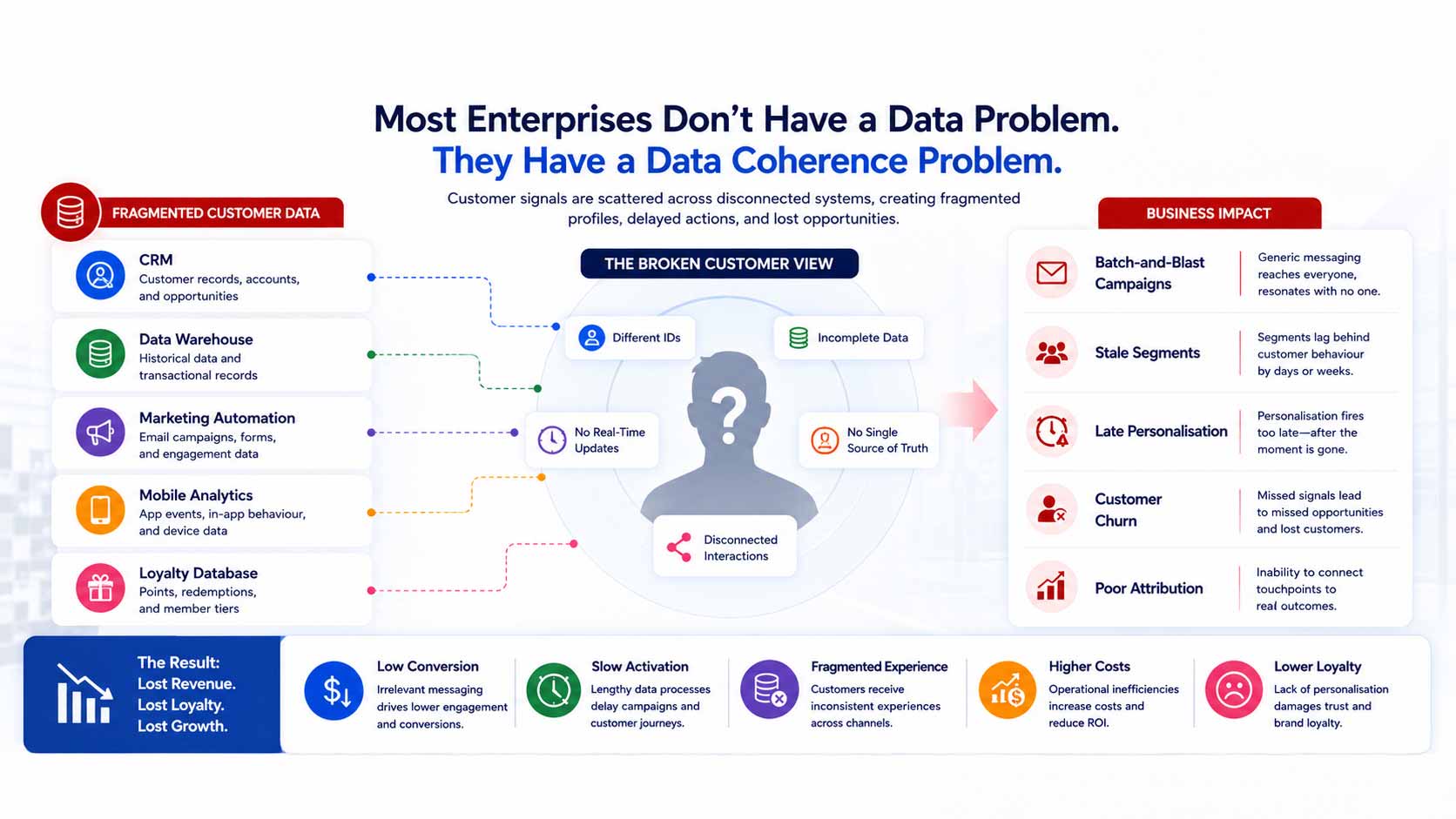
Most enterprises do not have a data shortage. They have a data coherence problem.
Customer signals are scattered across a CRM, a data warehouse, a marketing automation platform, a mobile analytics SDK, and a loyalty database each holding a partial truth about the same human being.
For CMOs and CDOs trying to orchestrate cross-channel journeys, this fragmentation produces the same failure modes at every turn:
- Batch-and-blast campaigns that feel impersonal
- Stale segments that lag customer behaviour by days
- Personalisation logic that fires too late after the customer has already churned, or already converted without attribution
Salesforce Data 360 anchored by Salesforce Data Cloud is built to resolve exactly this problem. It ingests, unifies, and activates customer data in real time, giving every team that touches the customer a single, live, actionable profile to work from.
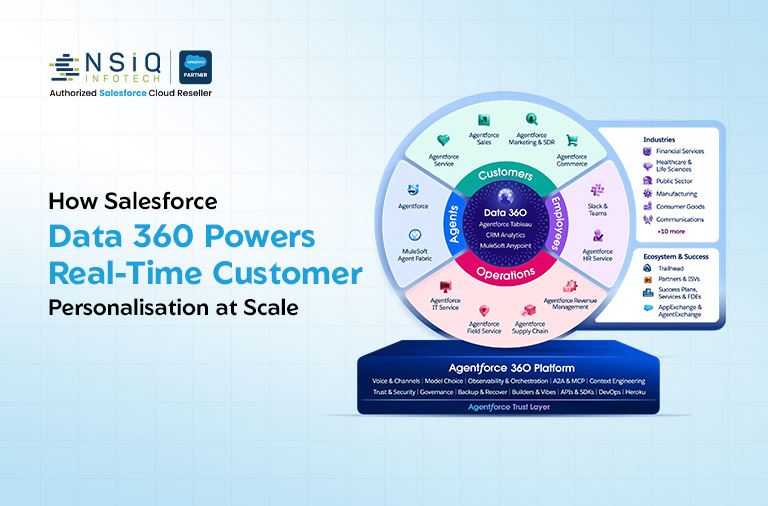
Salesforce Data 360 is not a standalone product but a strategic capability: the convergence of Data Cloud, Einstein AI, Flow automation, and the entire Salesforce platform into a unified data-and-personalisation layer that operates at the speed of the customer.
What Is Salesforce Data 360?
At its core, Data 360 refers to the complete, 360-degree view of a customer that Salesforce Data Cloud constructs and continuously refreshes by resolving identities, harmonising data from every source, and making that unified profile instantly available to downstream activation surfaces: Marketing Cloud, Commerce Cloud, Service Cloud, and Einstein models.
The architecture rests on three capabilities that, together, differentiate it from a conventional Customer Data Platform (CDP).
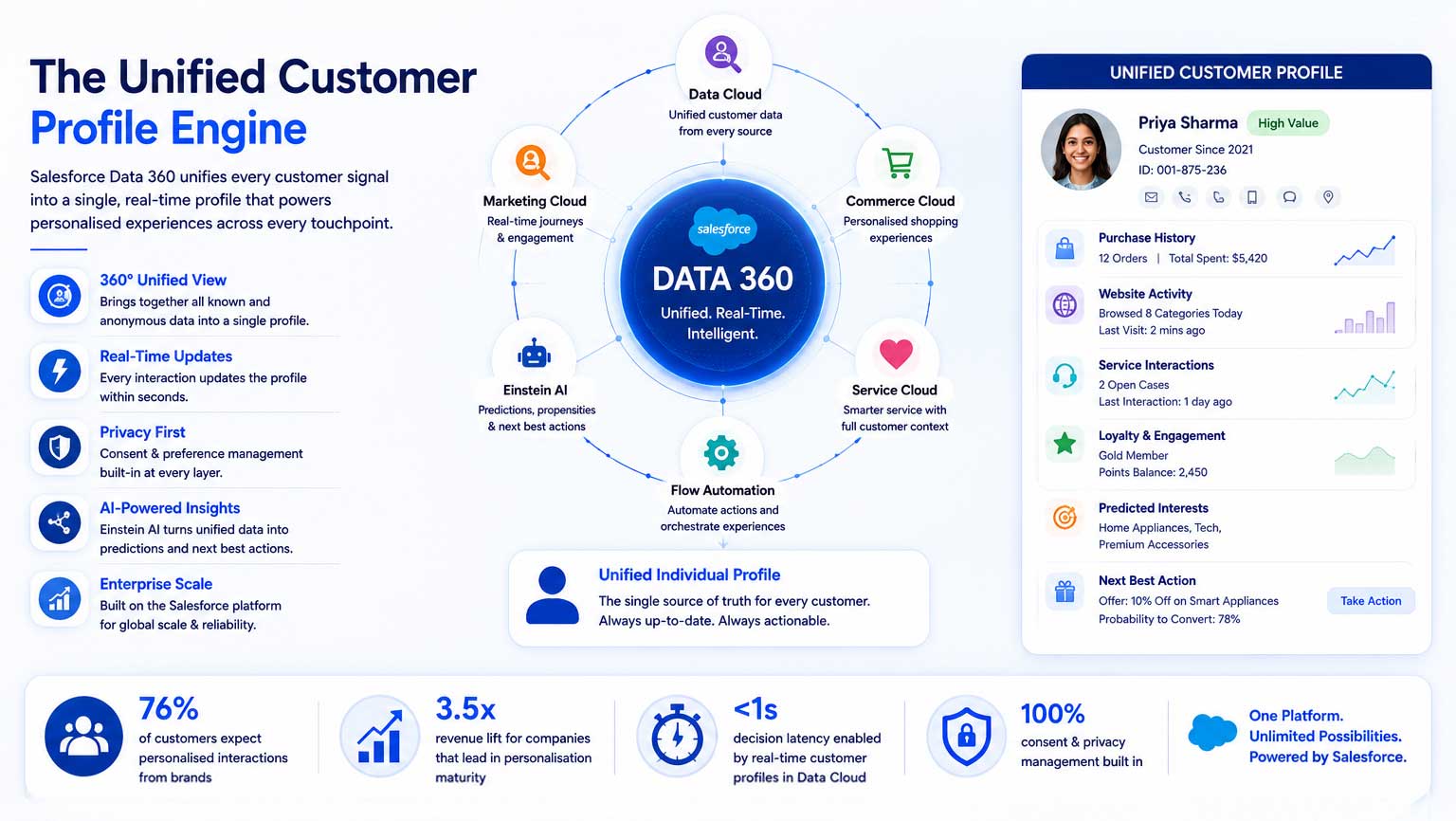
Data Cloud continuously recalculates the Unified Individual as new signals arrive web sessions, support calls, loyalty redemptions within seconds, not the next morning’s batch cycle.
Identity Resolution Across Anonymous and Known Data
Deterministic and probabilistic matching resolves identities across email, cookie, device, phone, and loyalty identifiers stitching the anonymous-to-known journey into a single continuous thread.
Zero-Copy Integration With the Broader Data Estate
For CDOs managing Snowflake, Databricks, or BigQuery, zero-copy federation surfaces insights directly into Salesforce profiles eliminating duplication and cutting time-to-activation from weeks to hours.
Four Ways Data 360 Delivers Real-Time Personalisation
1. Marketing Segment-of-One Journeys in Marketing Cloud
When a high-LTV customer abandons a cart, Data Cloud detects the event, evaluates the customer’s current propensity score, cross-references their service history, and triggers a personalised Journey Builder flow all within one second.
Practical Example
A global fashion retailer using Salesforce Data 360 reduced cart abandonment rate by 28% within 90 days of activating real-time Journey Builder personalisation.
2. E-Commerce Dynamic Storefront Personalisation via Commerce Cloud
E-Commerce Heads can surface product recommendations, promotional banners, and search rankings that adapt to each customer’s real-time profile.
Einstein Product Recommendations, fed by live Data Cloud profiles, account for browse history, purchase cadence, geographic context, and inferred life-stage signals.
3. Financial Services Next-Best-Action for Wealth and Retail Banking
For financial institutions, Data 360 enables relationship managers and digital channels to present the right product at the right moment.
Because the underlying profile incorporates transaction data, digital behaviour, and service interactions, the next-best-action model operates on signal, not assumption.
4. Professional Services Account Intelligence for Client-Facing Teams
In B2B professional services, personalisation means equipping client partners with a complete, real-time view of account health before every interaction.
Data 360 consolidates engagement signals into a living account profile that surfaces automatically in Sales Cloud.
Infographic-Friendly Summary
The Salesforce Data 360 Personalisation Journey: 5 Steps from Data to Delivery
Step 1: Ingest
Connect every data source into Salesforce Data Cloud.
Step 2: Unify
Identity resolution stitches anonymous and known signals into a single Unified Individual Profile.
Step 3: Enrich
Einstein AI calculates propensity scores, lifetime value predictions, churn risk, and next-best-action recommendations.
Step 4: Segment
Continuous recalculation replaces batch refresh.
Step 5: Activate
Live profiles push personalised content to Marketing Cloud, Commerce Cloud, Service Cloud, and ad platforms simultaneously.
Common Implementation Pitfalls and How to Avoid Them
Starting with the technology, not the use case
Define the use case first, then work backwards to the data and activation requirements.
Underestimating identity resolution complexity
Budget for a data quality sprint before go-live.
Treating consent as an afterthought
Design GDPR, CCPA, and DPDP compliance into the data model from day one.
Failing to align Marketing, Technology, and Data teams
Invest in enablement alongside implementation.
How NSIQ INFOTECH Helps You Get the Most from Salesforce Data 360
Deploying Salesforce Data 360 is not a plug-and-play exercise.
At NSIQ INFOTECH, our Salesforce Data Cloud practice helps enterprise clients across e-commerce, financial services, and professional services deliver measurable outcomes.
Our Approach Focuses On
- Designing unified customer profile architectures
- Configuring identity resolution rules
- Activating personalisation use cases across Salesforce Clouds
- Building executive-facing dashboards
- Training marketing and data teams
FAQs Salesforce Data 360 & Real-Time Personalisation
Q1. What is Salesforce Data 360?
Salesforce Data 360 is the strategic capability delivered by Salesforce Data Cloud that creates a complete, unified, and continuously updated 360-degree view of each customer.
Q2. How is Salesforce Data 360 different from a traditional CDP?
Unlike traditional CDPs, Salesforce Data Cloud updates profiles in real time and activates them natively across Salesforce products.
Q3. What is Salesforce Data Cloud?
Salesforce Data Cloud is the platform that powers Data 360 through data ingestion, identity resolution, and activation.
Q4. What industries benefit most from Salesforce Data 360?
Retail, e-commerce, financial services, professional services, media, and telecommunications.
Q5. How long does a Salesforce Data 360 implementation take?
Typically 8–16 weeks for focused use cases and 4–9 months for enterprise-wide rollouts.
Q6. Does Salesforce Data 360 support GDPR and data privacy compliance?
Yes, with consent management, suppression rules, and data residency controls.
Q7. What is zero-copy data federation in Salesforce Data Cloud?
It allows Data Cloud to access data directly from Snowflake, Databricks, and BigQuery without duplication.
Q8. What is identity resolution in Salesforce Data 360?
The process of matching and merging customer records into a Unified Individual Profile.
Q9. How does Salesforce Data 360 improve Marketing Cloud performance?
It enables real-time audience activation and personalised journeys.
Q10. What data sources can Salesforce Data Cloud connect to?
CRM, Marketing Cloud, Commerce Cloud, Service Cloud, warehouses, loyalty systems, and more.
Q11. What is a Unified Individual Profile in Salesforce Data Cloud?
A single merged record containing all customer interactions and signals.
Q12. How does Salesforce Data 360 support e-commerce personalisation?
Through dynamic content, personalised search, and Einstein-powered recommendations.
Q13. Can Salesforce Data 360 work with existing Salesforce licences?
Data Cloud requires separate licensing but integrates with existing Salesforce Clouds.
Q14. What team skills are needed to implement Salesforce Data 360?
Data Cloud architects, Salesforce specialists, data engineers, and business analysts.
Q15. How does NSIQ INFOTECH support Salesforce Data 360 implementations?
Through consulting, architecture, implementation, activation, and enablement services.
Conclusion
The promise of personalisation treating every customer as an individual, at scale, in real time has existed for years. What has changed is the infrastructure available to deliver it.
Salesforce Data 360, powered by Salesforce Data Cloud, represents a genuine architectural shift: from batch-based, silo-dependent data operations to a live, unified, AI-enriched customer profile that every team can act on instantly.
The organisations winning on personalisation today are not necessarily those with the largest data teams or the most complex technology stacks. They are those that have made a clear, executive-sponsored decision to treat customer data as a strategic asset and invested in the infrastructure to activate it.