
Agentforce Voice Is Changing the Traditional Customer Service Call
For many service organizations, the phone remains one of the most important ways customers ask for help.
A customer calls because an appointment needs to be changed. A student wants to know the status of an application. A homeowner wants to know when a restoration technician will arrive. A patient needs help with an administrative request.
Traditionally, these calls follow a familiar path.
The customer reaches an IVR, listens to a list of options, selects a number, waits for a representative, explains the issue and may have to repeat the same information if the call is transferred.
That model is changing.
Agentforce Voice brings conversational AI into the voice channel. Salesforce describes Agentforce Voice as enabling Agentforce Service agents to understand spoken customer conversations, determine customer intent and take actions to resolve supported requests. Salesforce also describes it as an alternative to static IVR hierarchies, using dynamic, intent-driven conversations instead.
But there is an important distinction.
Agentforce Voice is not simply about replacing the person answering the phone.
The more useful question for a service organization is:
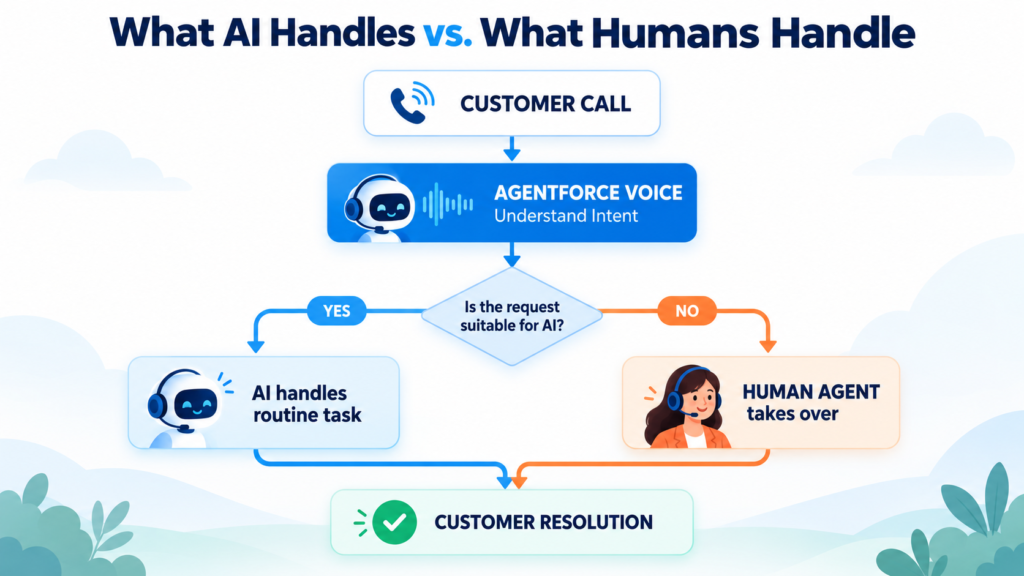
Which customer interactions can AI handle reliably, and where should a human service professional take over?
That question becomes particularly important in industries such as healthcare, restoration and education, where some requests are routine while others require context, judgment or human empathy.
What Is Agentforce Voice?
Agentforce Voice allows an Agentforce service agent to interact with customers through voice.
At a high level, the customer’s speech is converted into text, processed by the Agentforce reasoning layer, and used to determine an appropriate response or action. Salesforce’s current documentation describes this architecture as using speech-to-text, the Agentforce planning/reasoning layer and voice technology to deliver the response.
The important difference from a traditional IVR is how the customer communicates.
A traditional IVR might say:
“Press 1 for billing. Press 2 for support. Press 3 for appointments.”
A conversational voice agent can allow a customer to say:
“I need to move my appointment from Thursday to Friday.”
Instead of asking the customer to identify the correct menu category, the system is designed to understand the customer’s actual intent.
That makes Agentforce Voice particularly relevant to organizations looking at an AI voice agent for customer service.
The objective isn’t simply to make the IVR sound more natural.
The objective is to connect the conversation with CRM data, knowledge, business processes and configured actions.
What Can Agentforce Voice Handle Today?
The exact capabilities depend on the organization’s Salesforce configuration, data, knowledge, actions, telephony setup and service processes.
That means businesses should not approach Agentforce Voice as a universal replacement for every customer-service activity.
Instead, there are several areas where it can be particularly useful.
1. Answering Routine Customer Questions
Many service calls are informational.
Customers may want to know:
-
- Business hours
- Appointment details
- Application deadlines
- Service availability
- Case status
- Required documentation
- General service procedures
- Program information
- What happens next
When the appropriate information is available to the agent, these interactions can be strong candidates for automation.
For example:
Education
“What documents do I need for my application?”
Restoration
“Has my technician been assigned yet?”
Healthcare administration
“Can you confirm my appointment time?”
The important point is that AI needs access to trusted information.
A voice agent that can speak naturally but doesn’t have reliable business data is still limited.
This is why the combination of Agentforce Voice and Service Cloud is more significant than voice technology alone.
2. Handling Routine Service Requests
The next step beyond answering questions is taking action.
Consider a customer saying:
“I want to change my appointment to Friday afternoon.”
If the relevant Salesforce data and action are properly configured, the AI agent can potentially participate in the service workflow rather than simply telling the customer to call someone else.
This is where Service Cloud integration becomes important.
The interaction can potentially connect with:
-
- Accounts
- Contacts
- Cases
- Customer history
- Knowledge
- Tasks
- Service information
- Appointments
- Configured workflows
- Other connected business data
The important question isn’t only:
“Can AI understand the request?”
It is:
“Can AI safely perform the required business action?”
That distinction should guide every Agentforce Voice implementation.
3. Reducing Repetitive Call-Center Work
Service teams often spend significant time answering repetitive questions.
A representative may repeatedly:
-
- Identify the customer
- Open Salesforce
- Search for the relevant record
- Check a status
- Provide an answer
- Update information
- Close the interaction
When those interactions are predictable and appropriately governed, AI call center automation can potentially handle part of the workload.
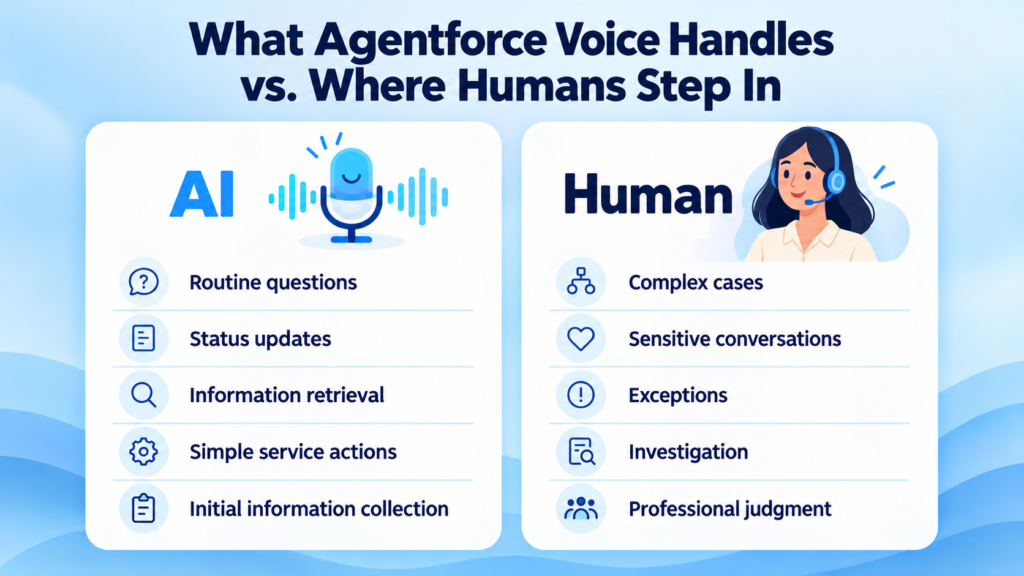
That can allow human representatives to spend more time on cases involving:
-
- Investigation
- Troubleshooting
- Complex service requests
- Exceptions
- Negotiation
- Sensitive conversations
- Specialized expertise
Salesforce itself describes its native Agentforce Contact Center as using AI and IVR to handle routine issues so representatives can focus on higher-value work.
The important word here is routine.
The goal isn’t to automate everything.
The goal is to automate what makes sense.
4. Understanding Customer Intent Instead of IVR Menus
Traditional IVR systems generally require customers to fit their problem into a predefined structure.
A customer might have to decide whether their problem is “billing,” “technical support” or “general information.”
Real conversations aren’t always that simple.
A student might say:
“I submitted my admission application last week, uploaded the additional documents yesterday and still haven’t received an update.”
There is more than one piece of information in that sentence.
The customer is talking about:
-
- An admission application
- A previous submission
- Additional documentation
- A missing update
A conversational AI agent can interpret the request as an intent and use the available context to determine what should happen next.
This is one of the reasons Agentforce Contact Center is becoming relevant to service organizations evaluating the next generation of contact-center technology.
Salesforce describes Agentforce Contact Center as an AI-first contact center bringing together voice, digital channels, CRM and AI within Salesforce.
Where Does a Human Still Have to Step In?
This is arguably the most important part of an Agentforce Voice strategy.
AI can be very useful for predictable service interactions.
Customer service, however, is not always predictable.
Some situations involve:
-
- Emotional conversations
- Complex cases
- Sensitive information
- Exceptions
- Professional judgment
- High-risk decisions
- Situations outside the AI’s configured scope
A strong implementation therefore needs a clear human handoff strategy.
1. Sensitive or Emotional Conversations
Consider a healthcare customer who is worried about a serious situation.
Or a parent calling an educational institution because their child’s admission process has become complicated.
Or a homeowner dealing with extensive property damage.
These conversations involve more than retrieving information from Salesforce.
The customer may need reassurance, interpretation, investigation or human judgment.
In such cases, the best automation strategy may not be to keep the caller with AI for as long as possible.
It may be to recognize the situation quickly and connect the customer with the right human representative.
Salesforce’s current Agentforce Voice guidance specifically recommends designing and confirming transfers as part of the voice experience.
2. Complex Cases Requiring Human Judgment
Not every customer problem has a predefined answer.
Consider a restoration customer saying:
“The damage is much worse than what was reported during the initial inspection.”
The case may involve:
-
- A previous inspection
- A technician
- Additional property damage
- Scheduling
- Insurance-related information
- A revised assessment
AI may be able to collect the relevant information and initiate an appropriate workflow.
But a human specialist may need to decide what should happen next.
That isn’t necessarily a failure of automation.
It is an example of appropriate division of responsibility.
AI handles the part of the process it is designed and authorized to handle.
The human takes over when professional judgment becomes necessary.
3. Healthcare Requires Strong Boundaries
Healthcare is an important potential use case for voice AI, particularly for administrative service interactions.
Examples can include:
-
- Appointment-related requests
- Clinic information
- Administrative questions
- Referral status
- Service information
- Scheduling-related requests
However, healthcare organizations need particularly clear boundaries around sensitive conversations.
An AI agent being able to understand a patient’s words does not automatically mean it should answer every healthcare question.
Organizations should define:
-
- What information the agent can access
- What information it can disclose
- Which actions it can perform
- Which requests require human intervention
- When escalation is mandatory
- How conversations and records are governed
For healthcare, automation should be designed around trust and appropriate escalation, not simply call reduction.
4. Education Has a Clear Divide Between Routine and Complex Calls
Education organizations receive large numbers of questions from prospective students, existing students and parents.
Common requests can include:
-
- Admission deadlines
- Application status
- Required documents
- Enrollment information
- Program details
- Financial-aid processes
- Student-service information
These can potentially provide useful starting points for voice automation.
Compare these two questions:
“What documents are required for this program?”
and:
“My application was rejected even though I submitted the additional documents yesterday. Can someone review my case?”
The first is primarily informational.
The second may require investigation.
A good AI service strategy recognizes the difference rather than trying to force both interactions through the same automated process.
5. Restoration Services Can Benefit From Faster Voice Support
Restoration companies often operate in situations where customers want immediate information.
Calls may involve:
-
- Water damage
- Fire damage
- Storm damage
- Emergency service
- Technician scheduling
- Inspection updates
- Job status
- Service coordination
A customer asking:
“When will the technician arrive?”
is very different from:
“The technician inspected the property, but the damage has spread since then.”
The first request may be appropriate for automated status information.
The second could require a human service specialist.
For restoration organizations, the opportunity is therefore not simply “automate calls.”
It is:
Give customers faster answers for routine requests while directing complex situations to the right specialist.
Agentforce Voice + Service Cloud Integration
Voice AI becomes significantly more useful when it is connected to the systems that contain customer context.
Imagine an AI agent that can talk naturally but doesn’t know:
-
- Who the customer is
- What case they have
- What service they requested
- What happened during the previous interaction
- What actions are available
The conversation may sound intelligent, but the customer may still end up being told:
“Please contact a representative.”
That is where CRM integration becomes important.
Salesforce’s Agentforce Contact Center brings voice, digital channels, CRM and AI together, while Salesforce also supports connecting Agentforce Voice with third-party telephony providers.
The architecture can therefore look like:
Customer
↓
Voice Channel
↓
Agentforce Voice
↓
CRM + Knowledge + Customer Context
↓
Configured Service Action
↓
Resolution OR Human Handoff
The voice channel becomes part of the service process rather than an isolated system.
What Happens When Agentforce Voice Needs a Human?
The handoff experience is critical.
A poor handoff looks like this:
AI: “I’ll transfer you to an agent.”
Human: “How can I help?”
Customer: “I already explained everything.”
A better experience preserves the context collected during the AI interaction.
Salesforce documents that its native voice approach can preserve the call transcript and session context through transfers between virtual and human representatives.
That means the human representative can potentially receive more context before continuing the conversation.
The objective is simple:
The customer should feel transferred, not restarted.
That can be one of the most important design principles for an Agentforce Voice deployment.
Native Salesforce Voice or Existing Telephony?
Many organizations already have a contact-center environment.
They may use:
- A telephony provider
- CCaaS
- Amazon Connect
- SIP infrastructure
- Existing call routing
- Existing recording systems
- Established contact-center workflows
Salesforce currently provides two broad approaches: Agentforce Contact Center with Salesforce-provided contact-center infrastructure and built-in voice, or Partner Contact Center, which connects Salesforce with a third-party telephony or CCaaS provider.
That means the architectural question isn’t simply:
“Should we use Agentforce Voice?”
It is:
“How should Agentforce Voice fit into our existing contact-center architecture?”
That assessment should consider telephony, routing, CRM data, security, recordings, transcripts, integrations and human escalation.
Agentforce Voice and Language Considerations
Language support is another area organizations should verify before deployment.
Salesforce has expanded Agentforce Voice availability, including an announcement in May 2026 introducing Hindi voice support for India.
At the same time, Salesforce’s current documentation notes that voice agents operate in a configured default language and that language availability and beta status should be verified when creating and testing voice agents.
For organizations operating across multiple regions, this means language requirements should be part of the discovery and testing phase rather than assumed from general Agentforce language support.
What Should Service Teams Automate First?
The best starting point usually isn’t the most complicated customer journey.
A more practical approach is to identify interactions that are:
High volume + predictable + low risk + well documented.
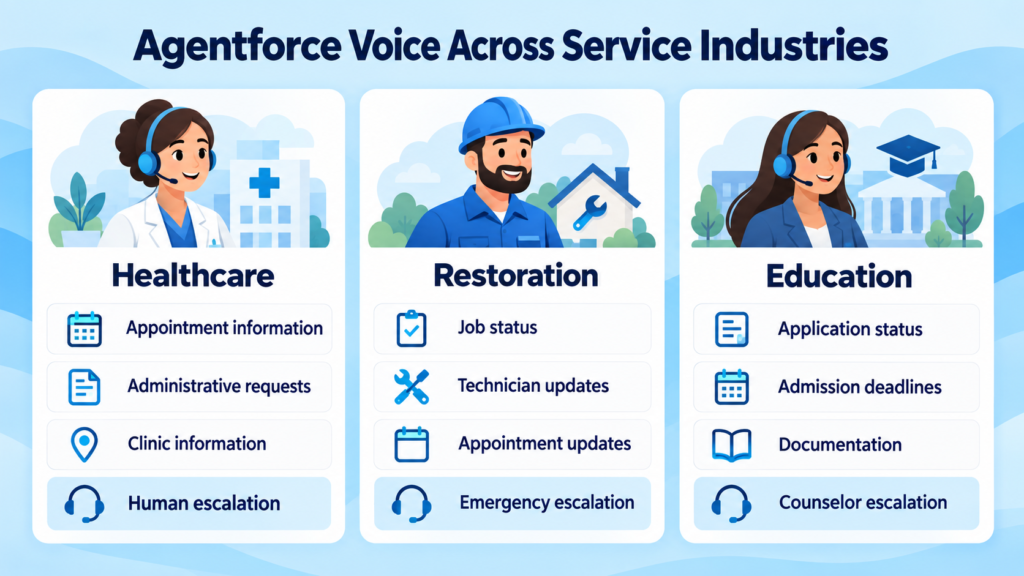
Healthcare
- Appointment information
- Administrative requests
- Clinic information
- Routine service questions
Education
- Application status
- Admission deadlines
- Required documentation
- Program information
- General admissions questions
Restoration
- Job status
- Technician information
- Appointment updates
- Initial information collection
Once these interactions are working reliably, organizations can evaluate more complex workflows.
This creates a controlled path toward broader automation.
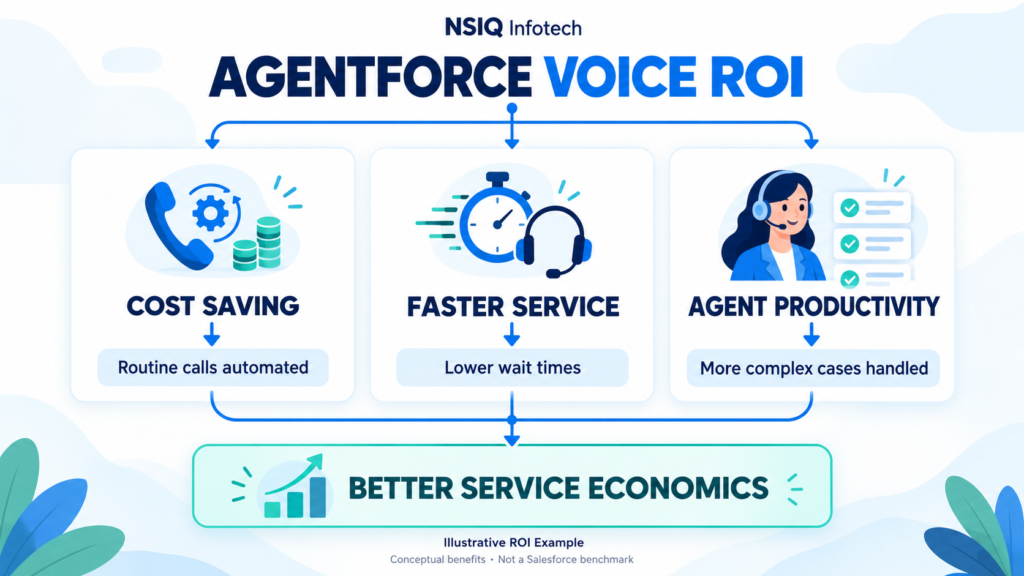
How to Calculate Agentforce Voice ROI
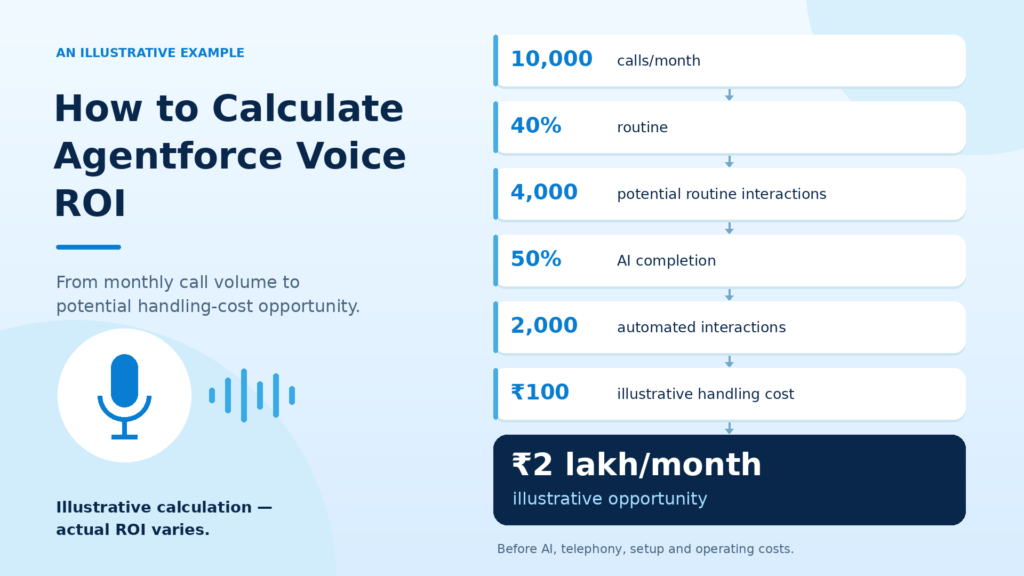
ROI should not be presented as a universal percentage because actual results depend on the organization’s call volume, service processes, automation rate, implementation costs, telephony costs and escalation rate.
A better approach is to calculate the potential business impact using the organization’s own numbers.
Illustrative Example
Suppose a service organization receives:
- 10,000 calls per month
- 40% routine calls
- 4,000 potentially suitable routine interactions
- 50% successful AI completion rate
- ₹100 illustrative human handling cost per interaction
The calculation would be:
4,000 × 50% × ₹100 = ₹2,00,000
That represents an illustrative monthly labor-cost opportunity.
Annualized:
₹2,00,000 × 12 = ₹24,00,000
This is not a guaranteed Agentforce Voice saving.
Actual ROI should also account for:
- Salesforce licensing
- Agentforce usage
- Telephony costs
- Implementation costs
- Integration costs
- Human escalation
- Maintenance
- Knowledge management
- Quality monitoring
The purpose of the calculation is to give a business team a framework for evaluating its own opportunity.
The Four ROI Areas Service Leaders Should Track
| ROI Area | What to Measure |
| Cost Efficiency | Cost per service interaction before and after automation |
| Agent Productivity | Human handling time saved on routine calls |
| Customer Experience | Wait time, abandonment, resolution and satisfaction |
| Automation Performance | AI completion rate and human escalation rate |
One metric deserves particular attention:
Why did the AI escalate?
If many calls are escalated because the AI cannot access required information, there may be a knowledge or integration problem.
If calls are escalated because customers require professional judgment, the human handoff may be working exactly as intended.
That distinction is important when measuring the actual value of AI call center automation.
Agentforce Voice ROI
What AI Handles vs. What Humans Handle
How Should Organizations Measure Agentforce Voice?
Call volume alone isn’t enough.
A service organization should measure whether automation is improving both customer experience and employee productivity.
Useful metrics include:
- AI containment rate
- Human escalation rate
- Task completion rate
- First-contact resolution
- Average handling time
- Customer wait time
- Call abandonment
- Repeat contacts
- Transfer rate
- Customer satisfaction
- Escalation reasons
- Incorrect-response rate
- Automation failure rate
Salesforce also provides voice-related monitoring and analytics capabilities that can help teams evaluate interactions and identify areas for improvement.
The goal isn’t simply to achieve the highest possible AI containment rate.
An unusually high containment rate could even be undesirable if customers are being prevented from reaching the right human representative.
The right KPI is successful service resolution, not AI involvement for its own sake.
A Practical Agentforce Voice Service Model
A mature implementation can follow this model:
1. Customer
The customer explains what they need naturally.
↓
2. Voice
The voice channel captures the conversation.
↓
3. Agentforce Voice
The AI interprets intent.
↓
4. Salesforce Context
The agent uses authorized customer data, knowledge and service information.
↓
5. Configured Action
The agent completes an appropriate action.
↓
6. Human Escalation
If the request is complex, sensitive or outside the AI’s scope, it moves to a human.
↓
7. Continuous Improvement
Teams review outcomes, transcripts, escalations and customer feedback.
This last step is essential.
Agentforce Voice should not be treated as a project that ends when the voice agent goes live.
The service team should continuously review what customers are asking, where AI succeeds, where it fails and where the underlying business process needs improvement.
What Agentforce Voice Does Not Automatically Solve
AI can automate a process, but it cannot automatically fix a poorly designed process.
If customer data is incomplete, the AI may not have enough context.
If knowledge articles are outdated, the AI may have limited information.
If service actions are poorly designed, automation may simply make an inefficient process faster.
If escalation rules are unclear, customers may experience inconsistent outcomes.
And if the organization has not defined what AI is allowed to do, adding voice does not solve the governance problem.
This is why implementation strategy matters as much as the AI technology itself.
Is Agentforce Voice Right for Every Service Team?
Not necessarily.
Organizations should evaluate:
- Call volume
- Repetitive service interactions
- Quality of CRM data
- Knowledge availability
- Process maturity
- Telephony architecture
- Security requirements
- Human escalation requirements
- Expected automation rate
- Total implementation cost
The right starting question isn’t:
“How can we automate our entire contact center?”
It is:
“Which customer conversations create the most repetitive work, and which of those can we automate safely?”
That approach creates a more measurable and manageable path to adoption.
The Human Agent Is Still Part of the Strategy
The future of customer service is unlikely to be purely AI or purely human.
AI is well suited to predictable interactions where customers need quick information or straightforward service actions.
Human representatives remain important when customers need:
- Judgment
- Empathy
- Investigation
- Negotiation
- Specialized expertise
- Exception handling
This means Agentforce Voice can change where the human enters the service journey rather than simply eliminating the human from it.
That distinction is important.
A customer who gets a simple answer in seconds may have a better experience.
A customer with a complicated problem may benefit from reaching a skilled human faster because AI has already collected the relevant information.
The best service architecture can support both experiences.
Final Takeaway
Agentforce Voice is changing what a service call can look like inside a Salesforce environment.
It can move beyond traditional menu-based IVR toward conversational interactions in which customers describe what they need and an AI service agent can use configured Salesforce capabilities to respond and take appropriate actions. Salesforce currently supports Agentforce Voice through its voice/contact-center architecture as well as integrations with partner telephony models.
But the goal shouldn’t be to automate the largest possible percentage of calls.
The goal should be to automate the right conversations.
For healthcare, that may mean handling appropriate administrative requests while maintaining strict boundaries around sensitive interactions.
For education, it may mean answering routine admissions questions while giving counselors more time for complex student cases.
For restoration, it may mean providing immediate job and appointment information while routing unusual or urgent situations to specialists.
And across all three industries, the principle remains the same:
Let AI handle predictable work. Let humans handle work that requires judgment. Connect the two with context.
That is the real opportunity behind Agentforce Voice for service teams.
It isn’t simply about giving Salesforce a voice.
It is about connecting voice, CRM data, AI, automation and human expertise into one service experience.
Frequently Asked Questions
What is Agentforce Voice?
Agentforce Voice enables Agentforce Service agents to communicate with customers through voice, understand spoken requests and take configured actions to help resolve supported service queries.
Is Agentforce Voice the same as a traditional IVR?
No. Traditional IVR typically relies on predefined menu structures. Agentforce Voice is designed around conversational, intent-driven interactions where customers can describe what they need naturally.
Can Agentforce Voice replace human customer service agents?
Agentforce Voice can automate appropriate service interactions, but human representatives remain important for complex, sensitive, exceptional and judgment-dependent situations.
Can Agentforce Voice work with existing telephony?
Yes. Salesforce supports its native Agentforce Contact Center voice model as well as Partner Contact Center approaches that connect Salesforce with third-party telephony or CCaaS providers.
What happens when Agentforce Voice needs a human?
Depending on the configuration, the voice interaction can be transferred to a human representative. Salesforce documents support for preserving transcript and session context through native voice transfers.
Does Agentforce Voice support Hindi?
Salesforce announced Agentforce Voice in Hindi in May 2026 for India. Organizations should nevertheless verify the current language availability, configuration and release status applicable to their Salesforce environment before deployment.
Is Agentforce Voice useful for healthcare?
It can be considered for appropriate administrative and service interactions. Healthcare organizations should establish clear boundaries around sensitive information, permitted actions and human escalation.
How can education organizations use Agentforce Voice?
Potential applications include routine admissions questions, application status, deadlines, documentation requirements and other administrative service interactions, while complex student situations can be escalated to staff.
What is AI call center automation?
AI call center automation uses artificial intelligence to automate selected customer conversations and service workflows. Agentforce Voice can provide a voice-based AI layer connected to supported Salesforce service processes.
What is Agentforce Contact Center?
Agentforce Contact Center is Salesforce’s AI-first contact-center offering that brings voice, digital channels, CRM and AI together within Salesforce.
Thinking About Agentforce Voice for Your Service Team?
Implementing Agentforce Voice isn’t only about enabling an AI voice agent.
The real work is identifying the right customer journeys, connecting the required Salesforce data, defining AI actions, designing human handoffs and measuring the business impact.
NSIQ Infotech can help organizations evaluate their Service Cloud environment and identify practical opportunities for Agentforce, Service Cloud integration and AI-powered customer service.
Talk to NSIQ Infotech about your Salesforce Service Cloud and Agentforce requirements.