
For a manufacturing company, choosing a CRM is rarely as simple as comparing a list of features.
A sales team may want better lead and opportunity management. The sales head may want more accurate forecasting. Account managers may want a complete view of customer relationships. Meanwhile, operations may be working with order commitments, distributors, production schedules, inventory data and spreadsheets.
That is where the question becomes important:
Do you actually need Salesforce Manufacturing Cloud, or can Salesforce Sales Cloud handle your manufacturing business effectively?
The answer is not necessarily “Manufacturing Cloud is better.”
In many cases, Sales Cloud is the right starting point. For other manufacturers, the industry-specific capabilities of Manufacturing Cloud can provide significant value by connecting sales, customer agreements, forecasting and operational information more closely.
Salesforce Manufacturing Cloud is built on the Salesforce platform, with Sales Cloud and Service Cloud as its foundation. It adds manufacturing-specific capabilities, data models and workflows designed around the needs of manufacturers.
So the real decision isn’t:
Sales Cloud vs Manufacturing Cloud — which product is better?
It is:
Which CRM capabilities does your manufacturing business actually need today, and where do you want the platform to take you next?
Let’s break it down.
What Is Salesforce Sales Cloud?
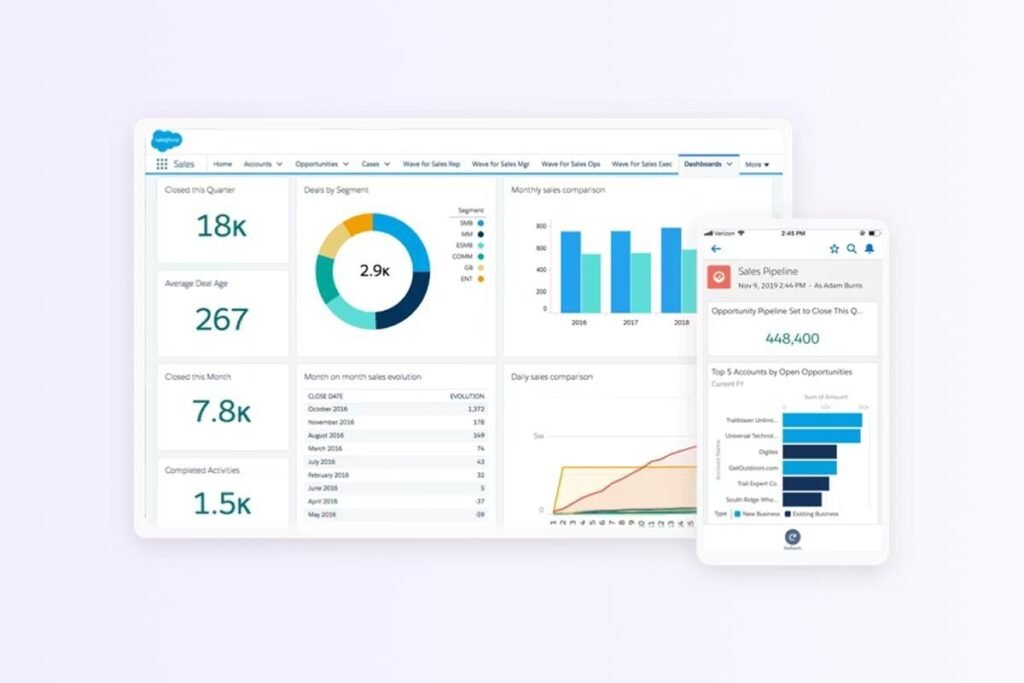
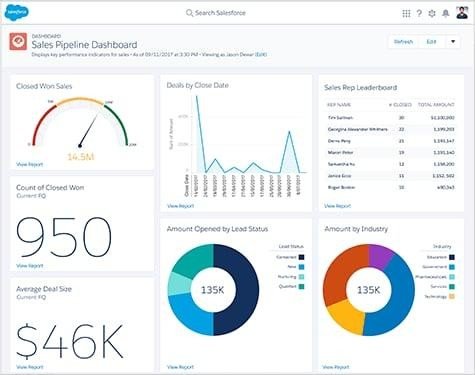
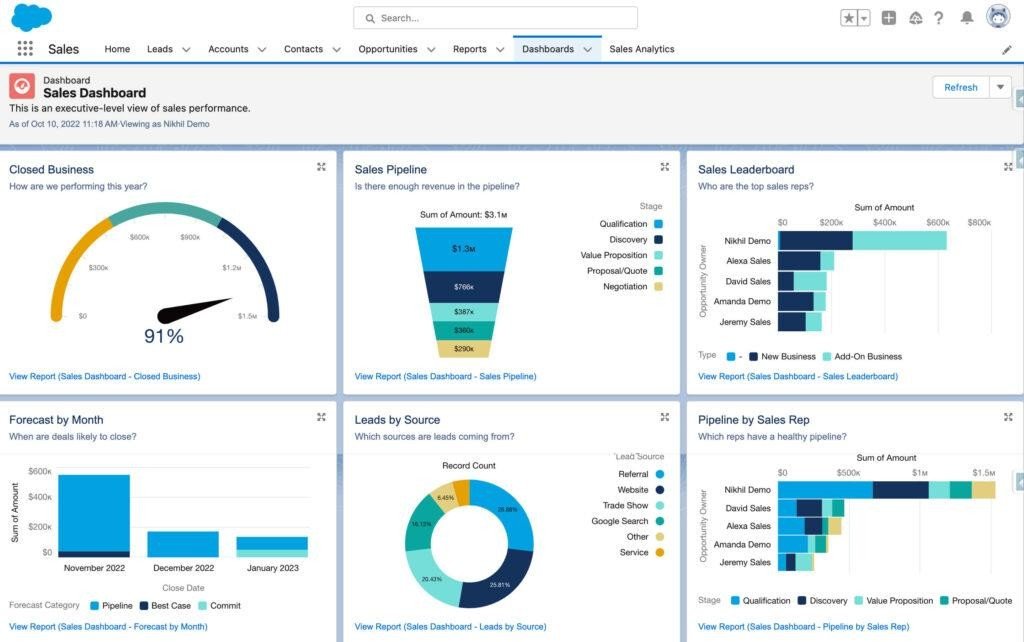
6 Sales Cloud is Salesforce’s core CRM platform for managing the sales process and customer relationships.
For a manufacturer, Sales Cloud can provide a centralized place to manage:
-
- Leads
- Accounts
- Contacts
- Opportunities
- Activities and follow-ups
- Sales pipelines
- Quotes and sales processes
- Forecasting
- Tasks and approvals
- Reports and dashboards
- Sales performance
Imagine a manufacturing sales representative managing 50 customer accounts.
Without a CRM, information may be spread across emails, Excel sheets, WhatsApp conversations, ERP screens and personal notes.
With Sales Cloud, the salesperson can have a structured view of the customer and sales pipeline in one place.
For many manufacturers, that alone can solve a significant business problem.
When Sales Cloud can be enough
Sales Cloud can be a strong choice if your primary objective is to:
-
- Standardize your sales process
- Improve opportunity visibility
- Track leads and prospects
- Improve follow-up discipline
- Create sales dashboards
- Improve sales forecasting
- Give management pipeline visibility
- Centralize customer information
- Automate repetitive sales tasks
- Integrate CRM with your ERP or other systems
If these are your immediate requirements, you shouldn’t automatically assume you need Manufacturing Cloud.
A well-designed Sales Cloud implementation can often deliver substantial value before introducing industry-specific functionality.
What Is Salesforce Manufacturing Cloud?
Salesforce Manufacturing Cloud is designed specifically around manufacturing business requirements.
It extends the Salesforce platform with capabilities intended to help manufacturers manage their broader book of business, customer relationships, sales agreements, forecasting and collaboration between commercial and operational teams.
Salesforce’s current product materials now position this capability under Agentforce Manufacturing, but the underlying manufacturing-specific capabilities continue to be commonly discussed as Manufacturing Cloud.
The important difference is the industry context.
A standard CRM asks:
“What opportunities are in your pipeline?”
A manufacturing-focused CRM can go further:
“What business have you committed to this customer, what is the expected demand, how does it compare with the agreement, and what does the sales team need to do next?”
That distinction can become extremely valuable for manufacturers with complex B2B sales models.
Salesforce Manufacturing Cloud vs Sales Cloud: The Real Difference
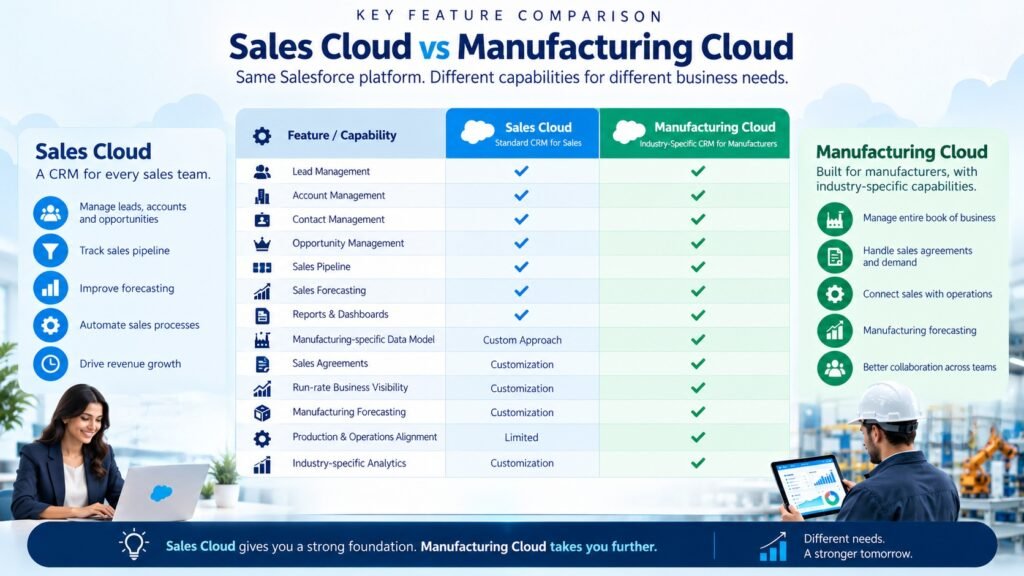
Salesforce describes Manufacturing Cloud as extending Sales Cloud and Service Cloud with industry-specific capabilities, including a manufacturing-specific data model and workflows.
This doesn’t mean Sales Cloud is “basic.”
It means Manufacturing Cloud starts with more manufacturing context already built into the platform.
Salesforce Manufacturing Cloud Features Manufacturers Should Know
The biggest advantage of Manufacturing Cloud is not simply having “more features.”
It is having features that are designed around common manufacturing business scenarios.
Some important capabilities include:
1. Sales Agreement Management
Manufacturers often operate with longer-term customer commitments rather than purely transactional sales.
Sales agreements can help account managers track long-term business negotiations and product commitments.
This can be particularly useful for manufacturers dealing with:
-
- Annual contracts
- Volume commitments
- Recurring orders
- Long-term customers
- Distributor relationships
- Forecasted demand
2. Advanced Forecasting
Manufacturing sales forecasting can become complicated because future revenue isn’t always represented by the current opportunity pipeline.
A manufacturer may need to consider:
Existing business + sales agreements + expected demand + opportunities = broader revenue picture
Manufacturing Cloud is designed to provide greater visibility across these areas. Salesforce specifically positions its manufacturing sales capabilities around opportunities, run-rate agreements, demand forecasts and projects.
3. Manufacturing Data Model
A major difference is the industry-specific data model.
Instead of designing every manufacturing concept from scratch, Manufacturing Cloud provides manufacturing-oriented structures and capabilities intended to unify commercial operations, service experience, partner engagement and related data.
4. Account Manager Targets
For manufacturers with dedicated account managers handling major customers, tracking individual and account-level targets can be important.
This allows management to move beyond:
“How many opportunities does the salesperson have?”
toward:
“How is this account performing against its expected business?”
5. Manufacturing Analytics
Manufacturing-focused analytics can help organizations understand areas such as sales agreements, account manager targets and warranty-related information, depending on the capabilities implemented.
But Here Is the Important Question: Do You Really Need Manufacturing Cloud?
This is where many CRM discussions go wrong.
A manufacturer doesn’t automatically need Manufacturing Cloud simply because it operates a factory.
Your business model matters more than the industry label.
Consider two companies.
Manufacturer A
It has:
- 10 salespeople
- A straightforward B2B sales process
- Limited product complexity
- Few long-term sales agreements
- Basic customer management requirements
- ERP already managing orders and inventory
Its biggest CRM problems are:
- Poor follow-up
- Excel-based pipeline
- Lack of management visibility
- Inconsistent sales processes
Sales Cloud may be the smarter choice.
Manufacturer B
It has:
- Multiple regional sales teams
- Large strategic accounts
- Distributor networks
- Long-term sales commitments
- Complex demand forecasting
- Multiple products and product configurations
- Strong coordination between sales, operations and customer service
Here, the industry-specific capabilities of Manufacturing Cloud may make more sense.
The point is not to buy the most specialized product.
The point is to buy the capability that solves the business problem.
A Simple Decision Framework
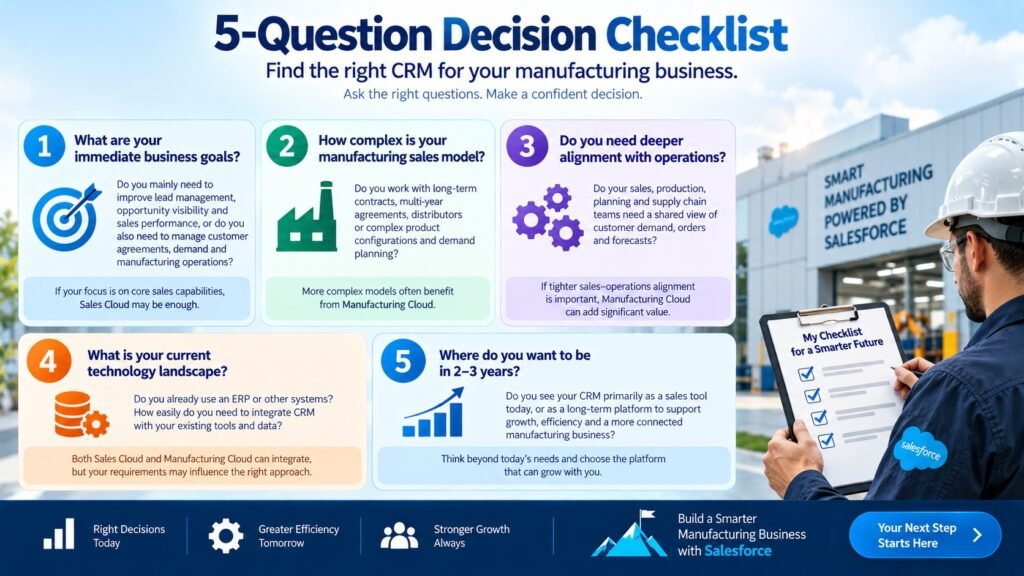
Use these five questions to evaluate your situation.
Question 1: Is your primary problem sales process management?
If yes, start by evaluating Sales Cloud.
Question 2: Do you need to manage long-term customer commitments and sales agreements?
If yes, Manufacturing Cloud deserves serious consideration.
Question 3: Does your sales forecast depend heavily on existing customer commitments and expected product demand?
If yes, Manufacturing Cloud may provide a better fit.
Question 4: Are you trying to connect sales, operations, service and partner information?
If yes, the broader manufacturing capabilities become increasingly valuable.
Question 5: Are you currently struggling with a relatively simple sales process?
If yes, don’t over-engineer the solution.
A properly configured Sales Cloud implementation may provide the foundation you need.
Manufacturing Cloud Pricing: What Should You Budget For?
Pricing is another area where businesses need to look beyond the license price.
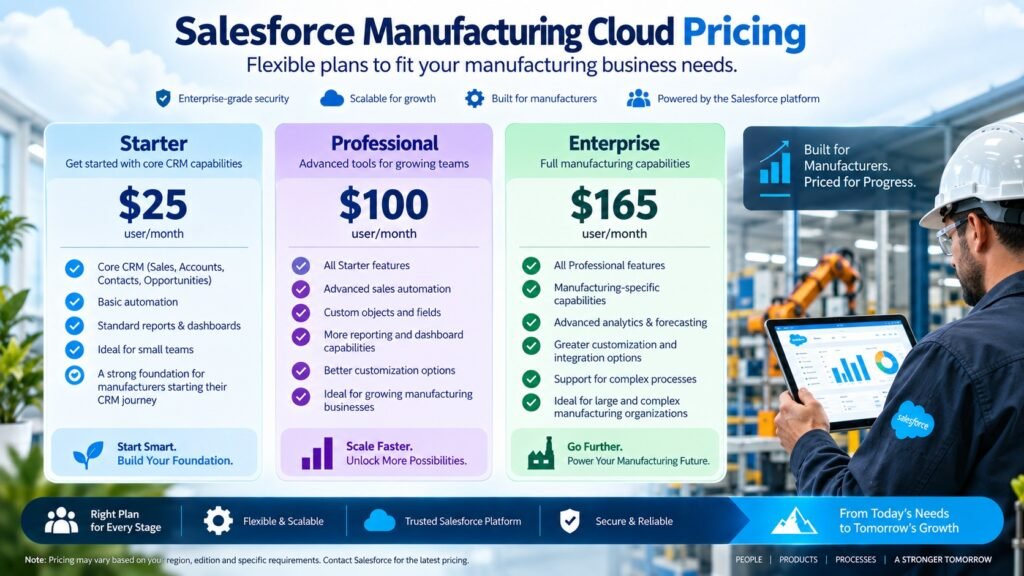
Salesforce’s current pricing information lists Manufacturing Cloud – Sales Enterprise at $275 USD/user/month when billed annually. The current Manufacturing Cloud Sales and Service Unlimited offering is listed at $475 USD/user/month, also billed annually. Salesforce notes that pricing is subject to change and recommends contacting Salesforce for detailed pricing.
However, license cost is only one component of the total CRM investment.
Your actual project budget can also depend on:
-
- Number of users
- Salesforce edition
- Implementation scope
- Data migration
- ERP integration
- Custom development
- Automation
- Reports and dashboards
- User training
- Security requirements
- Support and maintenance
- Additional Salesforce products or add-ons
For example, Salesforce lists MuleSoft as an integration option for connecting manufacturing systems, while additional capabilities such as Experience Cloud and other solutions can add to the overall technology investment.
Therefore, don’t make your decision purely on “Sales Cloud costs X and Manufacturing Cloud costs Y.”
Instead, calculate the total cost of ownership versus expected business value.
What About ERP Integration?
This is especially important for manufacturing companies.
Your CRM should not necessarily replace your ERP.
Your ERP may remain responsible for areas such as:
-
- Inventory
- Production
- Purchasing
- Accounting
- Order processing
- Financial transactions
Your CRM can focus on:
-
- Customer relationships
- Sales
- Opportunities
- Forecasting
- Account management
- Customer engagement
- Commercial workflows
The real value comes when these systems can exchange the right information.
Salesforce documentation states that Manufacturing Cloud can integrate with existing ERP and Order Management systems through APIs, MuleSoft accelerators or other middleware.
That means your CRM architecture should answer an important question:
Which system owns which data?
This should be decided before implementation—not after integration problems appear.
KPIs You Can Track With a Manufacturing CRM
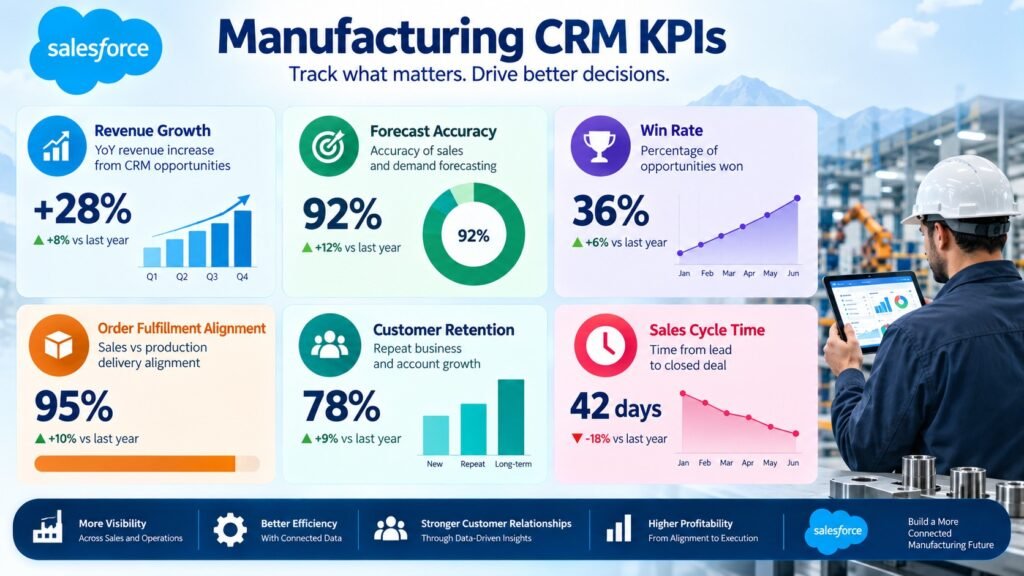
This is also where a CRM project can move from being a “software implementation” to a measurable business improvement program.
Consider building dashboards around KPIs such as:
Sales KPIs
-
- Lead Conversion Rate
- Opportunity Win Rate
- Sales Cycle Length
- Pipeline Value
- Pipeline Coverage
- Average Deal Size
- Revenue by Salesperson
- Revenue by Region
- Revenue by Product
Customer KPIs
-
- Customer Retention Rate
- Customer Revenue
- Customer Growth Rate
- New vs Existing Customer Revenue
- Account Engagement
- Customer Response Time
Forecasting KPIs
-
- Forecast Accuracy
- Pipeline vs Target
- Forecast vs Actual Revenue
- Committed Revenue
- Expected Revenue
- Opportunity Slippage
Manufacturing-Specific Commercial KPIs
-
- Sales Agreement Attainment
- Committed Volume vs Actual Volume
- Run-Rate Revenue
- Account Target Achievement
- Product-Level Demand
- Distributor Performance
- Revenue by Strategic Account
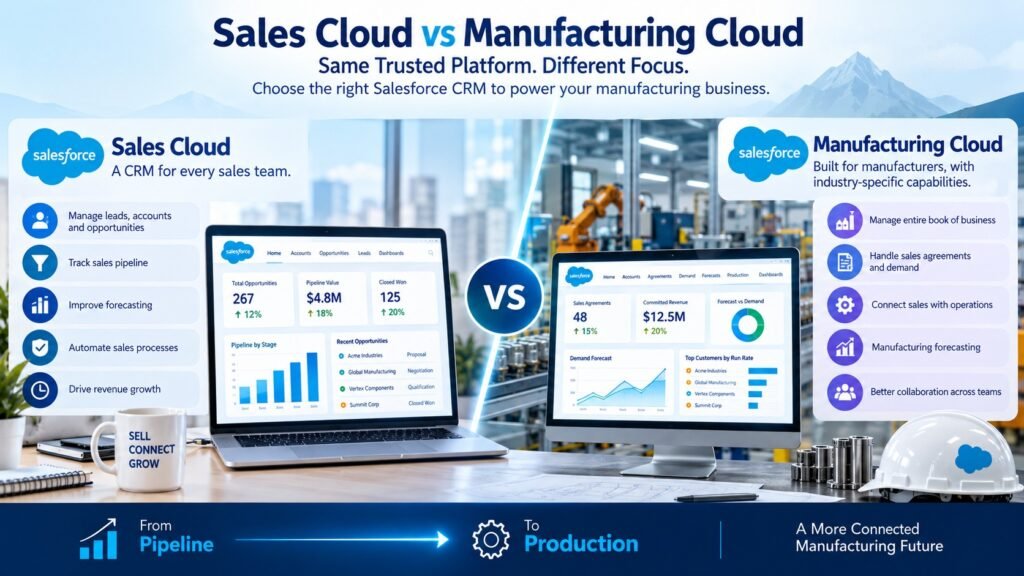
Sales Cloud vs Manufacturing Cloud
A Practical Implementation Strategy
Here’s something manufacturers should seriously consider:
You don’t have to solve everything on Day 1.
A phased Salesforce strategy can often reduce implementation risk.
Phase 1: Sales Foundation
Start with:
-
- Accounts
- Contacts
- Leads
- Opportunities
- Activities
- Sales stages
- Sales dashboards
- Basic automation
Phase 2: Manufacturing Processes
Then introduce capabilities such as:
-
- Sales agreements
- Account targets
- Demand forecasting
- Product-related processes
- Distributor management
- Manufacturing analytics
Phase 3: Integration & Intelligence
Finally, connect:
-
- ERP
- Order management
- External systems
- Advanced analytics
- Automation
- AI capabilities
Salesforce’s current manufacturing platform is designed to bring sales, service and operational information together, with AI and analytics increasingly incorporated into the broader experience.
This phased approach can help organizations avoid building a massive CRM implementation before users have even adopted the basics.
Common Mistakes Manufacturers Should Avoid
1. Buying Manufacturing Cloud Just Because You’re a Manufacturer
Industry-specific software isn’t automatically the right answer.
Start with your requirements.
2. Treating Salesforce as an ERP Replacement
CRM and ERP have different primary responsibilities.
Integration is often more valuable than duplication.
3. Over-Customizing Sales Cloud
Sales Cloud is highly flexible, but excessive customization can recreate industry functionality manually.
Before building custom objects and complex automation, evaluate whether the required capability already exists in Manufacturing Cloud.
4. Ignoring User Adoption
A technically impressive CRM that salespeople don’t use is still a failed CRM project.
Keep the user experience simple.
5. Measuring Only CRM Activity
Don’t celebrate the number of records created.
Measure outcomes.
Better forecasting.
Faster sales cycles.
Higher conversion.
Better customer retention.
Improved revenue visibility.
That’s where the real ROI is.
FAQs
Is Salesforce Manufacturing Cloud better than Sales Cloud?
Not universally.
Manufacturing Cloud is designed with manufacturing-specific capabilities, while Sales Cloud provides the core CRM and sales management foundation. The right choice depends on your business processes, complexity and growth plans.
Can a manufacturing company use Sales Cloud?
Absolutely.
Manufacturers can use Sales Cloud to manage leads, accounts, opportunities, sales pipelines, forecasting and customer relationships. For companies with straightforward sales processes, it may be sufficient.
Is Manufacturing Cloud built on Sales Cloud?
Yes. Salesforce describes Manufacturing Cloud as being built on the Salesforce Platform, with Sales Cloud and Service Cloud forming part of its foundation.
What are the main Salesforce Manufacturing Cloud features?
Important capabilities include sales agreement management, advanced forecasting, manufacturing-specific data models, account manager targets and industry-specific workflows and analytics. Exact capabilities depend on the edition and products implemented.
How much does Salesforce Manufacturing Cloud cost?
Salesforce currently lists Manufacturing Cloud – Sales Enterprise at $275 USD per user per month, billed annually. Sales and Service Unlimited is currently listed at $475 USD per user per month. Pricing can change, and implementation, integration and additional products are separate considerations.
Can Manufacturing Cloud integrate with an ERP?
Yes. Salesforce documentation describes integration with ERP and Order Management systems through APIs, MuleSoft accelerators and other middleware approaches.
Can I start with Sales Cloud and move toward Manufacturing Cloud later?
Salesforce’s architecture allows organizations to use a mix of Manufacturing Cloud users and standard Sales Cloud or Service Cloud users, depending on their implementation. Existing Salesforce organizations can also add manufacturing capabilities.
Should a small manufacturing company buy Manufacturing Cloud?
Not necessarily.
If the company’s immediate requirements are primarily lead management, opportunity management, account management and sales reporting, Sales Cloud may be a more practical starting point.
Conclusion: Choose the CRM That Matches Your Manufacturing Journey
The Salesforce Manufacturing Cloud vs Sales Cloud decision shouldn’t be made by comparing feature counts.
It should start with your business.
If your biggest challenge is:
“Our sales team needs a better CRM.”
Sales Cloud may be exactly what you need.
If your challenge is:
“We need to connect sales commitments, customer agreements, forecasting, demand and broader manufacturing commercial operations.”
Then Manufacturing Cloud deserves a closer look.
The good news is that these aren’t completely disconnected worlds. Manufacturing Cloud is built on the Salesforce platform and extends the capabilities of Sales Cloud and Service Cloud with manufacturing-specific functionality.
So rather than asking:
“Which Salesforce product should we buy?”
Ask:
“What business problem are we trying to solve?”
Then map that problem to the right Salesforce capabilities.
For some plants, that answer will be Sales Cloud.
For more complex manufacturing organizations, it may be Manufacturing Cloud.
And for growing manufacturers, the best answer may be a phased Salesforce roadmap that starts with Sales Cloud fundamentals and introduces manufacturing-specific capabilities when the business is ready for them.
The right CRM isn’t the one with the longest feature list. It’s the one your teams can actually use to sell better, forecast better and build stronger customer relationships.