
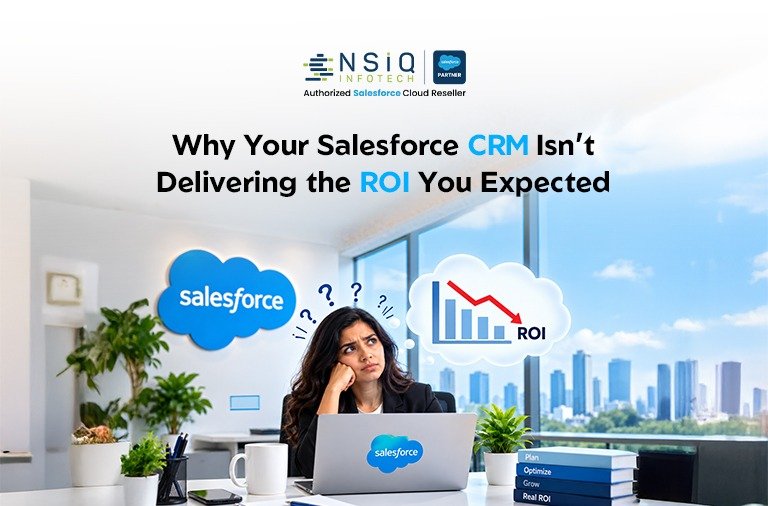
 You Didn’t Invest in Salesforce Just to Have a CRM
When a company invests in Salesforce, the expectation is rarely just to introduce another software platform.
The expectation is growth.
Better sales visibility. Faster customer service. More productive teams. Cleaner data. Better forecasting. Stronger customer relationships. Less manual work. And, increasingly, smarter use of AI.
But there is one question business leaders don’t always ask after implementation:
Are we actually getting the value we expected from Salesforce?
If that answer isn’t clear, the problem may not be Salesforce.
It may be the way Salesforce has been planned, implemented, adopted, managed, or optimized.
This is something we see repeatedly in the Salesforce ecosystem. Companies can have a powerful CRM, a large investment behind it, and plenty of functionality — yet still have sales teams working from spreadsheets, managers questioning reports, service teams handling repetitive tasks manually, and employees finding ways around the system.
At that point, adding another feature isn’t necessarily the answer.
Sometimes, you need to step back and look at the bigger picture.
Salesforce ROI Starts With the Right CRM Strategy
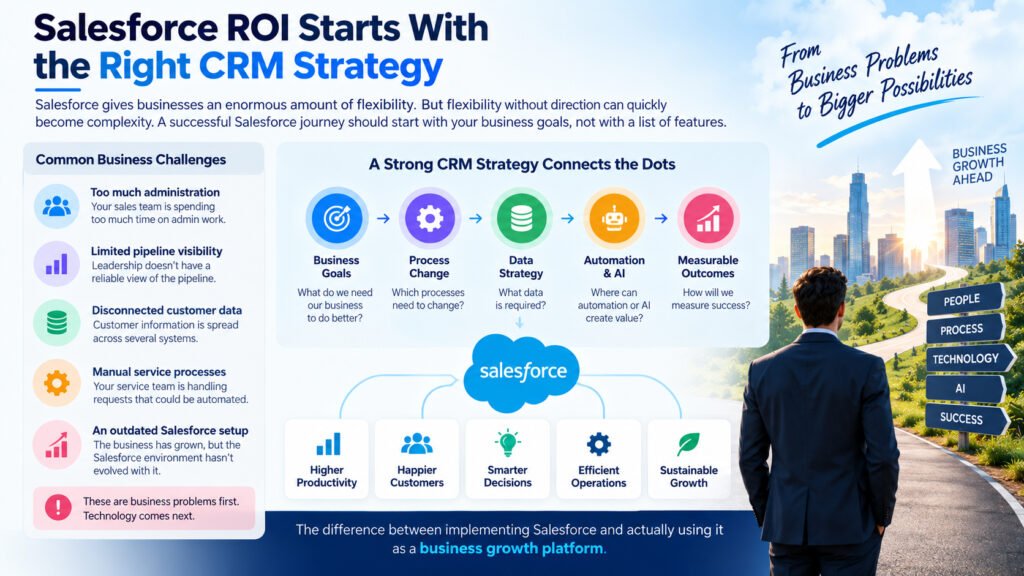
Salesforce gives businesses an enormous amount of flexibility. But flexibility without direction can quickly become complexity.
A successful Salesforce journey should start with your business goals, not with a list of features.
Instead of asking:
“Which Salesforce product should we implement?”
Start with:
“What do we need our business to do better?”
Maybe your sales team is spending too much time on administration.
Maybe leadership doesn’t have a reliable view of the pipeline.
Maybe customer information is spread across several systems.
Maybe your service team is handling requests that could be automated.
Maybe the business has grown, but the Salesforce environment hasn’t evolved with it.
These are business problems first.
Technology comes next.
A strong CRM strategy connects Salesforce to measurable business outcomes. It defines where Salesforce should create value, which processes need to change, what data is required, and where automation or AI can make a meaningful difference.
That is the difference between implementing Salesforce and actually using Salesforce as a business growth platform.
7 Reasons Your Salesforce Investment May Not Be Delivering Enough ROI
1. Your Salesforce Implementation Focused on Going Live — Not Business Outcomes
Getting Salesforce live is an achievement.
But it isn’t the finish line.
A project can be delivered on schedule. Requirements can be completed. Data can be migrated. Users can be trained. The system can technically work.
And six months later, leadership can still be asking:
“What did we actually improve?”
That’s where the difference between implementation and business transformation becomes clear.
A successful Salesforce CRM implementation should have measurable objectives from the beginning.
For example:
Instead of saying:
“We want to implement Sales Cloud.”
Ask:
“How can we reduce the amount of time our sales team spends on administration?”
Instead of:
“We want Service Cloud.”
Ask:
“How can we reduce resolution time and improve the customer experience?”
The technology should support the outcome.
This is why choosing the right Salesforce Implementation Partner matters. Your partner should understand your business processes and objectives, not simply translate a list of requirements into Salesforce configuration.
The goal isn’t to build the biggest Salesforce org.
The goal is to build the right one.
2. Your Employees Are Using Salesforce — But They Haven’t Really Adopted It
There is a big difference between using Salesforce and adopting Salesforce.
An employee might log into Salesforce every day because the company requires it.
That doesn’t necessarily mean Salesforce is helping them.
Look around your organization.
Are salespeople still maintaining their own spreadsheets?
Are important customer updates sitting in email inboxes?
Are managers asking employees for separate reports because they don’t trust the CRM dashboard?
Are opportunities updated only when someone asks for a forecast?
If yes, you have an adoption problem.
And low adoption directly affects ROI.
Sometimes the solution isn’t more training.
Sometimes Salesforce has simply become too difficult to use.
Too many fields.
Too many clicks.
Too many approval steps.
Too many notifications.
Too many processes that don’t reflect how people actually work.
A good Salesforce Consulting Partner should be willing to look at Salesforce from the user’s perspective.
The question isn’t just:
“Does the system work?”
It is:
“Does the system make people’s jobs easier?”
If the answer is no, adoption will always be difficult.
3. Your Data Isn’t Reliable Enough to Support Business Decisions
Here’s a situation no business leader wants.
The CEO asks:
“What is our real sales pipeline?”
Salesforce shows one number.
Finance has another.
Marketing has a third.
And eventually someone opens an Excel spreadsheet and says:
“This is the actual number.”
That’s not a minor reporting issue.
It’s a business problem.
Duplicate accounts, outdated contacts, incomplete records, inconsistent data entry, disconnected systems and poorly defined processes can make your CRM less trustworthy.
And the problem becomes even more important as businesses move toward AI.
If you’re considering Agentforce or other AI capabilities, your data foundation matters enormously.
AI doesn’t magically fix poor data.
If anything, AI makes the quality of your data and business processes even more important.
Before asking what AI can do for your organization, ask a more basic question:
Can we trust the information our AI will use?
4. You’re Automating Processes That Should Have Been Simplified First
Everyone wants more automation.
But there’s a simple principle businesses should remember:
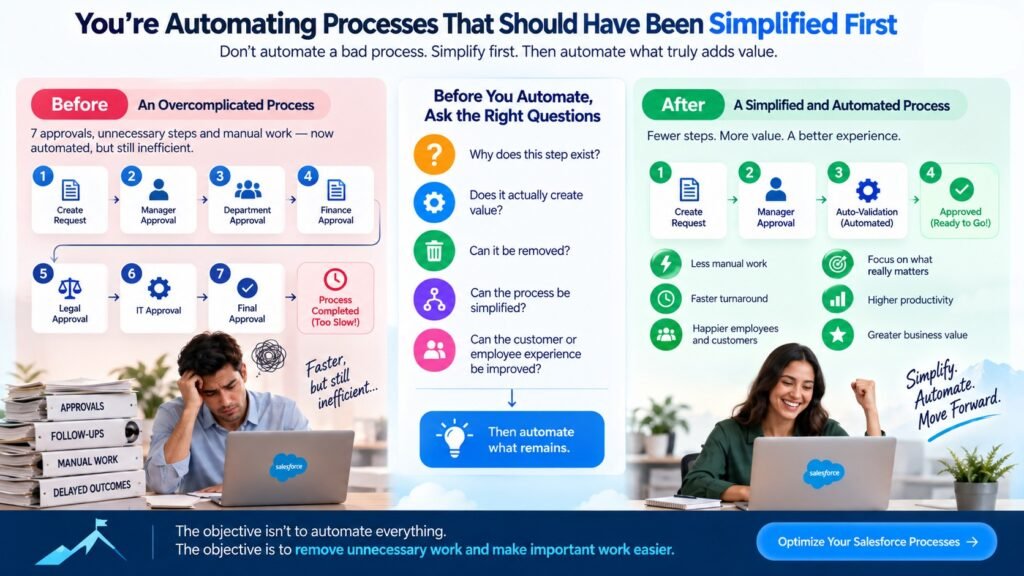
Don’t automate a bad process.
If your current process requires seven unnecessary approvals, automating all seven approvals doesn’t necessarily make the process better.
It just makes an inefficient process faster.
Before automating something, ask:
-
- Why does this step exist?
- Does it actually create value?
- Can it be removed?
- Can the process be simplified?
- Can the customer or employee experience be improved?
Then automate what remains.
This is one of the areas where Salesforce optimization can produce significant value.
The objective isn’t to automate everything.
The objective is to remove unnecessary work and make important work easier.
5. Your Salesforce Org Has Become Too Complicated
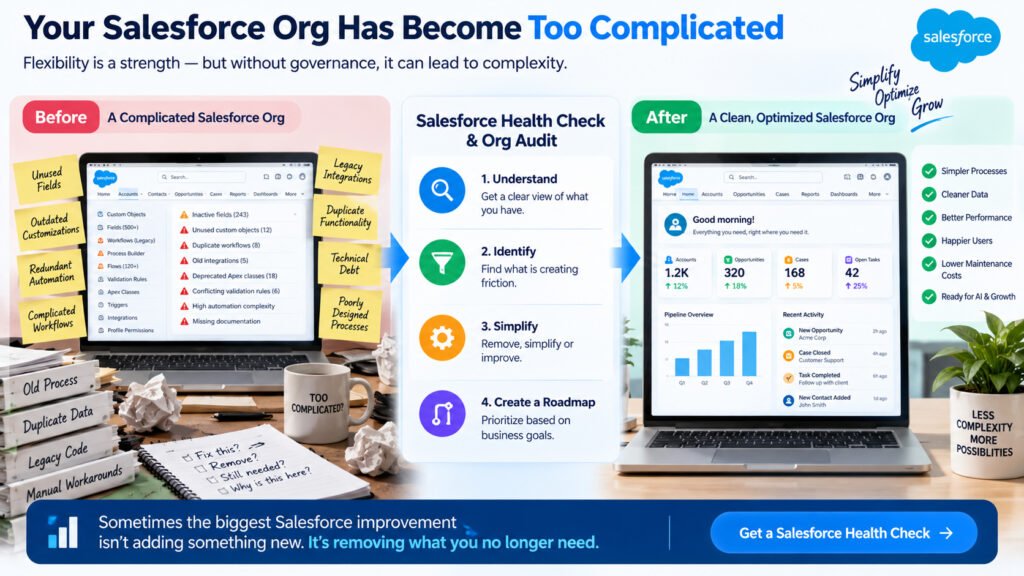
Salesforce’s flexibility is one of its greatest strengths.
But over time, that same flexibility can create technical debt.
A Salesforce org that has been developed and modified for years may contain:
-
- Outdated customizations
- Unused fields
- Redundant automation
- Legacy integrations
- Complicated workflows
- Duplicate functionality
- Technical debt
- Poorly designed processes
Eventually, people start working around Salesforce instead of working with it.
This is often the right time for a Salesforce Health Check or Salesforce Org Audit.
You don’t necessarily need to rebuild everything.
First, understand what you have.
Identify what is creating friction.
Find what can be removed, simplified or improved.
Then create a roadmap based on business priorities.
Sometimes the biggest Salesforce improvement isn’t adding something new.
It’s removing what you no longer need.
6. You’re Measuring CRM Activity Instead of Business Impact
Salesforce can give leadership access to an incredible amount of information.
But more dashboards don’t automatically mean better decisions.
You can measure:
-
- Number of leads
- Number of opportunities
- Number of cases
- Number of activities
- Number of users
- Number of tasks
Those metrics can be useful.
But the bigger questions are about business outcomes.
Sales
Are win rates improving?
Is the sales cycle getting shorter?
Are sales representatives spending more time selling?
Customer Service
Are customers getting faster resolutions?
Are service teams becoming more productive?
Operations
How much manual work has been eliminated?
Leadership
Can executives see what’s happening across the business without waiting for multiple teams to prepare reports?
Revenue
Is Salesforce helping the company identify, convert and retain more business?
These are the metrics that help leadership understand whether Salesforce is truly generating ROI.
7. You’re Thinking About AI Before Fixing the Foundation
AI is changing the Salesforce conversation quickly.
Agentforce is opening new possibilities for intelligent automation, customer service, sales assistance and digital work.
That’s exciting.
But businesses shouldn’t adopt AI simply because everyone is talking about it.
Before introducing Agentforce into important business processes, look at the foundation:
-
- Is our data reliable?
- Are our processes clearly defined?
- Are our systems connected?
- Are permissions and security properly managed?
- Do we have clear use cases?
- Can we measure the expected business impact?
- Are our employees and customers actually going to benefit?
AI should solve a business problem.
It shouldn’t become another technology project looking for a problem to solve.
The best AI strategy isn’t necessarily the one with the most AI.
It’s the one that creates the most meaningful business value.
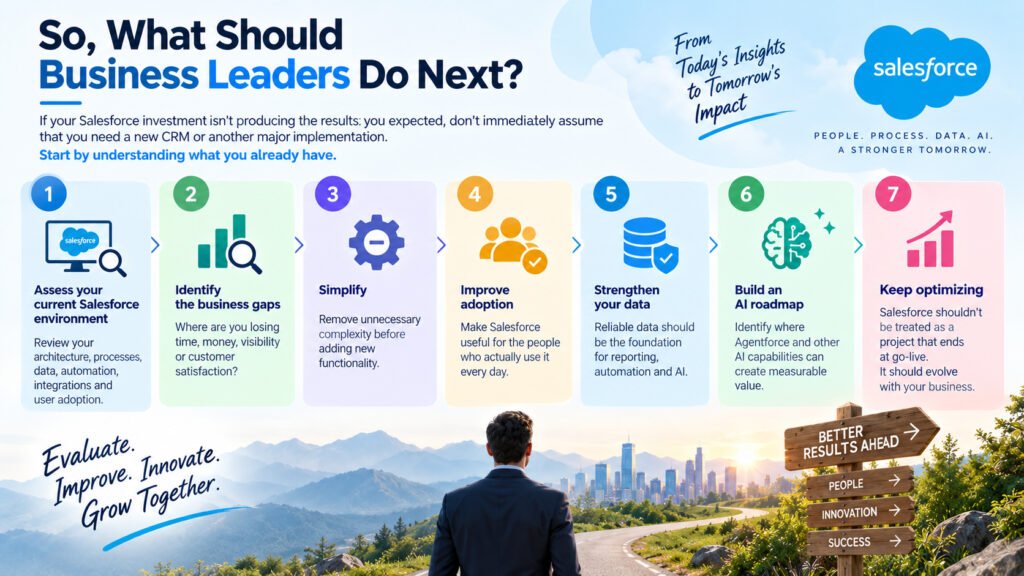
So, What Should Business Leaders Do Next?
If your Salesforce investment isn’t producing the results you expected, don’t immediately assume that you need a new CRM or another major implementation.
Start by understanding what you already have.
1. Assess your current Salesforce environment
Review your architecture, processes, data, automation, integrations and user adoption.
2. Identify the business gaps
Where are you losing time, money, visibility or customer satisfaction?
3. Simplify
Remove unnecessary complexity before adding new functionality.
4. Improve adoption
Make Salesforce useful for the people who actually use it every day.
5. Strengthen your data
Reliable data should be the foundation for reporting, automation and AI.
6. Build an AI roadmap
Identify where Agentforce and other AI capabilities can create measurable value.
7. Keep optimizing
Salesforce shouldn’t be treated as a project that ends at go-live.
It should evolve with your business.
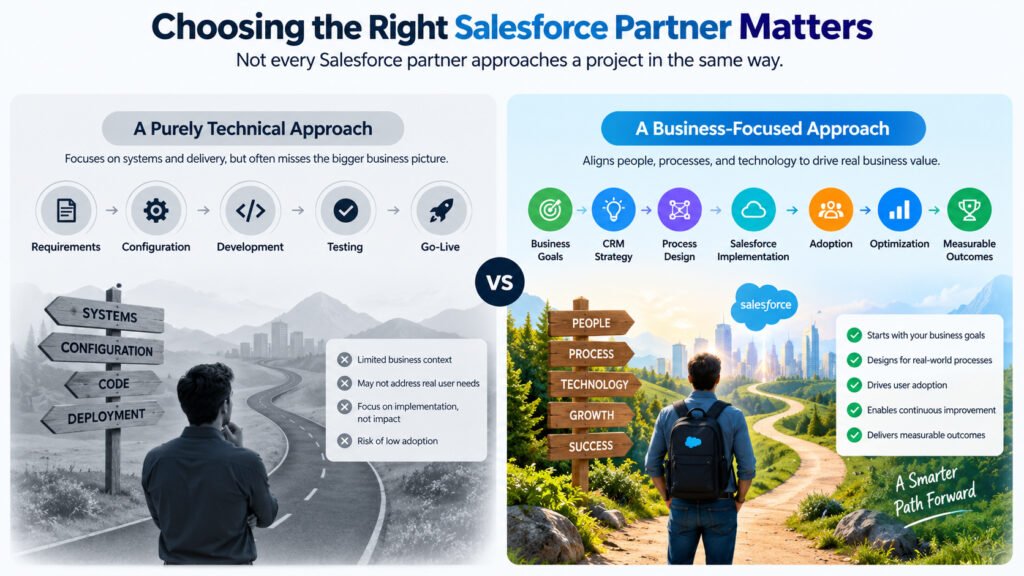
Choosing the Right Salesforce Partner Matters
Not every Salesforce partner approaches a project in the same way.
A purely technical approach might look like:
Requirements → Configuration → Development → Testing → Go-Live
A business-focused approach looks more like:
Business Goals → CRM Strategy → Process Design → Salesforce Implementation → Adoption → Optimization → Measurable Outcomes
That difference matters.
The right Salesforce Implementation Partner should understand what your business is trying to accomplish, not just what you want configured.
And the right Salesforce Consulting Partner should be comfortable discussing strategy, architecture, data, integrations, automation, adoption, AI and long-term growth.
Sometimes they should even tell you:
“You don’t need to build that.”
That’s valuable advice.
The best partner isn’t the one that sells you the most work.
It’s the one that helps you make the right investment.
Salesforce Managed Services: The Journey Doesn’t End at Go-Live
One of the biggest misconceptions about Salesforce is that implementation is the finish line.
It isn’t.
Your business continues to change.
New employees join. Processes evolve. New products launch. Customer expectations change. New systems are introduced. Salesforce releases new capabilities.
And new opportunities around AI continue to emerge.
This is where Salesforce Managed Services can play an important role.
Instead of waiting for something to break, organizations can take a proactive approach to:
-
- Salesforce administration
- Enhancements
- Optimization
- Automation
- Integration support
- Data quality
- User adoption
- Security
- Performance
- Ongoing Salesforce strategy
The objective isn’t simply to keep Salesforce running.
It’s to keep increasing the value your business gets from Salesforce.
Your Salesforce Investment Should Work Harder for Your Business
The question isn’t whether Salesforce is a powerful CRM.
It is.
The bigger question is whether your organization is using Salesforce in the right way.
If your Salesforce investment isn’t producing the expected results, there may be significant opportunities hidden inside the platform you already own.
Maybe your processes need to be simplified.
Maybe your users need a better experience.
Maybe your data needs attention.
Maybe your integrations need to be redesigned.
Maybe your organization needs a stronger CRM strategy.
Maybe it’s time to explore Agentforce.
Or perhaps you need an experienced Salesforce consulting team to take an objective look at your current environment.
The answer isn’t always:
“Buy more technology.”
Sometimes the answer is:
“Get more value from the technology you already have.”
Frequently Asked Questions About Salesforce CRM ROI
1. Why isn’t my Salesforce CRM delivering the expected ROI?
Salesforce itself may not be the problem. Poor implementation, low user adoption, inefficient processes, poor data quality, unnecessary customization and disconnected systems can all reduce ROI.
A Salesforce Health Check can help identify where value is being lost.
2. How can I improve the ROI of my Salesforce investment?
Start by reviewing Salesforce against your business objectives. Focus on user adoption, process efficiency, data quality, automation, integrations and measurable outcomes.
A qualified Salesforce Consulting Partner can help identify high-impact opportunities and create an actionable roadmap.
3. When should a company consider a Salesforce Health Check?
Consider one when adoption is low, reporting is unreliable, the Salesforce org has become complicated, users rely heavily on spreadsheets, automation isn’t working as expected, or you’re planning a major Salesforce or AI initiative.
A proactive assessment can also help before making another significant investment.
4. How do I choose the right Salesforce Implementation Partner?
Look beyond price and technical certifications.
Evaluate the partner’s understanding of your industry, business processes, architecture, data, integrations, adoption and long-term strategy.
Most importantly, ask:
“How will you measure whether our Salesforce investment has delivered business value?”
5. What is the difference between Salesforce consulting and implementation?
Salesforce implementation focuses on configuring, customizing and deploying Salesforce.
Salesforce consulting takes a broader view and can include CRM strategy, architecture, process transformation, data, integrations, automation, AI readiness and optimization.
6. Is Agentforce worth considering for my business?
Agentforce can be valuable when there are clear use cases for AI-powered assistance and automation.
However, businesses should first evaluate data quality, processes, security, governance, integrations and expected ROI.
The question isn’t simply:
“Can we implement Agentforce?”
It’s:
“Where can Agentforce create measurable value?”
7. Does Salesforce need ongoing optimization after implementation?
Yes.
Your business changes continuously, and your Salesforce environment should evolve with it. Salesforce Managed Services can support administration, enhancements, optimization, automation, integrations and ongoing improvements.
8. Should we rebuild our Salesforce org if it has become too complicated?
Not necessarily.
A Salesforce Org Audit can identify technical debt, redundant functionality and inefficient processes before you make a decision about rebuilding.
In many cases, simplifying and optimizing the existing environment can be more practical than starting again.
9. Can Salesforce help reduce operational costs?
Yes, when Salesforce is designed around efficient business processes.
Automation can reduce repetitive data entry, improve routing, streamline approvals and help employees spend more time on higher-value work.
10. What should business leaders ask before investing more in Salesforce?
Start with five questions:
-
- Are we getting measurable value from our current Salesforce investment?
- Are employees genuinely adopting the platform?
- Can we trust our Salesforce data?
- Which processes should we simplify or automate?
- What should our Salesforce and AI roadmap look like over the next 12–24 months?
The answers can help determine whether your next investment should focus on optimization, implementation, integration, managed services, Agentforce or broader CRM transformation.
Final Thought: Salesforce Should Be a Growth Platform, Not Just a CRM
Your Salesforce investment should ultimately help your business do three things better:
Work smarter.
Serve customers better.
Grow faster.
That’s the real measure of Salesforce ROI.
A successful Salesforce journey isn’t defined by how many objects were created, how many automations were built or how quickly the system went live.
It is defined by what changed in the business.
Did your sales team become more productive?
Did your customers receive better service?
Did leadership gain better visibility?
Did employees spend less time on repetitive work?
Did your organization create new opportunities for growth?
If the answer is yes, Salesforce is doing its job.
If the answer is unclear, it may be time to take a closer look.
Because your Salesforce investment shouldn’t simply support your business.
It should help move your business forward.
Ready to Get More From Salesforce?
If your Salesforce org has become difficult to manage, adoption is low, data quality is a concern, or you’re unsure whether your current investment is delivering enough business value, you don’t necessarily need another large project.
Start with an assessment.
NSIQ can help evaluate your Salesforce environment, identify opportunities for improvement and develop a practical roadmap around Salesforce consulting, Salesforce CRM implementation, Salesforce optimization, Agentforce and Salesforce Managed Services.
Let’s turn your Salesforce investment into measurable business value.
Talk to NSIQ about your Salesforce strategy and transformation roadmap.