
Introduction: Your Retail Data Is Sitting Idle – Here’s How to Fix That
You have more customer data than ever before. Purchase histories, abandoned carts, loyalty points, website clicks, in-store POS transactions, social interactions – the list goes on.
But here’s the uncomfortable truth most retail leaders face: that data is scattered across a dozen different systems, and none of them talk to each other cleanly. Your marketing team doesn’t know what your operations team knows. Your CDO is staring at dashboards that don’t agree with each other. And your CMO is running campaigns based on yesterday’s picture of a customer who has already moved on.
That gap between data you have and insight you can actually act on? That’s where revenue leaks.
Salesforce Data 360 for retail was built to close exactly that gap. It creates a single, unified, real-time view of every customer – across every channel, every touchpoint, and every team. And when you give your retail organization that kind of clarity, revenue follows.
In this guide, we’ll walk you through what salesforce data 360 for retail actually means in practice, what capabilities it unlocks, how real retailers are using it to grow, and what it takes to implement it effectively.
Stat: According to Salesforce’s State of the Connected Customer report, 73% of customers expect companies to understand their unique needs and expectations – but only 51% of customers say companies generally treat them as an individual. That gap is a revenue problem data 360 retail is designed to solve.
What Is Salesforce Data 360 for Retail?
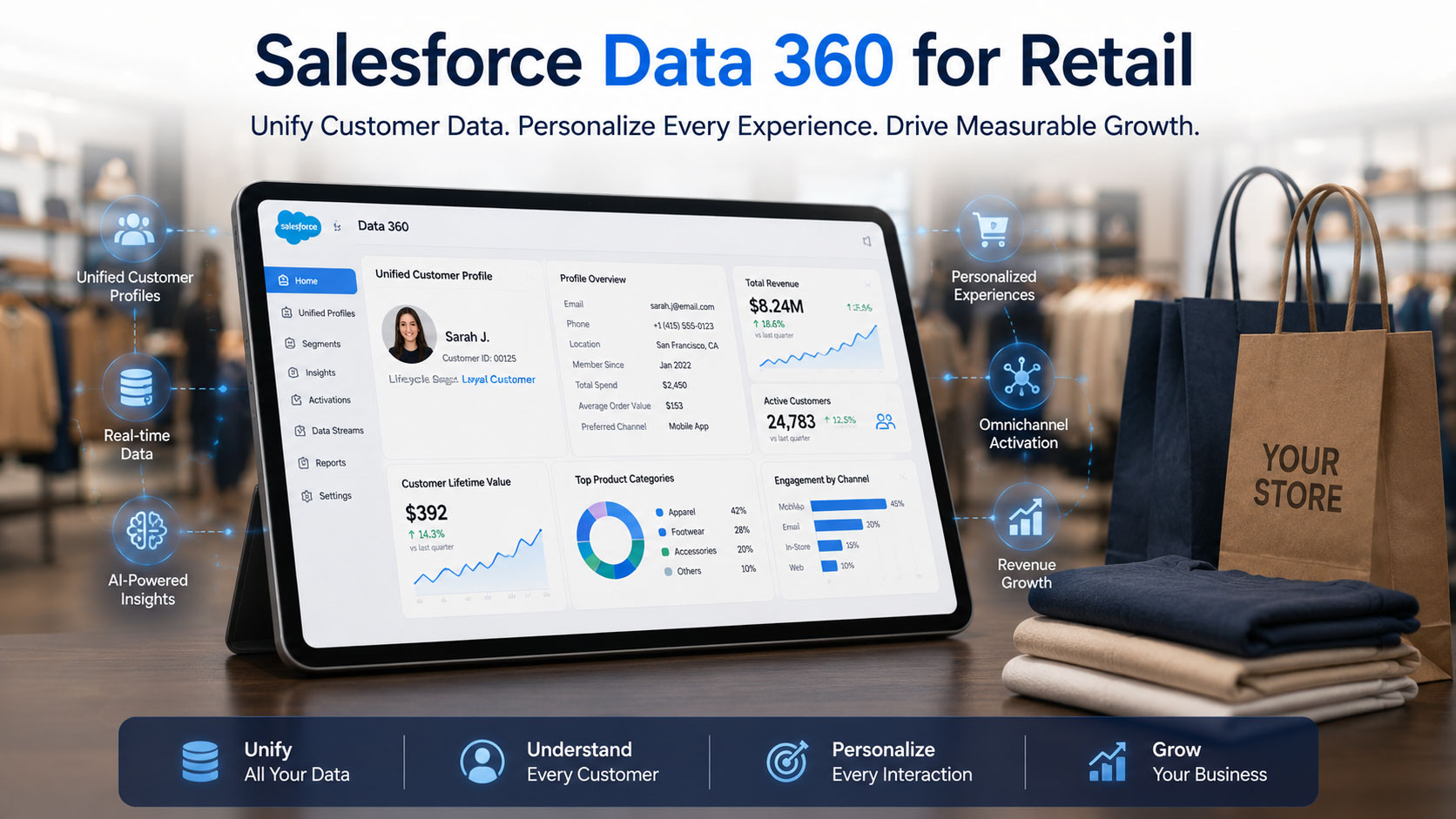
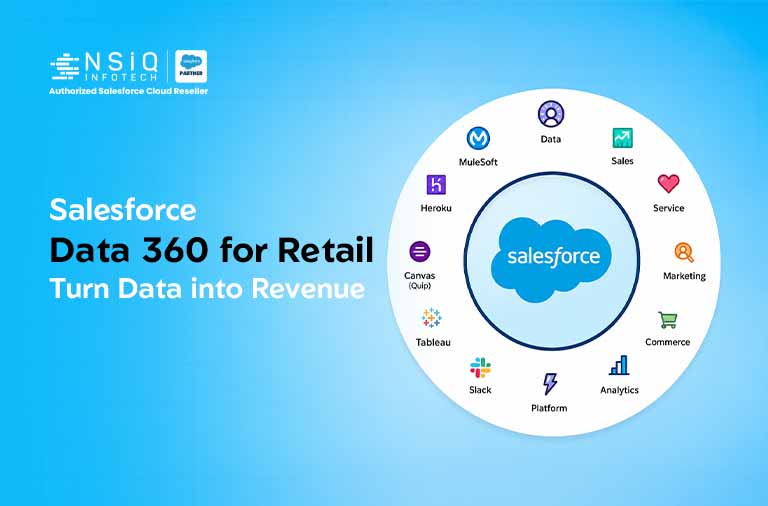
Salesforce Data 360 is Salesforce’s unified data strategy framework, powered by Salesforce Data Cloud (formerly Customer Data Platform or CDP). In the retail context, it means connecting and activating all of your customer data – online and offline – into a single real-time profile.
Think of it as your retail brain. Instead of your loyalty system, ecommerce platform, CRM, in-store POS, marketing automation, and customer service tools all operating in separate data universes, Data 360 brings all of it together. The result is one coherent picture of every customer.
What Makes It Specifically Built for Retail?
Retail is uniquely complex from a data perspective. Customers interact across:
- Physical stores
- E-commerce websites
- Mobile apps
- Loyalty programs
- Social commerce channels
- Call centres and chat support
Each of those touchpoints generates data – but in different formats, different systems, and different timelines. Salesforce Data 360 uses a combination of identity resolution, real-time data ingestion, and AI-powered segmentation to stitch these fragments together into something usable.
For a retail CMO, CDO, or Operations Head, this means you’re finally working from one version of the truth – not five conflicting ones.
The Core Problem: Why Fragmented Data Hurts Retail Revenue
Before we go deeper into capabilities, it’s worth understanding why fragmented data is so costly.
· The Hidden Cost of Data Silos in Retail
Here’s a scenario that plays out in retail organizations every day:
A high-value loyalty member buys a new laptop bag in-store. Two days later, she receives an email campaign promoting laptop bags – the exact item she just purchased – with a discount she could have used. She’s frustrated. The brand looks like it doesn’t know her. And the marketing budget just got wasted on a segment of one.
That’s data silos in action. And at scale, those micro-failures add up to millions in wasted spend, lost loyalty, and missed revenue.
· The Three Revenue Leaks Retailers Face Most Often
- Irrelevant marketing campaigns that ignore recent purchase behavior
- Missed upsell and cross-sell opportunities due to incomplete product history
- Poor inventory decisions driven by aggregate data instead of individual demand signals
Salesforce Data 360 for retail addresses all three – by making the right data available at the right moment to the right system.
Stat: McKinsey research shows that personalization leaders in retail generate 40% more revenue from those activities than average players. That’s the commercial value of getting data-driven customer engagement right.
Key Capabilities of Salesforce Data 360 for Retail
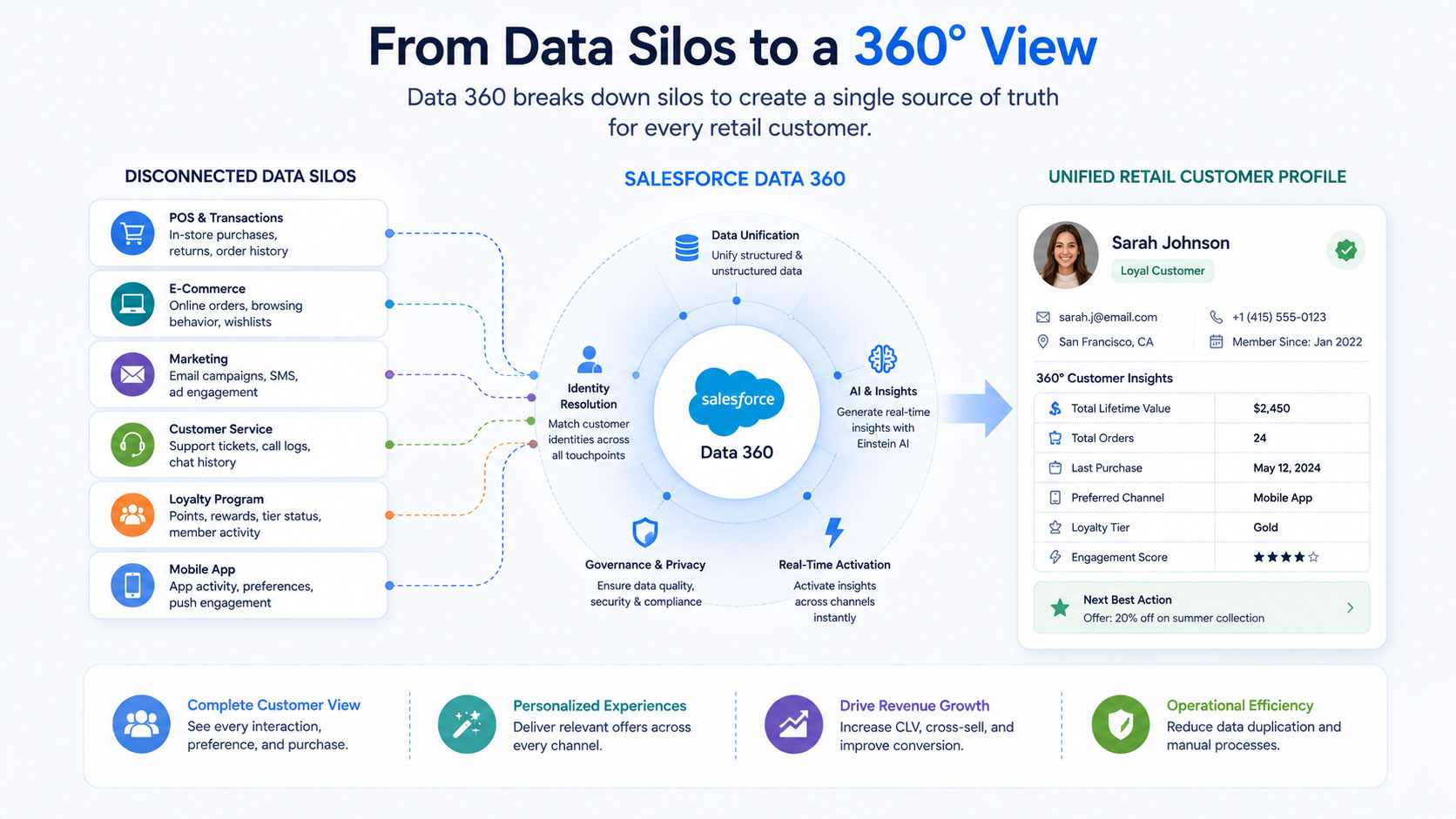
Let’s get specific about what Data 360 actually does in a retail environment.
1. Unified Customer Profile
Data Cloud ingests data from every source – your Salesforce CRM, Commerce Cloud, Marketing Cloud, Service Cloud, POS systems, loyalty platforms, and even external data providers – and resolves it into one unified profile per customer.
This isn’t just a data aggregation exercise. It’s identity resolution at scale. If a customer shops online under one email, in-store using a loyalty card, and calls your service line from a different phone number – Data 360 knows it’s the same person.
2. Real-Time Data Activation
One of the biggest limitations of legacy CDPs was the time lag. Data would get batched, processed overnight, and your segments would be 24 hours stale before your campaign even launched.
Data 360 processes and activates customer data in real time. That means if a customer abandons their cart at 9 AM, your personalized retargeting message can go out by 9:15 AM – not the next day.
3. AI-Powered Segmentation and Predictions
Einstein AI, embedded within Data Cloud, goes beyond static segments. It can predict:
- Likelihood to purchase in the next 30 days
- Churn risk scores
- Product affinity scores by category
- Lifetime value forecasts
For retail operations heads, this means demand forecasting that’s grounded in individual customer behaviour, not just historical averages.
4. Cross-Channel Journey Orchestration
Data 360 doesn’t just unify data – it activates it across channels. Through direct integration with Salesforce Marketing Cloud and Commerce Cloud, you can trigger personalized journeys across:
- Email and SMS
- Push notifications
- Paid media (Google, Meta)
- In-store associate apps
- Website personalization engines
5. Consent and Compliance Management
For retail brands operating in GDPR, CCPA, or India’s DPDP Act environments, Data Cloud includes built-in consent management. Customer preferences are honored automatically across every channel – reducing compliance risk while building customer trust.
Real-World Use Cases: How Retail Leaders Are Using Data 360 Retail
Use Case 1: Personalized Loyalty Program Campaigns
A mid-size fashion retailer with 2 million loyalty members was running one-size-fits-all promotional emails. Open rates were around 18%, and conversion rates were under 2%.
After implementing Data 360, they built micro-segments based on:
- Last purchase category
- Average order value tier
- Seasonal purchase patterns
- In-store vs. online purchase preference
Within 60 days, their segmented campaigns achieved open rates above 35% and conversion rates of 5.2%. Revenue from loyalty campaigns increased by 28% quarter over quarter.
The key metric: same budget, nearly 3x the conversion. That’s what data 360 retail customer data activation looks like at scale.
Use Case 2: Reducing Cart Abandonment with Real-Time Triggers
A home furnishings brand was losing approximately $4.5M annually to abandoned carts. Their retargeting was triggered only by their email platform, which operated on a 6-hour batch cycle.
After Data Cloud integration, cart abandonment triggers fired within minutes – and the messaging was personalized with the exact products left behind, combined with the customer’s purchase history and loyalty tier.
Cart recovery rate improved from 9% to 21% in three months. That single use case justified the entire platform investment.
Use Case 3: Unified In-Store and Online Experience
A specialty retailer’s in-store associates had no visibility into customer online browsing or purchase history. Associates were operating blind during high-value sales conversations.
Through Data 360 integration with their associate app, store staff gained access to real-time unified profiles – including online wishlist items, recent searches, and loyalty status. Average transaction value in assisted sales increased by 17%, and customer satisfaction scores improved by 22 points.
Infographic-Friendly Summary: 6 Steps to Activate Salesforce Data 360 for Retail Revenue Growth
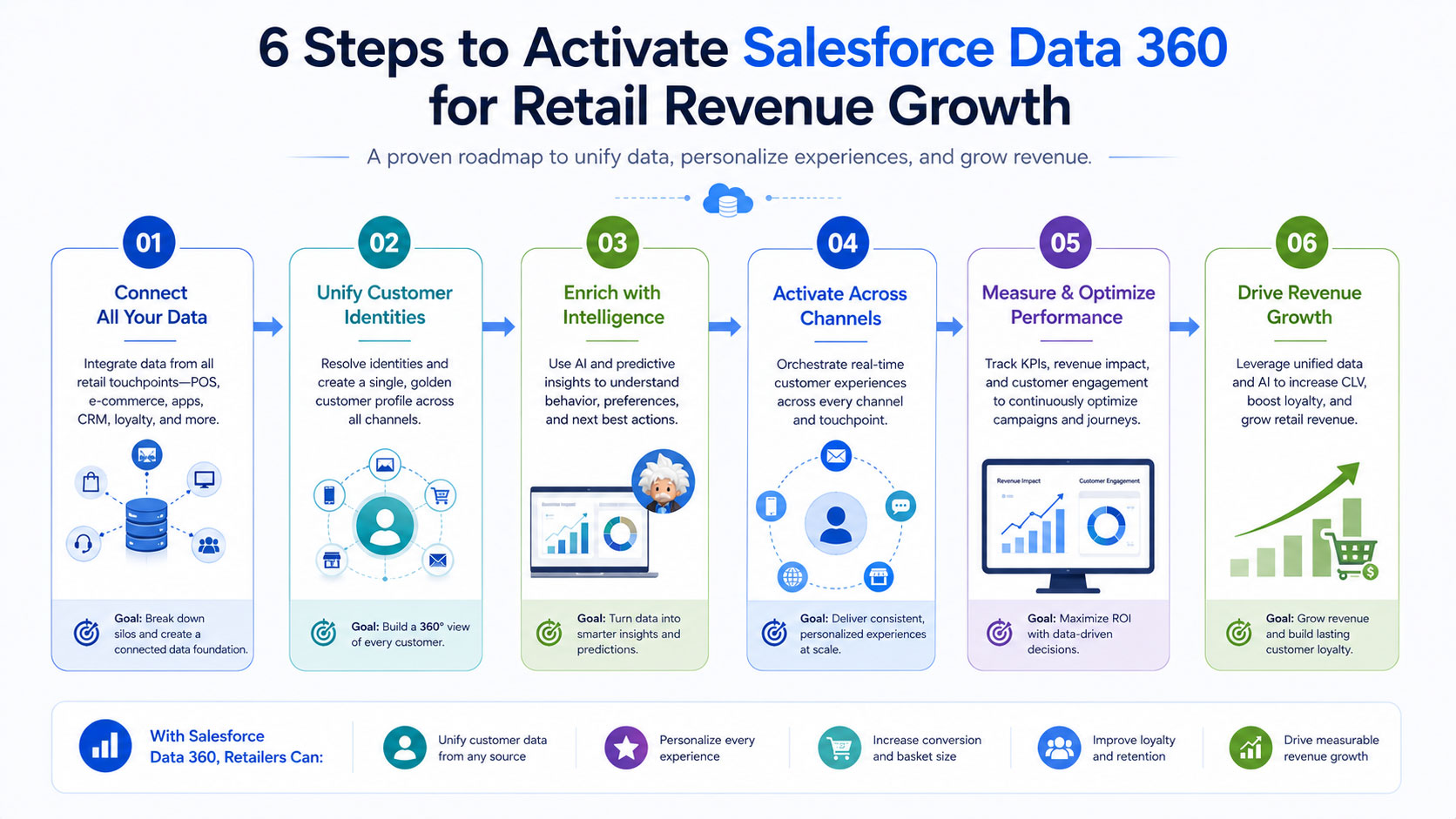
This section is designed for infographic conversion. Each step represents a milestone in your Data 360 retail implementation journey.
| STEP | ACTION |
| Step 1 | Audit & Map All Data Sources – Identify every customer data source: CRM, ecommerce, POS, loyalty, service, and social. Map data flows and ownership. |
| Step 2 | Define Your Unified Profile Schema – Work with your CDO to determine what fields make up your ideal 360-degree customer profile. Prioritize identifiers. |
| Step 3 | Implement Salesforce Data Cloud – Configure connectors for all data sources. Set up identity resolution rules. Begin real-time data ingestion. |
| Step 4 | Build AI-Powered Segments – Use Einstein to create predictive segments: high-LTV customers, churn risks, upsell candidates, lapsed buyers. |
| Step 5 | Activate Across Channels – Connect segments to Marketing Cloud, Commerce Cloud, in-store apps, and paid media platforms for coordinated activation. |
| Step 6 | Measure, Optimize, Scale – Track revenue metrics by segment. Use A/B testing on journeys. Expand use cases quarter by quarter. |
Data 360 Retail Revenue Growth: The Metrics That Matter
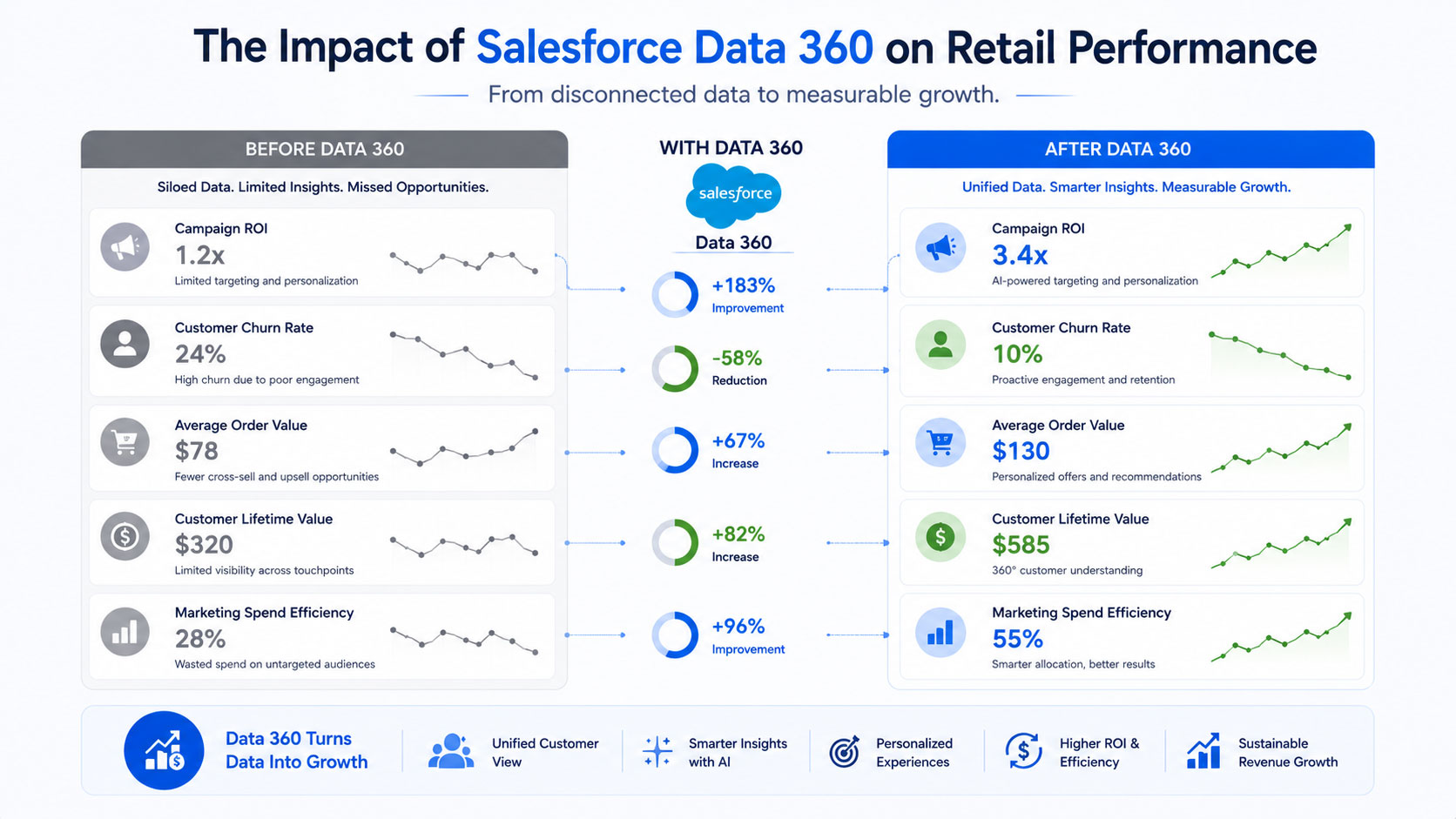
If you’re a CMO, CDO, or Operations Head evaluating Salesforce Data 360, you need a clear picture of what success looks like – in numbers.
Here are the key performance indicators your team should track post-implementation:
Marketing Metrics
- Campaign conversion rate by segment (target: 2–3x improvement over baseline)
- Email open rate and click-through rate by unified segment
- Cart abandonment recovery rate
- Customer acquisition cost by channel
Revenue Metrics
- Revenue per customer (loyalty tiers vs. non-loyalty)
- Average order value in personalized vs. generic campaigns
- Lifetime value growth across cohorts
- Cross-sell and upsell attach rates
Operational Metrics
- Data freshness: time from customer action to available profile update
- Segment build time: hours or days reduced to minutes
- Inventory accuracy improvements tied to demand signal activation
Stat: According to Statista, global retail e-commerce revenue is projected to exceed $8.1 trillion by 2026. Retailers that can personalize at scale will capture a disproportionate share of that growth. Data 360 retail is the infrastructure that makes that possible.
Common Mistakes Retail Leaders Make with Customer Data Platforms
Even with the right platform, implementation can go wrong. Here are the mistakes we see most often – and how to avoid them.
Mistake 1: Treating Data 360 as a Technology Project, Not a Business Strategy
The biggest failure mode we see is handing Data 360 entirely to the IT team and walking away. Data Cloud is a business transformation tool. Your CMO, CDO, and Operations Head all need to own outcomes – not just enable the technology.
Fix: Assign business owners to each use case. Define revenue targets before you go live.
Mistake 2: Poor Data Quality at the Source
Garbage in, garbage out. If your CRM has duplicate records, your POS system isn’t capturing loyalty IDs consistently, or your ecommerce platform uses multiple email formats – Data 360 will unify a mess.
Fix: Run a data quality audit before connecting sources. Establish data governance rules that all source systems must follow.
Mistake 3: Activating Too Many Use Cases at Once
Retail organizations that try to activate 15 use cases in the first quarter often end up delivering none of them well. The data infrastructure, team alignment, and change management required to run personalization across every channel simultaneously is enormous.
Fix: Start with two or three high-value, measurable use cases. Build confidence, demonstrate ROI, then scale.
Mistake 4: Ignoring the Consent Layer
With privacy regulations tightening globally, retailers that don’t build consent management into their Data Cloud architecture from day one will face painful retrofits – or worse, regulatory action.
Fix: Make consent a first-class data object in your unified profile. Use Data Cloud’s built-in consent management tools from launch.
How NSIQ INFOTECH Helps Retail Brands Unlock Data 360 Revenue Growth
Implementing Salesforce Data 360 for retail isn’t just a technical exercise – it requires a strategic partner who understands both the Salesforce ecosystem and the unique complexities of retail operations.
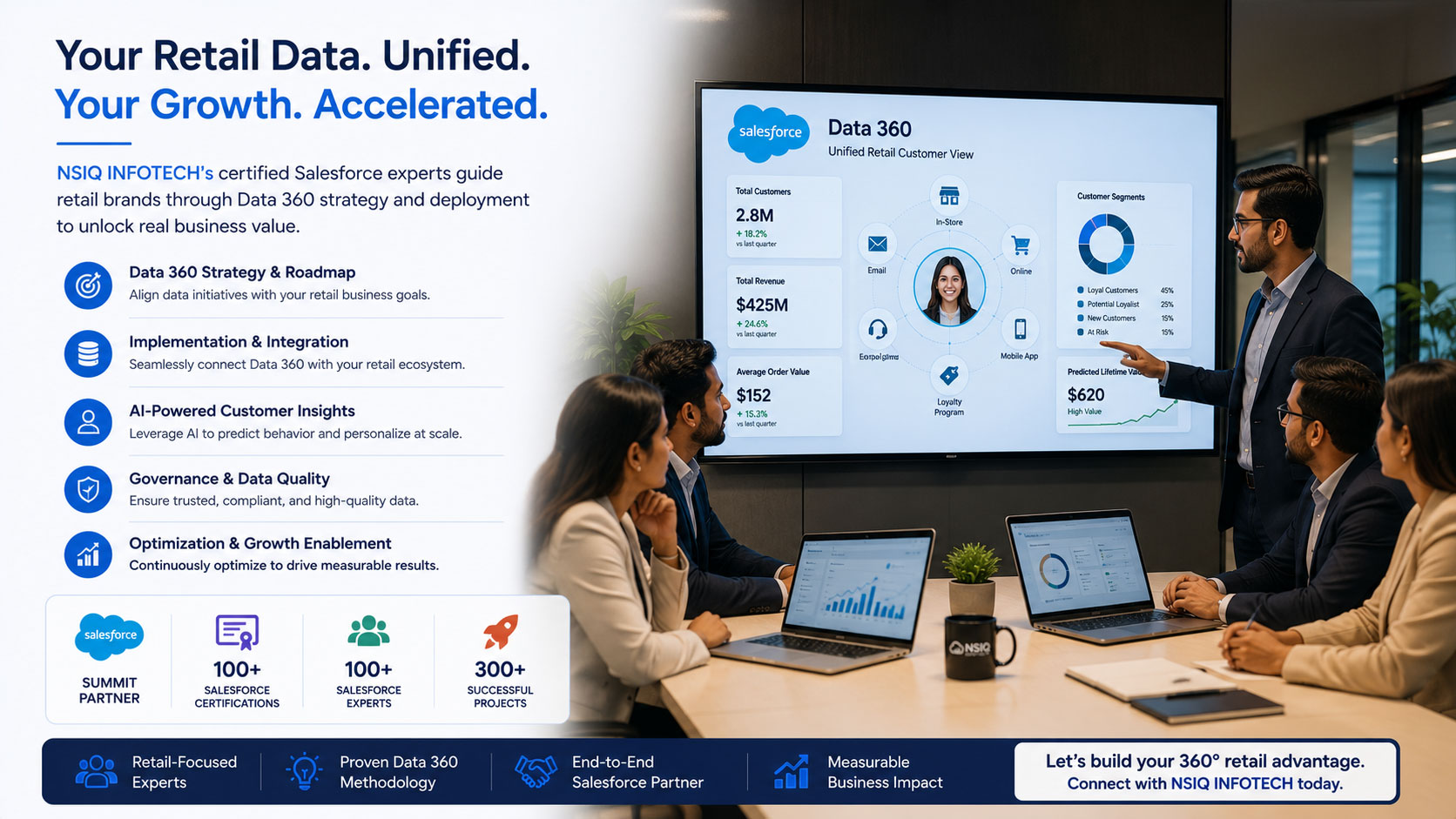
NSIQ INFOTECH works with retail CMOs, CDOs, and Operations Heads to design and deploy Data 360 strategies that deliver measurable commercial outcomes. Our approach goes beyond configuration.
We start by mapping your current customer data landscape – identifying where the gaps are, where the quick wins are, and what your first three use cases should be. Then we architect your Data Cloud implementation to support both your immediate needs and long-term data strategy.
Our Salesforce-certified team has delivered Data Cloud and CRM implementations across fashion retail, grocery, home furnishings, specialty retail, and direct-to-consumer brands. We bring both technical depth and business context – which means your implementation is designed around revenue outcomes, not just system integrations.
Whether you’re just starting to evaluate Data 360, or you have a Data Cloud instance that isn’t delivering the results you expected, NSIQ INFOTECH can help you close the gap between data potential and revenue reality.
Ready to Turn Your Retail Customer Data into Revenue? Book a Free Data Strategy Consultation with NSIQ INFOTECH Today.
Conclusion: The Retailers Who Win Will Be the Ones Who Unify
The retail landscape in 2026 and beyond will be defined by a simple truth: the brands that understand their customers best will win. Not the brands with the most data – but the ones who can turn that data into action, at speed, and at scale.
Salesforce Data 360 for retail gives you the infrastructure to do exactly that. It breaks down the silos that cause missed opportunities, wasted budgets, and frustrated customers. It puts a real-time, unified customer profile at the center of every decision your marketing, operations, and service teams make. And it activates AI-powered intelligence that moves your campaigns from generic to genuinely personal.
The retailers using data 360 retail customer data effectively today are not just improving marketing metrics – they are building the kind of customer relationships that drive lifetime value, reduce churn, and create durable competitive advantage.
The question isn’t whether you should invest in a unified data strategy. The question is whether you’re ready to move from fragmented data to revenue-generating clarity.
NSIQ INFOTECH is ready to help you make that move. Our team of Salesforce-certified experts has helped retail brands across segments design and deploy Data 360 strategies that deliver real commercial outcomes.