
If you’re a CIO, CEO, or digital transformation leader, you’ve probably had the same conversation a dozen times this year: “We need AI automation, but our chatbots and RPA scripts can’t keep up with how complex our business actually is.” That gap between what enterprises need and what older automation tools can deliver is exactly why Salesforce Agentforce has moved from a buzzword to a boardroom priority.
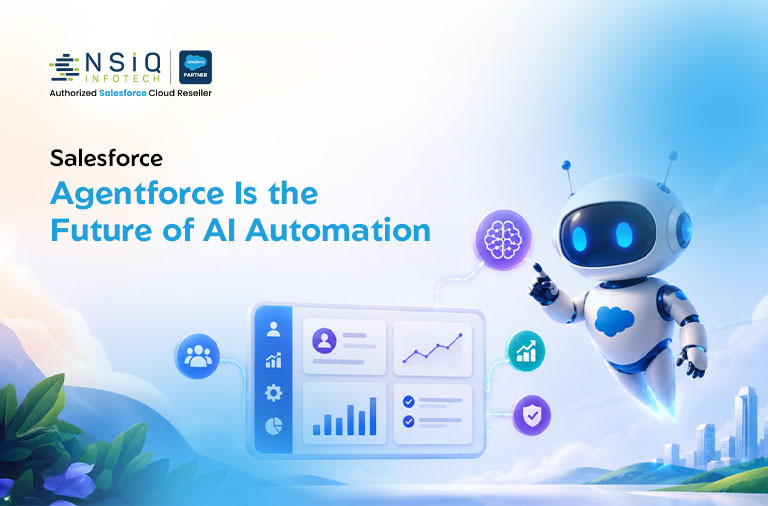
Salesforce Agentforce isn’t another copilot bolted onto your CRM. It’s a genuine shift in how work gets done — autonomous AI agents that can reason, plan, and take action across your business, grounded in the CRM data you already trust. In this article, we’ll break down why Agentforce represents where enterprise AI automation is headed, what makes it different from everything that came before it, and how leadership teams can approach adoption without falling into the common traps that derail AI initiatives.
What Is Salesforce Agentforce, Really?
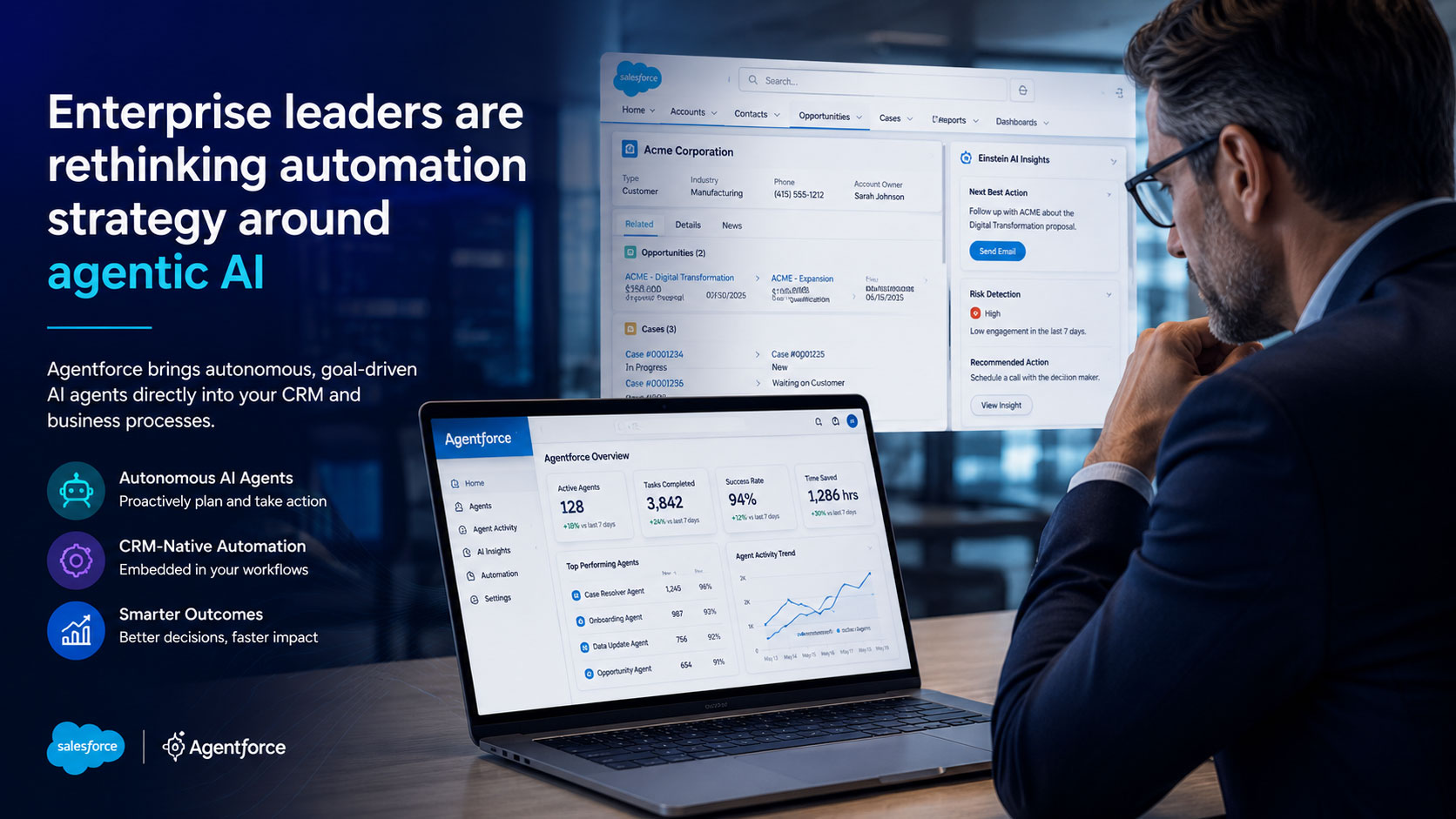
Agentforce is Salesforce’s platform for building and deploying autonomous AI agents that operate natively inside your Salesforce environment. Unlike a standalone AI tool that needs to be connected to your CRM through custom integrations, Agentforce agents live where your customer, sales, and service data already lives.
That distinction matters more than it sounds. When an agent is CRM-native, it doesn’t need a connector to know that an account has three open opportunities, a support case in progress, and a renewal coming up in six weeks. That context is simply available to it. The hardest part of building a useful AI agent — getting the right data to the right place at the right time — is largely solved by design rather than bolted on afterward.
Agentforce ships with a library of pre-built agent roles for common enterprise functions: service agents that resolve customer issues, sales development agents that qualify inbound leads, and workflow agents that support marketing, commerce, and operations. On top of that, enterprises can build fully custom agents using low-code tools, flows, prompt templates, and — for more technical teams — Apex and JavaScript.
Why Traditional Automation Falls Short for Modern Enterprises
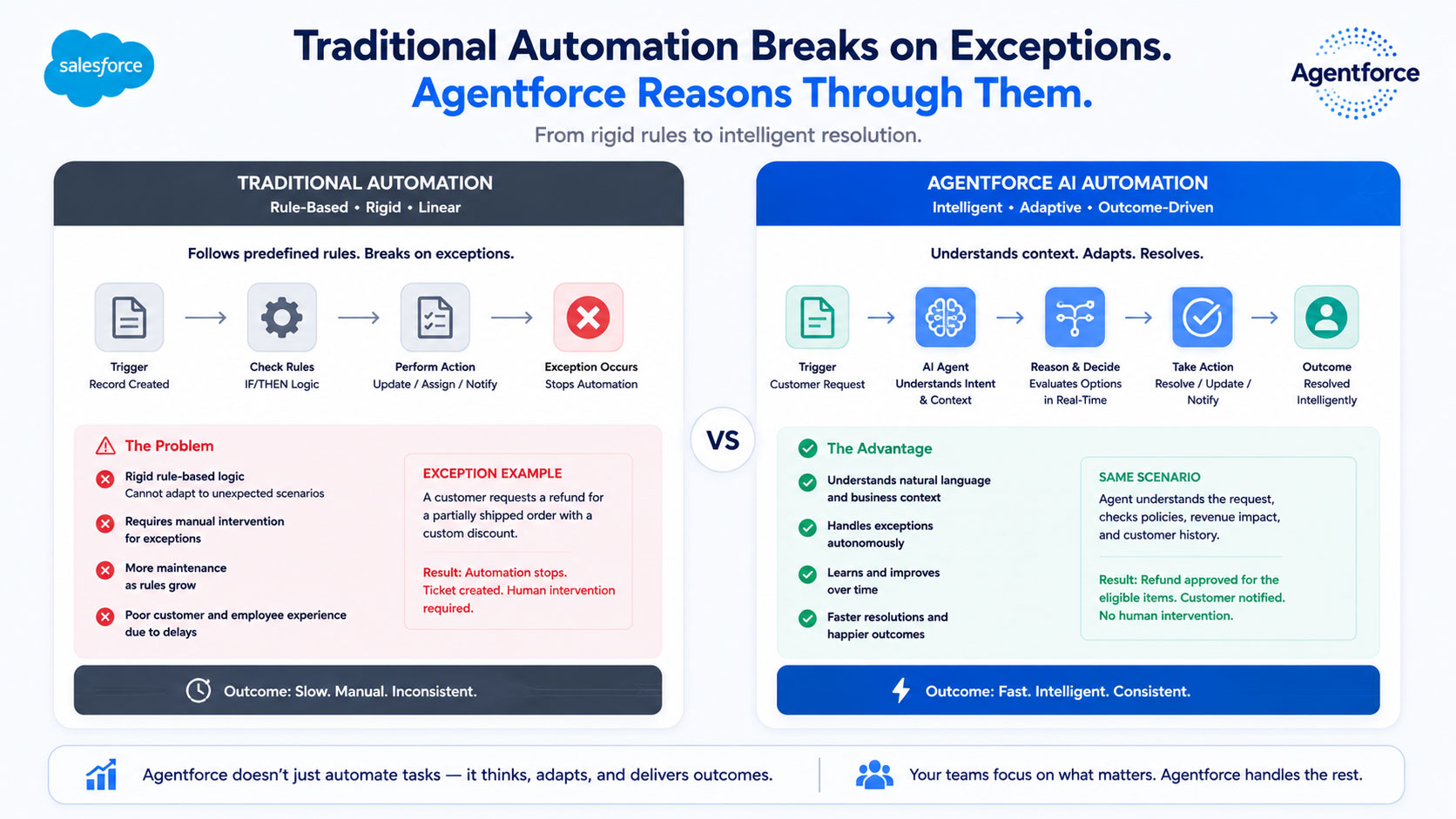
Rule-based automation and RPA scripts are excellent at doing exactly what they were told to do, and terrible at doing anything else. The moment a customer asks a question the script wasn’t built for, or a sales scenario doesn’t match the exact workflow it was coded against, the automation breaks and a human has to step in.
That’s the core limitation enterprise leaders keep running into. Automation scales the predictable 80% of work beautifully, but it’s the unpredictable 20% — the exceptions, the edge cases, the “it depends” scenarios — that actually consume the most human time and cost.
Agentic AI approaches this differently. Instead of following a fixed script, an Agentforce agent reasons through a request, decides which action to take, and adapts its response based on context. It can still follow strict, deterministic rules where precision matters — for example, verifying a customer’s identity before discussing account details — while flexibly handling the conversational parts a rigid script never could. That combination of structure and adaptability is a big part of why Agentforce is being positioned as the next stage of enterprise automation rather than a simple upgrade to existing tools.
Why Agentforce Is the Future of Enterprise AI Automation
1. It’s Built on a Trust Layer, Not Just a Model
For CIOs and CEOs, the AI conversation almost always circles back to governance. Where does the data go? Who can see what? Can this be audited? Agentforce addresses this through its Trust Layer architecture, which enforces data access controls, masks sensitive information, and maintains audit trails for every agent action. Agents operate under the permissions of the user who initiated the interaction, so an agent cannot see records that the underlying user isn’t already allowed to see. For enterprises building AI into customer-facing workflows, this isn’t a nice-to-have — it’s often the deciding factor in whether a pilot is allowed to reach production at all.
2. Deterministic Control Where It Actually Matters
One of the more recent additions to the platform, Agent Script, lets teams define explicit if/then logic for the parts of a workflow where sequence and outcome absolutely cannot vary — think a banking agent that must verify identity before discussing a balance. Pure reasoning models can’t reliably guarantee that kind of sequencing on their own. By pairing deterministic workflows with flexible LLM reasoning, Agentforce gives enterprises a hybrid model: predictable where it needs to be, adaptive everywhere else.
3. Open Connectivity Through MCP
Agentforce added native Model Context Protocol (MCP) client support, which means agents can connect to external systems and tools without custom-built integrations for every single connection. This opens the door to a growing partner ecosystem spanning cloud platforms, communication tools, and payment providers, letting agents reach beyond Salesforce data when a workflow calls for it.
4. It’s Already Producing Enterprise-Scale Results
This isn’t theoretical. Salesforce’s own reporting shows Agentforce has crossed $1 billion in annual recurring revenue, reflecting how quickly enterprise customers are moving from pilot to paid, scaled deployment. That kind of commercial traction is a meaningful signal — it means the platform isn’t just generating interest, it’s generating renewals.
5. It Matches Where the Market Is Actually Heading
According to McKinsey’s State of AI research, 62% of organizations report they are at least experimenting with AI agents, though a smaller share have moved past pilots into scaled deployment. That gap between experimentation and scale is precisely where Agentforce’s CRM-native architecture gives adopters an advantage: they’re not starting from zero on data integration, which is usually the single biggest reason agent projects stall.
Real-World Examples: What Agentforce Looks Like in Practice
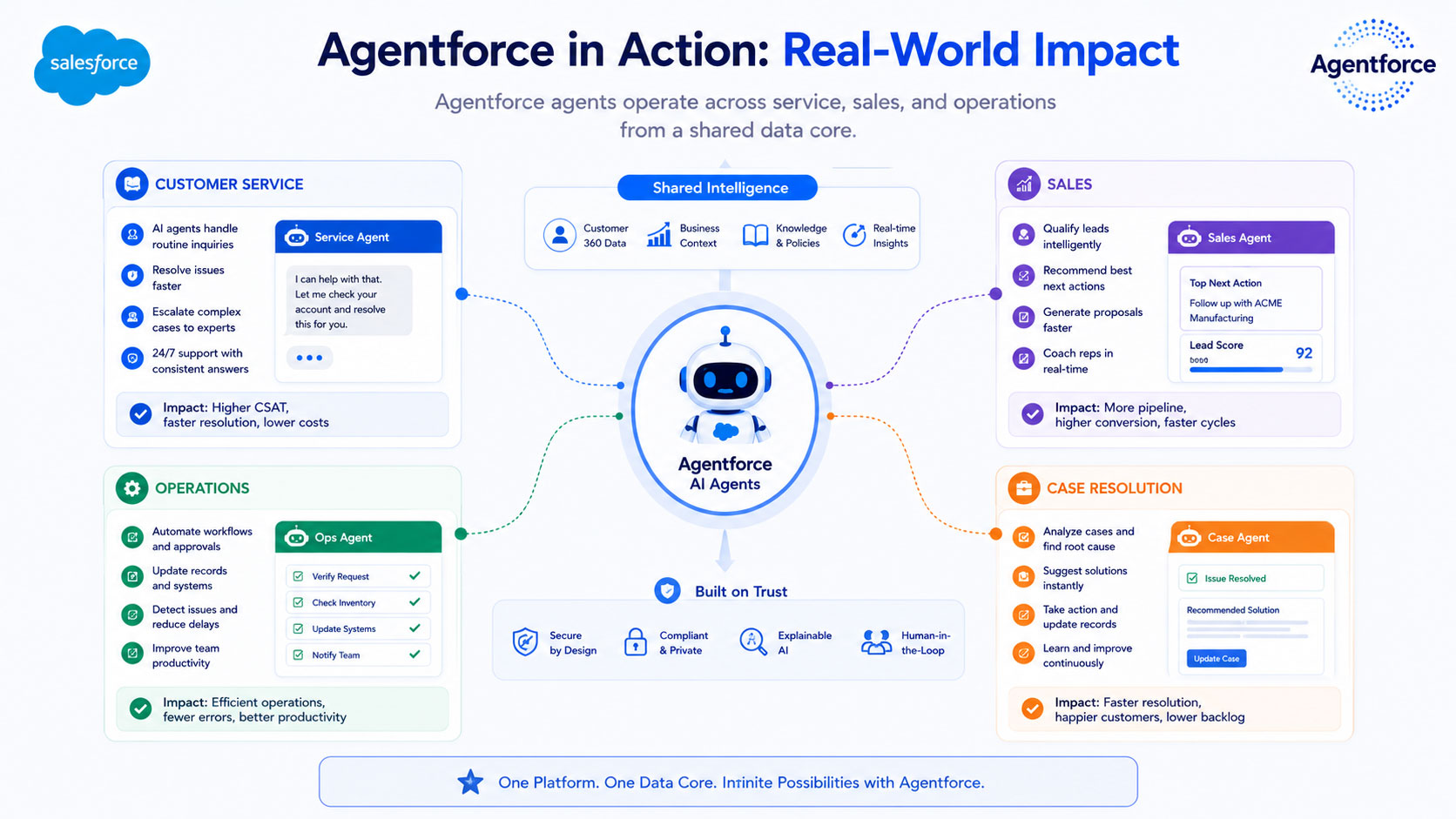
Customer service at scale: Enterprises deploying Agentforce service agents to handle common support questions — using existing knowledge base articles plus account-specific context — have reported meaningfully lower human case volume for the categories those agents cover, since the agent resolves routine, well-defined questions before they ever reach a queue. Salesforce’s own data indicates organizations using AI service agents can expect around a 20% average reduction in service costs and case resolution times, which is a substantial number when you’re running thousands of support interactions a month.
Lead qualification without the lag: A common early deployment pattern is a sales development agent that engages inbound leads the moment they arrive, asks qualifying questions, scores the lead against CRM data, and routes anything qualified straight to the right rep. The measurable win here isn’t just efficiency — it’s eliminating the response-time gap that causes warm leads to go cold before a human ever reaches out.
Quote and configuration workflows: Manufacturing and distribution businesses have used agents to assemble product configurations, apply the correct pricing rules, and generate quotes based on account history and active promotions — cutting a process that used to take a rep 20-30 minutes down to something close to instant, with far fewer manual errors.
The common thread across these examples: the agents succeed because they start from a single, high-value, well-scoped use case where the data already lives in Salesforce, prove the return, and expand from there — not because someone tried to automate everything on day one.
Common Mistakes Enterprises Make with Agentforce
- Trying to launch enterprise-wide instead of proving value with one well-defined use case first
- Skipping data quality cleanup, which leaves agents reasoning over incomplete or duplicate records
- Underestimating org readiness — Agentforce requires the right Salesforce edition, Data Cloud provisioning, and clean permission structures before an agent can perform reliably
- Writing vague agent scope definitions instead of explicit “do this, never do that” guardrails
- Treating governance as an afterthought rather than a board-level decision from the start
- Assuming the agent itself is the hard part, when in reality most of the effort goes into preparing the organization around it
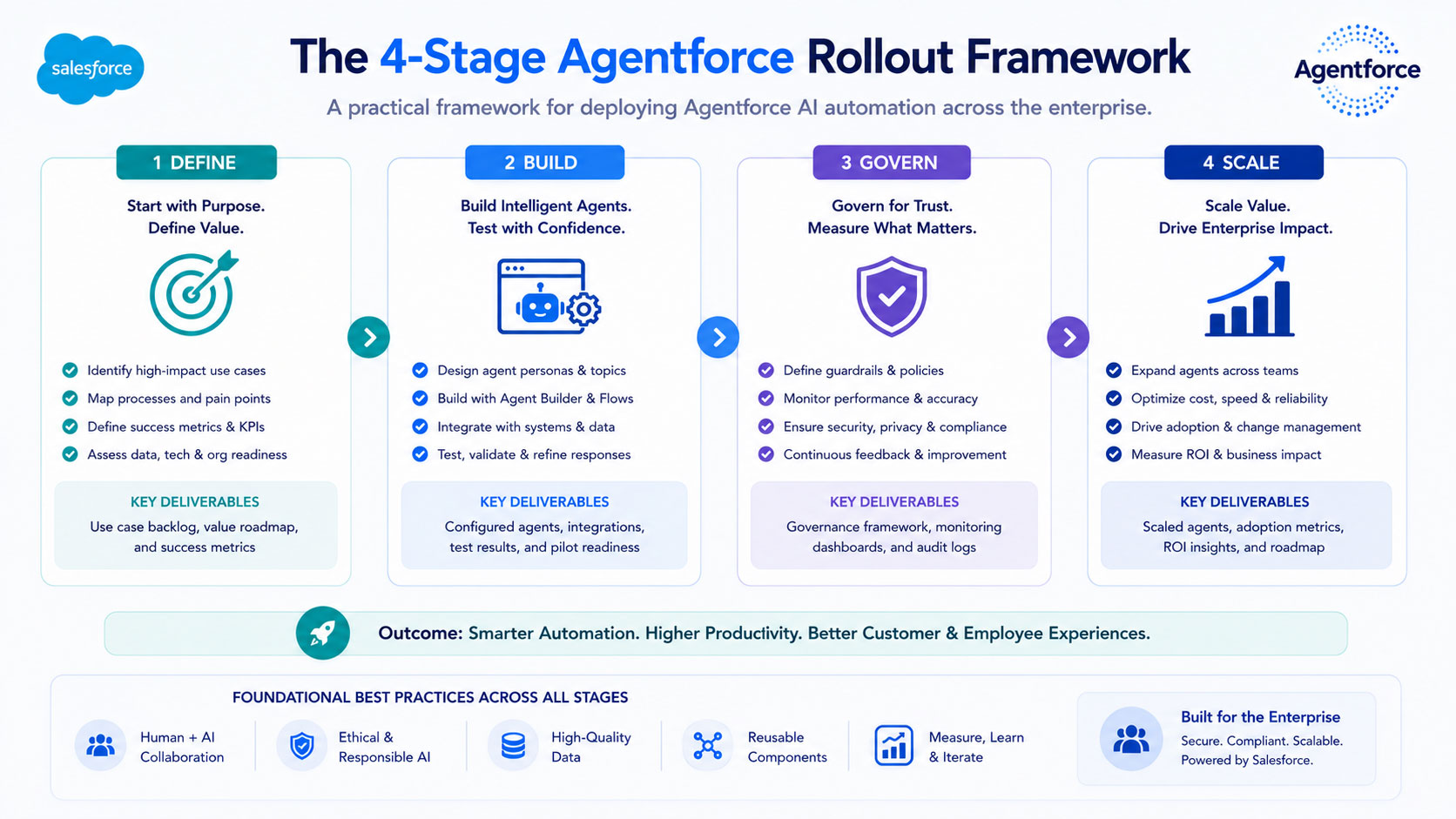
Infographic-Friendly Summary: The Agentforce Rollout Framework
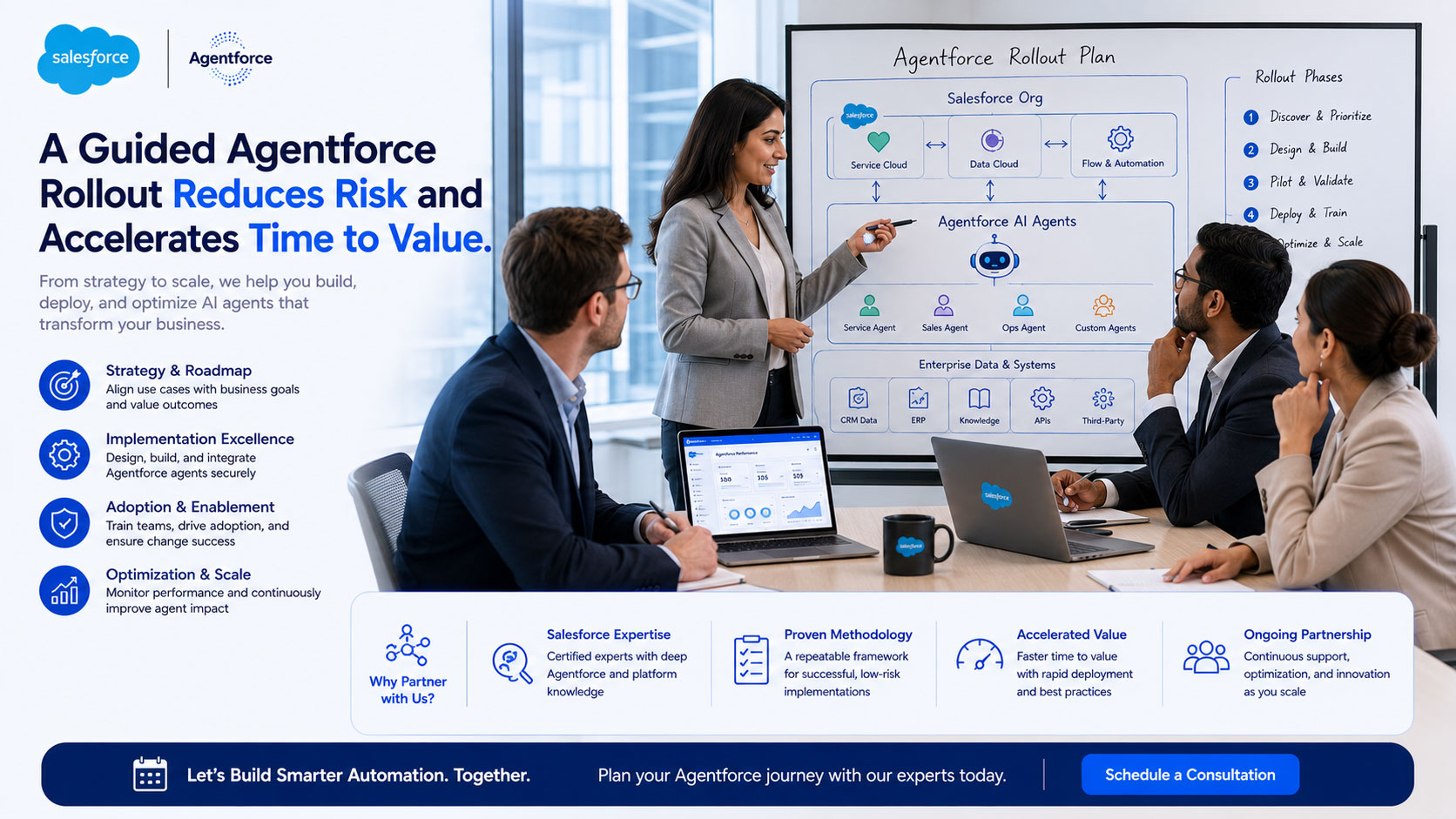
A practical, four-stage approach enterprises are using to move from pilot to production:
- Define — Pick one high-value, bounded use case where the data already lives in Salesforce (service deflection, lead qualification, or quote generation are common starting points).
- Build — Configure the agent’s topics, scope, and actions with explicit guardrails, using Agent Builder, Flows, and prompt templates.
- Govern — Apply the Trust Layer, define audit requirements, assign an agent owner, and set human-in-the-loop checkpoints for sensitive actions.
- Scale — Prove ROI on the first use case, then expand to adjacent workflows and departments using the same governance model.
How NSIQ INFOTECH Helps Enterprises Deploy Agentforce the Right Way
Getting an Agentforce agent to answer questions in a sandbox is the easy part. Getting your org ready — clean data, correct edition and licensing, well-scoped permissions, and a governance model your compliance team will actually sign off on — is where most enterprise rollouts stall.
That’s the part NSIQ INFOTECH focuses on. Our Salesforce consulting team works with CIOs and digital transformation leaders to assess org readiness, design the first high-value use case, configure agent topics and actions with proper guardrails, and set up the monitoring and governance structure needed to scale beyond a single pilot. Instead of a generic AI rollout, you get an Agentforce deployment built around your existing Salesforce architecture, your data, and your compliance requirements — so the agent works the way your business actually operates.
Quick Wins: Actionable Tips for Getting Started
- Start with a single agent and a single workflow — resist the urge to automate everything at once
- Audit your CRM data quality before configuring any agent; garbage context produces garbage decisions
- Write agent scope like a policy document, with explicit DO and DO NOT statements
- Assign a named owner for agent operations early, even before you scale
- Track one clear metric per use case (cost per case, response time, conversion rate) instead of vague “efficiency” goals
- Review the Trust Layer settings with your security and compliance teams before go-live, not after
Ready to Bring Agentic AI Into Your Enterprise?
Salesforce Agentforce is quickly becoming the standard enterprises are building their AI automation strategy around — but the platform only delivers results when it’s implemented with the right foundation underneath it. If you’re evaluating Agentforce for your organization, talk to our team. We’ll help you assess readiness, define your first use case, and build a rollout plan that fits your Salesforce environment.
Talk to our Agentforce experts today and get a clear, practical roadmap for your first deployment.
Conclusion
Enterprise AI automation has reached an inflection point, and Salesforce Agentforce sits right at the center of it. It solves the problems that made earlier automation brittle — rigid scripts, disconnected data, and unclear governance — by combining CRM-native context, deterministic control where precision matters, and an enterprise-grade Trust Layer that CIOs and compliance teams can actually stand behind.
The enterprises seeing real results aren’t the ones trying to automate everything at once. They’re the ones starting with one well-scoped use case, proving the value, and scaling deliberately from there. That’s the approach that separates organizations that get lasting value from agentic AI from the ones that stall out in pilot purgatory.
If your leadership team is ready to move from “we should look into AI agents” to an actual, working deployment, now is the time to build that roadmap.
Talk to NSIQ INFOTECH’s Agentforce experts and get a clear plan for your first deployment.
FAQs
What is Salesforce Agentforce used for? Agentforce is used to build and deploy autonomous AI agents inside Salesforce that can handle customer service, sales qualification, marketing workflows, and other CRM-connected tasks without constant human input.
How is Agentforce different from a regular chatbot? A chatbot follows scripted responses. Agentforce agents reason through requests, pull live CRM context, and take multi-step actions, adapting their response based on the specifics of each interaction.
Why is Agentforce considered the future of enterprise AI automation? Because it combines CRM-native data access, enterprise-grade governance through the Trust Layer, and a hybrid model of deterministic control plus flexible reasoning — solving problems that older automation tools and generic AI assistants can’t.
Does Agentforce require Salesforce Enterprise Edition? Yes. Agentforce generally requires Enterprise Edition or above, along with Einstein Generative AI enabled and specific Agentforce licensing, so it’s worth confirming current requirements with your Salesforce account executive.
Is Agentforce secure enough for regulated industries? Agentforce’s Trust Layer enforces data masking, permission-based access, and full audit trails, which is why it’s being adopted in regulated sectors like financial services and healthcare, though specific compliance needs should be validated for your industry.
Can Agentforce agents connect to systems outside Salesforce? Yes, through native Model Context Protocol (MCP) support and MuleSoft integrations, agents can reach external tools and data sources beyond the Salesforce platform.
What’s the biggest risk in an Agentforce rollout? Trying to scale across the whole enterprise before proving value on a single, well-scoped use case — this is one of the most common reasons agentic AI projects stall or get cancelled.
How long does it take to deploy Agentforce? Timelines vary widely depending on org readiness, data quality, and use case complexity — a single well-scoped agent can move faster, while enterprise-wide rollouts with multiple integrations take considerably longer.
Do we need Data Cloud to use Agentforce? Data Cloud is strongly recommended for production deployments that require retrieval-augmented knowledge grounding, though basic agent configurations can start without it.
What kind of ROI can we expect from Agentforce? Results vary by use case, but service-focused deployments have reported meaningful reductions in average service costs and case resolution times when the agent is scoped to a well-defined workflow.
Who should own Agentforce inside the organization? Enterprises are increasingly assigning a dedicated agent owner or AI operations lead, reflecting the fact that agentic AI now requires ongoing monitoring and governance, not just a one-time setup.
Can Agentforce replace our sales or service team? No — it’s designed to handle repetitive, well-defined interactions so human teams can focus on complex, high-value work, not to replace the judgment and relationship-building that people bring.
What industries benefit most from Agentforce? Financial services, retail, healthcare, manufacturing, and public sector organizations have all built vertical-specific Agentforce deployments, though any enterprise with well-defined, high-volume workflows can benefit.
How do we measure if an Agentforce agent is working well? Track a single clear metric tied to the use case — cost per case, response time, or resolution rate — rather than broad, hard-to-measure “efficiency” goals.
Where should we start if we’re new to Agentforce? Start with one high-value, bounded use case where your CRM data is already clean and complete, prove the ROI, and use that as the template for expansion.