
Customer service has always been the frontline of brand trust. But let’s be honest traditional service operations are struggling. Long wait times, inconsistent responses, overworked agents, and rising customer expectations are creating a perfect storm that most organizations are unprepared to handle.
That’s exactly where Agentforce for service comes in.
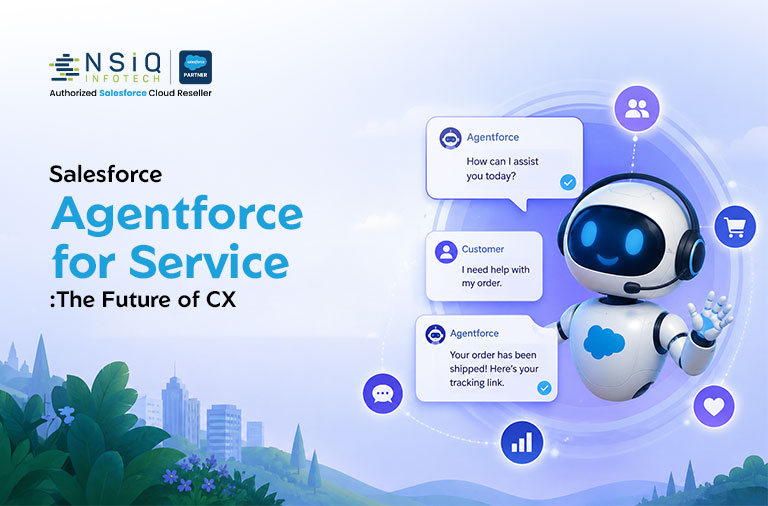
Salesforce Agentforce isn’t just another chatbot layer slapped onto your CRM. It’s a fundamentally different approach to service delivery one that puts autonomous AI agents at the center of your customer experience strategy. For VPs of Customer Experience, Service Heads, and COOs looking to transform their service operations without simply hiring more people, this technology represents a genuine inflection point.
In this blog, we’ll break down how Salesforce Agentforce customer service capabilities work, why forward-thinking enterprises are adopting it fast, and what you need to know before getting started.
What Is Salesforce Agentforce for Service?
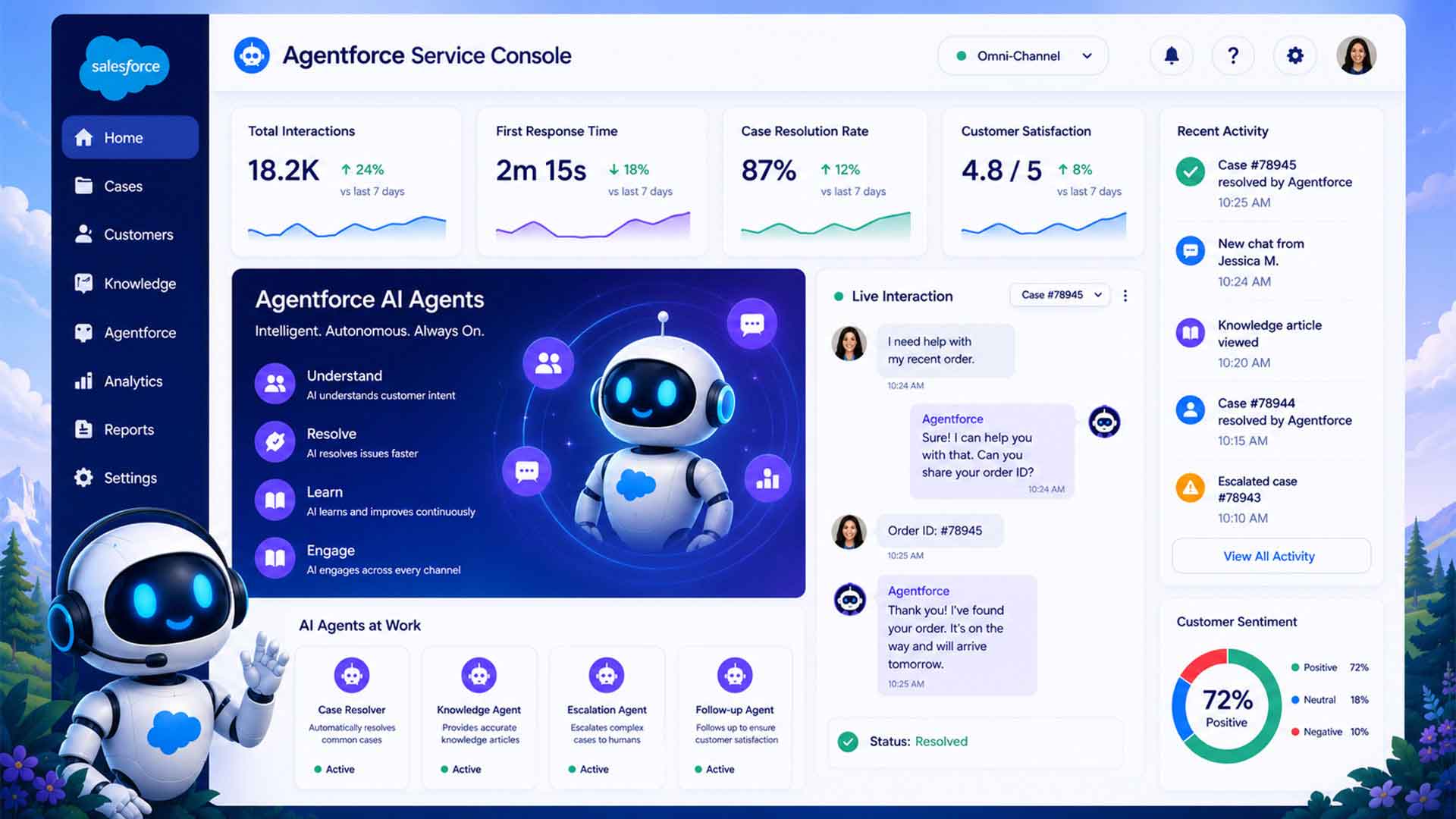
Salesforce Agentforce is an AI-powered platform built natively within Salesforce that enables organizations to deploy autonomous AI agents capable of handling complex service tasks not just answering FAQs, but actually resolving cases, executing workflows, personalizing interactions, and escalating intelligently when needed.
Unlike conventional bots that follow rigid decision trees, Agentforce agents reason through problems. They can retrieve customer history, interpret intent, trigger automated actions, and have multi-turn conversations that feel surprisingly human. Think of it as giving your service team a tireless, always-on colleague who never gets frustrated, never forgets a customer detail, and is available at 3 AM.
How It Fits Into the Salesforce Ecosystem
Agentforce integrates directly with Salesforce Service Cloud, Einstein AI, and your existing data layer. This means the AI agent doesn’t work in isolation it has access to your customer’s entire case history, account data, product purchases, and open tickets the moment a conversation starts. No more asking customers to repeat themselves.
The Real Problem: Why Traditional Service Operations Are Breaking
Before diving into what Agentforce does, let’s understand the scale of the problem it solves.
According to Salesforce’s State of Service Report, 88% of customers say the experience a company provides is as important as its product or service. Yet most service teams are still running on outdated processes, under-resourced teams, and fragmented tools.
That gap between expectation and delivery is where customer churn lives.
Here’s what typically breaks down in a traditional service model:
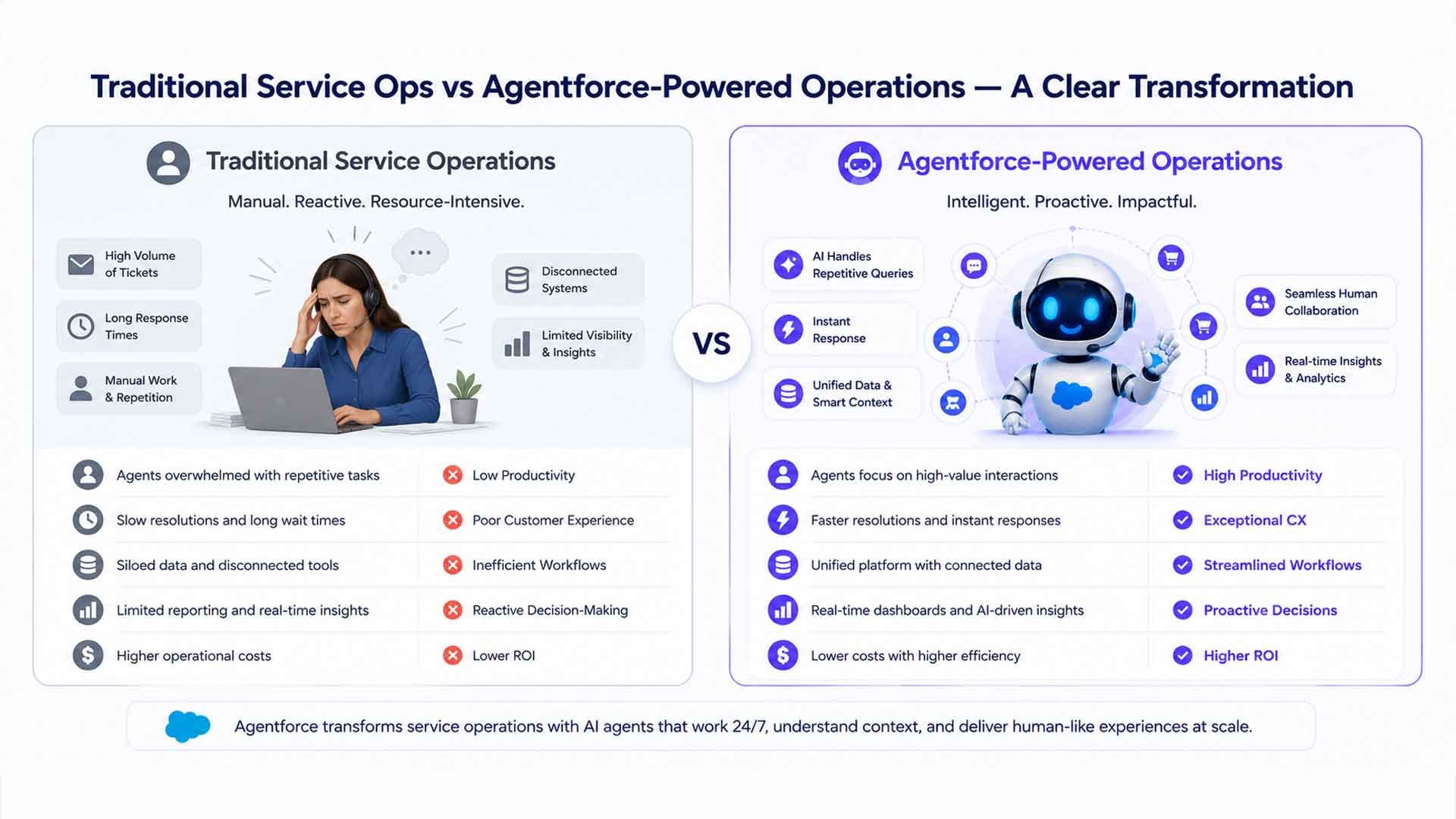
- Agents spend 30-40% of their time on repetitive, low-value tasks like resetting passwords, checking order statuses, or updating addresses.
- Peak volume spikes overwhelm teams and spike wait times during launches, holiday seasons, or outages.
- Knowledge inconsistency means different agents give different answers to the same question.
- Context gets lost when customers are transferred between channels or agents.
- Data exists everywhere but is accessible to no one quickly enough to matter.
This isn’t a people problem. It’s a systems and scale problem. And that’s precisely why AI-native platforms like Salesforce Agentforce are gaining traction so quickly.
Core Capabilities of Salesforce Agentforce Customer Service
Let’s get specific about what Salesforce Agentforce customer service capabilities actually look like in practice.
1. Autonomous Case Resolution
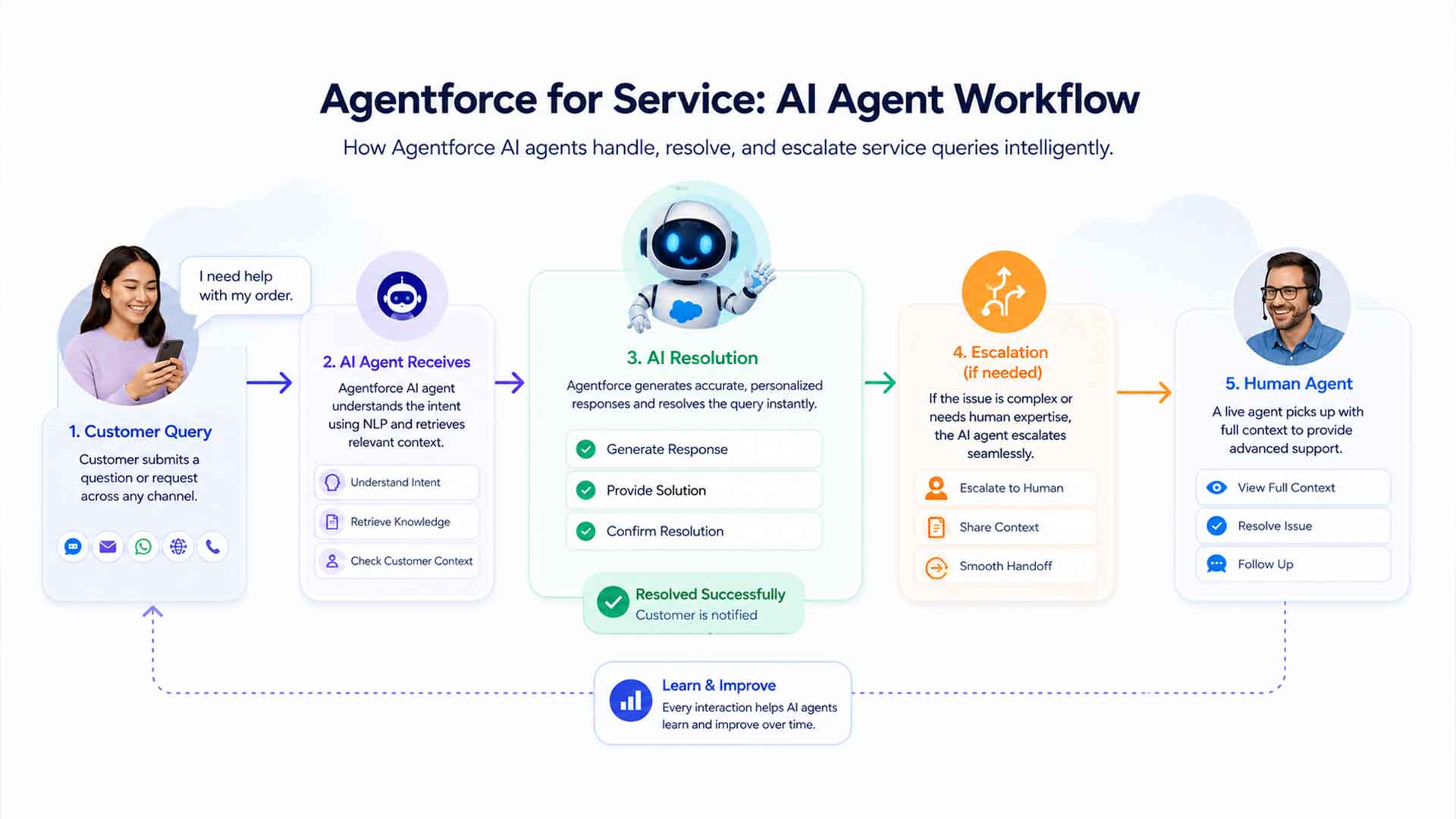
Agentforce agents can handle end-to-end resolution of common service cases without human intervention. A customer submitting a billing dispute can have their account reviewed, a credit applied, and a confirmation email sent all without a single agent touching it.
2. Intent-Based Routing
When a customer reaches out, Agentforce reads the intent not just the keywords. A message like “I’ve been waiting three weeks and nothing has arrived” is understood as a delivery issue with urgency, not just a vague complaint.
3. Seamless Human Handoff
When a case is too complex or emotionally sensitive for AI resolution, Agentforce doesn’t drop the ball. It passes the full conversation context, sentiment analysis, and recommended next steps to the human agent.
4. Proactive Service
Agentforce doesn’t just react it anticipates. By analyzing patterns in customer data, it can flag accounts likely to churn, trigger outreach for renewals, or notify customers about known service disruptions before they call in.
5. Knowledge-Driven Responses
Agentforce taps into your Salesforce Knowledge base in real time, ensuring every answer is accurate, up to date, and consistent across all channels.
Real-World Use Cases Across Industries
Financial Services
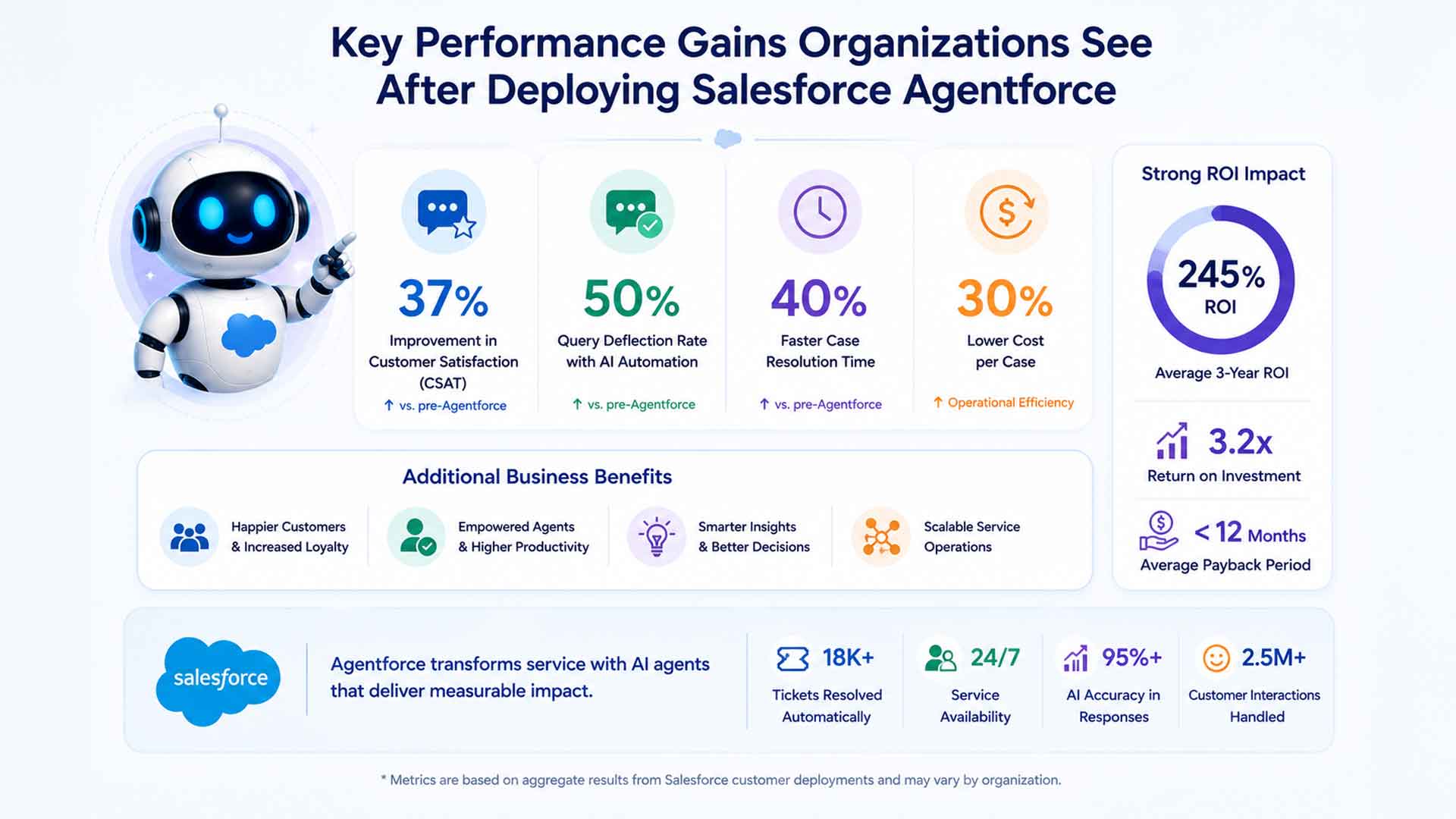
A regional bank deployed Agentforce to handle inbound queries about loan applications, account balances, and card disputes. Within 90 days, they reported a 47% reduction in average handle time and a 35% drop in inbound call volume.
E-Commerce & Retail
An online retailer used Agentforce to manage post-purchase queries during peak season. The AI handled order tracking, return initiation, and refund status checks autonomously.
Healthcare Administration
A healthcare provider used Agentforce to manage appointment rescheduling, insurance query handling, and post-visit follow-up communications.
Technology & SaaS
A mid-sized software company integrated Agentforce with their developer support portal. The AI triaged technical tickets, suggested solutions from documentation, and only escalated when issues required engineer-level diagnosis.
Key Statistics That Make the Case
- Gartner predicts that by 2026, conversational AI deployments within contact centers will reduce agent labor costs by $80 billion globally.
- McKinsey research shows that companies leading in customer experience generate 5-8x more revenue than laggards.
- Salesforce’s own data shows that high-performing service teams are 3.2x more likely to use AI extensively compared to underperformers.
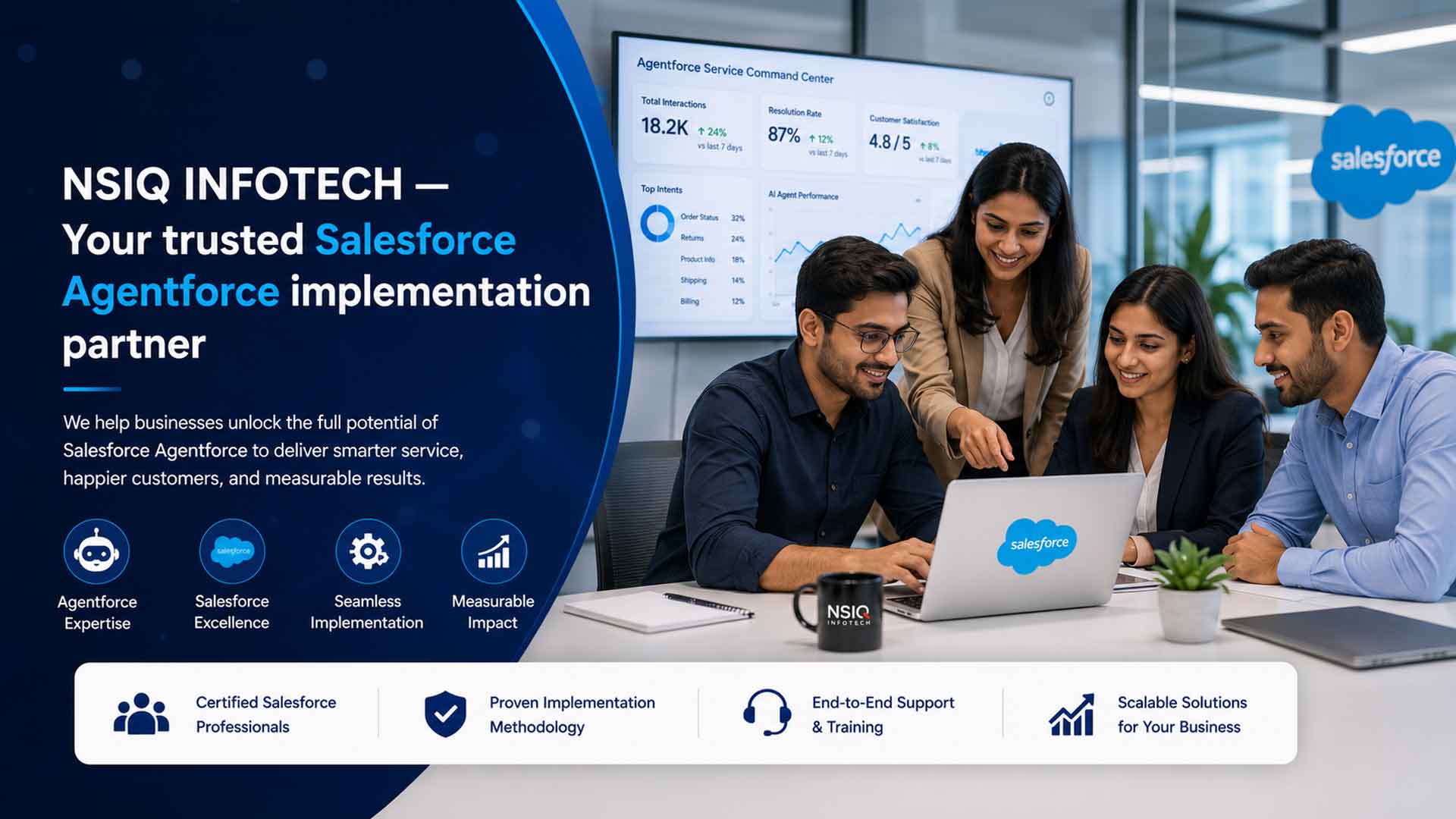
How NSIQ INFOTECH Helps You Deploy Agentforce for Service
Understanding what Agentforce can do is one thing. Deploying it so it actually works for your organization is where the real expertise comes in.
At NSIQ INFOTECH, we specialize in Salesforce implementations that go beyond configuration. Our team works with service leaders to:
- Audit your current service stack.
- Design Agentforce agent logic.
- Integrate with existing systems.
- Train and iterate.
- Enable your team.
Our clients typically see measurable improvements in first-contact resolution, agent productivity, and customer satisfaction within the first 60-90 days of going live.
Common Mistakes to Avoid When Implementing Agentforce
Treating Agentforce as a Standalone Chatbot
Agentforce performs best when it’s deeply integrated with your Salesforce data ecosystem.
Not Defining Clear Escalation Rules
AI should know when to step back. Without clear escalation thresholds, you risk frustrating customers.
Skipping the Knowledge Base Cleanup
Agentforce is only as good as the information it draws from.
Ignoring Agent Adoption
Human agents who don’t trust AI-generated handoffs will work around the system rather than with it.
Practical Tips for Getting Started with Agentforce for Service
- Start with one use case.
- Measure before and after.
- Map your escalation triggers early.
- Run a 30-day pilot.
- Create a feedback loop.
- Communicate to customers.
The Strategic Case: Why This Matters for COOs and Service Leaders
At the executive level, the Salesforce Agentforce customer service conversation isn’t just about automation. It’s about organizational design.
When AI handles 40-60% of tier-1 service volume, your human team’s composition and purpose change. Instead of a large frontline team handling routine queries, you build a smaller, higher-skilled team focused on complex problem-solving, relationship management, and escalation handling.
For COOs managing cost efficiency and scale, this is significant. For Service Heads accountable for CSAT and NPS, it’s transformational.
Q.1: What is Salesforce Agentforce for service?
Agentforce for service is an AI-powered agent platform built into Salesforce that autonomously handles customer service interactions.
Q.2: How is Agentforce different from a regular chatbot?
Unlike rule-based chatbots, Agentforce uses large language models and AI reasoning to understand intent, access live CRM data, execute actions, and have natural multi-turn conversations.
Q.3: Does Agentforce work with Salesforce Service Cloud?
Yes. Agentforce is natively integrated with Salesforce Service Cloud.
Q.4: Can Agentforce handle complex customer complaints?
Yes, and it can intelligently escalate cases to human agents when required.
Q.5: How long does it take to implement Agentforce for service?
Basic deployments can go live in 4-8 weeks, while enterprise implementations may take 3-6 months.
Q.6: Will Agentforce replace our human service agents?
No. Agentforce is designed to augment human agents, not replace them.
Q.7: What channels does Agentforce support?
Web chat, email, messaging apps, mobile channels, and telephony integrations.
Q.8: How does Agentforce protect customer data?
It inherits Salesforce’s enterprise-grade security and compliance framework.
Q.9: What metrics should we track after deploying Agentforce?
FCR, AHT, Containment Rate, CSAT, and Agent Productivity.
Q.10: Is Agentforce suitable for small and mid-size businesses?
Yes, especially for businesses with growing service volumes.
Q.11: How does Agentforce handle multilingual customer interactions?
It supports multiple languages through Salesforce AI models.
Q.12: Can Agentforce initiate outbound service communications?
Yes, through Salesforce automation rules.
Q.13: What training does our team need to use Agentforce?
Service managers and frontline agents require role-specific training.
Q.14: Does Agentforce require custom coding to deploy?
Basic deployments are low-code/no-code, while advanced customizations may require Apex development.
Q.15: How do we measure ROI from Salesforce Agentforce customer service deployment?
Compare pre- and post-deployment service costs, efficiency metrics, and customer satisfaction improvements.
Conclusion: The Service Operations Shift Is Already Happening
Customer expectations aren’t going back down. Service volume isn’t going to shrink. And the economic pressure on service operations isn’t going away.
Salesforce Agentforce for service represents a genuine step-change in what’s possible. With autonomous AI agents that reason, act, and hand off intelligently, service teams can deliver faster resolutions, more consistent experiences, and better outcomes without burning out their people.
The technology is here. The business case is clear. The competitive window for early movers is still open, but not indefinitely.
Whether you’re building the business case internally, evaluating vendors, or ready to start your first pilot, now is the right time to move.