
If you’re a CIO, IT Head, or Project Sponsor scoping a Salesforce Data 360 implementation right now, you’ve probably already sat through the vendor pitch. This isn’t that. This is what actually happens between signing the contract and seeing real value — the decisions that matter, the timelines that are realistic versus aspirational, and the mistakes that quietly derail otherwise well-funded projects.
Data 360 isn’t just another Salesforce module going live in the background. It’s the data foundation that Agentforce, AI-driven workflows, and every unified customer view in your organization will eventually depend on. Getting the implementation right the first time matters more than it did with previous generations of CRM tooling, because the cost of getting it wrong now shows up in AI decisions, not just dashboards.
Quick Grounding: What Data 360 Actually Is
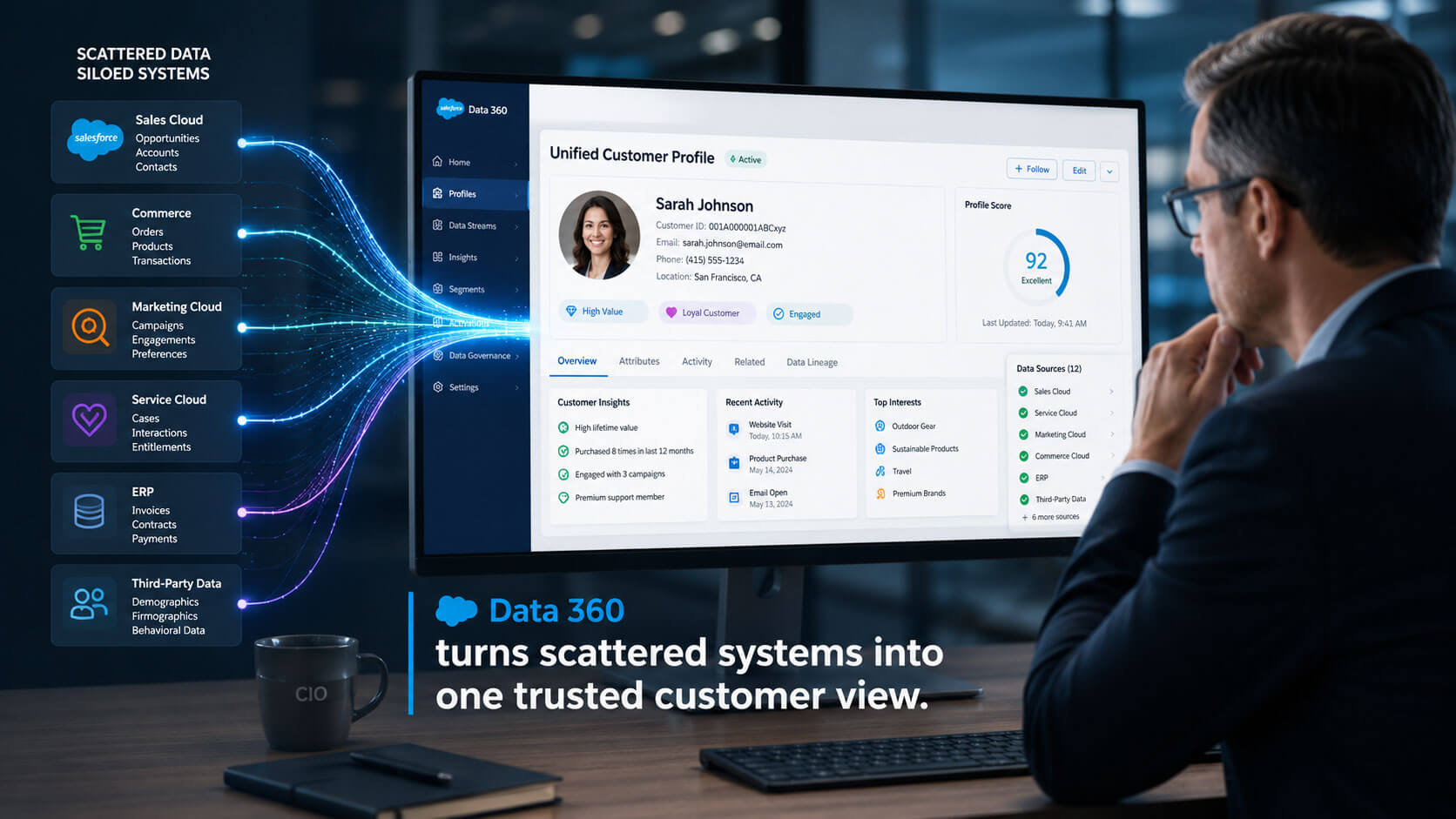
Data 360 is Salesforce’s rebrand of Data Cloud, effective October 2025. If your team has prior Data Cloud experience, that knowledge carries over directly — the underlying architecture, connectors, and data model haven’t changed. What has changed is the positioning: Data 360 is now framed as an enterprise-wide data foundation rather than a marketing-oriented customer data platform, reflecting how most organizations were already using it — across sales, service, and operations, not just campaigns.
For a Project Sponsor building the business case, that distinction is worth internalizing early. This is infrastructure spend, not a departmental tool purchase, and it should be evaluated and funded accordingly.
Why This Is on the Agenda Now
The honest driver behind most Salesforce Data 360 implementation projects in 2026 isn’t data unification for its own sake — it’s AI readiness. Agentforce and similar AI capabilities are only as reliable as the data feeding them. Disconnected records and duplicate identities don’t just produce bad reports; they produce AI agents that make confidently wrong decisions.
The scale of this problem is well documented. Gartner predicts that through 2026, organizations will abandon 60% of AI projects that aren’t supported by AI-ready data. That statistic isn’t about Data 360 specifically — it’s about what happens industry-wide when companies bolt AI onto messy foundations. For IT leaders, it reframes the whole implementation conversation: this isn’t primarily a data project measured in integration counts. It’s a trust project measured in whether downstream AI and operational workflows can actually rely on what they’re being fed.
Salesforce’s own research backs up why the underlying problem is so persistent. According to Salesforce’s State of the Connected Customer report, 76% of customers expect consistent interactions across departments, yet 54% say it generally feels like sales, service, and marketing don’t share information at all. Layered on top of that, the average enterprise now runs close to 900 applications, and only about a third of them are actually integrated. That’s the fragmented reality Data 360 is built to solve — and also exactly why implementation isn’t a quick, plug-and-play exercise.
The Implementation Journey: What the Timeline Actually Looks Like
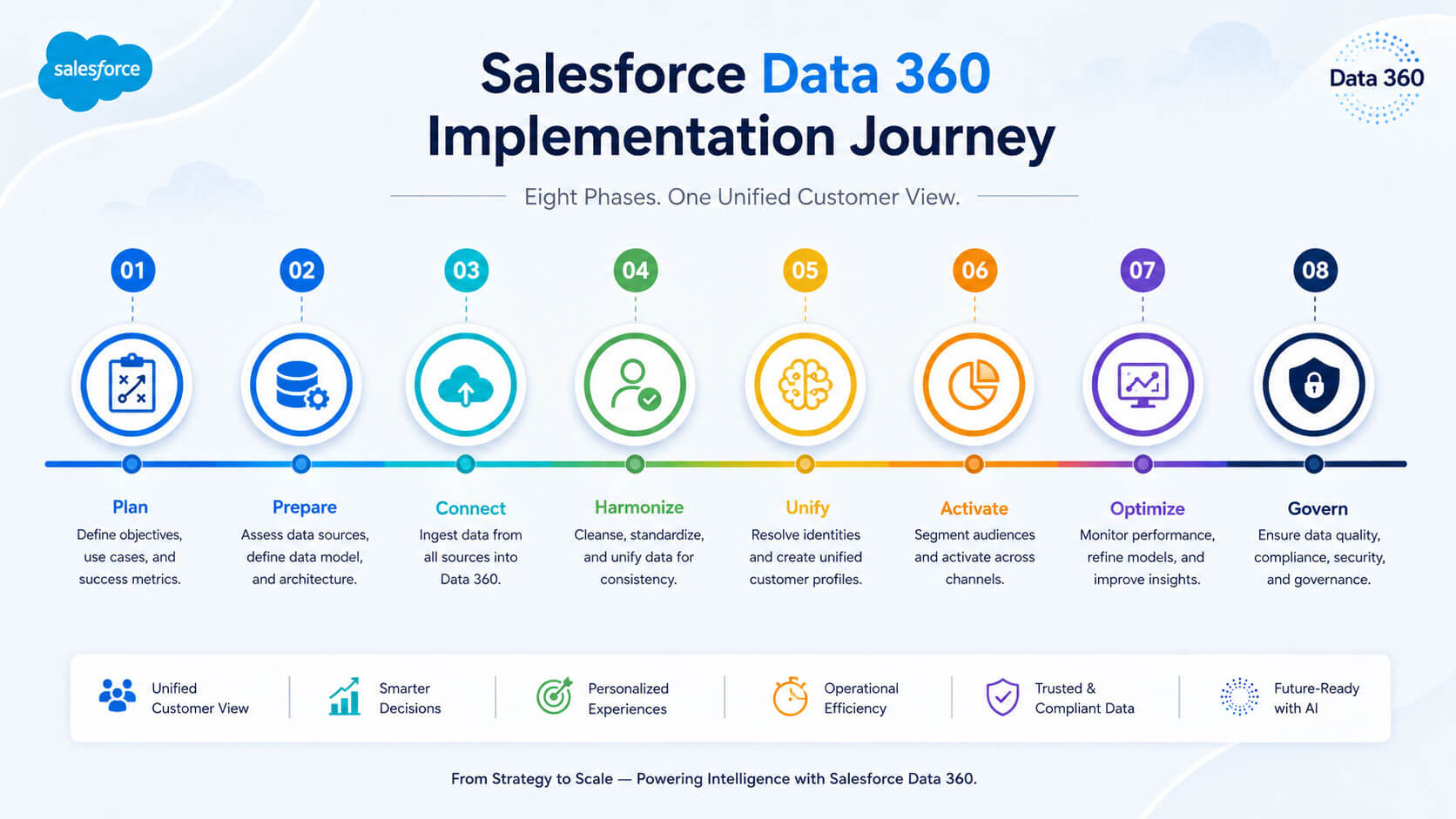
A Salesforce Data 360 implementation typically follows a predictable sequence, and skipping steps out of order is the single most common cause of stalled projects:
Plan, then Provision, then Connect, then Map and Harmonize, then Resolve Identity, then Segment and Build Insights, then Activate, then Govern.
A realistic phased timeline for a mid-to-large enterprise scope looks like this:
- Weeks 1 to 2: provisioning decisions, org architecture strategy, and first source connections
- Weeks 3 to 4: data model mapping and identity resolution rule design
- Weeks 5 to 8: profile validation, first segments, an initial activation path, and governance guardrails
Notice what’s missing from the early weeks: activation. Most delayed Data 360 projects don’t stall because a connector broke. They stall because teams push toward segmentation and activation before the mapping and identity work is validated. Unified profiles built on shaky identity resolution just produce noisy, duplicated data faster and at greater scale.
The practical takeaway for a Project Sponsor: resist pressure to show early activation wins before the foundational work is solid. A slower first eight weeks buys a faster, more stable next twelve months.
The Architecture Decision Every CIO Has to Make Early
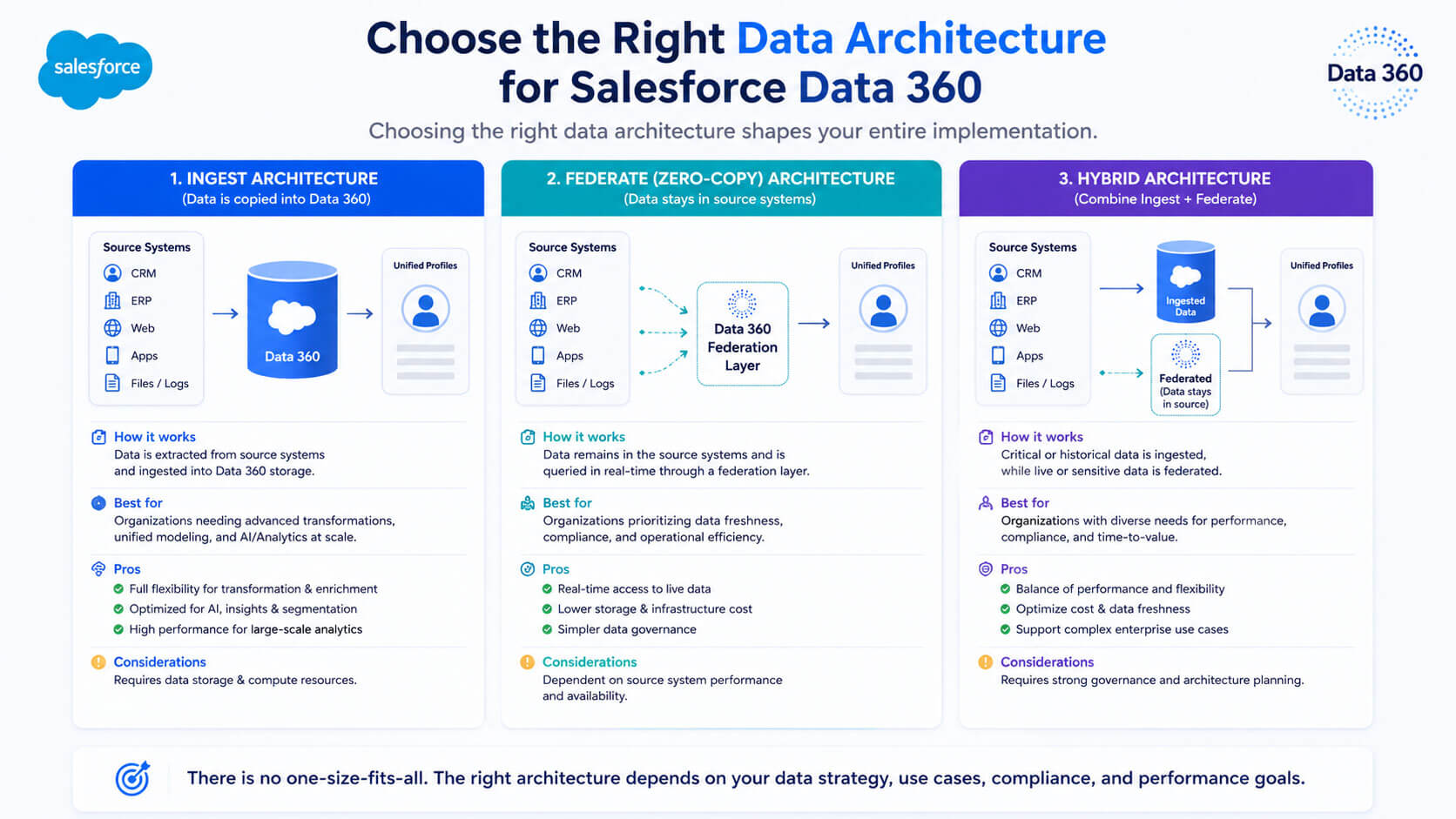
One of the first substantive decisions in any implementation is where the data actually lives and how it’s shared across orgs — specifically, whether to ingest data directly, federate it via zero-copy from an existing lake or warehouse, or use a hybrid of both.
- Ingest when data is business-critical, needs low-latency access, and will be used frequently in identity resolution or activation
- Federate through zero-copy when data is large, infrequently accessed, or already well-governed in an existing lake or warehouse, since this avoids duplicating storage and cuts operational overhead
- Use a hybrid approach when you need both, which is the common pattern in enterprise environments: ingest the canonical, high-value data and federate the rest
This decision has downstream consequences for cost, latency, and governance complexity. It deserves architecture-level sign-off, not something left to configuration teams mid-project.
Budgeting and Governing Consumption
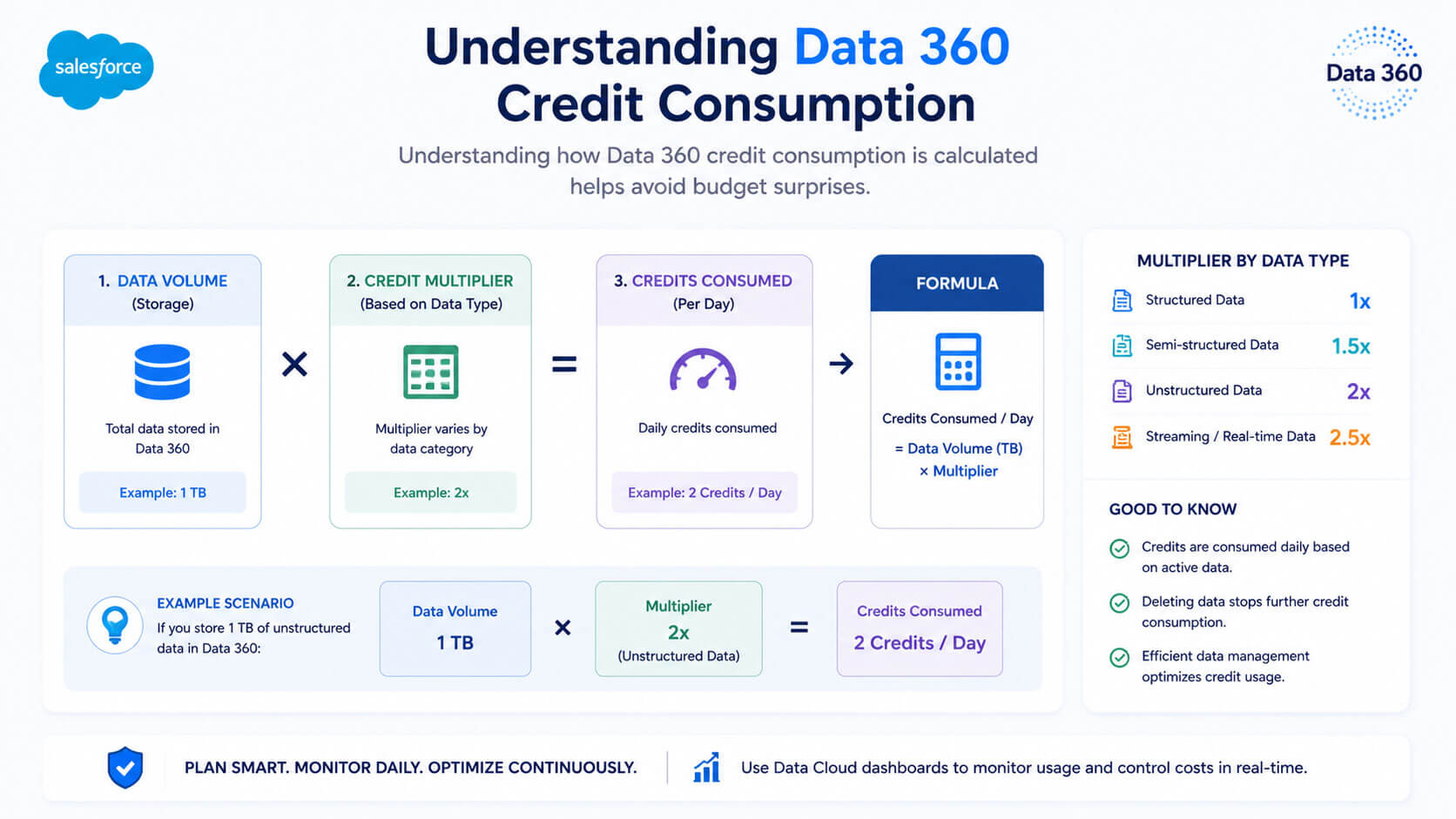
Data 360’s pricing shifted meaningfully in March 2026. Organizations now choose between three models: credit-based consumption, profile-based SKUs (roughly $240 to $420 per 1,000 profiles), and flex credits. Under the credit model, every operation, including ingestion, calculated insights, segmentation, and activation, consumes credits based on data volume and an operation-specific multiplier. Those credits are consumed again every time an insight or segment refreshes.
This has a direct implementation implication. A calculated insight refreshing daily against a large dataset can quietly become one of your biggest recurring cost lines if nobody is monitoring refresh cadence against actual business need. Build consumption governance into the implementation plan itself, not as an afterthought once the first invoice lands. Assign clear ownership for usage monitoring, and treat identity resolution rules and mapping changes with the same release discipline you’d apply to production code, since they ripple through every downstream credit-consuming process.
What Tends to Get Underestimated
A consistent pattern shows up across enterprise Data 360 rollouts in what teams didn’t plan for adequately:
- Data quality, not technology, is the real constraint. AI and automation don’t fix poor source data, they expose it faster and at greater visibility to leadership.
- Identity resolution is harder than it looks. Deterministic matching is straightforward; the rules-based reconciliation needed for messy real-world identifiers, like multiple emails or shared devices, takes real iteration before profiles can be trusted.
- Terminology is a genuine adoption barrier. Teams used to standard CRM objects need real ramp-up time on data streams, data model objects, calculated insights, and activation targets.
- Governance is not a phase-two conversation. Consent management, security design, and data usage controls need to be part of the initial architecture, not retrofitted after the first segments are built.
Mini scenario: A mid-size energy and utilities provider we’ve seen this pattern with connected six source systems in the first month and pushed straight into segmentation by week three. Within weeks, duplicate customer profiles surfaced across residential and commercial accounts because identity resolution rules hadn’t been tuned for shared billing addresses. The fix took nearly four extra weeks of rework — time that a proper eight-week foundation phase would have absorbed upfront.
Infographic-Friendly Summary: Salesforce Implementation Best Practices for Data 360
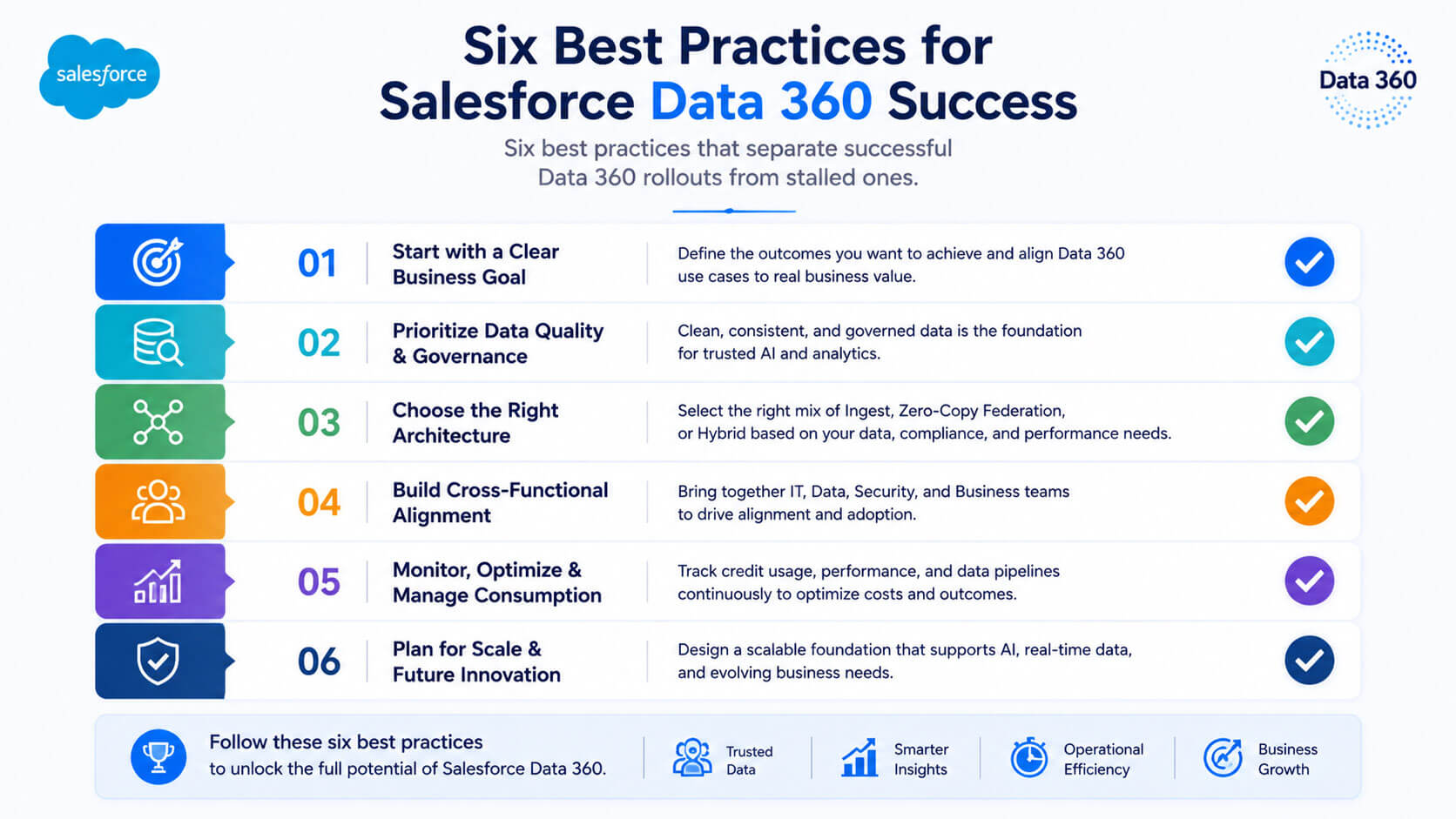
- Treat it as a program, not a project. Value compounds through continuous optimization, not a single go-live date.
- Sequence foundations before activation. Mapping and identity resolution come first, always.
- Choose partners on data architecture experience, not just Salesforce configuration experience.
- Govern consumption from day one. Build usage monitoring into standard operating procedure.
- Expand beyond a single use case deliberately. Reporting-only deployments see materially less value than those extending into activation and AI workflows.
- Plan for a hybrid data architecture from the outset, especially with multiple clouds or an existing data lake.
What This Means for Different Stakeholders
For the CIO, the architecture decisions made in week one, like ingest versus federate and identity governance, are the hardest to unwind later. Front-load architecture review rather than delegating it entirely to the implementation partner.
For the IT Head, the operational burden shifts from integration maintenance toward data quality and identity resolution stewardship. Plan your team’s skill development around data modeling and governance, not just Salesforce administration.
For the Project Sponsor, the business case should be built on enterprise data activation value, including AI trust, service efficiency, and reduced integration duplication, not narrowly on marketing personalization. That framing sets more realistic expectations with the board, since value here accrues over quarters of optimization rather than a single go-live date.
How the Right Implementation Partner Changes the Outcome
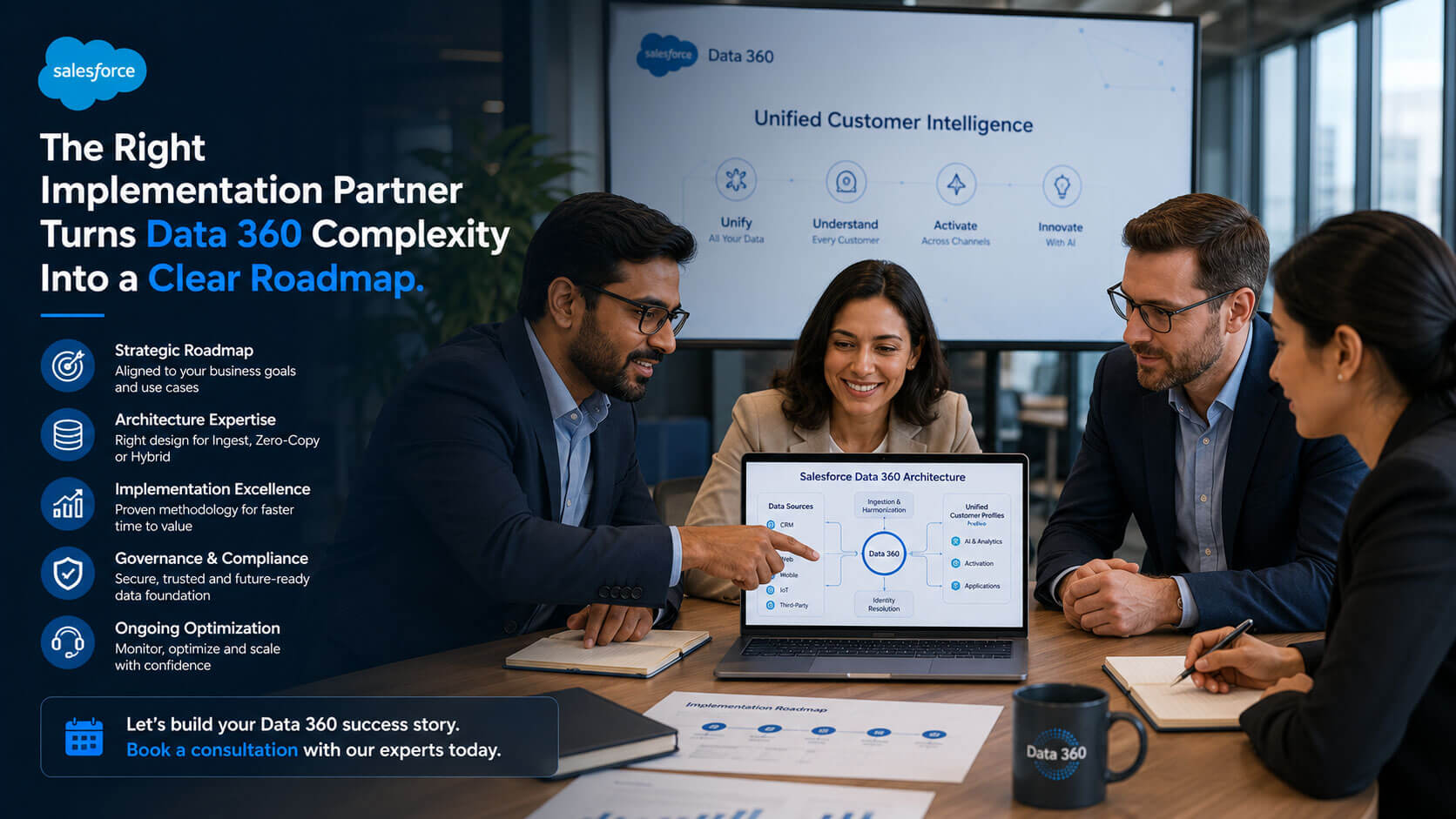
Most of the friction described above isn’t caused by the platform. It’s caused by treating Data 360 like a standard Salesforce configuration project instead of a data architecture initiative. Teams that bring in specialists with genuine data modeling, identity resolution, and governance experience, alongside standard Salesforce delivery skills, consistently move through the foundation phase faster and avoid the rework cycles that stall activation.
At NSIQ INFOTECH, this is exactly where our Salesforce implementation team spends the most time upfront: architecture decisions, identity resolution design, and consumption governance, before a single segment gets built. The goal isn’t just a technically complete Data 360 org. It’s a foundation your Agentforce agents, service teams, and analytics can actually trust from day one.
Conclusion
Implementing Salesforce Data 360 is less a software rollout and more an exercise in enterprise data discipline, with Salesforce providing the platform to enforce it. Organizations that respect the sequence, putting architecture first, identity and mapping second, activation third, and governance throughout, consistently report smoother rollouts and more durable AI outcomes than those chasing early activation wins. For CIOs and Project Sponsors, the real work isn’t the platform configuration. It’s building the organizational patience and governance discipline to let the foundation get built properly before asking it to carry the weight of enterprise AI.