
If you’ve spent any time on Salesforce’s pricing page trying to figure out Salesforce Agentforce pricing, you’ve probably walked away more confused than when you started. One section says $2 per conversation. Another mentions Flex Credits. A sales rep might quote you a per-user number entirely. And somewhere in the fine print, there’s a mention of Data Cloud that nobody explained clearly.
You’re not missing something. Agentforce pricing genuinely is layered, and Salesforce has changed the model more than once in the last two years as it tries to find a structure that actually fits how businesses buy AI.
This guide is for the people who actually sign off on the budget — CFOs, CIOs, and procurement leads who need a straight answer before committing spend. We’ll walk through every current Salesforce Agentforce cost model, what drives the real total price, where companies get surprised, and how to figure out if the investment will actually pay off for your organization.
Why Agentforce Pricing Feels So Complicated
Most enterprise software pricing is simple: pick a tier, pay per seat, done. Agentforce doesn’t work that way because it isn’t really “software” in the traditional sense — it’s a consumption-based AI agent platform. You’re not paying for a seat at a desk. You’re paying for work an AI agent actually performs.
That distinction matters because it means your Agentforce bill scales with usage, not headcount. A company with 50 employees but extremely high customer interaction volume could end up paying more than a 500-person company with light AI usage. This is exactly why Salesforce now offers multiple buying models — they’re trying to let different types of buyers self-select into a structure that matches their usage pattern.
According to SaaStrAI’s analysis of Salesforce’s pricing evolution, the company shipped three distinct pricing models for Agentforce within roughly 18 months — starting with per-conversation pricing, then Flex Credits, and most recently per-user licensing. That’s unusually fast iteration for an enterprise vendor, and it’s a signal that even Salesforce hasn’t found one model that fits everyone.
How Agentforce Pricing Actually Works: The Four Models
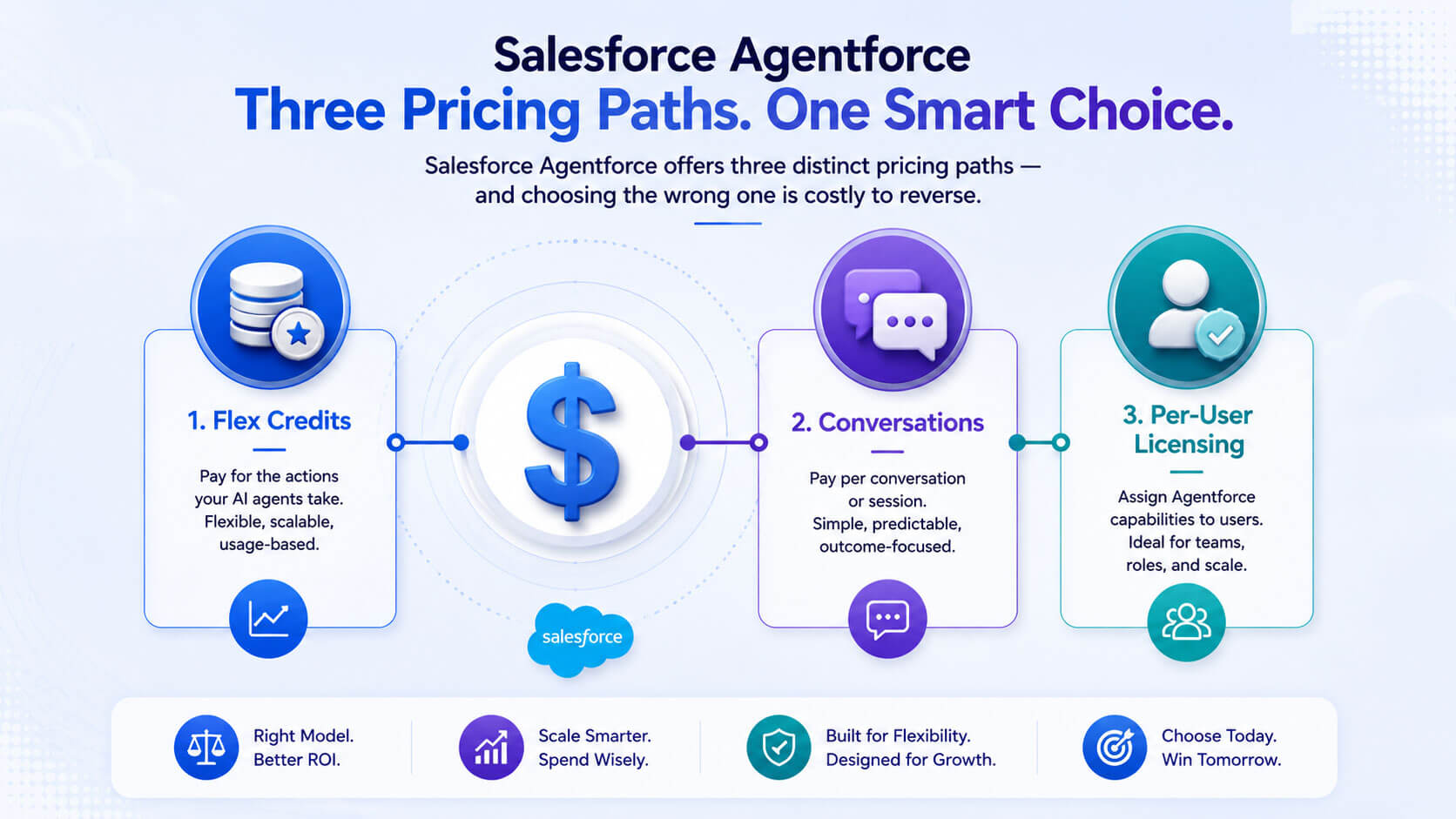
As of mid-2026, Salesforce offers four distinct ways to pay for Agentforce. Understanding the differences here is the single most important thing you can do before signing anything.
-
Salesforce Foundations (Free)
This is the on-ramp. Salesforce Foundations is available for free and includes Agent Builder and Prompt Builder access, plus a starter allotment of Flex Credits and Data Cloud credits to experiment with. It’s genuinely useful for testing whether Agentforce fits your workflows before committing real budget, but the credit allocation runs out quickly once you move past a pilot.
-
Flex Credits (Pay-Per-Action)
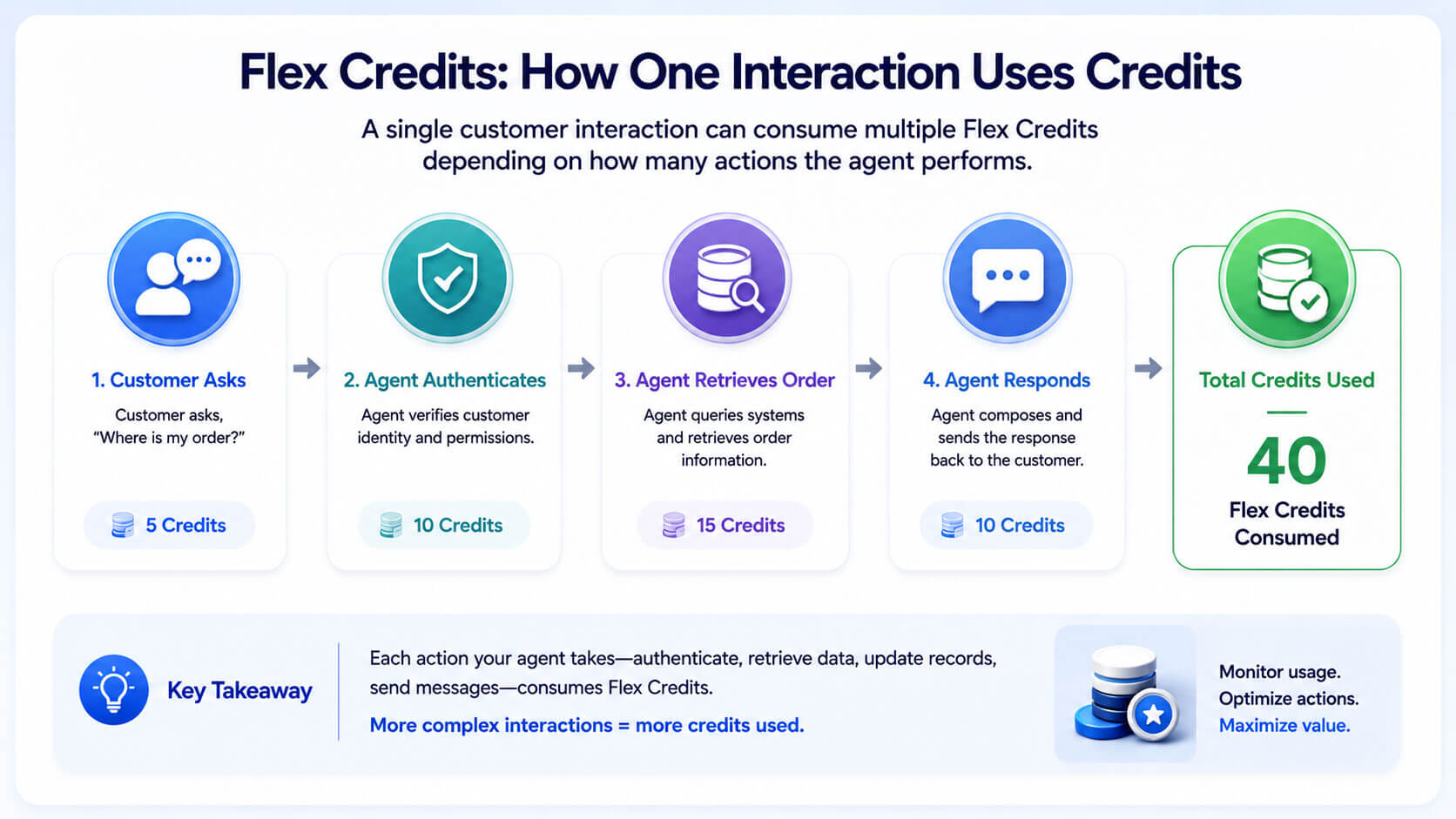
This is Salesforce’s primary consumption model today. You buy credits in bulk — roughly $500 per 100,000 credits — and each agent action draws down from that pool. Agentforce actions cost 20 Flex Credits each, while Agentforce Voice actions cost 30 Flex Credits each.
An “action” is granular: authenticating a customer, retrieving a record, summarizing a case, or answering a single question can each count as a separate action. That means a single conversation might consume anywhere from one to a dozen actions depending on complexity.
Salesforce publishes its own worked example: an agent handling 20 “where is my order” requests per day, each requiring two actions at 40 total Flex Credits, comes out to roughly $120 per month for that single use case at that volume.
Why this model exists: Flex Credits let you mix and match use cases — customer-facing agents, employee-facing agents, and voice agents — all drawing from the same pool, without needing separate contracts for each.
-
Conversations (Pay-Per-Conversation)
This is the original Agentforce pricing model, and it’s still available for customer-facing agents specifically. It’s straightforward: Conversations are billed at $2 per conversation, regardless of how many actions that conversation required internally.
This model is easier to forecast if your volume is predictable, but it can work against you if your agents tend to need many actions per conversation — you’re paying a flat rate either way, which can actually be cheaper than Flex Credits at high action-density, or more expensive at low action-density.
One important constraint: Flex Credits and Conversations cannot be active in the same Salesforce org simultaneously. You have to choose one model per org, which makes this an early decision with real downstream consequences.
-
Per-User Licensing (AgentforceAdd-Ons and Agentforce 1 Editions)
The newest addition to the lineup, and the one most likely to appeal to CFOs who want a predictable number. Instead of metering every action, you pay a flat monthly fee per employee for unmetered internal agent usage.
Current published figures put the entry-level Agentforce User License at $5 per user per month, scaling up to Agentforce add-ons in the $125–$150 per user per month range, and Agentforce 1 Editions starting around $550 per user per month for bundled access to the full AI suite plus Data Cloud. Government and public sector deployments requiring FedRAMP High authorization run higher, around $650 per user per month.
Important catch: even the cheapest $5/user license still requires you to separately purchase Flex Credits for metered usage — it’s not truly all-inclusive at that price point.
Agentforce Pricing Models at a Glance
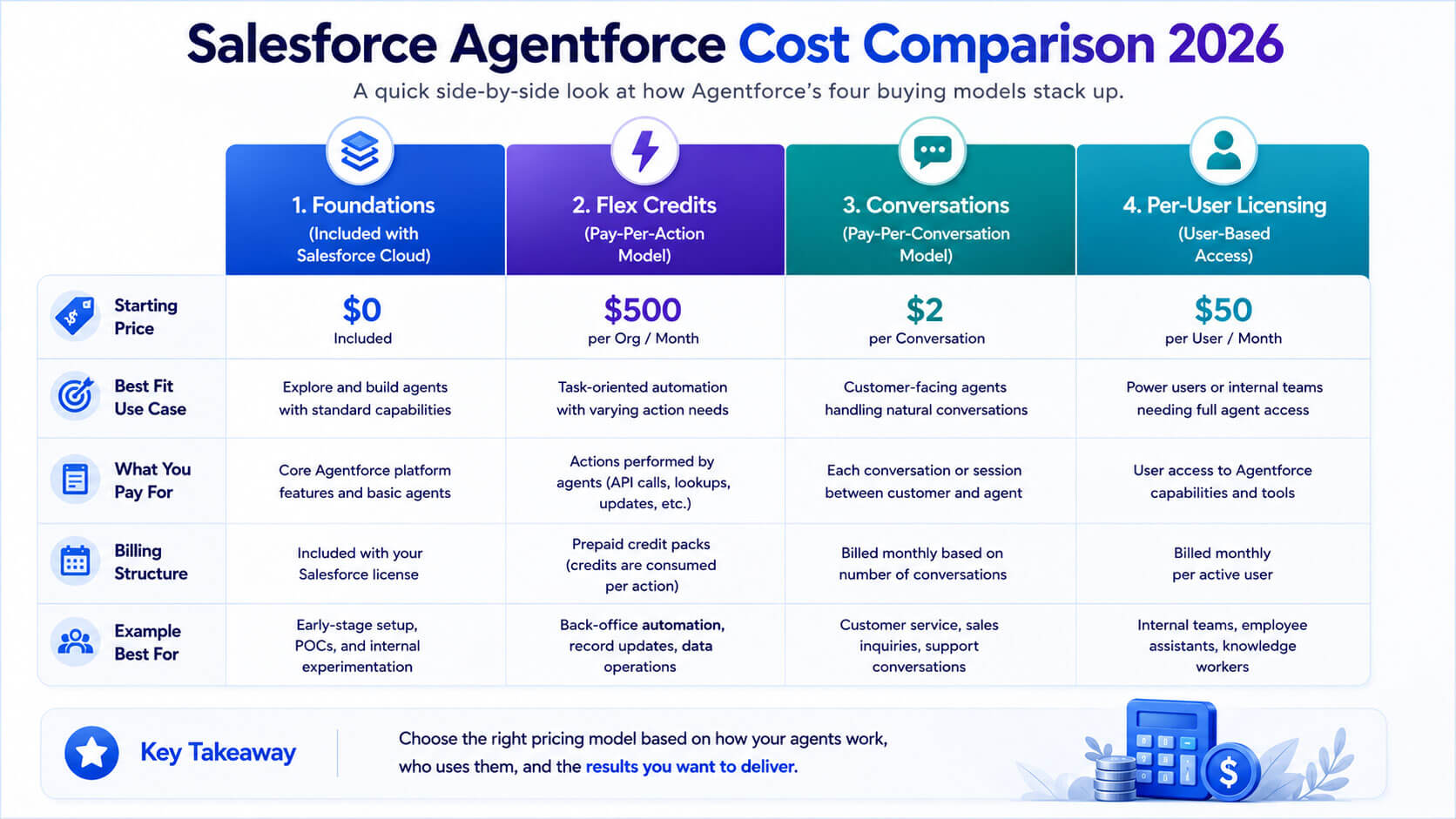
A few rules worth memorizing before any negotiation:
- Flex Credits and Conversations cannot run in the same org at the same time
- Unused Flex Credits typically don’t roll over past your contract term
- The $5/user license still requires a separate Flex Credits purchase
- There’s no punitive overage penalty — exceeding your allotment is billed in arrears at your contracted rate
The Real Total Cost: What Salesforce Doesn’t Put on the Pricing Page
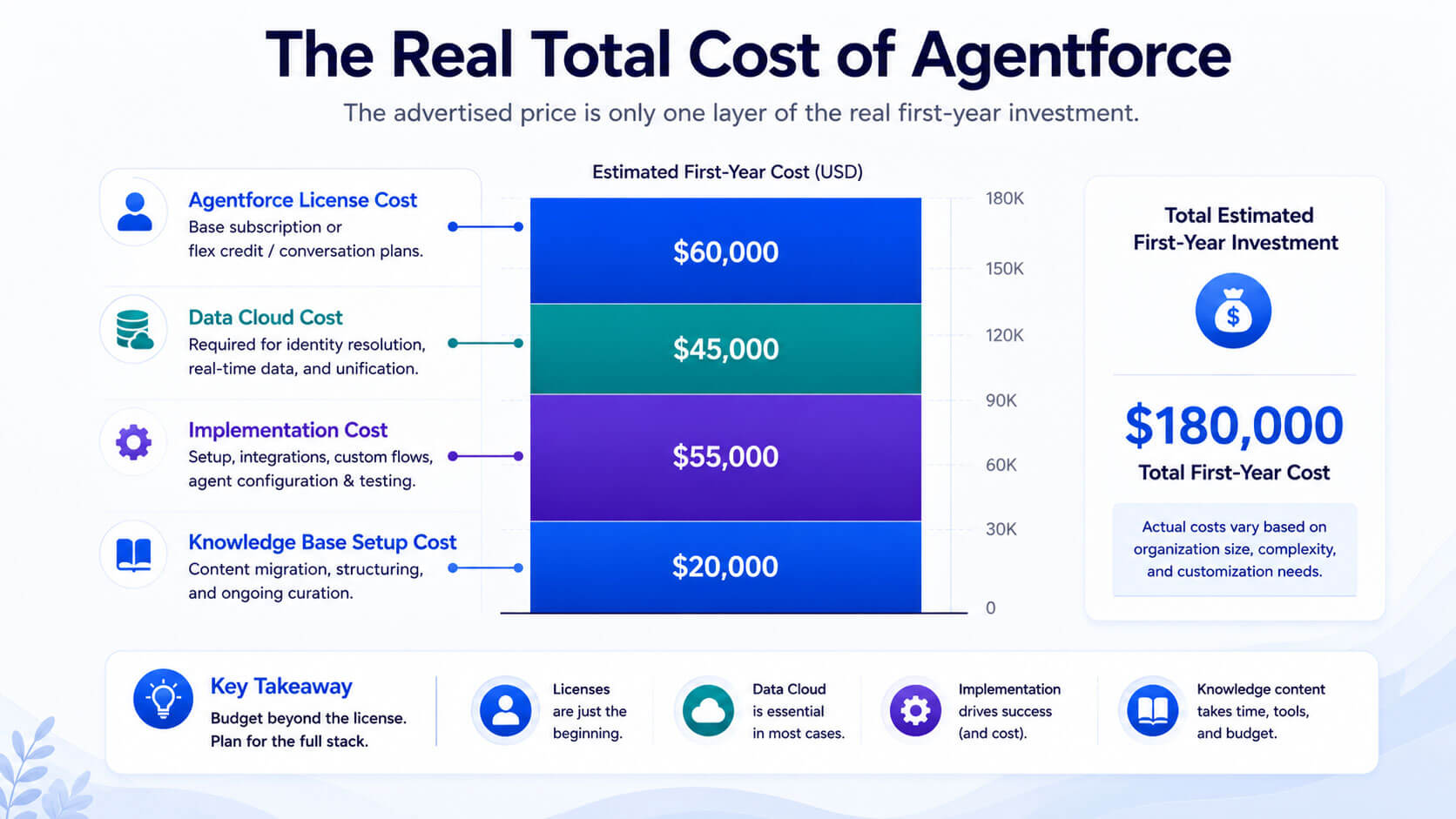
Here’s where most budget conversations go sideways. The advertised numbers — $2 per conversation, $500 per 100,000 credits — describe Agentforce itself. They don’t describe everything Agentforce needs to actually function.
Agentforce runs on Data Cloud for unified customer data, and for most organizations, this is not optional. Industry consulting analysis estimates that once you factor in the mandatory Data Cloud subscription, implementation services, and knowledge base setup, real first-year costs for a mid-market company can land anywhere between $150,000 and $600,000 — a very different number than the headline $2-per-conversation figure suggests.
Breaking that gap down, the typical additional line items include:
- Data Cloud licensing — frequently cited as a six-figure annual cost on its own for mid-market deployments
- Agent configuration and setup — typically $15,000 to $50,000 per individual use case, depending on workflow complexity
- Knowledge base structuring — if your Salesforce org doesn’t already have clean, organized content for agents to draw from, building one out runs $10,000 to $30,000 in setup work alone
Separately, a third-party review of Agentforce noted that most advanced Agentforce deployments require Data Cloud (recently rebranded as Data 360), which can push real first-year costs into the $150,000 to $600,000 range for mid-market teams — a figure that lines up closely with the consulting estimate above, which is a useful sanity check that this isn’t a one-off outlier number.
The takeaway for procurement: when a vendor or sales rep quotes you the headline Flex Credit or Conversation rate, your next question should always be: “What does this assume I already have in place?” If the answer includes Data Cloud, a structured knowledge base, and dedicated implementation support, build those into your budget from day one — not as a surprise six months in.
Quick Tip: Avoid the Most Common Budgeting Mistake
A frequent mistake we see is teams calculating Agentforce cost using only the per-action or per-conversation rate, multiplied by expected volume — and stopping there. That number is real, but it’s typically 20–40% of the actual first-year investment once Data Cloud, setup, and knowledge base work are included. Build your business case around the fully loaded number, not the sticker price.
Real-World Example: How the Math Plays Out
Let’s walk through a realistic scenario based on Salesforce’s own published worked examples.
Imagine a mid-sized company with 100 Salesforce users, each handling roughly 3 customer cases per day, across 20 working days a month. If each case requires three agent actions (identifying the customer, pulling case history, helping draft a response) at 20 credits per action, that’s 60 Flex Credits per case.
Run the math: 100 users × 3 cases × 20 days = 6,000 cases per month. At 60 credits per case, that’s 360,000 Flex Credits monthly — which at $500 per 100,000 credits comes out to roughly $1,800 per month just for this one workflow.
That number on its own looks manageable. The mistake would be assuming it’s the whole bill. Add a separate customer-facing self-service use case, a voice agent for after-hours support, and the underlying Data Cloud subscription, and the monthly number multiplies quickly — which is exactly why scoping your use cases before signing a contract matters so much.
Is Agentforce Worth It? A Simple ROI Framework
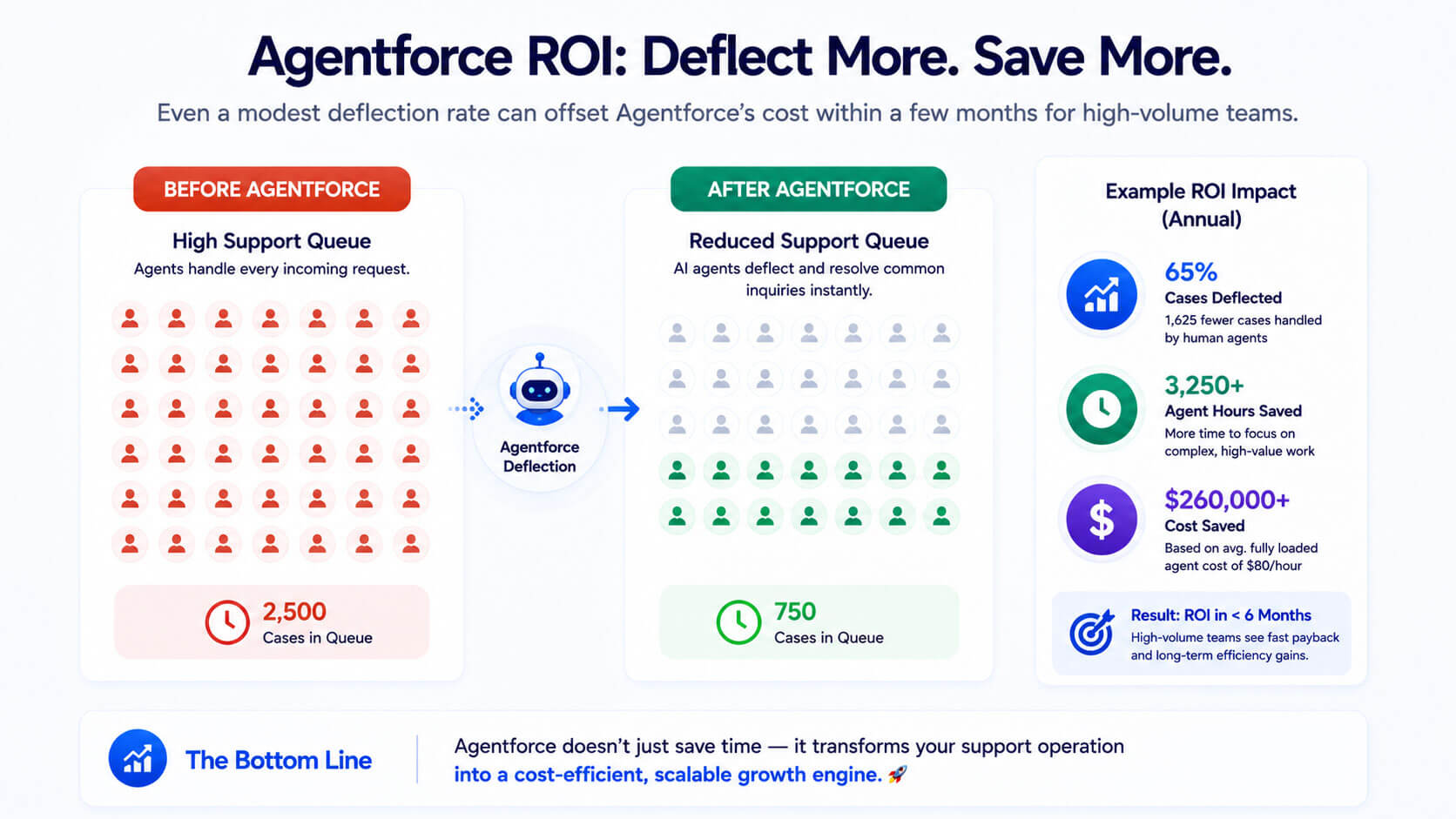
None of this matters if the investment doesn’t pay back. Here’s a simple way to frame the ROI conversation for your leadership team.
Start with deflection math for customer service use cases. If your team handles a high volume of support cases monthly and your average cost per human-handled case runs in the $15–$25 range, even a modest deflection rate from AI agents can produce meaningful monthly savings once volume is high enough. The math only works at scale — if you’re handling a few hundred support interactions a month, the Data Cloud prerequisite alone may make the case difficult to justify.
Then look at internal productivity use cases. Sales-focused agents that qualify leads, schedule meetings, or prepare call briefs are aimed at tasks that often consume a significant share of a sales rep’s week. Freeing up that time has a real, if harder to measure, revenue impact.
Finally, be honest about your data and AI maturity before committing. Gartner’s own research has found that over 40% of agentic AI projects are expected to be canceled by the end of 2027, driven primarily by escalating costs, unclear business value, and inadequate risk controls — not because the technology doesn’t work, but because organizations deployed it without the data foundations or governance to support it.
That statistic isn’t a reason to avoid Agentforce. It’s a reason to scope your first deployment narrowly, measure results for 60–90 days, and expand only where the numbers clearly justify it — rather than signing an enterprise-wide contract on day one.
Three Questions to Ask Before You Sign
- Do we already have clean, structured data in Salesforce, or does that need to happen first? If your knowledge base or CRM data is inconsistent, fix that before scaling Agentforce spend — poor inputs produce poor agent responses regardless of how much you spend.
- Which pricing model actually matches our usage pattern? High-volume, simple customer interactions often favor Conversations. Mixed use cases across departments often favor Flex Credits. Company-wide internal rollouts often favor per-user licensing. Pick based on your actual workflow, not the model your sales rep leads with.
- What’s our exit or pivot plan if usage patterns change? Since Flex Credits and Conversations can’t run simultaneously in the same org, negotiate flexibility into your contract upfront — including the ability to switch models without penalty if your usage looks different after six months than it did at signing.
How NSIQ INFOTECH Helps You Get This Right
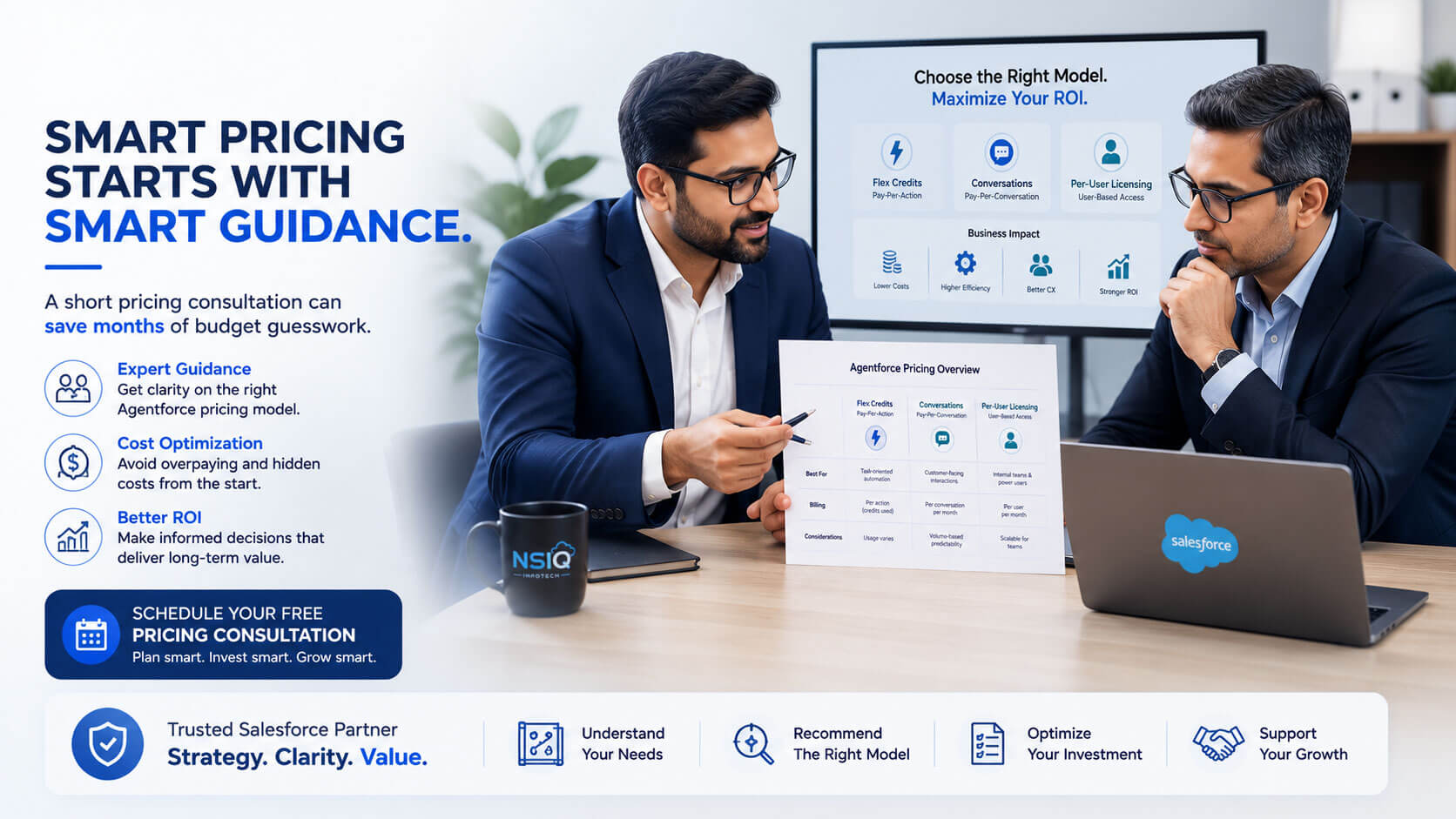
Pricing decisions like this are hard to reverse once you’ve signed. Choosing the wrong model, underestimating Data Cloud costs, or rolling out company-wide before validating ROI on a smaller pilot are the most common — and most expensive — mistakes we see organizations make with Agentforce.
Our Salesforce consulting team works directly with finance and IT leadership to map your actual usage patterns against Agentforce’s pricing models before you commit budget. That means modeling realistic Flex Credit consumption based on your specific workflows, identifying whether your existing Salesforce data and knowledge base are ready for agent deployment, and structuring contracts that leave room to pivot if your usage looks different than projected.
We’ve helped organizations across service, sales, and operations teams scope Agentforce pilots that prove ROI before scaling — rather than discovering six months in that the real cost was three times the headline number. If you’re at the stage of evaluating whether Agentforce fits your budget and your workflows, that’s exactly the conversation we have before any contract gets signed.
Conclusion
Salesforce Agentforce pricing isn’t complicated because Salesforce is trying to confuse buyers — it’s complicated because Agentforce isn’t a simple per-seat product. It’s a consumption-based AI platform with four different buying structures, a mandatory data infrastructure requirement, and real implementation costs that don’t show up on the headline pricing page.
The key takeaway for any CFO, CIO, or procurement lead evaluating this investment: don’t budget against the advertised $2-per-conversation or $500-per-100,000-credit figures alone. Build your business case around the fully loaded cost — Data Cloud, implementation, knowledge base setup, and ongoing consumption — and validate ROI on a narrow pilot before committing to an enterprise-wide rollout.
Get that sequencing right, and Agentforce can genuinely pay for itself through deflection savings and freed-up internal capacity. Get it backwards — sign first, scope later — and you’re the kind of cautionary tale that shows up in next year’s Gartner cancellation statistics.
If you want a clear-eyed view of what Agentforce would actually cost for your specific use cases, talk to our team before your next contract renewal cycle. We’ll help you model the real numbers, not just the sticker price.
Ready to get a realistic Agentforce cost estimate for your organization? Schedule a consultation with NSIQ INFOTECH’s Salesforce team today.
FAQs
What is the actual cost of Salesforce Agentforce? There’s no single number. Salesforce Agentforce pricing depends on which model you choose — Flex Credits start around $500 per 100,000 credits, Conversations cost $2 each, and per-user licensing ranges from $5 to $650 per user monthly. Most organizations also need Data Cloud, which adds significant additional cost.
Is there a free version of Agentforce? Yes. Salesforce Foundations is a free tier that includes Agent Builder, Prompt Builder, and a starter allocation of Flex Credits and Data Cloud credits, designed for testing and small pilots.
What are Flex Credits in Agentforce pricing? Flex Credits are Salesforce’s consumption-based currency for Agentforce. You purchase a pool of credits, and each agent action — like retrieving a record or answering a question — draws down credits from that pool, typically 20 credits per standard action.
Can I use both Flex Credits and Conversations pricing at the same time? No. Salesforce does not support running Flex Credits and Conversations pricing models within the same Salesforce org simultaneously. You need to choose one per org.
Why is Data Cloud required for Agentforce? Agentforce relies on Data Cloud to unify customer data so agents have accurate context when responding. For most organizations, this is treated as a mandatory prerequisite rather than an optional add-on, which significantly affects total Agentforce cost.
How much does Agentforce really cost in the first year, including everything? Including Data Cloud, implementation services, and knowledge base setup, real first-year costs for mid-market companies commonly fall between $150,000 and $600,000, even though the advertised per-conversation or per-credit rate looks much lower in isolation.
What’s the difference between Agentforce Add-ons and Agentforce 1 Editions? Agentforce Add-ons are department-specific licenses (Sales, Service, Field Service) typically priced around $125–$150 per user per month. Agentforce 1 Editions are broader bundles that include the add-on plus Flex Credits and Data Cloud access, starting around $550 per user per month.
Does Agentforce pricing change based on industry? Yes, in some cases. Industries-specific Agentforce add-ons (for regulated or specialized sectors) typically carry a price premium over standard add-ons, reflecting additional compliance and industry-specific workflow requirements.
Is per-conversation pricing or Flex Credits cheaper? It depends on how many actions each conversation requires. Simple conversations with few actions tend to be cheaper under Conversations pricing ($2 flat). Complex conversations requiring many actions can be cheaper under Flex Credits, since you’re paying per action rather than a flat rate.
What happens if we exceed our Flex Credits allocation? There’s no penalty rate. Overages are billed monthly in arrears at your contracted rate. Using Salesforce’s Digital Wallet tracking tool can help you monitor consumption and avoid unexpected overage billing.
Do unused Flex Credits roll over to the next contract period? Generally, no — unused Flex Credits typically do not carry over once your contract term ends, so accurate usage forecasting before purchase matters.
Is Salesforce Agentforce worth the investment for a mid-market company? It depends heavily on use case and volume. High-volume customer service deflection and sales process acceleration tend to show the clearest ROI. Low-volume use cases, or organizations without clean underlying data, often struggle to justify the full cost.
Can small businesses afford Agentforce? It’s possible to start small using Salesforce Foundations’ free tier, but most reviewers note that per-conversation and credit-based costs become difficult to justify for small businesses once you scale past pilot usage, particularly given the Data Cloud prerequisite.
How do we decide which Agentforce pricing model is right for us? Start by mapping your actual use cases: high-volume, simple, customer-facing interactions often suit Conversations pricing; mixed customer and employee use cases often suit Flex Credits; and company-wide internal rollouts often suit per-user licensing. Model your expected volume against each structure before signing.
Should we negotiate our Agentforce contract, or is pricing fixed? Negotiate. Salesforce has shown flexibility on enterprise contracts, including discounted credit rates and the ability to structure conversion rights between pricing models if your usage changes. Treat the published pricing page as a starting point, not a final number.