
Introduction
Artificial Intelligence has rapidly moved from innovation labs into boardroom discussions. CIOs, Chief Data Officers (CDOs), and Digital Transformation leaders are under increasing pressure to deliver measurable business outcomes from AI investments.
Yet despite significant spending on AI technologies, many organizations struggle to achieve meaningful results.
The reason is surprisingly simple.
Most AI initiatives are built on fragmented, inconsistent, and incomplete customer data.
Organizations often focus on selecting the right AI platform, model, or vendor while overlooking the most important prerequisite: a unified customer data foundation.
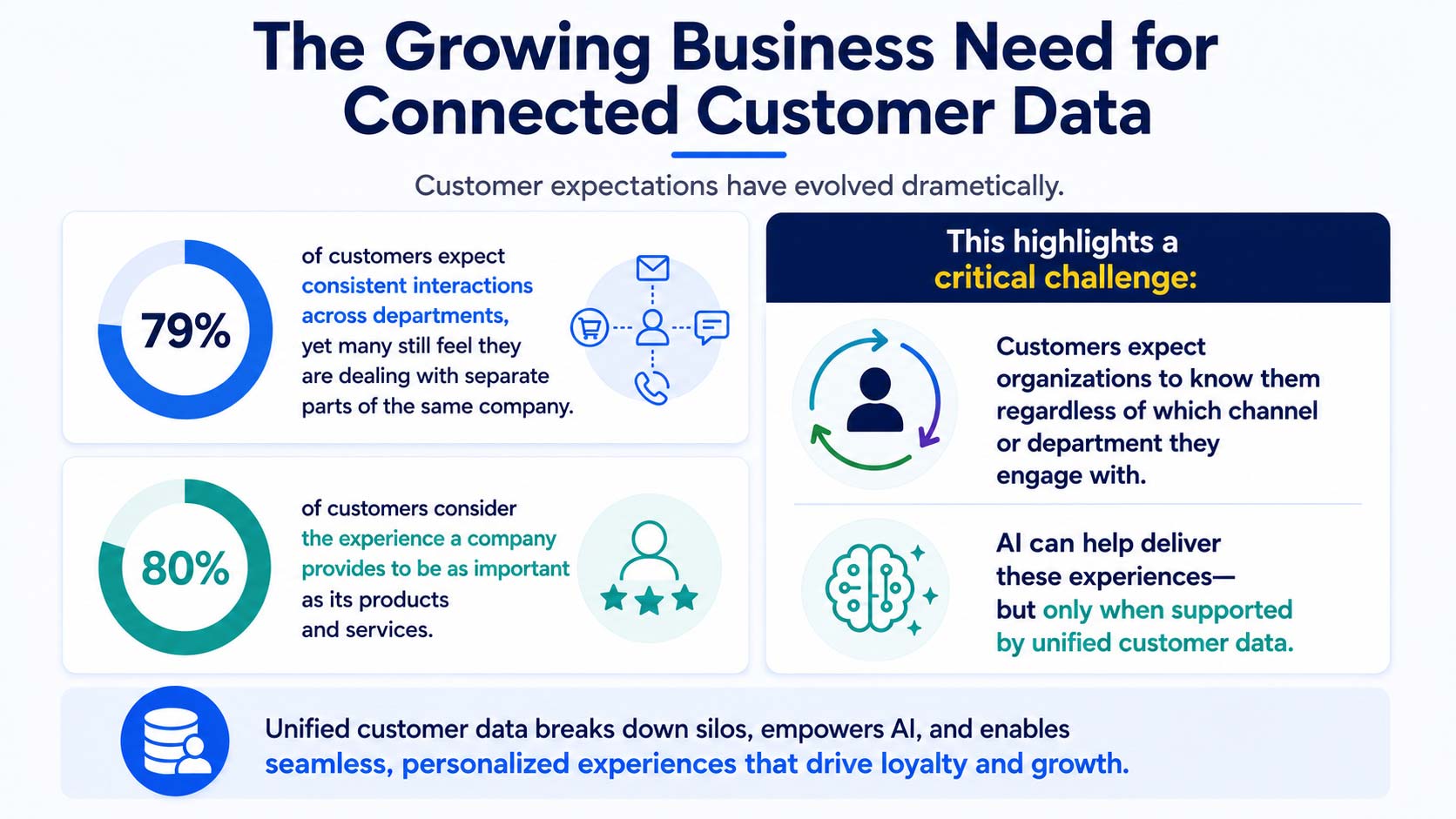
Without unified customer data, AI systems lack the context needed to generate accurate insights, automate processes effectively, and deliver personalized customer experiences.
In this guide, we’ll explore why unified customer data is the backbone of every successful AI strategy, the challenges organizations face, and how enterprise leaders can create an AI-ready data ecosystem.
What Is Unified Customer Data?
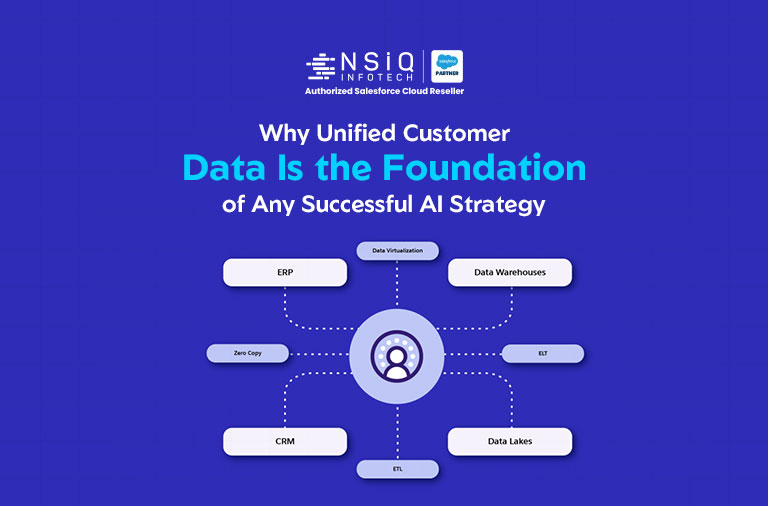
Unified customer data refers to the process of bringing customer information from multiple systems into a single, consistent, and accessible view.
These systems often include:
- CRM platforms
- Marketing automation tools
- Customer support systems
- E-commerce platforms
- ERP systems
- Mobile applications
- Website analytics
- Social media channels
Instead of maintaining separate customer records across departments, organizations create a centralized customer profile that reflects every interaction, transaction, and engagement.
This single source of truth becomes the foundation for analytics, personalization, automation, and AI-driven decision-making.
Why AI Depends on Unified Customer Data
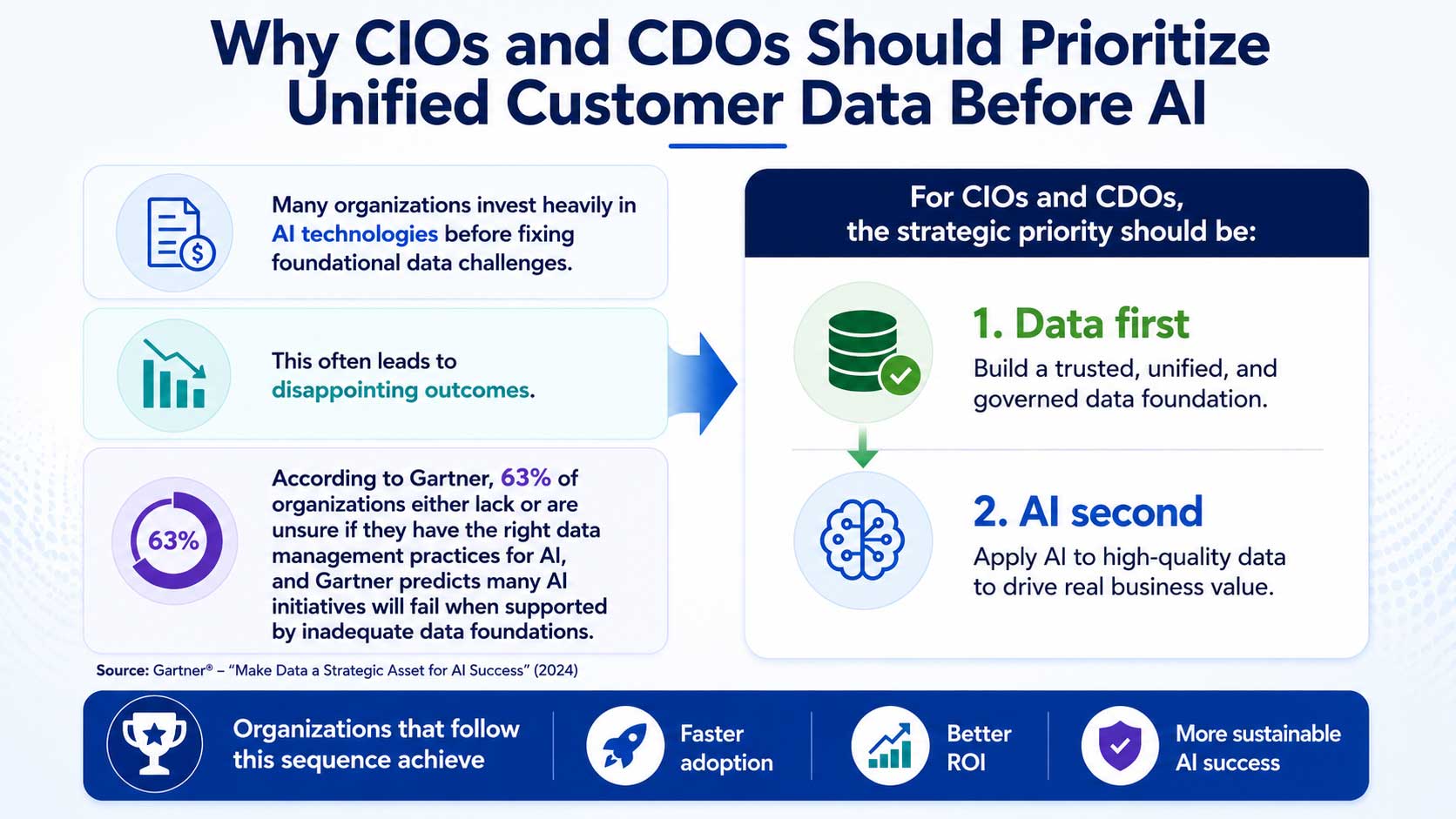
AI systems are only as good as the data they consume.
Even the most advanced machine learning model cannot compensate for incomplete, duplicate, or inaccurate customer information.
When customer data exists across disconnected systems, AI encounters several challenges:
- Inconsistent customer identities
- Missing behavioural context
- Duplicate records
- Outdated information
- Contradictory customer attributes
As a result, AI-generated recommendations become unreliable.
The Garbage In, Garbage Out Problem
A customer may exist in:
- Salesforce CRM
- Marketing platform
- Support desk
- Billing system
Each system may contain different information.
If AI only accesses one source, it sees an incomplete picture.
For example:
A customer may appear inactive in the CRM but recently made a high-value purchase through an e-commerce channel.
Without unified customer data, AI may incorrectly classify that customer as low-value and trigger the wrong marketing actions.
The Link Between Unified Customer Data and AI Performance
Better Predictions
AI models become more accurate when they have access to complete customer histories.
Examples include:
- Churn prediction
- Customer lifetime value forecasting
- Product recommendations
- Next-best-action suggestions
The more context available, the better the predictions.
Improved Personalization
Personalization requires understanding:
- Customer preferences
- Purchase behavior
- Service history
- Engagement patterns
Unified customer data enables AI to personalize experiences at scale.
Smarter Automation
AI-powered workflows rely on trusted data.
Examples include:
- Automated lead scoring
- Customer service routing
- Marketing campaign optimization
- Dynamic content recommendations
Without reliable data, automation can create poor customer experiences.
Stronger AI Governance
AI initiatives increasingly face regulatory scrutiny.
Unified customer data supports:
- Data governance
- Consent management
- Compliance reporting
- Auditability
These capabilities are becoming essential as AI adoption grows.
Common Challenges Organizations Face with Customer Data
Many enterprises recognize the importance of data, yet struggle to unify it.
Data Silos
Different departments often own different systems.
Examples include:
- Sales using CRM
- Marketing using automation tools
- Support using ticketing platforms
- Finance using ERP systems
These systems rarely communicate effectively.
Duplicate Records
Multiple customer profiles create confusion and reduce AI accuracy.
Inconsistent Data Quality
Customer information may contain:
- Missing fields
- Outdated records
- Formatting inconsistencies
- Conflicting values
According to Gartner, poor data quality costs organizations an average of $12.9 million annually.
For enterprise leaders, this isn’t just a data issue—it’s a business performance issue.
Legacy Systems
Many organizations still operate with older platforms that were never designed for real-time data sharing.
Real-World Business Scenario
Consider a global healthcare provider implementing AI-driven patient engagement.
Before Data Unification
Customer information existed in:
- Salesforce CRM
- Marketing platform
- Appointment scheduling software
- EMR systems
Challenges included:
- Duplicate patient records
- Inconsistent communication
- Limited visibility across touchpoints
After Unified Customer Data
The organization integrated all systems into a centralized customer data platform.
Results included:
- 360-degree patient profiles
- Improved campaign targeting
- Faster service resolution
- More accurate AI recommendations
Within six months, patient engagement rates increased significantly while operational inefficiencies decreased.
This is a common pattern across industries including healthcare, financial services, manufacturing, and retail.
Building an AI-Ready Data Foundation
Creating unified customer data requires more than integration.
It requires a structured strategy.
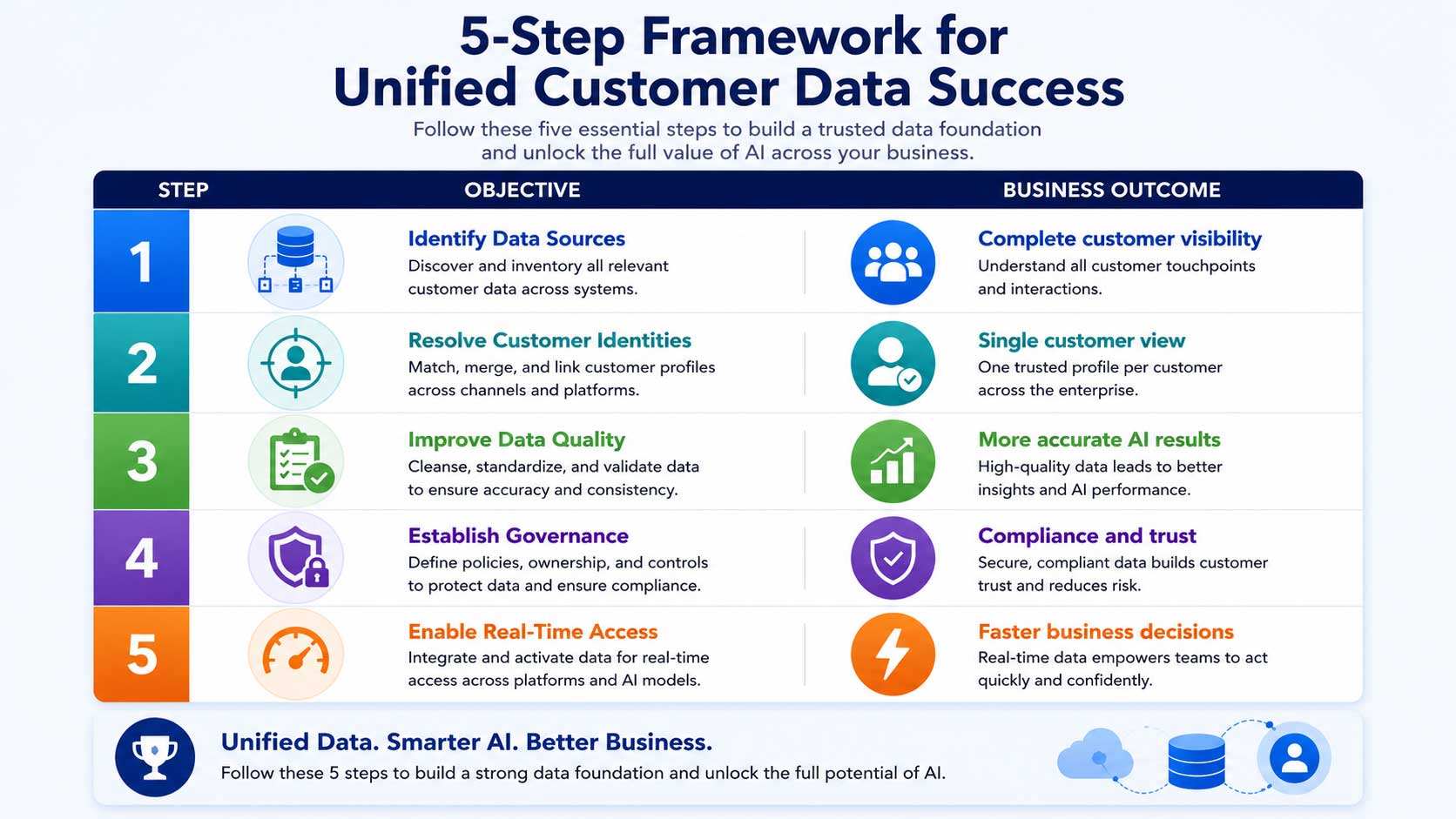
Step 1: Identify All Customer Data Sources
Start by mapping:
- Internal systems
- Third-party platforms
- Customer touchpoints
Many organizations discover dozens of disconnected data repositories.
Step 2: Establish Identity Resolution
Determine how customer records are matched across systems.
This creates a single customer profile.
Step 3: Improve Data Quality
Focus on:
- Deduplication
- Standardization
- Validation
- Data enrichment
Step 4: Implement Data Governance
Define:
- Ownership
- Access controls
- Compliance policies
- Data quality standards
Step 5: Enable Real-Time Connectivity
Modern AI applications require near real-time access to customer information.
This ensures decisions are based on current data rather than outdated snapshots.
The Role of Customer Data Platforms (CDPs)
Customer Data Platforms have become a critical component of modern AI strategies.
A CDP helps organizations:
- Consolidate customer information
- Create unified profiles
- Enable identity resolution
- Support advanced segmentation
- Deliver real-time data access
When integrated correctly, CDPs become the operational layer connecting customer data with AI applications.
Popular enterprise approaches often combine CRM platforms, data lakes, data warehouses, and CDPs into a unified ecosystem.
How Unified Customer Data Supports Emerging AI Technologies
The next generation of AI includes:
- Generative AI
- AI Agents
- Predictive Analytics
- Autonomous Workflows
These technologies require context-rich information.
Gartner notes that AI systems become significantly more effective when supported by strong semantic and contextual data foundations. Organizations that prioritize AI-ready data structures can improve AI accuracy while reducing costs.
In simple terms:
The future of AI depends on understanding customer context, not just storing customer records.
How NSIQ INFOTECH Helps Organizations Build AI-Ready Customer Data Foundations
Many organizations know they need unified customer data but struggle with execution.
Common challenges include:
- Legacy integrations
- Data quality issues
- Governance gaps
- Platform complexity
- Scalability concerns
NSIQ INFOTECH helps enterprises design and implement modern customer data architectures that support both current business needs and future AI initiatives.
Our Approach Focuses On:
- Customer data assessment
- Data integration strategy
- Salesforce and CRM optimization
- Customer Data Platform implementation
- Data governance frameworks
- AI readiness planning
The goal is simple:
Create a trusted, scalable customer data foundation that enables organizations to unlock the full value of AI investments.
Q.1: What is unified customer data?
Unified customer data combines customer information from multiple systems into a single, accurate customer profile.
Q.2: Why is unified customer data important for AI?
AI relies on accurate and complete data. Unified customer data provides the context needed for better predictions and automation.
Q.3: What is a single customer view?
A single customer view is a consolidated profile containing all relevant customer interactions and attributes.
Q.4: How does unified customer data improve personalization?
It gives AI access to complete customer histories, enabling more relevant recommendations and experiences.
Q.5: What causes customer data silos?
Separate systems, departmental ownership, legacy applications, and lack of integration typically create data silos.
Q.6: What is identity resolution?
Identity resolution matches customer records across systems to create one unified profile.
Q.7: Can AI work without unified customer data?
AI can function, but results are often less accurate, less reliable, and harder to scale.
Q.8: What is a Customer Data Platform (CDP)?
A CDP is a technology platform that unifies customer data from multiple sources into centralized profiles.
Q.9: How does data quality impact AI?
Poor data quality leads to inaccurate predictions, unreliable insights, and reduced business value.
Q.10: What are the biggest challenges in creating unified customer data?
Data silos, duplicate records, governance issues, and legacy system integration are common challenges.
Q.11: How long does a customer data unification project take?
Timelines vary, but enterprise implementations typically range from a few months to a year, depending on complexity.
Q.12: Is unified customer data necessary for generative AI?
Yes. Generative AI performs best when it can access trusted and contextual customer information.
Q.13: What industries benefit most from unified customer data?
Healthcare, financial services, retail, manufacturing, telecommunications, and technology companies all benefit significantly.
Q.14: How can CIOs measure the success of unified customer data initiatives?
Metrics include data quality improvements, customer satisfaction, AI accuracy, operational efficiency, and revenue growth.
Q.15: Does Salesforce support unified customer data strategies?
Yes. Solutions such as Salesforce Data Cloud help organizations create unified customer profiles and AI-ready data environments.
Conclusion
Unified customer data is no longer just a technology initiative—it is a business imperative.
As AI becomes central to customer engagement, operational efficiency, and strategic decision-making, organizations must recognize that data quality and connectivity determine AI success.
The most successful AI strategies are not built on algorithms alone. They are built on trusted, connected, and actionable customer data.
For CIOs, Digital Heads, and CDOs, the path forward is clear:
Create a unified customer data foundation first, then scale AI initiatives with confidence.
Organizations that invest in this foundation today will be far better positioned to deliver exceptional customer experiences, accelerate innovation, and maximize AI ROI tomorrow.