
Introduction
Most enterprise organizations are sitting on more customer data than they know what to do with. The problem isn’t that the data doesn’t exist it’s that it lives in ten different places, owned by three different teams, and nobody can agree on which number is actually right.
Your marketing team has one version of the customer. Your sales team has another one. And when your CIO asks for a simple report on active accounts, the room goes quiet while three people pull three different spreadsheets.
This is a real, expensive problem. According to a McKinsey report, companies that make strong use of customer analytics are 23 times more likely to outperform competitors in new customer acquisition. But you can’t run strong analytics on fractured data.
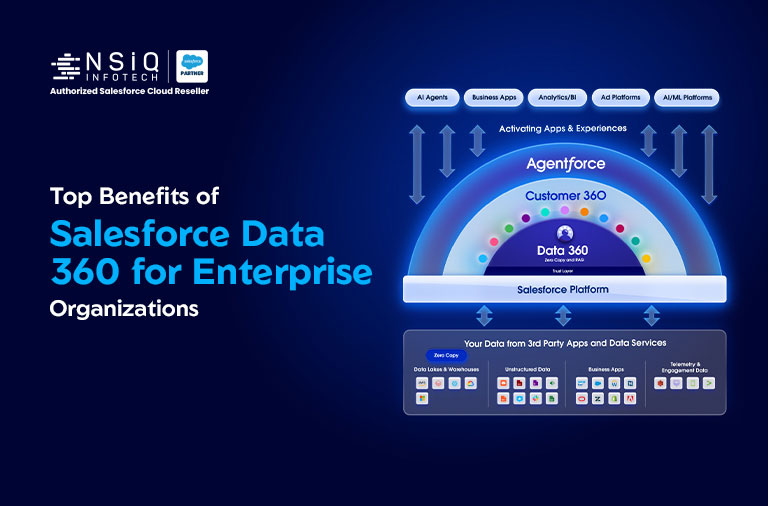
Salesforce Data 360 was built specifically to fix this. It pulls data from every system your organization runs CRM, marketing, service, e-commerce, and ERP and builds one clean, unified customer profile that every department can trust.
This guide covers the top benefits of Salesforce Data 360 in plain language, with real examples built for CDOs, CMOs, and CIOs who need to understand what this actually changes not just what the brochure says.
Table of Contents
- What Is Salesforce Data 360?
- Why Enterprise Leaders Are Prioritizing Data Unification Right Now
- Top 10 Benefits of Salesforce Data 360
- How Salesforce Data 360 Works
- Industries That See the Biggest Impact
- Common Challenges Without a Unified Data Platform
- Best Practices for Implementing Salesforce Data 360
- How NSIQ INFOTECH Can Help
- Frequently Asked Questions
- Conclusion
What Is Salesforce Data 360?
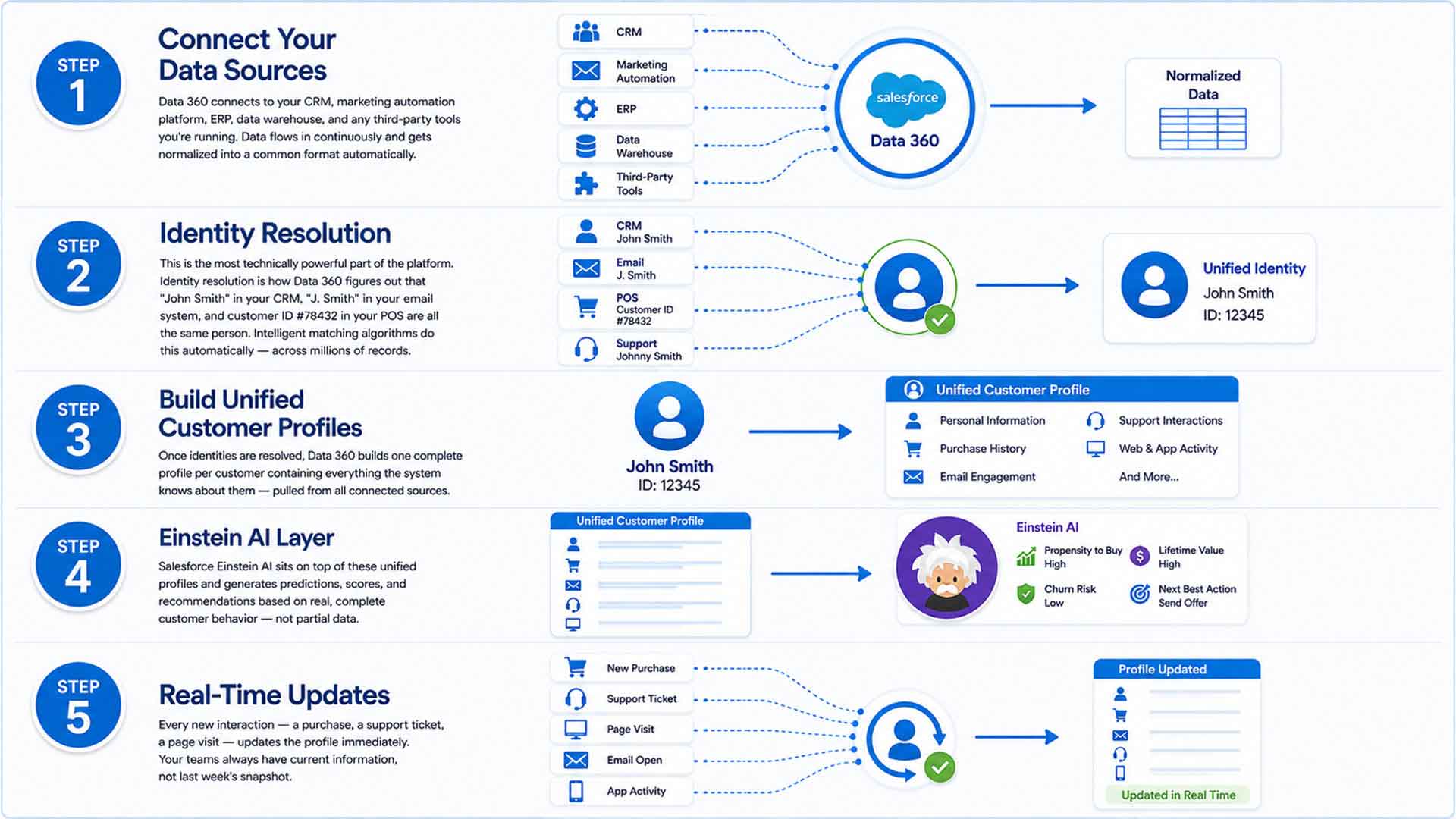
Salesforce Data 360 is a customer data platform (CDP) that connects data from all your existing systems and consolidates it into a single, unified customer profile updated in real time.
Think of it this way. A customer who browsed your website on Monday, called your support team on Wednesday, and bought something in-store on Friday is one person. But in most enterprise environments, those three touchpoints live in three separate systems that don’t talk to each other. That customer looks like three different strangers depending on which system you’re looking at.
Data 360 connects those systems, identifies that all three interactions belong to the same person (through a process called identity resolution), and builds one complete profile that your whole organization can use.
What Makes It Different from a Standard CRM?
A CRM stores and manages what your team puts into it. Data 360 automatically pulls from every connected source, cleans and standardizes the data, resolves duplicate identities, and keeps everything current without manual effort.
Why Enterprise Leaders Are Prioritizing Data Unification Right Now
Data silos aren’t a new problem. But the cost of ignoring them is growing.
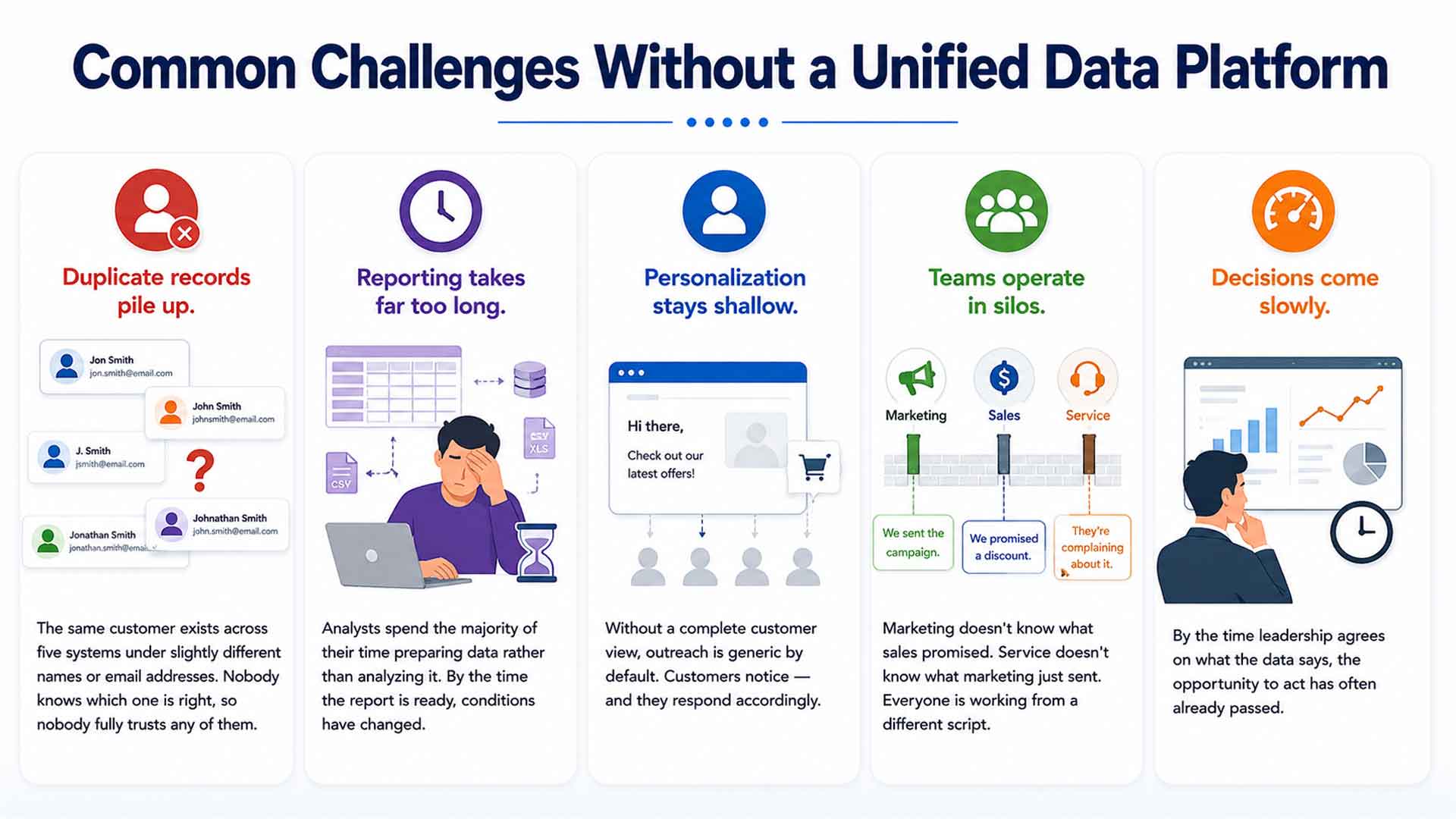
When each department runs its own tools and maintains its own version of the customer, decision-making slows to a crawl. Leaders spend more time debating which dataset is accurate than actually acting on insights. By the time everyone agrees, the moment has passed.
The operational cost is significant too. Analysts in large enterprises can spend 30–40% of their week just cleaning and reconciling data before any actual analysis can happen. That’s not a data problem that’s a strategy problem.
The benefits of using Salesforce CRM as the foundation of your data strategy are already well-documented. When you add Data 360, you’re not upgrading a tool you’re upgrading how your entire organization understands and serves its customers.
Top 10 Benefits of Salesforce Data 360
1. Unified Customer View
Every team, every department, every touchpoint all working from the same customer record.
Salesforce Data 360 pulls from your CRM, marketing automation, service platform, website analytics, and every other connected source, then merges everything into one profile.
Real-World Example
A financial services firm managing clients across banking, investment, and insurance no longer needs advisors to log into three separate systems before a call. With Data 360, the full relationship history every product, every interaction, every complaint is in one place before the advisor even says hello.
2. Better Personalization at Scale
Generic outreach is dead. Customers expect to feel recognized and they notice immediately when they don’t.
Real personalization means knowing a customer’s full history across every channel they’ve used to interact with you.
Data 360 makes that possible across your entire customer base, not just your VIP tier.
3. Faster, More Confident Decision Making
Bad data leads to bad decisions.
Salesforce Data 360 gives CDOs, CMOs, and CIOs one verified, complete version of the truth.
Real-World Example
A manufacturing company combined CRM data with supply chain data inside Data 360 to build a demand forecast that actually reflected real customer behavior.
4. Real-Time Customer Insights
Salesforce Data 360 updates customer profiles as interactions happen in real time.
Real-World Example
If a key user at an enterprise account suddenly stops logging in, the system flags it right away. Customer success can reach out before that account goes cold.
5. Stronger Marketing Performance
Marketers who work with unified customer data build better segments, run more relevant campaigns, and get far more from their budget.
6. Enhanced Customer Experience Across Every Channel
Customer experience isn’t one big moment. It’s the sum of every small interaction.
Real-World Example
A telecom provider using Data 360 gave service reps full account context before the call even started. Resolution times dropped and satisfaction scores improved.
7. Better AI and Machine Learning Outcomes
AI is only as good as the data it’s trained on.
Salesforce Data 360 feeds clean, complete, unified profiles into Salesforce Einstein AI.
Real-World Example
A retail chain used Einstein AI on top of Data 360 to identify which customers were most likely to respond to a discount offer.
8. Increased Operational Efficiency
How much time does your team spend each week just getting data ready to analyze?
Data 360 automates most of that work.
Benefits
- Reduced manual reporting
- Automated data standardization
- Fewer duplicate records
- Faster access to insights
9. Scalable Data Management That Grows With You
Growth creates data complexity.
Salesforce Data 360 is built for enterprise-scale data from the start.
Example
Whether you’re working with one million customer records or fifty million, performance stays consistent.
10. Improved Collaboration Across the Entire Organization
When every department works from the same data, organizational friction disappears.
Benefits
- Shared customer visibility
- Better handoffs between teams
- Faster strategy execution
- More accurate reporting
How Salesforce Data 360 Works
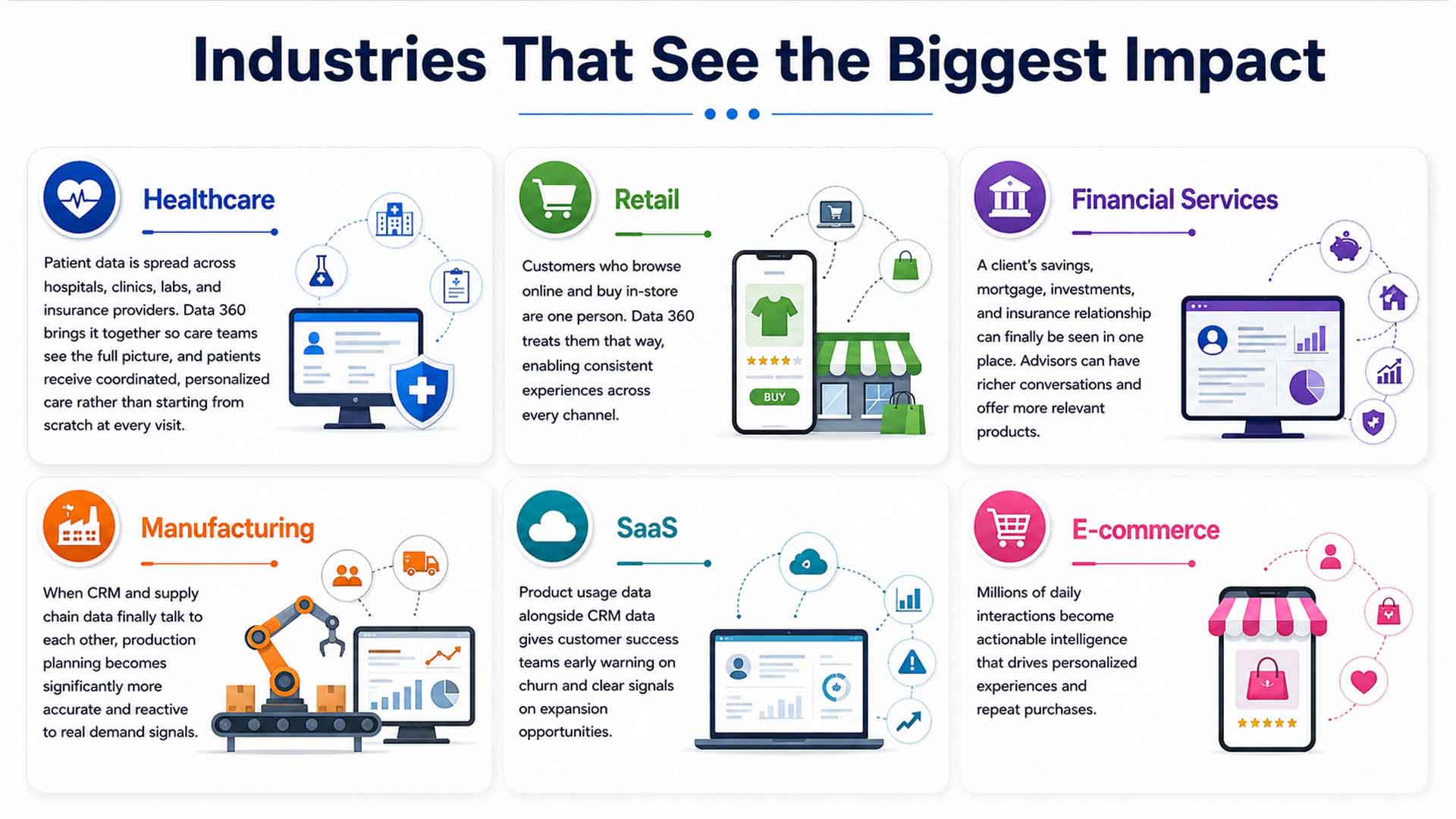
Industries That See the Biggest Impact
Common Challenges Without a Unified Data Platform
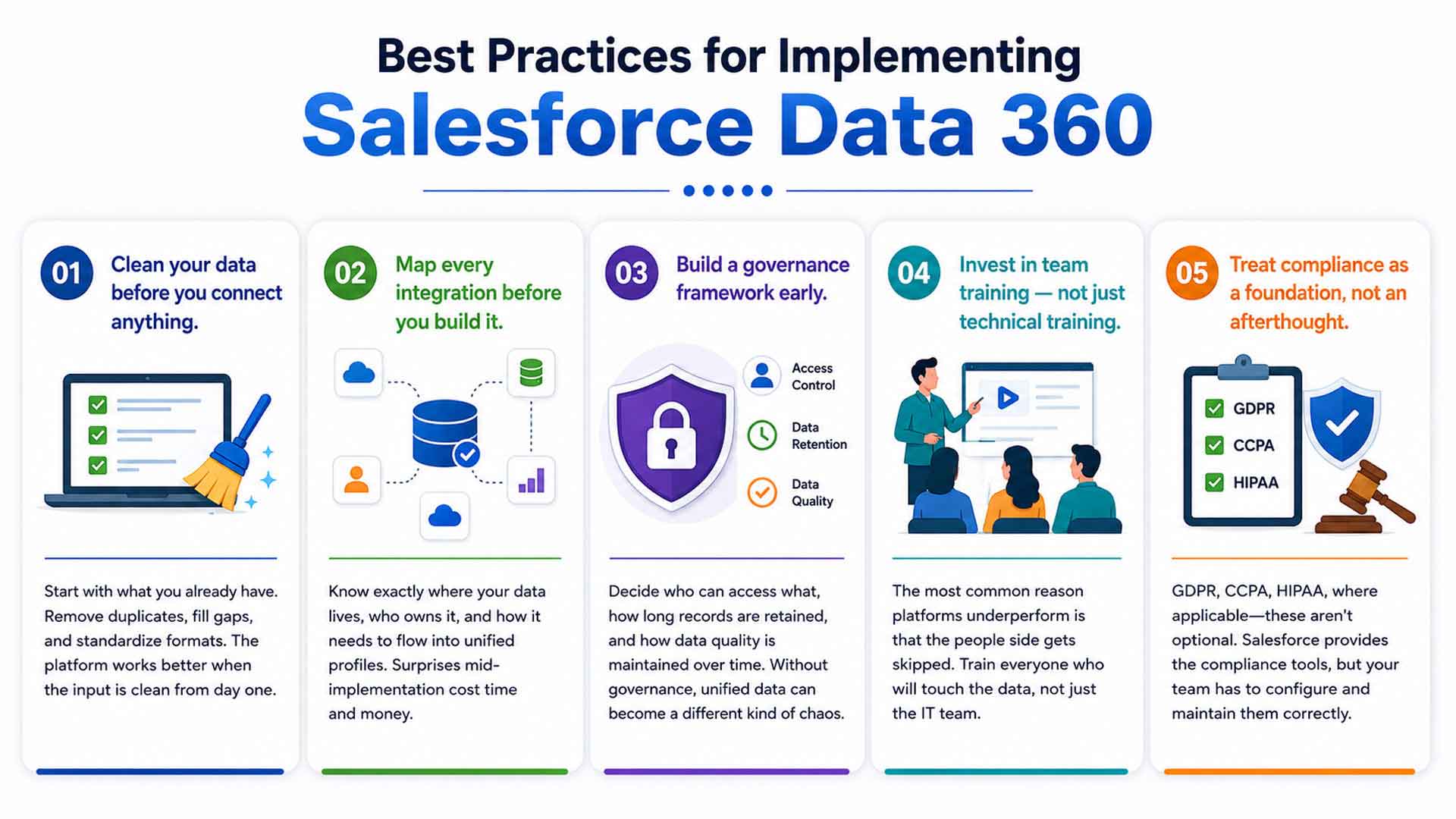
How NSIQ INFOTECH Can Help
Implementing Salesforce Data 360 the right way takes more than simply enabling the platform.
At NSIQ INFOTECH, we help organizations:
- Conduct data audits
- Design integration architecture
- Configure identity resolution
- Build unified customer profiles
- Train teams
- Provide ongoing support
We’ve helped organizations across healthcare, retail, financial services, manufacturing, SaaS, and e-commerce create trusted, scalable customer data foundations.
Frequently Asked Questions (FAQ) section designed to help users quickly find answers, resolve common queries, and access important information about products, services, and support.
1. What is Salesforce Data 360?
Salesforce Data 360 is a customer data platform that unifies customer data from multiple systems into one profile.
2. What are the main benefits of Salesforce Data 360?
Unified customer views, personalization, real-time insights, improved AI, stronger marketing performance, and better collaboration.
3. What are the benefits of using Salesforce CRM alongside Data 360?
CRM manages customer relationships while Data 360 creates a complete customer intelligence layer.
4. How does Salesforce Data 360 work?
It connects data sources, resolves identities, builds profiles, and applies AI-driven insights in real time.
5. What is identity resolution in Salesforce Data 360?
The process of recognizing and merging customer records from different systems into one profile.
6. Is Salesforce Data 360 suitable for large enterprises?
Yes. It is designed for enterprise-scale customer data management.
7. How does Data 360 improve customer experience?
By giving every team access to a complete, up-to-date customer profile.
8. Which industries benefit most from Salesforce Data 360?
Healthcare, retail, financial services, manufacturing, SaaS, and e-commerce.
9. How does Salesforce Data 360 support AI and machine learning?
It provides clean, unified data that improves prediction accuracy and recommendations.
10. What is the difference between Salesforce CRM and Salesforce Data 360?
CRM manages customer relationships. Data 360 unifies customer data across all systems.
11. How long does implementation take?
Typically between 8–16 weeks, depending on complexity.
12. What data sources can Salesforce Data 360 connect to?
CRM, ERP, marketing automation, e-commerce, data warehouses, POS systems, service tools, and APIs.
13. Does Salesforce Data 360 help with GDPR compliance?
Yes. It includes governance and privacy management capabilities.
14. What is the ROI of implementing Salesforce Data 360?
ROI comes from improved efficiency, better marketing performance, higher retention, and stronger decision-making.
15. How does NSIQ INFOTECH help with implementation?
Through consulting, architecture design, integrations, configuration, training, and support.
Conclusion
Data is only valuable when you can actually act on it. And you can only act on it when it’s clean, unified, and accessible to the people who need it in real time.
The top benefits of Salesforce Data 360 all connect back to one idea: when every part of your organization works from the same accurate picture of the customer, everything improves.
Marketing spends smarter. Sales closes with more context. Service resolves issues faster. Leadership gains confidence in every decision.
For enterprise CDOs, CMOs, and CIOs, this isn’t just a technology decision, it’s a competitive one.
If you’re ready to see what Salesforce Data 360 can do for your organization, the NSIQ INFOTECH Salesforce team is ready to help.