
A practical CRM comparison for businesses that plan to grow
Choosing a CRM is one of those decisions that looks simple on the surface and becomes expensive to undo. Pick the wrong platform and you spend the next two years working around its limits, paying for add-ons, or migrating data at the worst possible time.
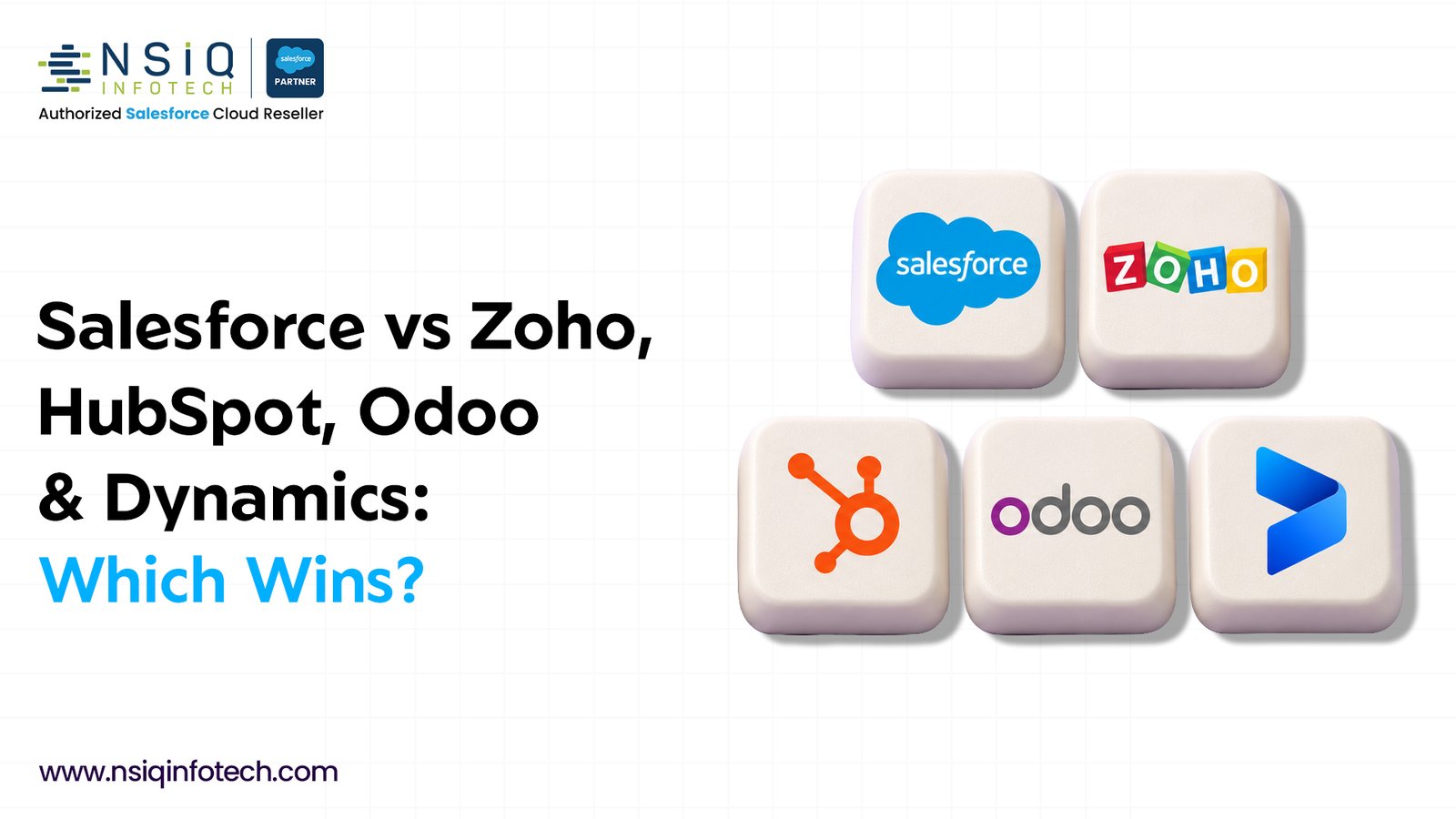
In this guide we compare five of the most popular CRM platforms: Salesforce, Zoho CRM, Odoo, HubSpot, and Microsoft Dynamics 365. We look at what matters in real projects: features, customization, scalability, integrations, AI, ecosystem, and total cost of ownership. Our verdict is that Salesforce is the overall winner, and we will explain why, as well as where the other platforms are a genuinely good fit.
What Should You Look For in a CRM?
Before comparing tools, agree on the criteria. A CRM is not just a contact database. It is the system where your sales, service, and marketing teams work every day. Evaluate it on:
- Core functionality: leads, accounts, opportunities, forecasting, and service management
- Customization: can it adapt to your process, or must your process adapt to it?
- Scalability: will it still work at 10x your current users and data volume?
- Integration: how well does it connect with your ERP, email, finance, and marketing tools?
- AI and automation: how much manual work can it remove?
- Ecosystem: apps, partners, talent, and community support
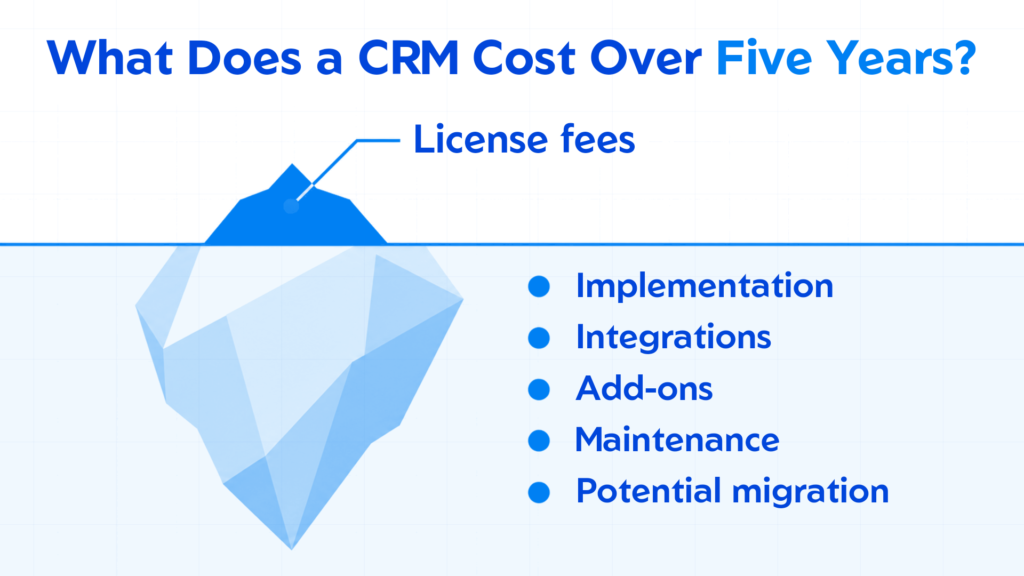
- Total cost of ownership: license price plus implementation, add-ons, and maintenance
The Contenders at a Glance
| Criteria | Salesforce | Zoho CRM | Odoo | HubSpot | Dynamics 365 |
| Best for | Mid-size to enterprise, complex processes | Small and mid-size, budget-conscious | Companies wanting CRM plus ERP in one | Marketing-led SMBs | Microsoft-centric enterprises |
| Customization | Excellent (clicks and code) | Good | Very flexible, but code-heavy | Limited at lower tiers | Strong |
| Scalability | Excellent | Moderate | Moderate | Good | Excellent |
| AI capabilities | Agentforce, Einstein | Zia | Basic and add-on | Breeze | Copilot |
| App ecosystem | Largest (AppExchange) | Growing marketplace | Odoo apps store | Solid marketplace | AppSource |
| Learning curve | Moderate | Easy | Moderate to steep | Easy | Moderate |
| Cost | Higher | Lowest | Low to moderate | Free tier, expensive at scale | Moderate to high |
Pricing changes often, so always confirm current plans on each vendor’s website before deciding.
Salesforce vs Zoho CRM: Great Value, but Limited at Scale
Zoho CRM is popular for a reason. It is affordable, easy to start with, and part of a wide suite of business apps. For a small team that needs lead tracking, basic automation, and reporting, it does the job well.
Strengths
- Very competitive pricing
- Quick setup and a friendly interface
- Good integration inside the Zoho family of products
Limitations
- Customization depth and governance tools are lighter than enterprise platforms
- The third-party ecosystem and talent pool are smaller
- Complex, multi-team processes can become hard to maintain as you scale
Verdict: an excellent starter CRM, but companies often outgrow it once processes, data volumes, and integrations get complex.
Salesforce vs Odoo: CRM Inside a Full ERP
Odoo’s biggest selling point is that CRM is just one module in a modular business suite covering inventory, accounting, manufacturing, and more. If you want one system for everything and have technical resources, it is attractive.
Strengths
- CRM, sales, inventory, and accounting in one platform
- Open-source community edition and flexible hosting options
- Low entry cost
Limitations
- The CRM module is less mature than dedicated CRM leaders, especially for forecasting, analytics, and service
- Heavy customization usually means developers and ongoing upkeep
- Smaller partner network and fewer ready-made integrations
Verdict: a strong choice when ERP is the priority and CRM is secondary. It is not the strongest choice when customer-facing revenue operations are the heart of your business.
Salesforce vs HubSpot: Easy to Love, Costly to Scale
HubSpot is famous for its user-friendly design and its marketing automation strength. Its free CRM is a great way to begin, and marketing teams tend to adopt it quickly.
Strengths
- Very intuitive interface and fast adoption
- Excellent marketing, content, and inbound tools
- Free tier for getting started
Limitations
- Costs rise steeply as contacts, seats, and premium hubs are added
- Deep customization, complex data models, and advanced permissions are more constrained
- Enterprise-grade governance and large-scale process automation are not its focus
Verdict: ideal for marketing-led small and mid-size businesses. Companies with complex sales structures often hit its ceiling.
Salesforce vs Dynamics 365: The Closest Competitor
Dynamics 365 is a serious enterprise contender. If your organization lives in Microsoft 365, Teams, Power BI, and Azure, the integration is genuinely smooth, and Copilot brings AI into familiar tools.
Strengths
- Deep integration with the Microsoft ecosystem
- Strong enterprise capability and Power Platform extensibility
- Combines CRM and ERP offerings
Limitations
- Implementation and licensing can be complex
- Smaller CRM-focused app marketplace and community compared to Salesforce
- The best experience depends on being committed to the Microsoft stack
Verdict: the closest competitor to Salesforce for large organizations, particularly Microsoft-first ones.
Why Salesforce Wins
Each platform above has a sweet spot. But when we weigh the full picture, including capability today, flexibility tomorrow, and the ecosystem around it, Salesforce comes out ahead. Here is why.
1. Unmatched Customization Without Losing Control
Salesforce lets you shape the platform at every level. Admins can build with declarative tools such as Flow, custom objects, and page layouts. Developers can go further with Apex, Lightning Web Components, and APIs. This “clicks and code” model means the platform grows with your business instead of boxing it in.
Crucially, this flexibility comes with governance: sandboxes, version control, deployment pipelines, role hierarchies, and field-level security keep large teams safe while they customize.
2. A Complete Customer 360, Not Just a Sales Tool
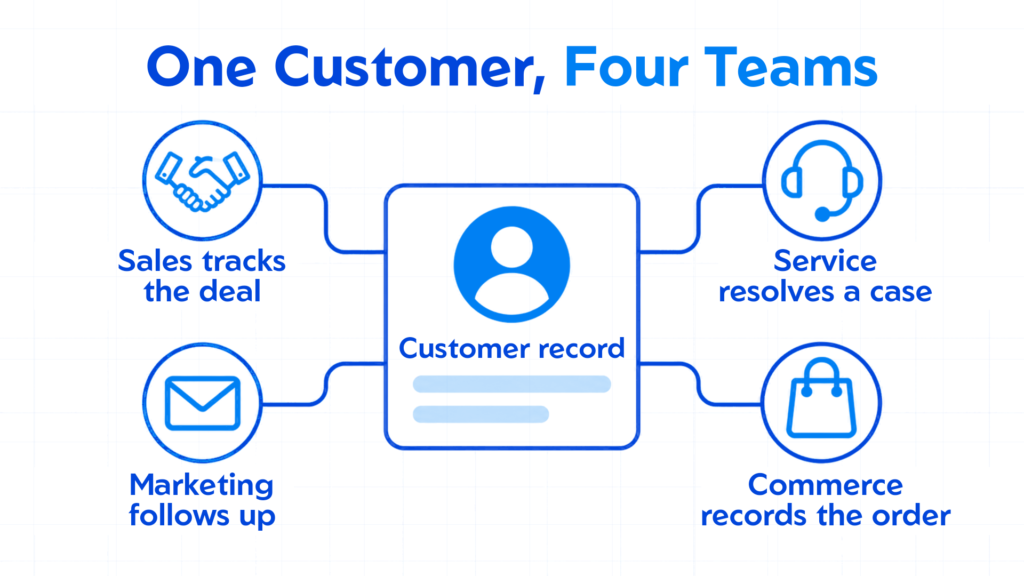
Salesforce goes well beyond lead and opportunity tracking. Sales Cloud, Service Cloud, Marketing Cloud, Commerce Cloud, Experience Cloud, and Data 360 (formerly Data Cloud) all share one data foundation. Your sales, support, marketing, and commerce teams see the same customer, which removes the data silos that make other setups painful.
3. The Biggest Ecosystem in CRM
The AppExchange offers thousands of pre-built apps for almost any need, from CPQ and document generation to payments and industry solutions. On top of that, Salesforce has a large global community, a deep consulting partner network, extensive Trailhead learning content, and a big pool of certified professionals. For a business, that means easier hiring, faster problem solving, and less risk.
4. AI That Is Built Into the Workflow
Salesforce has invested heavily in AI. Einstein brings predictive scoring and insights, while Agentforce lets businesses build autonomous AI agents that can take action on CRM data, such as answering customer questions, updating records, and supporting sales and service teams. Because the AI sits on the same trusted data and security model as the CRM, it can be useful without being a bolt-on.
5. Enterprise-Grade Scalability and Security
Salesforce runs a multi-tenant cloud platform designed for very large organizations, with strong security controls, compliance certifications, and a mature release cycle. Whether you have 20 users or 20,000, the architecture holds up.
6. Integration and Automation Power
With robust REST and SOAP APIs, platform events, MuleSoft, and a wide range of connectors, Salesforce integrates with ERPs, finance tools, marketing systems, and legacy applications. Flow and Apex handle complex automation that simpler CRMs struggle to express.
7. Industry Depth
Salesforce offers industry-specific solutions for areas such as financial services, healthcare, nonprofits, manufacturing, retail, and more. That reduces the amount of custom work needed for specialized processes.
Is Salesforce More Expensive? A Fair Look at Cost
Yes, Salesforce license costs are generally higher than Zoho or Odoo, and we should not hide that. But license price is only one part of the story. Consider total cost of ownership:
- Cheaper tools can become expensive when you outgrow them and must migrate, or when you pay for workarounds and third-party add-ons.
- Salesforce’s ecosystem often replaces custom development with ready-made apps.
- Productivity gains from automation, AI, and unified data can outweigh license differences for revenue-critical teams.
The right question is not “which CRM is cheapest today?” but “which CRM will still serve us in five years?”
Not sure what Salesforce would actually cost for your team? As a Salesforce Cloud Reseller, NSIQ Infotech can help you compare editions, estimate licensing and implementation costs, and build a realistic budget. Book a free CRM consultation
When Another CRM Might Be the Better Fit
An honest comparison should say this clearly. Choose something else if:
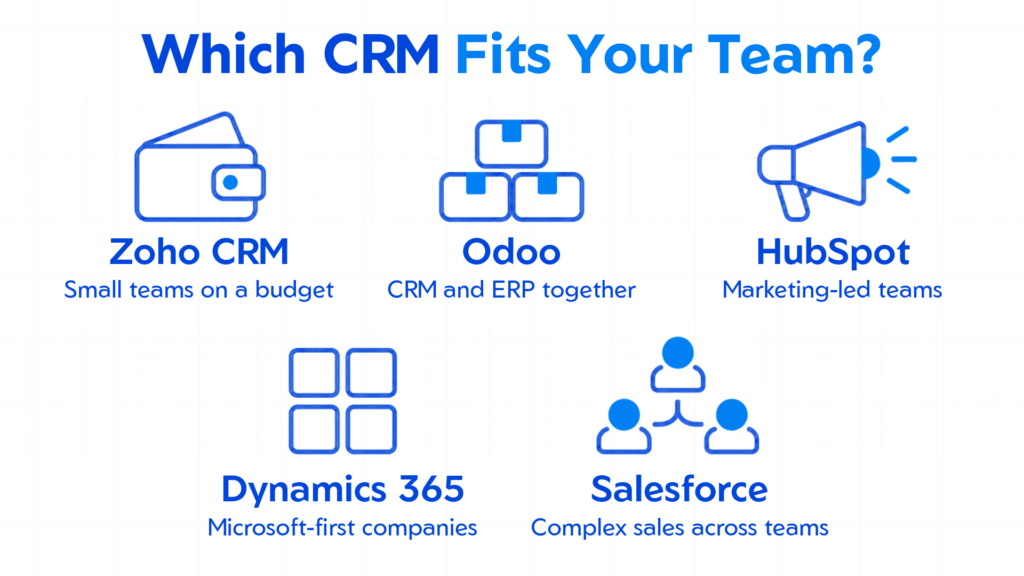
- You are a very small team on a tight budget and need basic CRM: Zoho or HubSpot Free may be enough to start.
- You need ERP first: Odoo may be the better foundation.
- You are fully committed to Microsoft: Dynamics 365 deserves a serious look.
- You are a marketing-led business with simple sales processes: HubSpot is a strong option.
For everyone else, especially companies that expect growth, complexity, multiple teams, and deeper integrations, Salesforce is the safest long-term investment.
When Should Indian Businesses Move From Zoho to Salesforce?
Zoho is built in India and is one of the most widely used CRMs among Indian small and mid-size businesses. For many companies, it is the right place to start. But as the business grows, a few signs usually show that it is time to move to Salesforce:
- Multi-branch or multi-state sales teams: regional managers need one view of pipeline, targets, and forecasts across locations.
- Dealer and distributor networks: partners need their own portal to log orders, claims, and service requests.
- ERP and accounting integration: sales data needs to flow reliably into Tally, SAP, or Microsoft Dynamics without manual re-entry.
- Growing service teams: customer support moves beyond email and needs case routing, SLAs, and WhatsApp-based communication.
- Leadership reporting: management wants accurate, real-time dashboards instead of spreadsheets compiled every month.
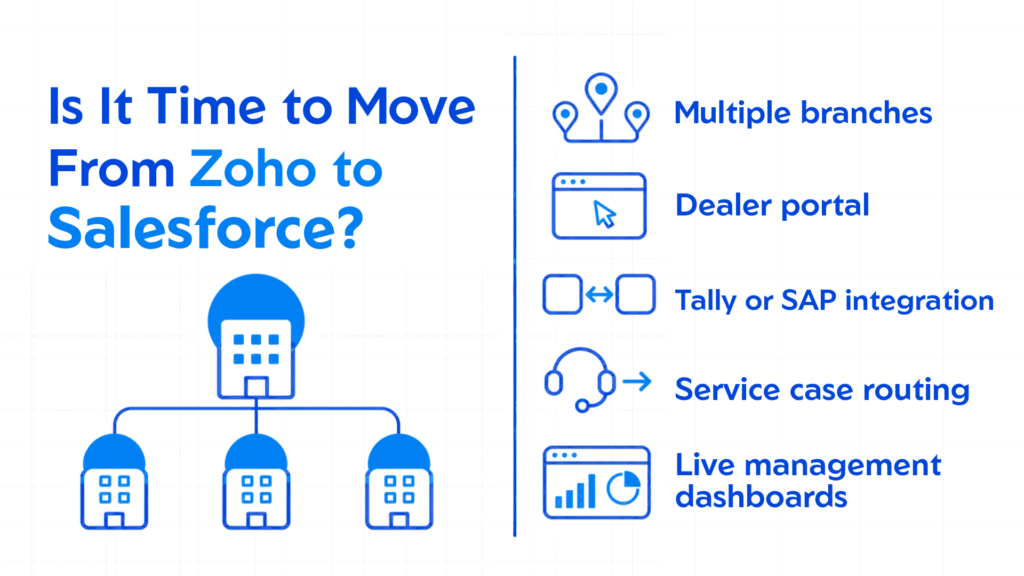
If two or more of these sound familiar, your business may be ready for Salesforce. NSIQ Infotech helps Indian companies plan and complete Zoho-to-Salesforce migrations with clean data, minimal disruption, and teams that are trained from day one.
How to Make Your Decision
- Map your process first. Document how leads, deals, and support cases flow before looking at tools.
- List must-have integrations. Check each platform’s connectors for your ERP, email, and finance systems.
- Estimate three-to-five-year growth. Think about users, data, and new business units.
- Run a pilot. Use a trial or sandbox with real scenarios from your team.
- Work with an experienced implementation partner. A well-implemented CRM beats a feature-rich CRM that nobody adopts.
Final Verdict
| Platform | Overall Take |
| Salesforce | Winner. The most complete, customizable, and scalable CRM platform, with the strongest ecosystem and AI roadmap |
| Dynamics 365 | Strong runner-up, especially for Microsoft-centric enterprises |
| HubSpot | Best for marketing-led, ease-of-use-focused teams |
| Zoho CRM | Best value for small businesses |
| Odoo | Best when ERP and CRM must live in one system |
If you want a CRM that adapts to your business rather than the other way around, and that keeps pace as you grow, Salesforce is the one to bet on.
How NSIQ Infotech Can Help
Choosing Salesforce is the first step. Getting real value from it depends on how well it is implemented, and that is where the right partner makes the difference.
NSIQ Infotech is a Salesforce Consulting Partner, a Salesforce Cloud Reseller, and an AppExchange-listed company with its own Salesforce-native products, including SPForceLink and Quoteforce. We support you end to end, from licensing and implementation to integration, custom development, and long-term optimization, across India, the US, the UK, and Australia.
What We Offer
- Salesforce consulting and strategy: we study your sales, service, and marketing processes and recommend the right clouds, editions, and roadmap for your business.
- Implementation: end-to-end setup of Sales Cloud, Service Cloud, and other Salesforce products, configured around the way your teams actually work.
- Custom development: tailored Salesforce solutions for business requirements that standard configuration cannot cover.
- Integration: connecting Salesforce with your ERP, finance, marketing, and other business systems so data flows in one place.
- Data migration: moving your data from Zoho, Odoo, HubSpot, spreadsheets, or legacy systems into Salesforce cleanly and safely.
- Licensing as a Cloud Reseller: guidance on choosing and purchasing the right Salesforce licenses for your team size and budget.
- AppExchange solutions: ready-to-use apps that extend Salesforce without the cost of building from scratch.
- Training and ongoing support: user training, admin support, and continuous improvements so adoption stays high after go-live.
Why Work With Us
- Certified, hands-on expertise in the Salesforce platform, from admin configuration to code.
- A practical, business-first approach: we start with your goals and processes, not with features.
- Support beyond go-live: we stay available as your needs, users, and data grow.
Ready to Get Started?
Whether you are moving from another CRM or starting fresh, NSIQ Infotech can help you plan, implement, and grow with Salesforce. Reach out to our team to discuss your requirements and get a clear, tailored roadmap for your business.
Frequently Asked Questions
-
Is Salesforce better than Zoho CRM?
For small teams with simple sales processes, Zoho CRM offers excellent value. For growing businesses with multiple teams, complex processes, and deeper integration needs, Salesforce offers stronger customization, scalability, and ecosystem support.
-
Is HubSpot cheaper than Salesforce?
HubSpot is cheaper to start with, thanks to its free CRM. However, costs rise quickly as you add contacts, users, and premium hubs, so at scale the total cost can be similar to or higher than Salesforce.
-
Salesforce vs Dynamics 365: which is better for large enterprises?
Both are strong enterprise platforms. Dynamics 365 suits organizations fully committed to Microsoft tools, while Salesforce offers a larger CRM ecosystem, more industry solutions, and stronger AI capabilities through Agentforce.
-
Can we migrate from Zoho, HubSpot, or Odoo to Salesforce?
Yes. With proper data mapping, cleanup, and testing, contacts, deals, activities, and custom data can be moved into Salesforce. Working with an experienced partner reduces the risk of data loss and downtime.
-
Which CRM is best for growing businesses in India?
Zoho is a popular starting point for Indian SMBs. Businesses with multi-location teams, dealer networks, or ERP integration needs often move to Salesforce as they scale.