
Healthcare leaders today have a hard job. They need to keep patient care accurate and safe, and they also need to give patients the easy, quick service they get everywhere else. At the same time, many hospitals are short on staff, short on money, and dealing with patients who are tired of messy, disconnected communication.
Electronic Health Record (EHR) systems are very important. They store medical charts and handle billing. But they were never built to manage patient messages, appointment coordination, or busy call centers.
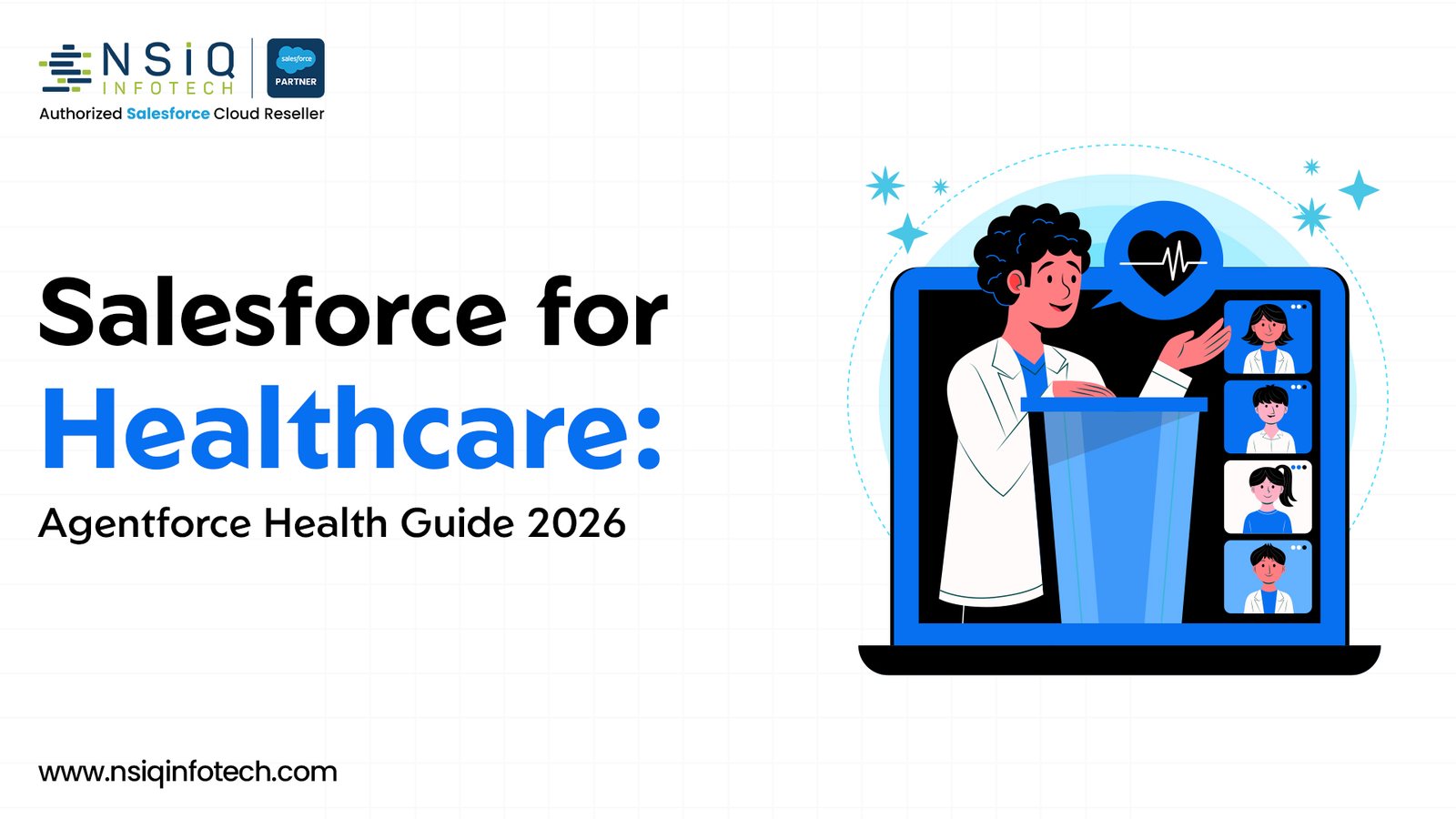
Salesforce has helped businesses manage customer relationships for years. In 2026, it renamed its healthcare product from Health Cloud to Agentforce Health. The big change is that it now does more than store records. It can also help with everyday tasks on its own. This guide explains what it is, how it works, and what to think about before you start.
What Is Agentforce Health?
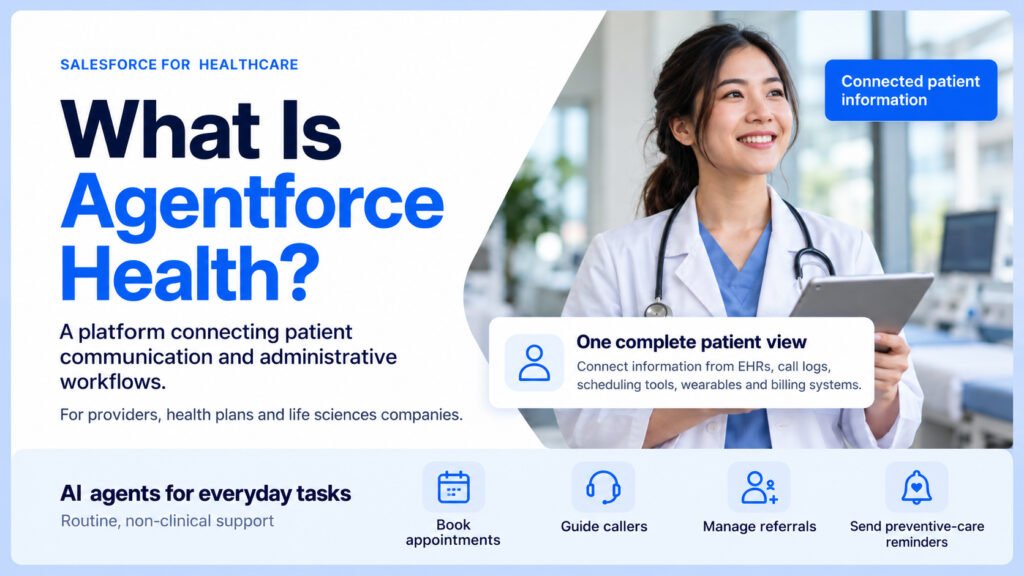
Agentforce Health is a platform that connects patient communication and office work for healthcare providers, health insurance plans, and life sciences companies.
An EHR keeps clinical history and medical codes. Agentforce Health pulls information from many places, such as EHRs, call logs, scheduling tools, wearable devices, and billing systems. Then it shows you one full picture of each patient.
The biggest update in 2026 is the addition of AI helpers called “Agents.” They use live patient data to handle routine, non-clinical work like booking appointments, guiding callers, managing doctor referrals, and sending reminders for preventive care.
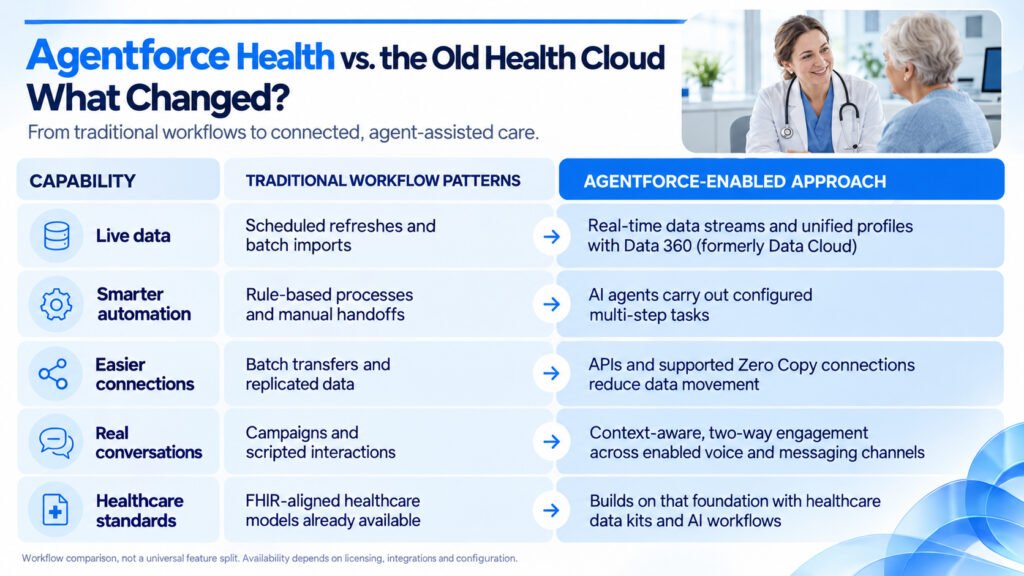
Agentforce Health vs. the Old Health Cloud: What Changed?
The new name reflects real changes in how the system works:
- Live data: Before, records often updated overnight. Now the platform handles incoming data as it arrives, using Data Cloud.
- Smarter automation: Older setups ran on simple rules and basic decision trees. Now AI assistants can finish multi-step tasks by themselves.
- Easier connections: Systems share information instantly through live links, so you don’t need extra copies of your data.
- Real conversations: Instead of mass emails and text blasts, patients get natural, two-way chats by phone, web chat, and text message.
- Healthcare standards built in: You no longer have to build custom data mappings from scratch. Standard healthcare data models come ready to use.
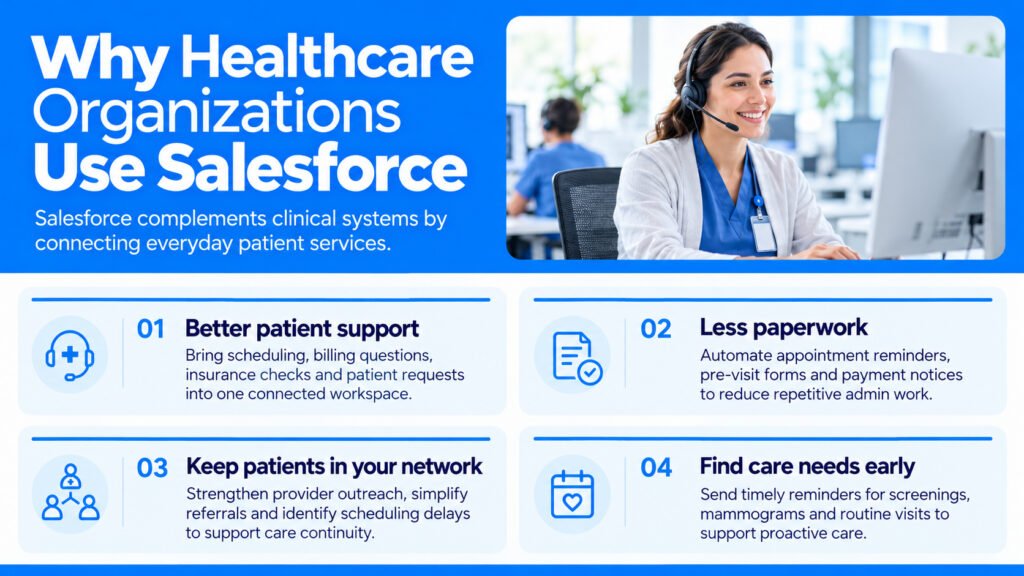
Why Healthcare Organizations Use Salesforce
Hospitals don’t bring in Salesforce to replace their clinical systems. They use it to solve daily problems that EHRs weren’t made for:
-
Better patient support:
Call center staff often jump between several programs. Agentforce Health puts scheduling, billing questions, insurance checks, and patient requests on one screen.
-
Less paperwork:
AI assistants take care of repeat tasks like appointment reminders, pre-visit forms, and payment notices. This saves staff a lot of time.
-
Keeping patients in your network:
Health systems want patients to stay with their own specialists and facilities. Provider tools help with doctor outreach, easier referrals, and spotting scheduling delays before patients go somewhere else.
-
Finding care needs early:
Care teams don’t have to wait for yearly checkups. They can send automatic reminders for screenings, mammograms, and routine visits.
Key Features and Real-World Examples
1. Patient Access and Support on Every Channel
When a patient reaches out, staff can quickly see how the patient likes to be contacted, their past visits, their insurance details, and any open tasks.
Example: A patient receives a text reminder to book a checkup after surgery. An AI assistant chats with the patient, finds an open slot on the doctor’s calendar in Epic, checks the insurance, and confirms the visit. Nobody on staff has to make a phone call.
2. Care Coordination and Long-Term Illness Management
Care managers often look after hundreds of patients at the same time. Agentforce Health turns complex care plans into simple to-do lists, ordered by what matters most that day.
Example: A heart patient steps on a connected scale and the weight shows a sudden jump. The platform records it and alerts a nurse care manager. The nurse can adjust the care plan before the patient needs an emergency room visit.
3. Provider Relationship Management (PRM)
Good communication between primary doctors and specialists keeps care moving and helps fill open appointment slots.
Example: Physician liaisons track when specialists are available, measure how long referred patients wait, and fix credentialing problems quickly.
4. Health Plan and Medical Device Support
For insurance plans and medical device companies, the platform makes approval processes less painful.
Example: The system reads medical codes straight from chart notes and sends the needed paperwork to insurance plans automatically. This speeds up prior authorizations.
AI Support and Safety Rules
AI in healthcare needs strict security and clear limits. Agentforce Health keeps office tasks separate from medical decisions. It uses the safety features of the Einstein Trust Layer:
-
No stored AI data:
Patient information sent to outside AI systems is never saved and never used to train public models.
-
Automatic privacy protection:
Names, contact details, and personal health information are hidden before processing.
-
Human oversight:
AI assistants handle simple admin jobs like scheduling or address changes. If a patient asks about symptoms, triage, or medicines, the conversation goes straight to a licensed clinician.
-
Clear records:
The system logs every automated step and suggestion, so compliance teams can review them any time.
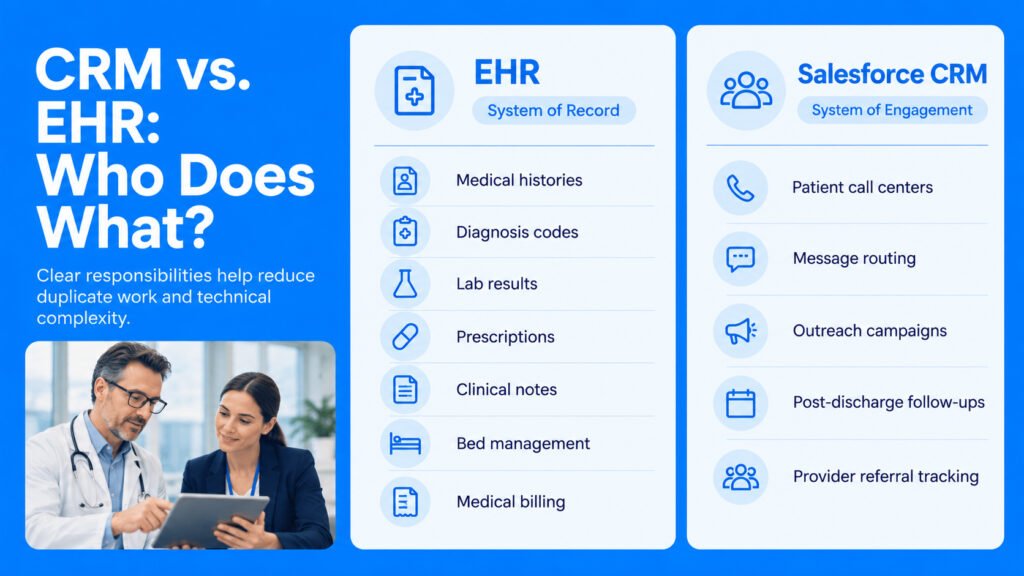
CRM vs. EHR: Who Does What?
During technology upgrades, many teams get confused about what belongs in the EHR and what belongs in the CRM. Drawing a clear line avoids double costs and technical trouble.
What the EHR handles (the System of Record):
medical histories, diagnosis codes, lab results, prescriptions, clinical notes, bed management, and medical billing.
What Salesforce handles (the System of Engagement):
patient call centers, message routing, outreach campaigns, checkups after discharge, and tracking provider referrals.
Data Setup: Zero Copy and Data Cloud
In the past, connecting a communication platform to a data warehouse meant copying huge amounts of data again and again. Data teams spent many hours building and repairing custom connections.
Agentforce Health avoids this using the data-sharing tools in Salesforce Data Cloud. Instead of making copies, Salesforce connects directly to outside platforms like Snowflake or AWS. It uses open table standards such as Apache Iceberg to do this.
The benefits are simple:
- No duplicate data: Information stays where it already lives, which cuts storage costs.
- Live updates: Staff see fresh information right away, not after an overnight transfer.
- Smoother work: If a risk model in your data warehouse recalculates a patient’s readmission score, the new score shows up on the staff dashboard immediately.
Security, Privacy, and Compliance
Patient information needs strong protection. Agentforce Health supports healthcare privacy rules with these features:
- HIPAA support and BAAs: Salesforce signs standard Business Associate Agreements (BAAs) for Agentforce Health and Data Cloud.
- Salesforce Shield: Adds strong encryption, live activity monitoring, and automatic audit trails.
- Role-based access: Clear permissions let call center agents see contact details without seeing private medical records.
Challenges, Costs, and Common Mistakes
Agentforce Health offers a lot, but leaders should be ready for a few common challenges.
1. Pricing Details
Pricing includes user licenses, data usage, AI conversations, and security add-ons. Plan your expected usage carefully so you aren’t surprised by a large bill.
2. Effort to Connect Your EHR
Connecting a custom Epic or Oracle Health setup takes real work. Before launch, clean up any duplicate patient records. This step matters a lot for success.
3. Helping Your Staff Adjust
New tools only work when people use them. Call center teams and care coordinators need hands-on training so they feel comfortable with the new automated tools.
Checklist for Leaders
Keep these questions in mind when you review software options:
- Data cleanup: Are patients matched correctly across all our systems?
- Clear scope: Have we separated clinical work (EHR) from patient communication (CRM)?
- Safety control: Do our clinical leaders oversee the AI rules and the steps for handing over to a human?
- Integration plan: Can our EHR systems share data cleanly in real time?
- Long-term budget: Have we planned for ongoing team support, usage checks, and improvements after launch?
2026 Roadmap
A step-by-step plan lowers risk and helps you see results sooner:
- Months 1 to 3 (Build the base): Set up security, sign compliance agreements, and connect Salesforce to core patient records.
- Months 4 to 6 (Call center and access): Launch staff dashboards, connect phone systems, and bring access teams onto one platform.
- Months 7 to 9 (AI assistants): Start automated scheduling and check-in texts, with close human supervision.
- Months 10 to 12 (Share more data): Connect enterprise data platforms directly to power real-time reports.
Frequently Asked Questions
Does Agentforce Health replace our Epic or Cerner EHR?
No. It works alongside your EHR. The EHR stays your main system for medical charts and billing. Salesforce handles communication, scheduling, contact centers, and helping patients find their way.
Is Agentforce Health HIPAA compliant right away?
Salesforce provides HIPAA-ready infrastructure and signs BAAs. But full compliance still depends on setting up the system properly, writing clear security rules, and controlling who can see what.
What happens when an AI assistant gets an unexpected or wrong answer from a patient?
The assistants work within clear limits. If a patient asks something unusual or describes a medical emergency, the assistant passes the conversation to a real person right away, along with the full chat history.
How long does a typical rollout take?
A focused launch for one department or call center usually takes 4 to 6 months. A full rollout across a multi-hospital system usually takes 12 to 18 months, done in phases.
Final Thoughts for Health System Leaders
Agentforce Health is a big step forward in how health systems connect with patients outside the exam room. Smart AI helpers, live data, and strong privacy controls can lower call center costs, keep care within your system, and make patients happier.
For leaders planning future technology spending, the key is to treat Salesforce as a platform for daily operations, not just another piece of software. Health systems that plan their data well, keep a clear line between Salesforce and the EHR, and support their staff through the change will get the most out of the investment.
I removed every long dash and used simple words or “to” for ranges. I also fixed the jumbled section on data architecture so it reads in a logical order. Would you like this as a Word doc or a shareable page?