
Salesforce Healthcare Statistics 2026: Adoption Trends and What They Mean for Providers
If you lead a hospital, a clinic network or a healthcare strategy team, you have probably noticed that “patient experience” now shows up in every board deck. The question is no longer whether to invest in a CRM. It is how much, how fast, and on which platform.
That is why Salesforce healthcare statistics matter. The numbers show where the market is heading, what patients now expect, and where your peers are putting their budgets. This guide pulls together the most useful data points for 2026, explains what each one means in plain language, and turns them into steps you can act on.
One note up front. Healthcare CRM data comes from several research firms, and their numbers do not always agree. We have flagged those differences so you can quote the figures with confidence.
Healthcare CRM Market Size: How Big Is It in 2026?
Before looking at Salesforce specifically, it helps to understand the wider category it competes in. Salesforce Health Cloud is one product inside the healthcare CRM market, so market size gives you the context for adoption.
The Global Numbers
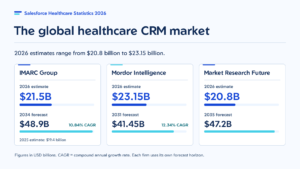
Most analysts place the healthcare CRM market size at roughly USD 20 to 23 billion for 2026. Here is how the major estimates compare:
| Research firm | 2026 market size | Forecast |
| IMARC Group | USD 21.5 billion (up from USD 19.4 billion in 2025) | USD 48.9 billion by 2034 (10.84% CAGR) |
| Mordor Intelligence | USD 23.15 billion | USD 41.45 billion by 2031 (12.34% CAGR) |
| Market Research Future | USD 20.8 billion | USD 47.2 billion by 2035 |
What this means for you: Every credible source points to the same story. The market is on track to roughly double within a decade. Healthcare organizations that wait for the category to “mature” will be buying into a crowded, competitive field.
Why the Estimates Differ
You will notice the numbers do not match. That is normal. Each firm defines “healthcare CRM” differently. Some count only software licenses, while others include implementation, consulting and support services. One Research and Markets report, for example, puts the market at just USD 10.7 billion in 2025, which shows how much the definition matters.
Quick tip: When you cite a market figure in a board presentation, name the source and the year. Never quote a single number as if it were universal.
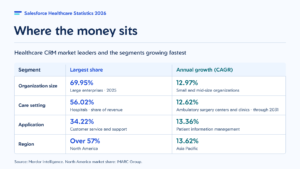
Where the Money Sits
Mordor Intelligence’s segment data gives a useful picture of who is buying and why:
- Large enterprises accounted for 69.95% of the market in 2025, while small and mid-size organizations are growing faster at 12.97% CAGR.
- Hospitals captured 56.02% of revenue, while ambulatory surgery centers and clinics are forecast to grow at 12.62% CAGR through 2031.
- Customer service and support was the largest application at 34.22%, while patient information management is rising fastest at 13.36% CAGR.
- North America holds over 57% of the market, according to IMARC. Mordor puts Asia Pacific as the fastest-growing region at 13.62% CAGR.
What this means for you: Smaller providers and outpatient clinics are no longer sitting out. If you run a mid-size network, you are not behind, but the window to modernize before your competitors do is narrowing.
Healthcare CRM Statistics That Show Where Providers Are Investing
Market size tells you how much money is moving. The segment data tells you why.
Notice that patient information management is the fastest-growing application. That signals a shift from using a CRM as a call-center tool to using it as the core record of every patient relationship. Providers want one place where appointments, outreach, referrals, care plans and communication preferences live together.
Cloud deployment tells a similar story. With cloud share above three-quarters of the market, on-premise CRM is becoming the exception. That matters for platform choice, because Salesforce is a cloud-native platform and fits this direction naturally.
Actionable takeaways:
- Audit how many systems currently hold a piece of a patient’s story. If it is more than three, a unified record should be your first priority.
- Ask your CIO team how much IT time goes into maintaining on-premise CRM tools. That cost is usually the strongest argument for moving to the cloud.
- Treat customer service and patient access as your first use case. It is where most peers are investing.
Salesforce Healthcare Adoption Trends in 2026
Now let’s look at what is happening on the Salesforce side. The best current source is Salesforce’s own 2026 Connected Health Consumer Report.
That report surveyed 3,200 adults across the United States, Canada, Mexico, Brazil, the United Kingdom, Ireland, Australia and New Zealand between March 24 and April 10, 2026. It is a patient-side survey, so it does not measure how many providers use Health Cloud. What it does show is what patients expect, and that drives adoption.
Trend 1: AI Is Welcome, but Only With a Human in the Loop
Ninety percent of patients want medical AI to have human oversight, and nearly 60% already use AI to ask about their personal health. Salesforce’s own headline for the research goes further: patients trust their doctor’s AI agents about three times more than public AI.
What this means for you: Patients are already asking AI health questions before they ever call you. The opportunity is to give them a trusted, provider-governed option instead of leaving them with a general chatbot. Platforms that keep AI connected to your care team, your data and your rules have a clear advantage.
Trend 2: Patients Want Easier, Not Flashier
The 2026 report’s framing is that patients are not asking healthcare to become retail. They want it to be easier to navigate, and providers who fall short risk patients delaying care, skipping referrals or abandoning care altogether.
The report backs this up with hard numbers. Nearly half of patients (49%) hang up after 10 minutes on hold with a doctor’s office, and two in three (66%) have run out of medication while waiting for a prescription refill to be approved.
That is a powerful message for strategy heads. The goal is not a fancy app. The goal is fewer hold times, fewer repeated forms and fewer dropped referrals.
Trend 3: Cloud-First Is Now the Default
As covered above, cloud holds the clear majority of healthcare CRM deployments. For Salesforce customers, that means faster rollouts, easier updates and simpler integration with other cloud tools.
Trend 4: Mid-Size Providers Are Joining In
Clinics, ambulatory centers and mid-size groups are growing faster than the large enterprises in the data. Salesforce’s modular approach lets these organizations start with one use case, such as patient outreach, and grow from there.
Trend 5: Asia Pacific, Including India, Is the Fastest-Growing Region
Mordor Intelligence expects Asia Pacific to grow fastest, at 13.62% CAGR through 2031. India is part of that shift. In July 2026, Kolkata’s Vivekananda Hospital announced a collaboration with Salesforce to build a connected patient engagement platform on the Agentforce 360 Platform, integrated with its hospital information management system. For Indian hospital chains and clinic groups, the same priorities apply: a unified patient record, faster access and outreach on the channels patients actually use, such as WhatsApp.
Salesforce Health Cloud Statistics: What the Data Does and Doesn’t Tell Us
This is the part many “statistics” articles get wrong, so we want to be direct.
Salesforce does not publish a public count of Health Cloud customers or a clean adoption percentage for healthcare providers. Any article that quotes a precise “X% of hospitals use Health Cloud” figure without a named source should be treated with caution. We have not included one here for that reason.
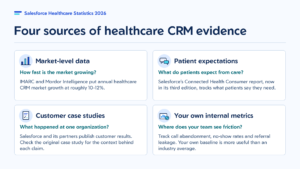
What you can reliably use are these categories of evidence:
- Market-level data from firms like IMARC and Mordor, which show the category is growing at roughly 10 to 12% a year.
- Patient-expectation data from Salesforce’s Connected Health Consumer reports, now in their third edition.
- Customer case studies published by Salesforce and its partners, which should be checked against the original source.
- Your own internal metrics, such as call abandonment, no-show rates and referral leakage, which matter more than any industry average.
Pro tip: Before presenting Salesforce Health Cloud statistics to your leadership team, build a one-page “source sheet” listing each number, who published it, the year and the sample size. It protects your credibility and makes approvals faster.
Healthcare Digital Transformation: What These Numbers Mean for Providers
Healthcare digital transformation is a heavy phrase, so let’s make it practical. Here is how the data translates into decisions for each leader.
-
For CEOs
The market is growing, patient expectations are rising and AI is entering the patient relationship whether you plan for it or not. Your job is to decide where trust and experience become a competitive advantage. Ask your team for a 12-month plan tied to measurable outcomes, such as access, retention and referral capture.
-
For CIOs
Cloud share and AI interest mean architecture decisions made now will last years. Prioritize platforms that integrate cleanly with your EHR, support strong data governance and keep AI auditable. Security and consent management should be designed from day one, not added later.
-
For Strategy Heads
The fastest growth is in patient information management and in smaller providers. That suggests the winners will be organizations that unify data early. Map your patient journey end to end and find the three points where patients most often drop off.
Real-World Scenarios: What Good Looks Like
The following are illustrative scenarios based on common patterns in healthcare CRM projects. The figures are hypothetical examples to show the process, not results from a named client.
Scenario 1: A Multi-Specialty Clinic Fixes Referral Leakage
The problem: A 12-location clinic group loses a share of outbound referrals because staff track them in spreadsheets and email.
The process:
- Build a single referral workflow in Health Cloud with automatic status updates.
- Send reminders to patients and referred specialists.
- Create a dashboard showing referrals sent, scheduled and completed.
Target outcome: Referral completion visibility within 60 days, and a measurable drop in referrals that never get scheduled.
Common mistake: Automating a broken process. Map the manual workflow first and fix the gaps before you build.
Scenario 2: A Regional Hospital Reduces No-Shows
The problem: Outpatient no-shows leave expensive gaps in the schedule.
The process:
- Segment patients by channel preference (WhatsApp, text, email or call).
- Trigger reminders at set intervals before the visit.
- Let patients confirm or reschedule in one step.
Target outcome: A lower no-show rate and fewer manual reminder calls, freeing staff for higher-value work.
Common mistake: Sending the same message to everyone. Preference-based outreach consistently feels more respectful and works better.
Want to know which of these scenarios fits your organization first? NSIQ Infotech can help you identify the highest-value use case and plan a focused pilot.
Common Mistakes to Avoid
Based on how these projects typically go, watch for these pitfalls:
- Buying a platform before defining the patient journey it should support.
- Treating AI as a standalone feature instead of connecting it to governed data and a human escalation path.
- Skipping change management, so clinicians and front-desk teams never adopt the tool.
- Launching across every department at once instead of proving value with one use case.
- Ignoring data quality. A CRM full of duplicate or outdated records will only automate confusion.
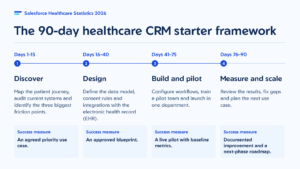
The 90-Day Healthcare CRM Starter Framework
| Phase | Timeline | Key Actions | Success Measure |
| 1. Discover | Days 1-15 | Map the patient journey, audit current systems, list top three friction points | Agreed priority use case |
| 2. Design | Days 16-40 | Define data model, consent rules and integrations with the EHR | Approved blueprint |
| 3. Build and Pilot | Days 41-75 | Configure workflows, train a pilot team, launch with one department | Pilot live with baseline metrics |
| 4. Measure and Scale | Days 76-90 | Review results, fix gaps, plan the next use case | Documented improvement and next-phase roadmap |
How NSIQ Infotech Helps Healthcare Providers Move From Data to Results
Reading statistics is easy. Turning them into a working patient experience is harder, especially when you have legacy systems, compliance requirements and busy clinical teams.
This is where an experienced Salesforce partner helps. At NSIQ Infotech, we work with healthcare organizations to plan, implement and optimize Salesforce Health Cloud so it fits real workflows rather than forcing staff to adapt to the software.
In practice, that usually means:
- Starting with a short discovery phase to find the highest-value use case.
- Connecting Health Cloud with your existing EHR and other systems so patient data is not scattered.
- Designing consent, privacy and security controls early, so compliance is built in.
- Training your teams and setting up dashboards, so you can see improvement in access, outreach and retention.
The benefit is a faster path to a unified patient view and fewer expensive rework cycles. If you are still weighing options, we are happy to share what we have seen work, with no obligation.
Frequently Asked Questions
-
How much of the healthcare CRM market is cloud-based?
According to Mordor Intelligence, cloud deployments held about 77.65% of the market in 2025.
-
Are there official Salesforce Health Cloud statistics on how many hospitals use it?
Salesforce does not publish a public adoption percentage for healthcare providers. Be careful with any article that quotes one without naming its source.
-
Do patients trust AI in healthcare?
Trust depends on who runs it. Salesforce’s research indicates patients trust their doctor’s AI agents about three times more than public AI.
-
Is Salesforce Health Cloud suitable for small clinics?
Yes, it can be. Mid-size and smaller providers are among the fastest-growing segments, and starting with one use case keeps cost and complexity manageable.
-
What should a provider do first when starting with Salesforce Health Cloud?
Pick one high-impact use case, such as referrals or appointment outreach. Map the current process, then build and pilot it before scaling.
Conclusion
The Salesforce healthcare statistics for 2026 point in one direction. The healthcare CRM market is growing steadily, cloud is the default, and patients want AI that is trustworthy, governed and connected to a real person.
Three takeaways are worth remembering:
- The market is expected to roughly double by the early 2030s, so waiting carries a real competitive cost.
- Patient information management is the fastest-growing use case, which makes a unified patient record the best place to start.
- Be careful with numbers. Cite named sources, and focus on your own metrics.
Your next step does not need to be big. Pick one friction point, map it, and pilot a fix in 90 days.