
Salesforce Health Cloud is becoming an important part of how healthcare organisations manage patient relationships, coordinate care, and improve their day-to-day operations.
From large hospital networks to specialised healthcare providers and insurance companies, organisations are using Health Cloud to address different operational challenges. While some focus on improving patient engagement, others use it to streamline referrals, manage enrolment, or provide better support to members.
However, the requirements are not the same for every organisation. Hospitals often need a unified view of patient information, smaller healthcare providers may prioritise scheduling and referral management, while health insurance companies focus more on enrolment and member services.
Let’s explore some real-world examples of organisations using Salesforce Health Cloud and understand how they are applying the platform to their business operations.
Hospitals and Healthcare Systems
Large hospital networks often manage information across multiple departments, applications, and communication channels. Bringing these systems together is essential for delivering a consistent patient experience.
Several healthcare organisations have adopted Salesforce Health Cloud to address these challenges.
Ochsner Health
Ochsner Health, a major healthcare provider in Louisiana operating more than 40 hospitals, faced challenges with disconnected digital communication systems.
Over time, the organisation had implemented several tools for patient communication, but these systems were not effectively connected.
Working with implementation partner Slalom, Ochsner developed a patient engagement solution using Salesforce Health Cloud and Marketing Cloud.
The results were significant:
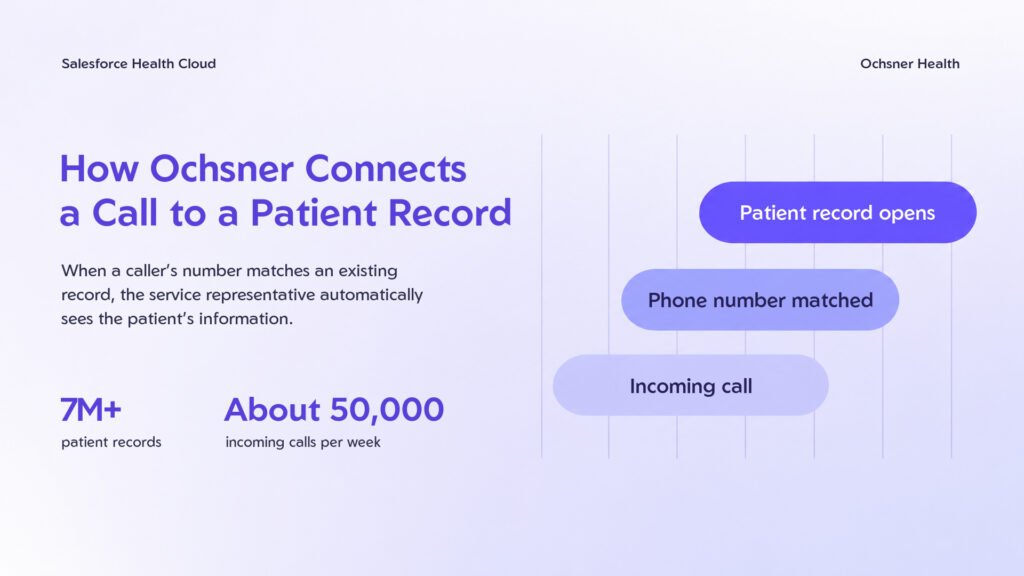
- Organised more than 7 million patient records.
- Supported approximately 50,000 incoming calls every week.
- Enabled service representatives to view patient information automatically when an incoming phone number matched an existing record.
- Brought marketing activities previously managed by an external vendor back in-house.
This implementation demonstrates how integrating patient data and communication channels can improve both operational efficiency and patient engagement.
UChicago Medicine
UChicago Medicine focused on improving how it communicates with patients.
Its access centre manages approximately 2.5 million enquiries annually. The organisation wanted to move away from sending generic communications to large patient groups and instead deliver more relevant, targeted messages.
To achieve this, it implemented Salesforce Health Cloud, Marketing Cloud, and Data 360.
Within four months, the organisation created 100 patient segments. One campaign achieved a conversion rate of 60%, and the hospital reported a return on investment in less than a year.
Looking ahead, UChicago Medicine is also exploring AI agents to handle non-clinical requests, including appointment scheduling, prescription refills, and directions.
Importantly, these AI agents are not intended to diagnose patients or respond to clinical questions.
Bon Secours Mercy Health
During the COVID-19 pandemic, Bon Secours Mercy Health needed a faster way to connect patients with healthcare support.
Using Salesforce Health Cloud, Marketing Cloud, and MuleSoft, the organisation connected patient information across systems and introduced a virtual triage chatbot in less than six days.
According to Salesforce, the solution reduced calls to the healthcare hotline by 80%.
This example highlights how Salesforce technology can help healthcare organisations respond quickly when patient communication requirements increase unexpectedly.
Penn State Health
Penn State Health serves more than four million patients across 29 counties.
The organisation used Salesforce Health Cloud, Experience Cloud, and Marketing Cloud to support virtual healthcare services, COVID-19 testing, and vaccination administration.
Its implementation demonstrates how Salesforce can support patient-facing digital experiences across a large healthcare network.
In-Home, Specialised, and Regional Healthcare Providers
Salesforce Health Cloud is not limited to large hospital networks. Smaller and specialised healthcare providers are also using the platform to improve specific business processes.
HarmonyCares
HarmonyCares is one of the largest providers of in-home physician services in the United States, supporting older adults and individuals living with chronic conditions.
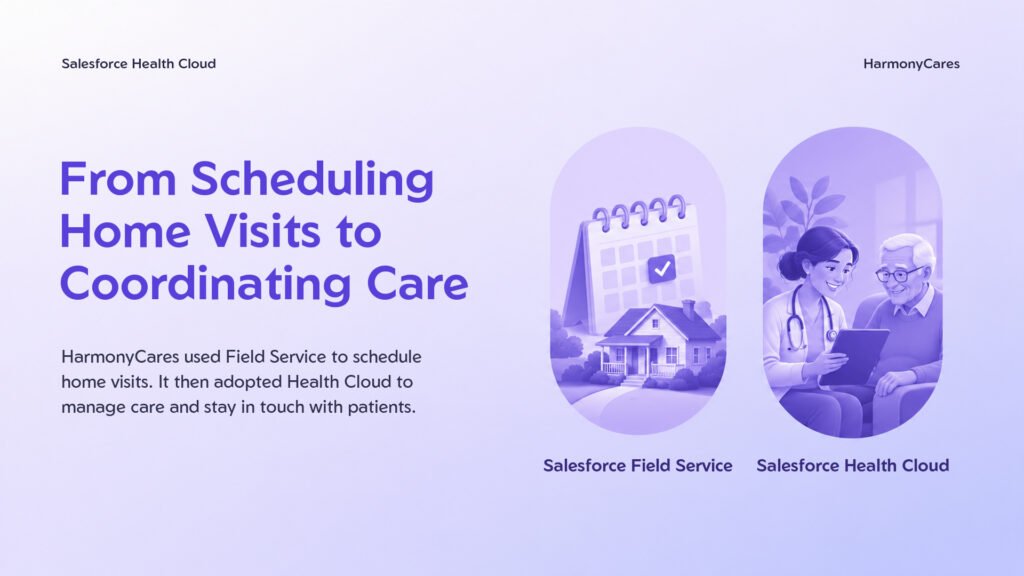
The organisation initially experienced success with a scheduling solution built on Salesforce Field Service.
Following that success, it expanded its Salesforce investment by adopting Health Cloud to scale its care management and patient engagement operations.
This is a good example of how organisations can begin with a focused business requirement and gradually expand their Salesforce implementation as their needs grow.
Tribeca Pediatrics
Tribeca Pediatrics, a paediatric healthcare practice, used Salesforce to improve its referral management and reporting processes.
Following implementation, the organisation reported a 33% reduction in the staff resources required to manage this work.
This demonstrates how even a focused Salesforce implementation can help healthcare providers reduce manual effort and improve operational efficiency.
Joint Replacement Programme – Nonprofit Healthcare System
A large nonprofit healthcare system partnered with Huron to improve its joint replacement programme.
Using Salesforce Health Cloud and Marketing Cloud, the organisation replaced manual processes that were previously managed separately across individual facilities.
The new solution introduced a more connected patient journey and provided nurse navigators with tools to manage patient care coordination.
The approach helped create a more consistent experience throughout the treatment process.
Vivekananda Hospital, India
Salesforce Health Cloud adoption is also gaining attention in the Indian healthcare market.
In July 2026, Vivekananda Hospital in Kolkata announced a collaboration with Salesforce.
The hospital is building its solution on the Agentforce 360 Platform and connecting it with its existing hospital information system.
Although the implementation is still developing and measurable results have not yet been published, it represents an interesting example of how Indian healthcare organisations are exploring Salesforce-based digital transformation.
Health Plans and Insurance Providers
Healthcare insurance companies have different requirements compared with hospitals and medical service providers.
Their priorities often include simplifying insurance enrolment, managing member information, improving benefits administration, and making renewals easier.
Salesforce supports these requirements through its broader healthcare capabilities, including Health Cloud and OmniStudio.
However, publicly available examples specifically demonstrating Health Cloud implementations among health plans are relatively limited.
Rural Healthcare System – Health Plan Division
One notable example involves the health plan division of a large rural healthcare system with more than 200,000 members.
The organisation faced challenges with a slow and largely manual insurance purchasing process.
Working with implementation partner Perficient, it developed a digital portal that guides consumers through the insurance marketplace while bringing consumer and insurance plan information together.
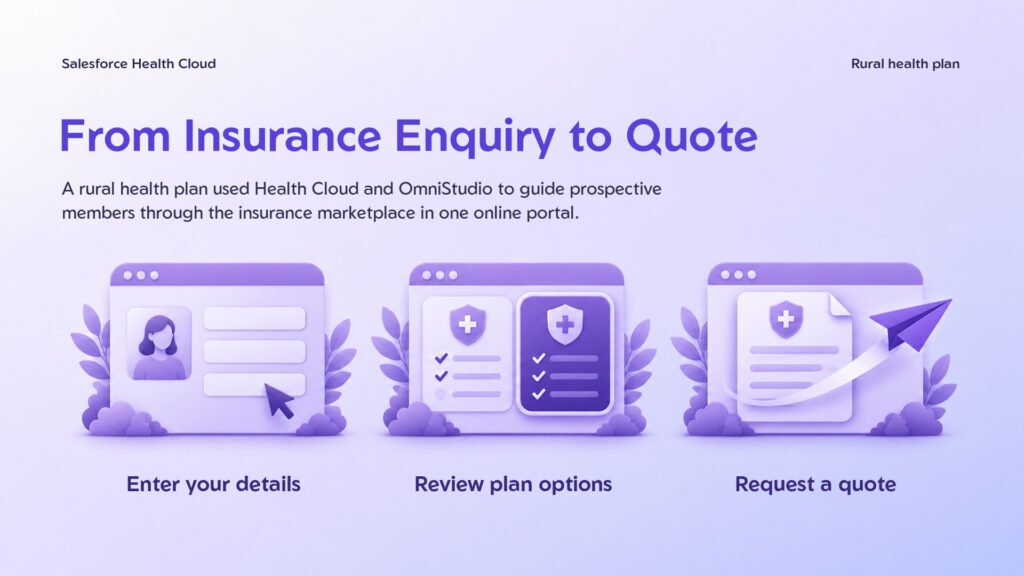
The solution used Salesforce Health Cloud and OmniStudio.
According to Perficient, the implementation helped reduce administrative costs and improve lead-to-quote turnaround time. However, specific performance figures have not been published.
Regional Health Insurance Payer
Another example comes from AArete, which describes a project involving a regional healthcare payer.
The organisation implemented an analytics platform built on Salesforce Health Cloud to improve access to business information and support decision-making.
As with the previous example, detailed performance metrics are not publicly available.
What About Humana and UnitedHealthcare?
Large healthcare organisations such as Humana and UnitedHealthcare are also associated with Salesforce.
However, it is important to distinguish between using Salesforce’s broader platform and specifically implementing Health Cloud.
- Humana: Operates HumanaPharmacy.com using Salesforce B2C Commerce.
- UnitedHealthcare: Approximately 9,600 employees use Salesforce to support personalised member services.
Both organisations are Salesforce customers, but their publicly available customer stories do not specifically identify these implementations as Health Cloud use cases.
Therefore, they should not be presented as confirmed Health Cloud implementations.
What Can Healthcare Organisations Learn From These Implementations?
Looking across these customer examples, a few important patterns emerge.
Start with a specific business problem.
Most organisations did not begin by implementing every available Salesforce healthcare feature. Instead, they started with a particular requirement, such as appointment scheduling, referral management, patient engagement, or insurance enrolment.
Once the initial implementation delivered value, they expanded the solution to support additional business processes.
Integration plays an important role.
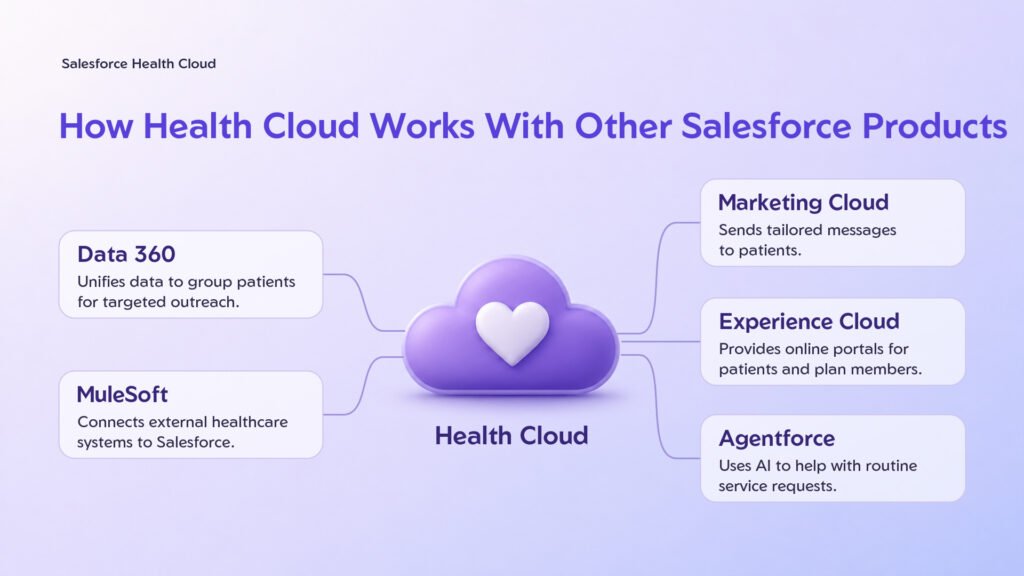
Health Cloud is rarely implemented as a standalone solution. Organisations often combine it with other Salesforce products, including:
- Marketing Cloud for patient communication and engagement.
- MuleSoft for connecting external healthcare systems.
- Data 360 for bringing data together and supporting segmentation.
- Experience Cloud for building patient and member portals.
- Agentforce for supporting selected service processes through AI.
Measure operational improvements.
The publicly reported results mainly focus on improvements such as reduced call volumes, faster processing, better campaign conversion, and reduced administrative effort.
These are useful indicators when evaluating the success of a healthcare technology implementation.
At the same time, organisations should avoid assuming that improvements in operational efficiency automatically translate into better clinical outcomes.
Four Questions to Consider Before Implementing Salesforce Health Cloud
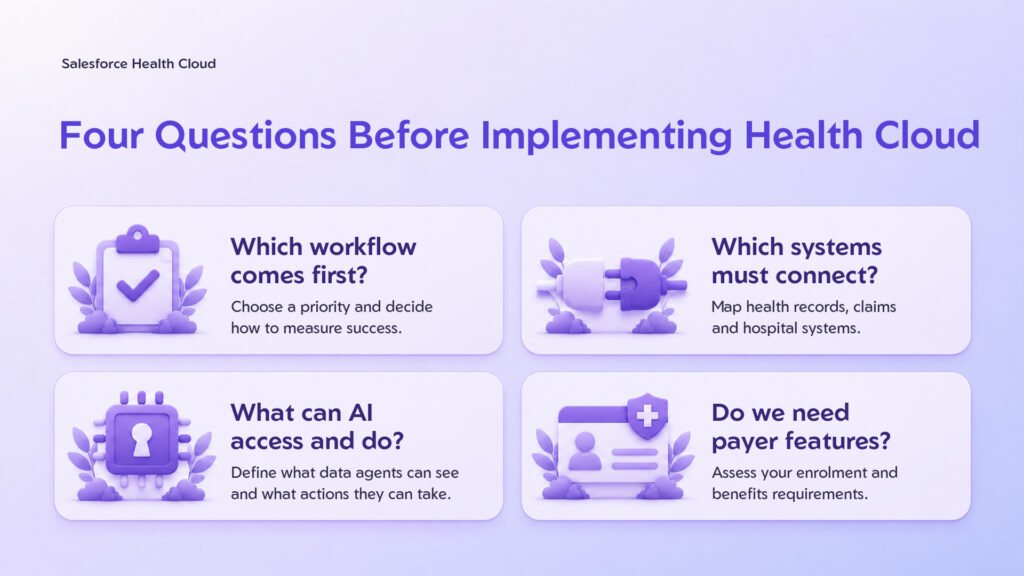
If your organisation is evaluating Salesforce Health Cloud, it is worth addressing a few important questions before moving forward.
Which business process should be implemented first?
Identify one high-priority workflow, such as patient scheduling, referrals, care coordination, or member enrolment. Define how its success will be measured.
Which existing systems need to be integrated?
Consider your Electronic Health Record (EHR), claims systems, hospital information systems, and other applications. Also, establish clear ownership of integration activities.
How will patient data be used with AI?
Define which information AI agents can access, what actions they can perform, and where appropriate security and governance controls must be applied.
Does your organisation actually need Health Cloud’s payer capabilities?
If you operate a health insurance business, evaluate whether Health Cloud’s specialised payer features are necessary or whether the wider Salesforce platform can meet your requirements.
Conclusion
Salesforce Health Cloud offers healthcare organisations an opportunity to bring patient information, communication, and operational workflows into a more connected environment.
The examples discussed in this article show that its value is not limited to large hospitals. Specialised healthcare providers, regional organisations, and health insurance businesses can also use Salesforce to address specific operational challenges.
The most practical approach is to start with a clearly defined business requirement, integrate the systems that matter, and measure the results before expanding further.
One final point worth remembering: public customer success stories are useful for understanding what is possible, but they do not tell the entire story. Before making an investment decision, speak with implementation partners, request relevant customer references, and understand how long it took other organisations to achieve their reported results.
A successful Health Cloud implementation is not simply about adopting new technology. It is about choosing the right processes, connecting the right information, and creating a better experience for patients and healthcare professionals.