
The Salesforce project went live a while ago. Licences are paid. Reps are logging calls. Then the CFO leans back and asks the question everyone was hoping to avoid: “So what did we actually get for this?”
Silence. Somebody mentions adoption rates. Somebody else mentions dashboards. Nobody mentions money.
We’ve watched this scene play out more than once, and it’s almost never because Salesforce failed. It’s because the business bought a sales diary when it needed a nervous system.
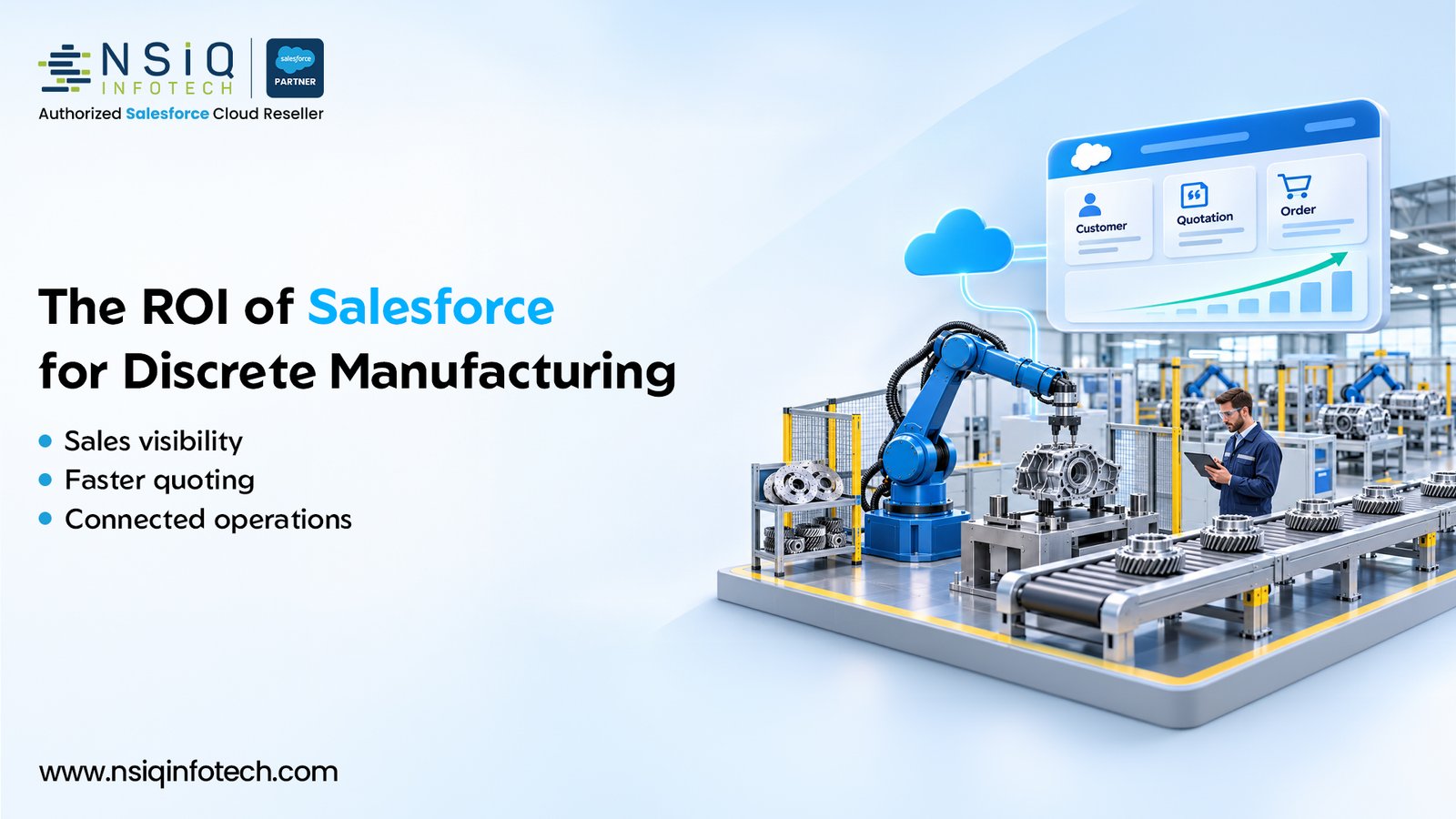
Here’s the truth most vendors won’t put on a slide: Salesforce for discrete manufacturing ROI doesn’t come from reps logging calls. It comes from the moment your front office stops working in isolation and finally connects to the rest of the business. That means the ERP, the shop floor, the service van and the dealer network. When enquiries, quotes, orders, shipments, invoices and service cases all point to one customer record, the hidden waste becomes visible. Then it becomes fixable.
This guide shows you exactly where those returns hide, and how to go and get them.
The quick answer
Salesforce pays off in discrete manufacturing when it connects sales, production, finance, service and dealers around one customer record. The returns come from fewer lost enquiries, quotes that match invoices, forecasts everyone trusts, first-visit service fixes and a healthier dealer channel. Many manufacturers start with Sales Cloud and add Manufacturing Cloud when they need customer agreements and account-based forecasting.
Key Takeaways
- Connection beats features. The value lives in the links between sales, ERP, service and dealers.
- Sales Cloud is a powerful first step for tracking every enquiry, quote, order and invoice in one place.
- Manufacturing Cloud is the next level for run-rate business, customer agreements and serious forecasting.
- Salesforce sits on top of your ERP. It never replaces it.
- No baseline, no proof. Record how things work today, or you’ll never prove the return tomorrow.
The expensive problems hiding in plain sight
Most ROI conversations in discrete manufacturing go wrong for one simple reason. They start with the cost per user, when they should start with the cost of the mess.
That mess rarely shows up on a budget line. But it costs you every single month. You’ll probably recognise a few of these characters:
- The ghost enquiry. A promising lead lands in a shared inbox, gets forwarded twice, and quietly dies. The customer buys from a competitor who simply replied first.
- The wrong-price quote. A rep sends a quote built on last quarter’s price list. The invoice says something else. Now finance is issuing credit notes and the customer is asking awkward questions.
- The spreadsheet forecast. Sales has one number. Finance has another. The plant has a third. Someone loses days stitching them together, and by the time they’re done, the forecast is already out of date.
- The second truck roll. A technician drives out to a site without the machine’s history or the right part. Then drives back. Then drives out again.
- The silent dealer. A distributor stops pushing your product. Nobody noticed, because nobody could tell them where their rebate stood.
None of these feel dramatic on their own. Together, they’re where your margin goes to disappear. And every one of them is a front-office problem that connected data can fix.
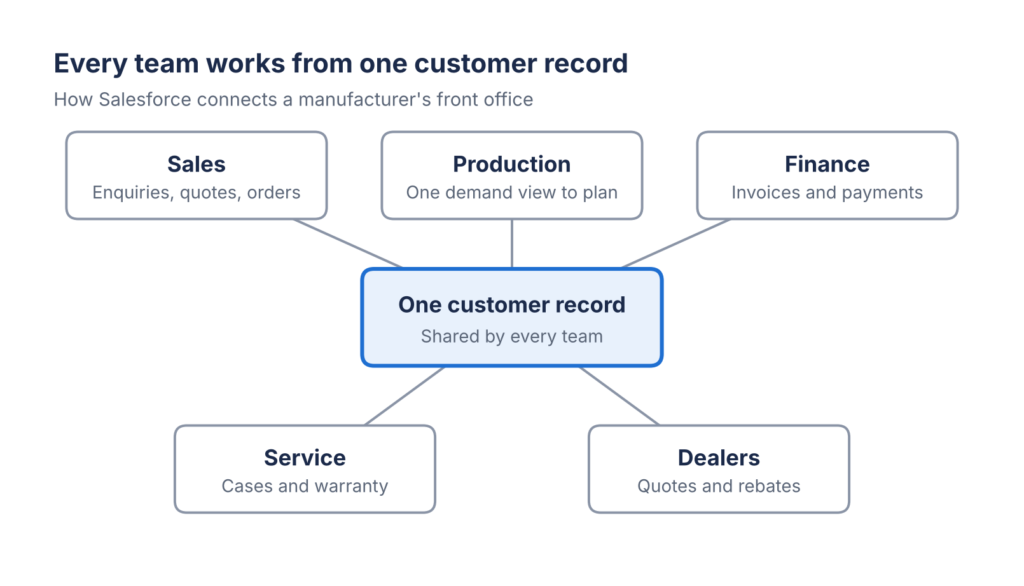
One customer record. Every team on the same page.
Sales Cloud or Manufacturing Cloud? Start where you sell
This is the question we hear most from manufacturing leaders. The honest answer: it depends on how your money comes in.
| Start with Sales Cloud when… | Step up to Manufacturing Cloud when… | |
| How you sell | Project by project, order by order | Through long-term agreements and repeat orders |
| Your biggest pain | Lost enquiries, messy quotes, no order visibility | Forecasts that don’t match reality |
| What you need most | A clean enquiry-to-invoice journey | Sales agreements and account-based forecasting |
| Pricing | Standard price books and discounts | Contract prices, volume breaks and dealer tiers |
Sales Cloud: your fastest win
Salesforce Sales Cloud is where many manufacturers should begin, especially those who sell to other businesses deal by deal. It lets you map your real customer journey, in your own factory’s language:
- Enquiry: every lead gets a source, an owner and a status. No more ghosts.
- Opportunity: deals move through the stages your team actually uses, like sampling, technical approval or price negotiation.
- Quote: one clear version, built from saved products and prices, sent as a PDF in a click.
- Order: sales sees whether an order is confirmed, in production or ready to ship, without phoning the plant.
- Dispatch and invoice: courier details, delivery status and payment status, all on the same record.
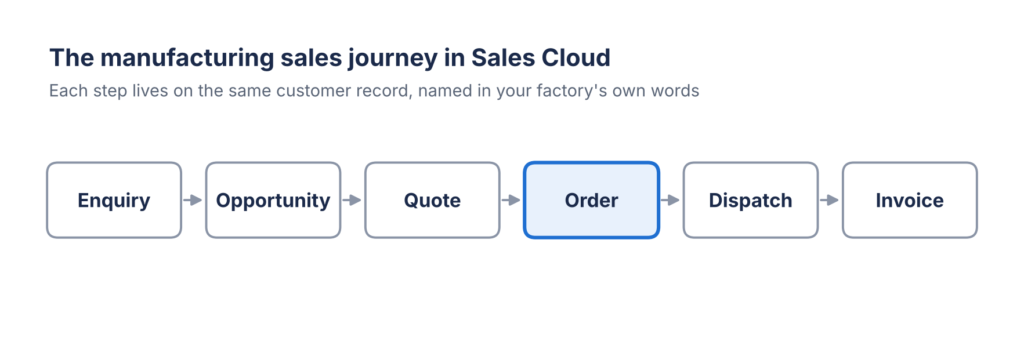
The full manufacturing sales journey, mapped in Sales Cloud.
This is exactly what we help manufacturing clients achieve. The moment sales stops ringing the plant to ask “where’s my order?”, you feel the difference across the whole business.
Manufacturing Cloud: built for run-rate business
Salesforce Manufacturing Cloud sits on top of Sales Cloud and Service Cloud. It adds the muscle that discrete manufacturers with contract-based business really need:
- Sales agreements that put what a customer promised right next to what they actually ordered.
- Account-based forecasting that builds one forecast per customer from agreements, open deals and ERP history.
- Advanced pricing designed for contract prices, volume breaks and dealer tiers.
- Warranty and service features that connect assets, cases and claims.
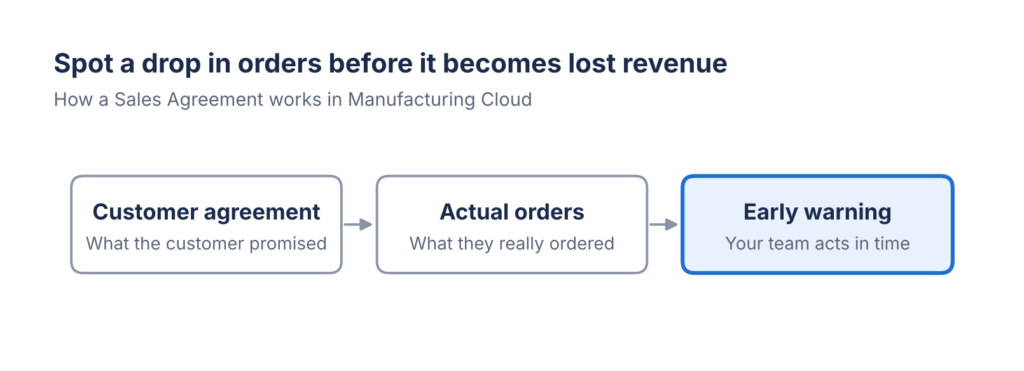
Sales agreements turn a nasty surprise into an early warning.
The smart path for many companies? Start with Sales Cloud, get the basics humming, then add Manufacturing Cloud when the business is ready for it.
Where the money actually comes from
1. From enquiry to invoice, without the chasing
The quickest return is often the least glamorous one. When every enquiry is logged and owned, fewer opportunities slip away. When quotes come from one system, customers stop receiving the wrong version. And when sales can see order status for themselves, they spend their time selling instead of chasing.
It won’t make headlines. It will make money.
2. Quotes that match the invoice, every time
Discrete manufacturing pricing is a maze of contract prices, volume discounts, dealer tiers, surcharges and regional lists. When the quote comes from a spreadsheet and the invoice comes from the ERP, every gap between them becomes a dispute, a credit note or margin that finance quietly writes off.
Get the price right at the moment the order is taken, and the disputes dry up. Cash comes in faster. And your best customers stop getting calls they never wanted.
3. One forecast everyone finally trusts
Here’s a secret: most discrete manufacturers don’t have a forecasting problem. They have a reconciliation problem.
Sales agreements and account-based forecasting end the tug-of-war. Sales, finance and production plan from the same customer-level number. A key account that starts ordering less shows up early, while there’s still time to act. The plant plans with confidence. And less stock sits in the warehouse “just in case.”
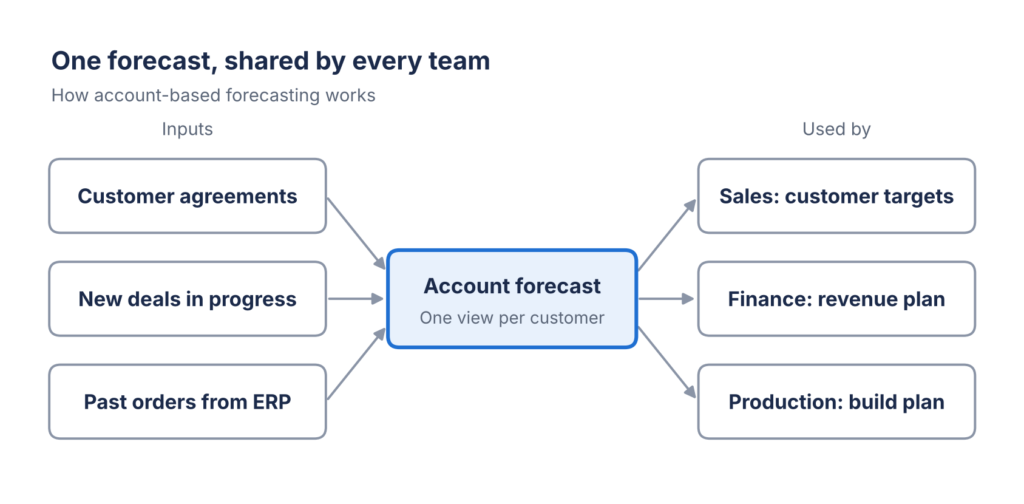
One forecast, shared by sales, finance and production.
4. Fix it on the first visit
Every repeat service visit is a cost nobody budgets for. There’s the extra drive, the extra technician-hour and the customer whose patience wears thinner each time.
With Salesforce Field Service, technicians arrive knowing the machine’s history, the open case and whether the right part is already on the van. Even on a remote site with no signal, the mobile app keeps working. For equipment makers, this is where service stops being a cost centre and starts becoming a steady income stream.
5. Turn your dealers into your best sales team
For many manufacturers, the channel is where revenue quietly leaks away. Rebates live in spreadsheets. Warranty claims arrive by email. And nobody can say what’s sitting in distributor stock right now.
A partner portal built on Experience Cloud changes the relationship. Dealers can request quotes, register deals, file warranty claims and check their rebate progress themselves. Channel Revenue Management adds structured rebate programs and price protection, and it tracks channel inventory. Your dealers get answers without calling you, and you stop paying claims you shouldn’t.
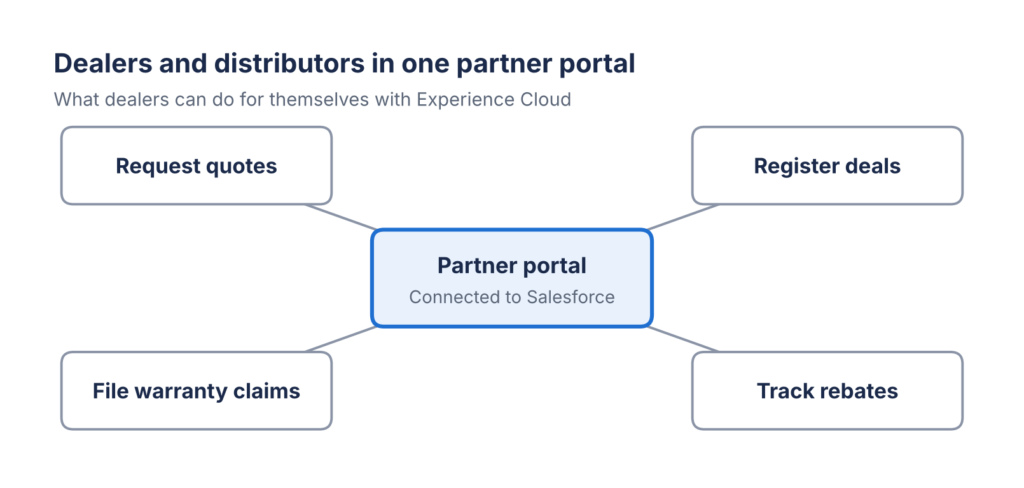
Give dealers self-service, and they give you more of their attention.
The return you lose by waiting
This is the one CFOs forget. Every month a rollout drags on is another month of licence fees with nothing flowing back.
Forrester’s commissioned study of Salesforce Professional Services found 272% ROI and $6.0M NPV over three years for a composite organisation. It’s an engagement-level number, not a product-only claim, but a useful anchor for what’s possible when rollout is done right.
The manufacturers who see returns fastest share the same habits. They keep the first phase small, use standard features before custom code, and put something useful in front of users early. Then they build on the win.
“Software doesn’t change habits. People do. Every successful rollout we’ve seen had a business owner, not just IT, who made adoption their personal mission.”
The scorecard your CFO will ask for
Measurement has to start before the project does. Without a baseline, the ROI conversation turns into a debate about opinions.
| What to measure | What it reveals | Where today’s data lives |
| Enquiry response time | How fast new leads hear back | Email inboxes, sales team |
| Quote turnaround | How quickly an accurate quote goes out | Quote files, sales team |
| Order status chasing | How often sales has to call the plant | Calls and emails to operations |
| Invoice disputes and credit notes | What pricing errors really cost | Accounts receivable |
| Forecast accuracy by customer | Whether the forecast matches real orders | ERP order history |
| First-time fix rate | How often service jobs close on the first visit | Service tickets |
| Warranty claim time | How long dealers wait to be paid | Warranty inbox, ERP |
Don’t track everything. Pick the measures that hurt most today. A short scorecard your leadership actually reads beats a dashboard nobody opens.
The business case on a single page
If you’re presenting this to the board, here’s the argument in four lines:
- Salesforce is your front office, not your ERP. Your ERP keeps orders, inventory, costing and finance. Salesforce gives sales, service and partners a clear view of that data and a place to act on it. The connection between the two is the heart of the project, so budget for it properly.
- Start small. Win fast. Then grow. Pick the sharpest pain, whether that’s enquiry-to-order in Sales Cloud, forecasting for key accounts or field service in one region. Prove the value, then expand.
- Count every cost, honestly. That means licences, setup, ERP connection, data clean-up, training and support. A business case that hides costs won’t survive its first review.
- Name an owner in the business. Technology goes live. People make it pay.
Mistakes that quietly kill ROI
- Buying for someday. Start with the processes that hurt today, not features you might need later.
- Pouring old spreadsheets into a new system. Fix the process first, then build it.
- Skipping the ERP connection. Without order and shipment data, sales is still phoning the plant.
- Using generic stage names. Say “In Production” and “Ready to Ship.” People adopt words they recognise.
- Forgetting the baseline. You can’t prove improvement without a starting point.
Is your business ready? A quick self-check
Before you book anything, ask your team these questions honestly:
- Do we lose track of enquiries between the inbox and the sales team?
- Do quotes and invoices ever disagree on price?
- Does sales have to call the plant to find out where an order stands?
- Do sales, finance and production work from different forecasts?
- Do technicians ever arrive without the right part or history?
- Do dealers chase us for rebate and warranty updates?
If you answered yes to even a couple of these, the returns are already sitting in your business, waiting to be collected.
See your returns with your own eyes
Reading about ROI is one thing. Seeing it built around your own business is another.
Book a Salesforce for discrete manufacturing demo with our team, and we’ll walk through it using your enquiry flow, your pricing rules, your order stages and your service process. No generic pipelines. No sales theatre. Just a clear view of where Sales Cloud and Manufacturing Cloud would pay off for you, and which measures will prove it.
Book your Salesforce for discrete manufacturing demo: Let’s Talk
Frequently Asked Questions
1. What is the ROI of Salesforce for discrete manufacturing?
The return comes from operational improvements, not from the CRM by itself. It shows up as fewer lost enquiries, quotes that match invoices, better forecasts, faster service and a healthier dealer channel. The best way to know your ROI is to measure these areas before and after rollout.
2. Can a manufacturer use Sales Cloud instead of Manufacturing Cloud?
Yes. Many manufacturers start with Sales Cloud to track enquiries, quotes, orders, dispatch and invoices in one place. Manufacturing Cloud adds sales agreements, account-based forecasting and advanced pricing for businesses with long-term customer contracts.
3. Does Salesforce replace ERP?
No. Your ERP stays in charge of orders, inventory, costing and finance. Salesforce connects to it and gives sales, service and partners a clear front-office view.
4. How long does Salesforce take to show ROI in manufacturing?
It depends on scope. A small, focused first phase, such as enquiry-to-order tracking or forecasting for key accounts, shows results much sooner than a large, all-at-once rollout.
5. We already have an ERP. Do we really need Salesforce?
Yes, because they do different jobs. Your ERP runs the business: orders, inventory, costing and finance. Salesforce connects your front office, meaning sales, service and dealers, to that ERP data so they can act on it. One keeps the books straight. The other keeps customers moving. They work together, not instead of each other.