
Introduction: The Customer Churn Crisis in Retail & E-Commerce
You have spent weeks and thousands of dollars acquiring a new customer. They browse your store, add items to their cart, and complete a purchase. Then they never come back.
Sound familiar?
You are not alone.
Customer churn is one of the most costly, yet preventable, challenges facing retail and e-commerce brands today.
Customers do not leave because of price alone. They leave because of broken experiences:
- A support ticket ignored for 48 hours
- A complaint sent on Instagram that received no response
- An order issue that required multiple phone calls to resolve
The frustration is not with your product.
It is with your customer experience.
This is precisely where a strong customer retention strategy backed by Salesforce Omni-Channel changes the game.
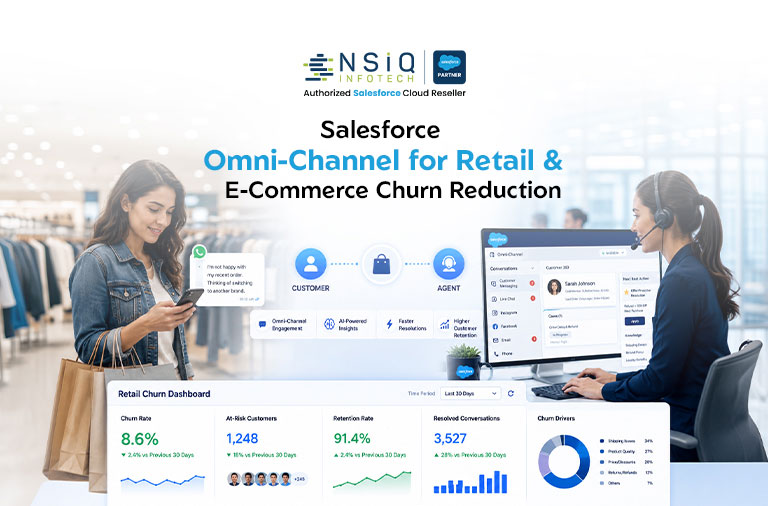
Salesforce Omni-Channel is not just a support tool — it is a complete ecosystem that unifies every customer touchpoint, routes the right queries to the right agents, and empowers your team to resolve issues faster, smarter, and more personally.
In this blog, we will walk you through exactly how Salesforce Omni-Channel reduces customer churn for retail and e-commerce businesses, what its key features are, how it compares to traditional support models, and why making this investment in customer retention will directly impact your bottom line.
Whether you are a Retail CMO, an E-Commerce Head, or a CX Leader, this guide is written for you.
Understanding Customer Churn in Retail and E-Commerce
Before discussing solutions, it is important to understand the problem.
Customer churn (or customer attrition) is the rate at which customers stop doing business with your brand.
In retail and e-commerce, churn often appears quietly:
- Customers stop opening emails
- They stop visiting your website
- They begin purchasing from competitors
Common Causes of Customer Churn
Poor Customer Service Experiences
- Long wait times
- Unresolved issues
- Generic or robotic responses
Disconnected Communication Channels
The left hand does not know what the right hand said.
Lack of Personalization
Customers feel like account numbers rather than people.
Reactive Support
Organizations respond only after a problem escalates.
89% Customer Retention Opportunity
Key Takeaway
If your customer service infrastructure cannot deliver:
- Fast support
- Consistent experiences
- Personalized engagement
Then it is actively contributing to customer churn.
The answer is not necessarily hiring more agents.
The answer is enabling your team with better tools.
What Is Salesforce Omni-Channel? (Plain-English Explanation)
Salesforce Omni-Channel is a feature within Salesforce Service Cloud that automatically routes customer inquiries from any channel to the most qualified available agent in real time.
Supported channels include:
- Live Chat
- Phone
- SMS
- Social Media
Think of it as an intelligent air traffic controller for your customer service operation.
Instead of:
- Agents manually checking inboxes
- Customers waiting in the wrong queue
- Conversations getting lost
Omni-Channel ensures every interaction reaches the right person immediately.
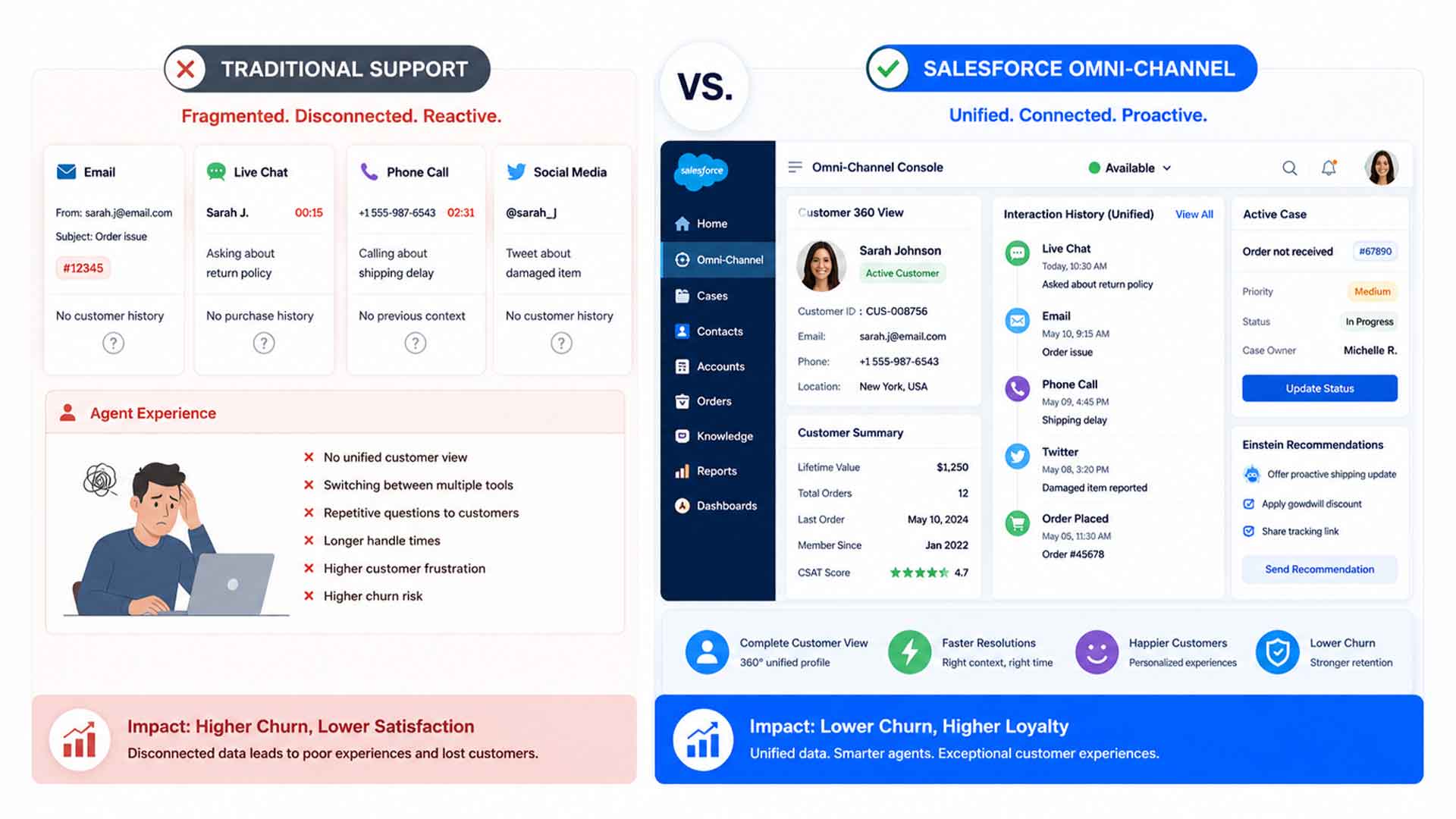
Traditional Multichannel vs Omni-Channel
Traditional Multichannel
- Channels operate independently
- Customer history is fragmented
- Teams work in silos
- Customers repeat themselves
Salesforce Omni-Channel
- Unified customer view
- Shared customer history
- Connected communication channels
- Seamless customer experience
The result:
- Faster resolutions
- Less repetition
- Higher customer satisfaction
Pro Tip
Salesforce Omni-Channel supports intelligent workload balancing.
The platform monitors:
- Agent availability
- Capacity
- Active workload
This helps reduce average response times by 30–40% in large retail operations.
How Salesforce Omni-Channel Directly Reduces Customer Churn
1. Eliminates the “Start Over” Problem
One of the biggest reasons customers leave is having to repeat themselves.
Salesforce Omni-Channel solves this through a unified customer timeline.
Every interaction is:
- Logged
- Visible
- Accessible
Customers explain their issue once.
Future conversations continue exactly where the last interaction ended.
2. Speed Becomes a Retention Tool
Customers expect instant support.
Salesforce Omni-Channel uses intelligent routing to automatically send inquiries to the most appropriate available agent.
Benefits
- Faster response times
- Reduced queue backlog
- Improved customer trust
- Higher retention rates
When customers feel heard quickly, they are far more likely to remain loyal.
3. Proactive Outreach Before Churn Happens
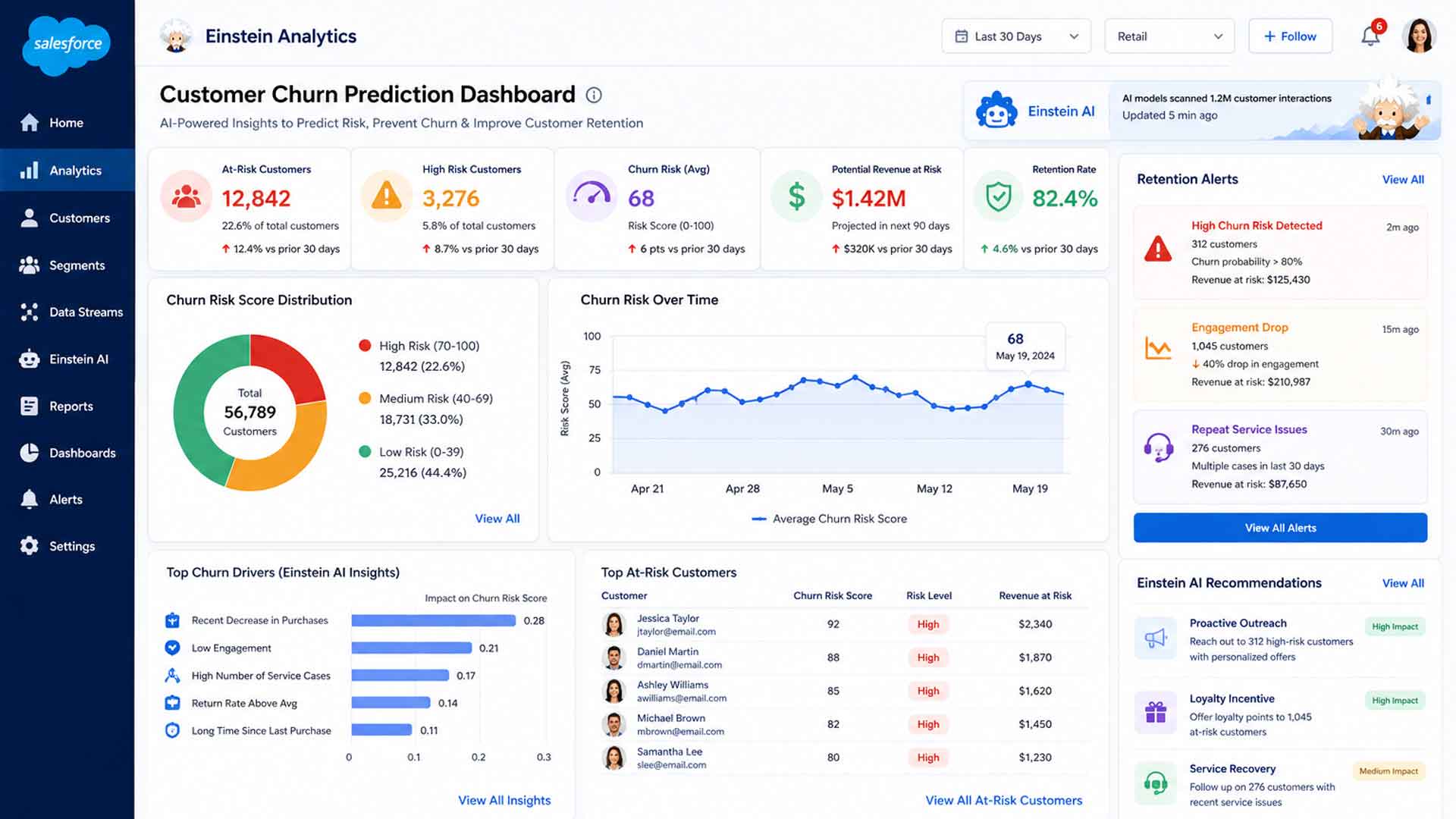
When paired with Salesforce Einstein AI, Omni-Channel becomes a predictive retention engine.
The platform identifies churn signals such as:
- Reduced order frequency
- Declining engagement
- Unresolved support issues
Automated actions can then trigger:
- Personalized emails
- Loyalty rewards
- Discount offers
- Proactive outreach
This shifts retention from reactive damage control to proactive relationship building.
4. Personalization at Scale
Customers remember how brands make them feel.
Salesforce Omni-Channel gives agents access to:
- Purchase history
- Loyalty status
- Preferences
- Previous interactions
Every conversation becomes more relevant and personalized.
Key Features of Salesforce Omni-Channel That Drive Retention
Intelligent Case Routing
Cases are automatically assigned based on:
- Agent expertise
- Current workload
- Priority level
Examples:
- VIP customers → Retention specialists
- Product issues → Technical experts
- New customer questions → Onboarding teams
Unified Agent Console
Agents work from a single interface containing:
- Customer information
- Order history
- Cases
- Chat conversations
- Social interactions
Benefits:
- Higher productivity
- Fewer mistakes
- Better customer experiences
Einstein AI & Predictive Churn Detection
Salesforce Einstein continuously analyzes behavior patterns.
The system can:
- Calculate churn risk
- Trigger retention campaigns
- Recommend next best actions
This transforms retention from reactive to predictive.
Real-Time Supervisor Dashboard
Managers gain visibility into:
- Queue lengths
- Agent performance
- Customer wait times
- Service levels
This enables rapid intervention before customer experience deteriorates.
Seamless Channel Escalation
Customers can move between:
- Phone
- Chat
without losing context.
The next agent already understands the situation.
The experience remains seamless.
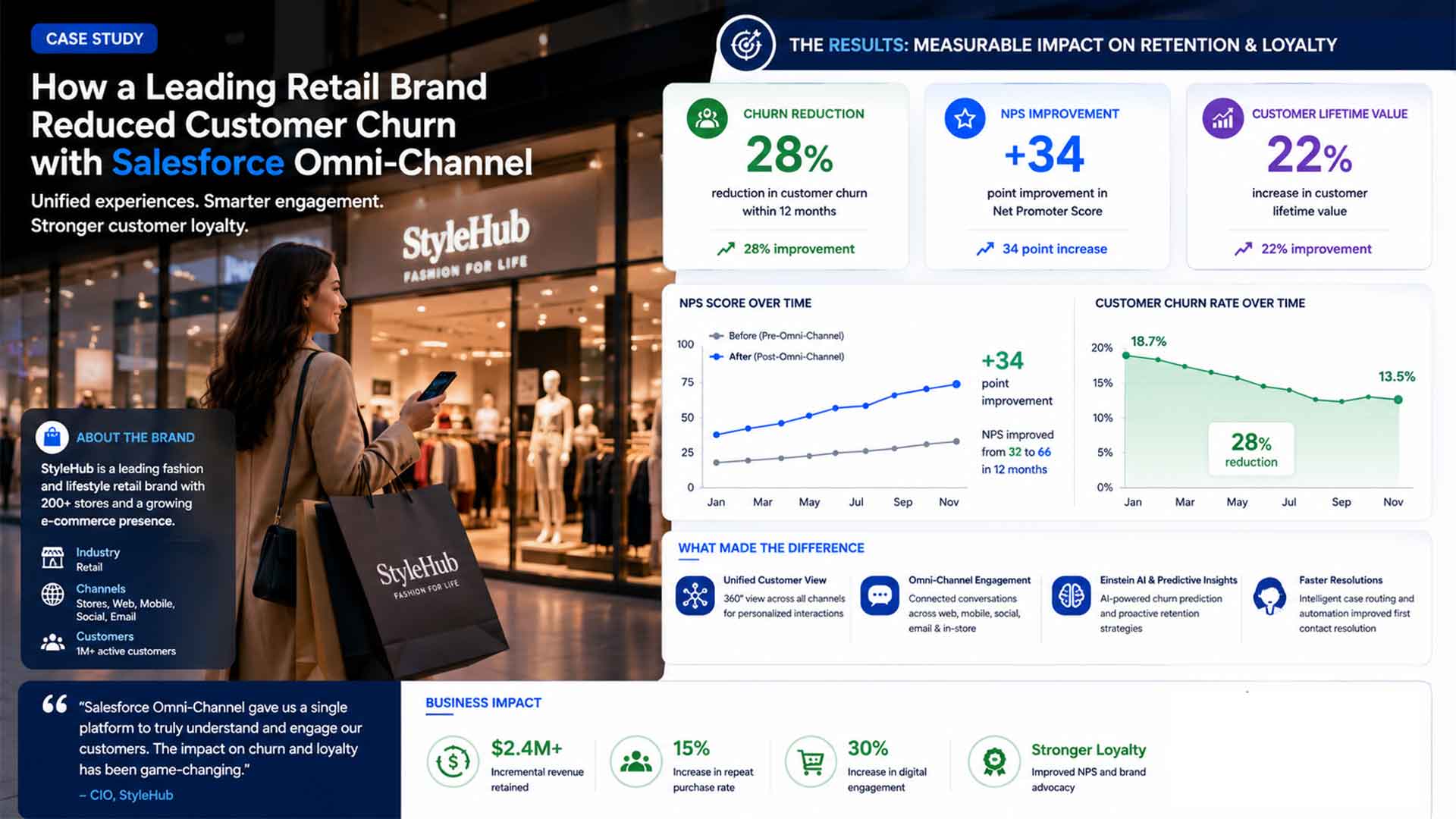
Real-World Example: Retail Brand Reduces Chrnu by 28%
Mini Case Study
A mid-sized UK fashion retailer was losing approximately 22% of repeat customers annually.
Their support operation relied on:
- Legacy CRM
- Phone support
Average first-response time was 14 hours.
Customer satisfaction scores were falling.
After Implementing Salesforce Omni-Channel
The company unified all channels within Salesforce Service Cloud.
Einstein AI identified unresolved cases older than six hours and automatically triggered:
- Escalations
- Apology emails
- Discount vouchers
Results Within Two Quarters
- First-response time reduced from 14 hours to under 2 hours
- CSAT improved by 31%
- Customer churn decreased by 28%
- Repeat purchases increased by 19%
ROI
The Salesforce investment paid for itself within 8 months.
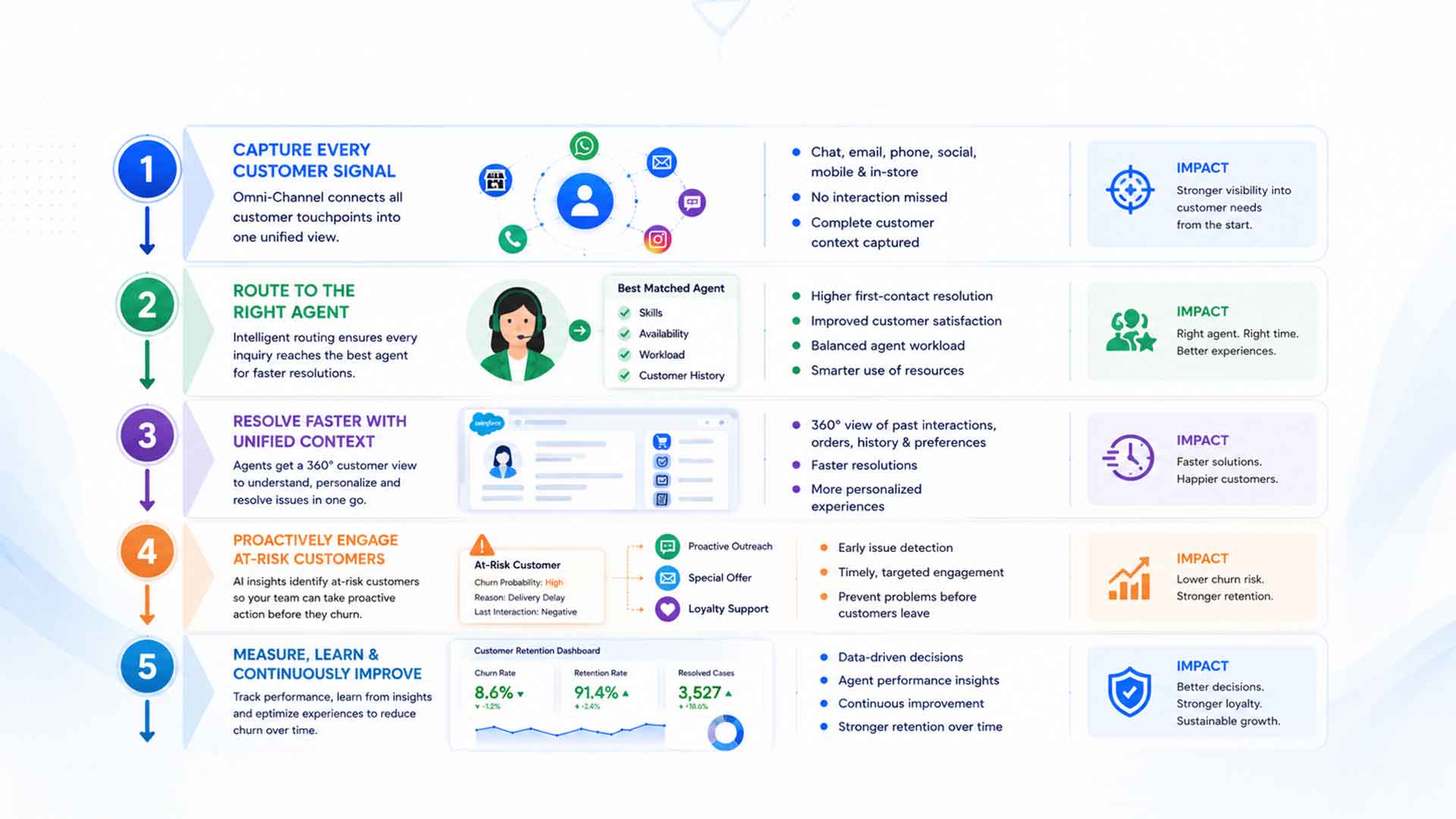
The 5-Step Omni-Channel Churn Reduction Framework
Step 1: Unify All Channels
Connect:
- Chat
- Social
- SMS
- Phone
into one Salesforce environment.
Step 2: Route Intelligently
AI assigns cases according to:
- Skill
- Capacity
- Customer history
Step 3: Detect Churn Signals
Einstein Analytics identifies at-risk customers in real time.
Step 4: Engage Proactively
Launch personalized retention campaigns before customers leave.
Step 5: Measure & Optimize
Track:
- CSAT
- Churn
- Resolution times
- Repeat purchases
and continuously improve performance.
Common Mistakes Retail & E-Commerce Brands Make
Many organizations unintentionally increase churn by:
- Treating channels independently
- Routing all cases into one queue
- Waiting for complaints
- Measuring volume instead of quality
- Ignoring customer feedback loops
- Underinvesting in training
Salesforce Omni-Channel directly addresses these challenges when implemented correctly.
How NSIQ INFOTECH Helps Retail & E-Commerce Brands
At NSIQ INFOTECH, we help retail and e-commerce organizations implement Salesforce Omni-Channel as part of a broader customer retention strategy.
Our Process
Discovery & Audit
Identify churn risks and CX gaps.
Omni-Channel Architecture
Configure routing and workflows tailored to your business.
Einstein AI Setup
Implement predictive churn monitoring and retention automation.
Agent Training
Ensure rapid adoption and productivity.
Continuous Optimization
Monitor:
- Churn Rate
- CSAT
- First Response Time
- Repeat Purchases
and refine continuously.
Most clients see measurable retention improvements within 90 days.
Ready to Stop Losing Customers?
Partner with NSIQ INFOTECH to implement Salesforce Omni-Channel and build a customer retention strategy that delivers measurable ROI.
Book Your Free Consultation Today
Q1. What is Salesforce Omni-Channel and how does it work?
Salesforce Omni-Channel automatically routes customer inquiries from any channel to the most qualified available agent in real time.
Q2. How does Salesforce Omni-Channel help reduce customer churn?
It improves response times, personalizes support, enables proactive engagement, and provides a unified customer experience.
Q3. Is Salesforce Omni-Channel suitable for small e-commerce businesses?
Yes. It scales from small businesses to enterprise organizations.
Q4. What channels does Salesforce Omni-Channel support?
Email, chat, phone, SMS, WhatsApp, social media, and custom digital channels.
Q5. How does Einstein AI help with retention?
Einstein identifies churn risks and triggers personalized retention actions automatically.
Q6. What is the difference between multichannel and omni-channel support?
Multichannel uses disconnected channels. Omni-channel connects all channels into one unified experience.
Q7. How long does implementation take?
Typically 6–12 weeks depending on complexity.
Q8. Can Omni-Channel integrate with Shopify, Magento, or WooCommerce?
Yes. Salesforce integrates with major e-commerce platforms.
Q9. What metrics should I track?
Track churn rate, CSAT, NPS, first-response time, first-contact resolution, and repeat purchase rate.
Q10. How does Omni-Channel improve agent productivity?
It eliminates manual routing, reduces switching between systems, and provides complete customer context.
Q11. What is the ROI?
Many businesses recover implementation costs within 6–12 months through improved retention and efficiency.
Q12. Is training required?
Yes. Proper training ensures successful adoption and maximum value.
Q13. Can responses be automated?
Yes. Salesforce Chatbots and Flow can automate common inquiries.
Q14. How is Omni-Channel different from a traditional helpdesk?
It supports all channels, AI-powered routing, CRM integration, and predictive insights.
Q15. How do I get started?
Contact NSIQ INFOTECH for a consultation and implementation assessment.
Conclusion: Your Customer Retention Strategy Starts Here
Customer churn rarely happens because of a single bad interaction.
It is usually the result of:
- Slow responses
- Disconnected channels
- Poor personalization
- Frustrating customer experiences
Salesforce Omni-Channel changes that completely.
By unifying communication channels, intelligently routing inquiries, leveraging Einstein AI for proactive retention, and empowering agents with complete customer context, it transforms customer service into a strategic retention engine.
The numbers are clear:
Retaining customers is significantly more cost-effective than acquiring new ones.
The brands that thrive in today’s competitive retail and e-commerce landscape are those that invest in long-term customer relationships.
If you are serious about reducing churn, improving customer satisfaction, and increasing customer lifetime value, Salesforce Omni-Channel provides the foundation to make it happen.
And with NSIQ INFOTECH as your implementation partner, you can deploy that foundation faster, smarter, and with measurable business impact.