
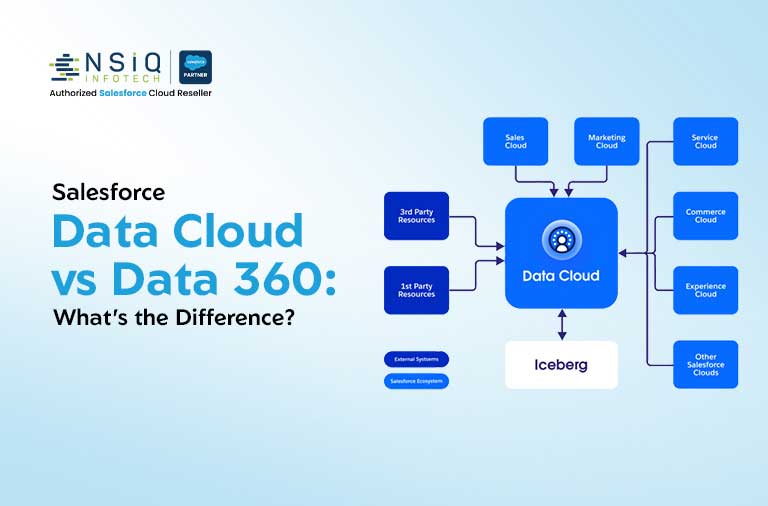
If you’ve been following Salesforce news lately, you’ve probably noticed the name “Data Cloud” starting to disappear, replaced by something new: Salesforce Data 360.
And if your first reaction was “here we go again,” you’re not alone.
Salesforce has a well-known habit of renaming its products. But this time, there’s more to the story.
The shift from Data Cloud to Data 360 isn’t just a cosmetic rebrand. It signals a meaningful change in how Salesforce thinks about data, what it does, where it lives, and how it powers the next generation of AI-driven business operations.
For IT Heads, CIOs, and Salesforce Admins, understanding this change is important. It shapes how your Salesforce environment is architected, how your AI agents are grounded, and ultimately how much value your data investments deliver.
In this guide, we’ll clear up the confusion around Salesforce Data Cloud vs Data 360, what changed, what stayed the same, and what it actually means for your organization.
A Quick History: How Many Times Has This Product Been Renamed?
Before diving into the differences, it’s worth understanding the history.
Salesforce’s data platform has carried six different names since its initial launch in 2020.
Product Evolution Timeline
| Year | Product Name |
|---|---|
| 2020 | Customer 360 Audiences |
| 2021 | Salesforce CDP |
| 2022 | Marketing Cloud Customer Data Platform |
| 2022 | Salesforce Genie |
| 2023 | Salesforce Data Cloud |
| 2025 | Salesforce Data 360 |
Each rename reflected a strategic evolution rather than a simple marketing refresh.
The platform began as a marketing-focused Customer Data Platform (CDP), evolved into a multi-cloud customer data platform, and has now become the AI-grounding data layer for the Agentforce ecosystem.
Why This Matters
If you’re reviewing:
- Older Salesforce documentation
- Trailhead modules
- Certifications
- Partner resources
You’ll still see references to Data Cloud.
Those references aren’t wrong. They’re simply referring to the previous branding of what is now Salesforce Data 360.
What Is Salesforce Data 360?
Salesforce Data 360 is the renamed and significantly enhanced version of Salesforce Data Cloud.
Announced during Dreamforce 2025 as part of the broader Agentforce 360 initiative, Data 360 serves as the centralized data layer across the Salesforce ecosystem.
From Data Unification to Data Activation
One of the biggest conceptual shifts is Salesforce’s positioning.
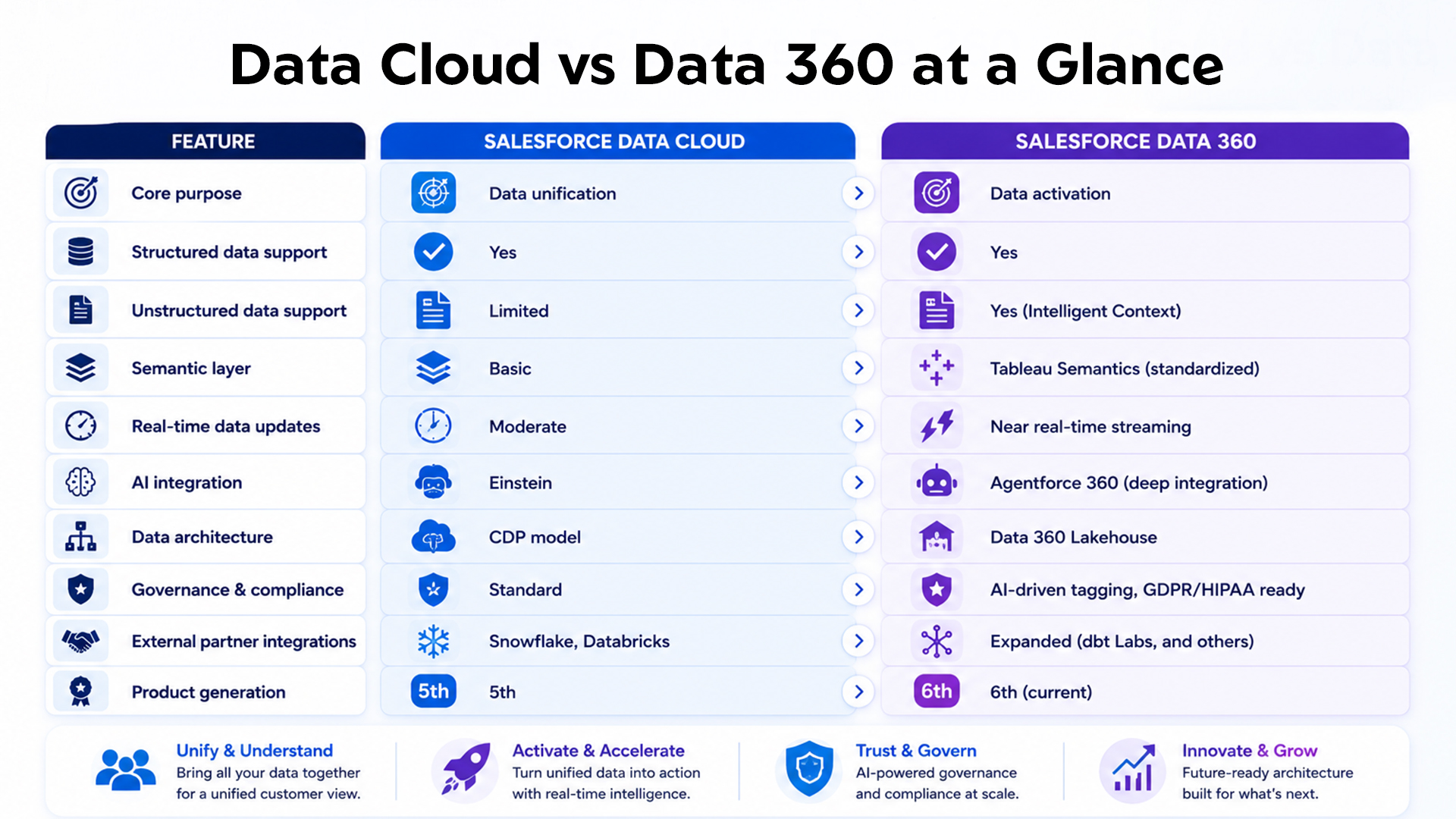
Data Cloud Focused On:
- Data unification
- Building customer profiles
- Consolidating records
Data 360 Focuses On:
- Data activation
- AI grounding
- Real-time decision making
- Autonomous agent enablement
Think of it this way:
With Data Cloud, users queried data to understand what happened.
With Data 360, data actively powers decisions, workflows, and AI agents in real time.
What Is Agentforce 360, and Where Does Data 360 Fit?
To understand Data 360, you need to understand Agentforce 360.
Salesforce introduced Agentforce 360 during Dreamforce 2025 as the next evolution of its AI platform.
Agentforce 360 consists of four core pillars:
The Four Pillars of Agentforce 360
1. Data 360
The real-time unified data layer.
2. Agentforce Voice
Human-like conversational AI for customer interactions.
3. Einstein AI
The reasoning and intelligence engine.
4. Customer 360 Semantic Data Model
A shared business language across Salesforce clouds.
Why Data 360 Matters
Data 360 connects all four pillars.
Without accurate data, AI agents are guessing.
With Data 360, every agent has:
- Context
- Memory
- Customer history
- Real-time business information
This ensures decisions are grounded in reality rather than assumptions.
Salesforce Data Cloud vs Data 360: What Actually Changed?
This is the most common question.
Let’s break it down.
What Stayed the Same?
The core foundation remains intact.
Data 360 still provides:
- Customer data unification
- Unified customer profiles
- Segmentation and activation
- Cross-cloud data sharing
- Zero-Copy integrations with Snowflake and Databricks
If you’re already using Data Cloud, your implementation remains valid.
There is no need to rebuild your environment from scratch.
What’s New in Data 360?
The rename introduced several major enhancements.
1. Intelligent Context
Arguably, the most important new capability.
Intelligent Context extends beyond structured CRM records and incorporates:
- Emails
- PDFs
- Call transcripts
- Support documents
- Knowledge articles
- Other unstructured content
Why It Matters
AI agents can now understand the complete customer story, not just fields stored inside Salesforce objects.
2. Tableau Semantics
One of the biggest challenges in enterprise reporting is inconsistent definitions.
For example:
- What qualifies as revenue?
- What defines an active customer?
- How should churn be calculated?
Tableau Semantics creates a shared business language across the organization.
Benefits
- Consistent reporting
- Standardized KPIs
- Better AI reasoning
- Improved cross-functional alignment
3. Real-Time Data Pipelines
Data 360 introduces significantly faster ingestion and harmonization.
Capabilities
- Near real-time streaming
- Immediate profile updates
- Faster activation workflows
- Improved AI responsiveness
When a customer:
- Makes a purchase
- Opens a case
- Submits a form
Data updates almost instantly.
4. Data 360 Lakehouse
A new architecture that combines:
- Operational data
- Historical data
- Real-time data streams
within a unified platform.
Benefits
- Real-time activation
- Historical analytics
- Reduced infrastructure complexity
- Less dependence on separate data warehouses
Why Did Salesforce Make This Change Now?
The timing aligns directly with Salesforce’s AI strategy.
As Agentforce adoption accelerates, AI agents require:
-
- Better data quality
- Faster access
- Richer context
- Stronger governance
Salesforce research indicates that organizations grounding AI agents in real-time unified data achieve significantly better outcomes in:
- Task completion
- Customer satisfaction
- Operational efficiency
The Data 360 brand signals that data is no longer a back-office function.
It’s now the foundation of every AI-powered interaction.
For CIOs and IT Leaders
Data 360 represents a strategic shift.
Organizations investing in AI must now prioritize:
- Real-time data architecture
- Governance
- Context-rich customer data
- AI readiness
Key Benefits
- Better AI performance
- Improved compliance
- Faster automation
- Reduced data silos
The governance enhancements are particularly valuable.
Data 360 includes:
- AI-driven tagging
- GDPR support
- HIPAA readiness
- Data Clean Rooms
For Salesforce Admins
The transition is evolutionary rather than disruptive.
Good News
You do not need to:
- Rebuild Data Cloud
- Reconfigure integrations
- Recreate profiles
What You Should Evaluate
- Intelligent Context setup
- Tableau Semantics configuration
- Lakehouse architecture opportunities
- Agentforce integration readiness
You should also prepare for naming inconsistencies while documentation catches up.
Real-World Example: Data 360 in Action
Consider a mid-sized financial services company.
Before Data 360
AI tools could access:
- Products owned
- Case history
- Customer records
But they couldn’t access:
- Call transcripts
- Customer emails
- Informal complaints
After Data 360
With Intelligent Context enabled, the system ingests:
- Call recordings
- Email conversations
- PDFs
- Support interactions
Now, when an Agentforce agent responds, it understands the complete customer journey.
Results
- Faster resolutions
- Reduced escalations
- Better customer satisfaction
- More personalized interactions
This is what Salesforce means by data activation.
Do You Need to Migrate From Data Cloud to Data 360?
The short answer:
No.
The rebrand happened at the product level.
Existing Data Cloud customers automatically operate under the Data 360 umbrella.
What You Should Do Instead
Treat Data 360 as a platform expansion opportunity.
Evaluate:
- Intelligent Context
- Tableau Semantics
- Lakehouse Architecture
- Agentforce Integrations
Prioritize the capabilities that align with your organization’s AI roadmap.
How NSIQ INFOTECH Helps You Get the Most From Data 360
At NSIQ INFOTECH, we help organizations maximize the value of Salesforce Data 360.
Our certified Salesforce experts assist with:
- Data Cloud to Data 360 strategy
- Zero-Copy integrations
- Snowflake connectivity
- Databricks integrations
- Tableau Semantics implementation
- Agentforce grounding architecture
- Data governance and compliance
- Customer 360 design
Whether you’re starting fresh or expanding an existing deployment, our team helps create a scalable, secure, and AI-ready foundation.
Q.1: Is Salesforce Data 360 the same as Data Cloud?
Yes and no. Data 360 is the renamed version of Data Cloud, but it introduces significant enhancements, including Intelligent Context, Tableau Semantics, real-time pipelines, and deeper Agentforce integration.
Q.2: When was Data Cloud renamed to Data 360?
Salesforce announced the rename during Dreamforce 2025 as part of the Agentforce 360 launch.
Q.3: How many times has Salesforce renamed this product?
Six times since 2020, evolving from Customer 360 Audiences to Data 360.
Q.4: Do I need to rebuild my implementation?
No. Existing Data Cloud implementations continue to operate without requiring redevelopment.
Q.5: What is Intelligent Context?
Intelligent Context allows Data 360 to unify structured and unstructured data sources such as emails, PDFs, and call transcripts.
Q.6: What is Tableau Semantics?
Tableau Semantics creates a shared business language and standardized KPI definitions across the Salesforce ecosystem.
Q.7: Is Data 360 part of Agentforce?
Yes. Data 360 is one of the four core pillars of Agentforce 360.
Q.8: What is Zero-Copy Integration?
Zero-Copy Integration allows Data 360 to access external data without physically copying it into Salesforce.
Q.9: How is Data 360 different from a traditional CDP?
Traditional CDPs focus primarily on marketing use cases. Data 360 supports sales, service, commerce, operations, analytics, and AI.
Q.10: Can small businesses use Data 360?
Data 360 is primarily designed for enterprise organizations with advanced data and AI requirements.
Q.11: Does Data 360 support GDPR and HIPAA?
Yes. Data 360 includes governance features designed to support major regulatory frameworks.
Q.12: What is the Data 360 Lakehouse?
The Lakehouse combines real-time operational data and historical analytics within a single architecture.
Q.13: Will Salesforce rename this product again?
Possibly, although the Data 360 branding appears more strategically aligned with Salesforce’s long-term Customer 360 ecosystem.
Q.14: What should current Data Cloud customers do now?
Assess which new Data 360 capabilities align with your AI roadmap and create a phased adoption strategy.
Q.15: How does Data 360 improve AI agent performance?
By providing unified, real-time, context-rich data that enables Agentforce agents to make more accurate decisions and deliver more personalized interactions.
Conclusion
The rename from Salesforce Data Cloud to Data 360 is more than a branding update; it’s a clear statement about where Salesforce is heading.
Data is no longer a passive layer that teams query when they need answers. With Data 360, it becomes an active, intelligent foundation that continuously powers agents, workflows, and decisions in real time.
For enterprise leaders, this shift creates both an opportunity and an obligation.
The opportunity is to build a modern data foundation that accelerates AI adoption and creates a competitive advantage.
The obligation is to take the new capabilities seriously. Intelligent Context, Tableau Semantics, real-time pipelines, and AI governance are not optional enhancements; they are becoming core requirements for organizations competing in an increasingly AI-driven world.
If you’re already using Data Cloud, you’re closer than you think.
The next step isn’t reinvention.
It’s activation.
And with the right strategy, Salesforce Data 360 can become the foundation that powers your organization’s next generation of growth, automation, and AI innovation.