
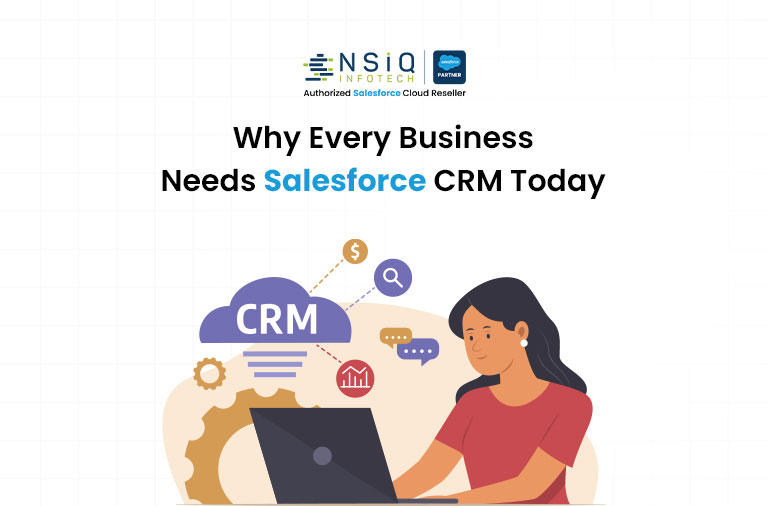
Why Every Business Needs Salesforce CRM Today
Introduction
In today’s competitive business world, having a good product or service is not enough. The real success factor lies in how effectively a business manages, understands, and retains its customers.
This is where Salesforce, the world’s leading CRM platform, plays a crucial role. Salesforce does not just help businesses manage operations — it helps them grow faster, smarter, and more efficiently.
1. Centralized Customer Data – Everything in One Place
Traditional businesses often rely on multiple tools such as:
-
Excel sheets
-
Emails
-
Manual registers
-
WhatsApp follow-ups
This results in scattered information, data duplication, and confusion.
What Does Salesforce Do?
-
Stores all leads, customers, and interactions in one centralized system
-
Provides a complete 360-degree customer view
-
Offers real-time access to data across teams
Example
When a sales executive calls a client, Salesforce instantly shows:
-
Past interaction history
-
Previous complaints
-
Last purchase details
-
Ongoing opportunities
All information is visible in seconds — no searching required.
2. Faster Sales Process & Better Lead Management
Salesforce helps sales teams work smartly, not just hard.
It enables:
-
Automatic lead capture
-
Smart lead assignment
-
Follow-up tracking
-
Deal stage monitoring
Example
When a lead is generated from a website:
-
Salesforce automatically assigns it to the right salesperson
-
A follow-up task is created
-
The sales manager receives a notification
This ensures no lead is missed and response time improves dramatically.
3. Automation = Time & Cost Savings
Manual work is:
-
Slow
-
Error-prone
-
Time-consuming
With Salesforce automation:
-
Emails are triggered automatically
-
Approval processes run instantly
-
Reminders are generated automatically
Example: Invoice Approval
-
Manual process: 2–3 days
-
Salesforce automation: 2–3 minutes
Automation reduces operational costs and increases team productivity.
4. Better Decision-Making with Real-Time Reports
Making business decisions based on guesswork increases risk. Salesforce provides:
-
Live dashboards
-
Sales forecasts
-
Team performance tracking
-
Revenue insights
Example
A sales manager can instantly see:
-
Which deal is stuck
-
Which sales rep is performing best
-
Whether monthly targets are achievable
Data-driven decisions improve business growth and reduce uncertainty.
5. Improved Customer Support & Satisfaction
Today’s customers expect fast and accurate responses. Salesforce Service tools help businesses:
-
Track customer complaints
-
Monitor SLA compliance
-
Speed up issue resolution
Example
When a customer raises a complaint:
-
Salesforce automatically creates a support case
-
Assigns it to the appropriate agent
-
Tracks resolution time
This improves customer satisfaction and loyalty.
6. Scalability – Grow Without Changing Systems
As businesses expand:
-
Customer data increases
-
Teams grow
-
Processes become complex
Salesforce:
-
Is fully cloud-based
-
Scales from startups to enterprises
-
Allows easy addition of users and features
Example
A startup can begin with 5 users and scale to 500 users smoothly — without switching platforms.
7. Secure & Cloud-Based Platform
Because Salesforce is cloud-based, it provides:
-
High-level data security
-
Automatic backups
-
Access from anywhere
Example
Remote teams can securely access real-time data from:
-
Office locations
-
Home offices
-
Different countries
Security and accessibility work together seamlessly.
8. Industry-Specific Solutions
Salesforce is not just a generic CRM. It offers tailored solutions for industries like:
-
Healthcare
-
Education
-
Manufacturing
-
Real Estate
Example
A real estate company using Salesforce can:
-
Automate site visit follow-ups
-
Track client property preferences
-
Manage leads efficiently
-
Close deals faster
Industry customization increases operational efficiency.
Conclusion
In today’s fast-moving business environment, managing customer relationships effectively is no longer optional — it is essential.
Businesses that fail to organize their customer data, automate processes, and respond quickly to customer needs risk falling behind competitors.
Salesforce empowers organizations by:
-
Centralizing data
-
Automating workflows
-
Improving customer engagement
-
Enabling data-driven decisions
From startups to global enterprises, companies that adopt Salesforce gain scalability, security, and long-term growth readiness.
Salesforce is not just a CRM system — it is a growth engine for modern businesses.