
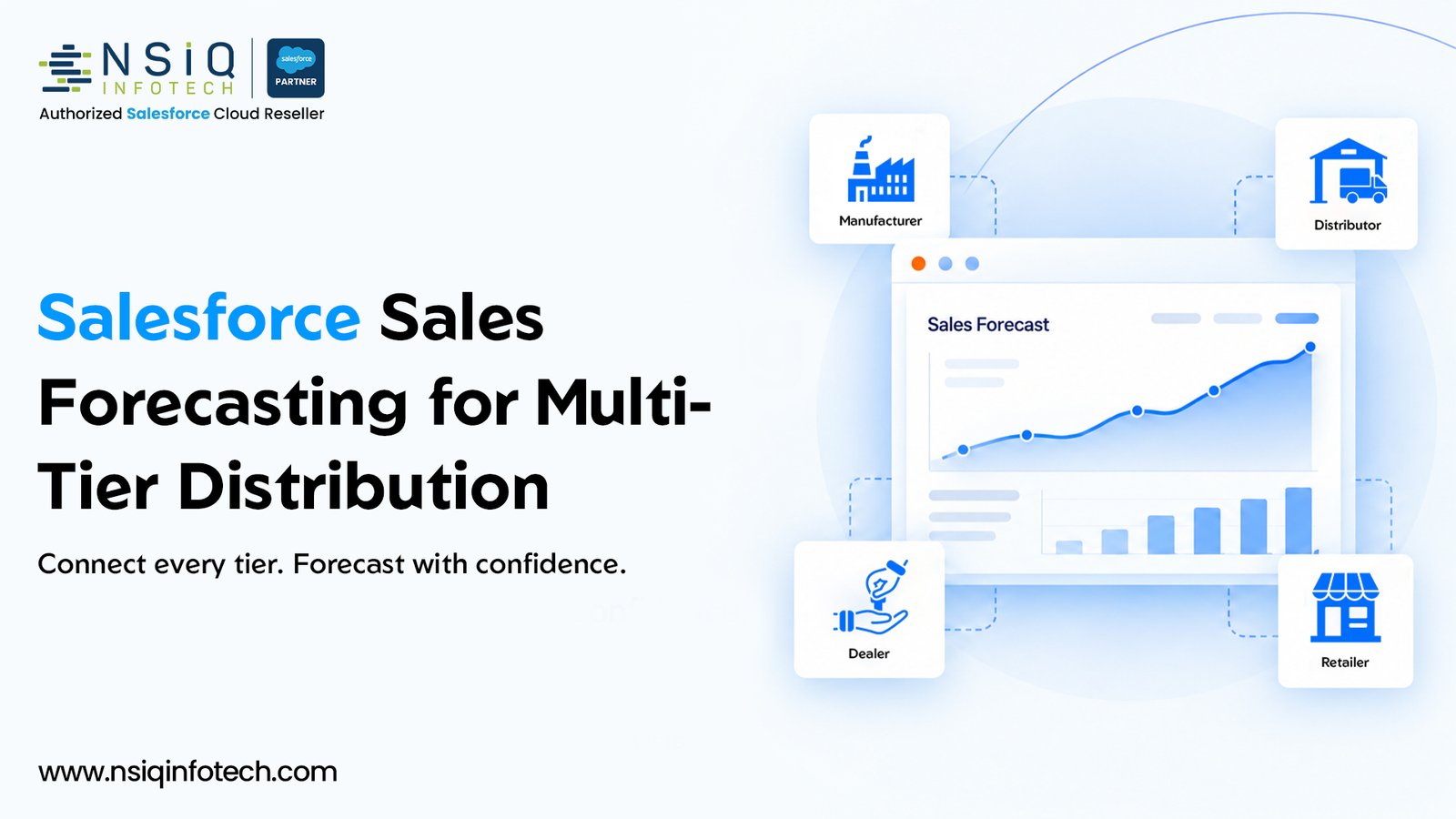
Introduction: Why Manufacturing Sales Forecasts Often Miss the Mark
For a manufacturing business, a sales forecast is more than a number on a dashboard. It influences production schedules, raw material purchases, inventory levels, workforce planning, cash flow, and commitments to customers.
Yet forecasting becomes complicated when products pass through multiple distribution layers before reaching the end customer.
A manufacturer may sell to a national distributor, which supplies regional distributors, which then sell to dealers or retailers. Each participant has its own inventory, sales targets, reporting process, and view of market demand. The manufacturer might know exactly how much it has shipped to its distributors, but that does not necessarily reveal how much product customers are actually buying.
This creates a familiar problem: the sales team reports strong demand, distributors place large orders, and production increases. A few weeks later, the manufacturer discovers that distributors are still holding excess inventory while end-customer sales remain weak.
The opposite can happen, too. A distributor may underreport demand or delay sharing its inventory position, leaving the manufacturer unprepared for a sudden increase in orders.
This is where Salesforce Sales Cloud can play an important role. With the right data model, forecasting processes, integrations, and sales workflows, manufacturers can build a more connected view of expected demand across their distribution network.
The goal is not simply to generate a more attractive forecast report. It is to understand what is likely to sell, where demand is developing, which opportunities are reliable, and what action the business should take next.
In this guide, we explore why traditional forecasting breaks down in multi-tier distribution and how manufacturers can improve visibility and sales forecast accuracy using Salesforce Sales Cloud.
1. What Makes Sales Forecasting Difficult in Multi-Tier Distribution?
Traditional sales forecasting works relatively well when a company sells directly to its customers. Sales representatives manage opportunities, update expected closing dates, and estimate revenue based on their pipelines.
Multi-tier distribution introduces additional complexity because the manufacturer does not always have a direct relationship with the final buyer.
Consider a manufacturer that produces industrial electrical components.
Its distribution network might look like this:
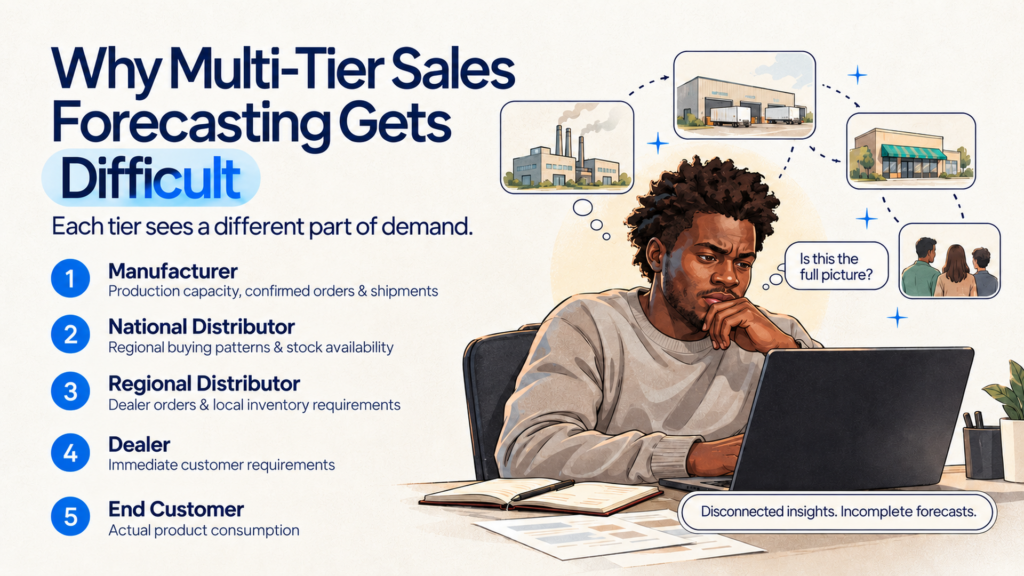
Manufacturer → National Distributor → Regional Distributor → Dealer → End Customer
Each level provides a different perspective on demand.
- The manufacturer knows its production capacity, confirmed orders, and shipment history.
- The national distributor understands regional purchasing patterns and stock availability.
- The regional distributor sees dealer orders and local inventory requirements.
- Dealers understand their customers’ immediate requirements.
- End customers determine the actual consumption of products.
If these insights remain disconnected, the manufacturer must build its forecast using incomplete information.
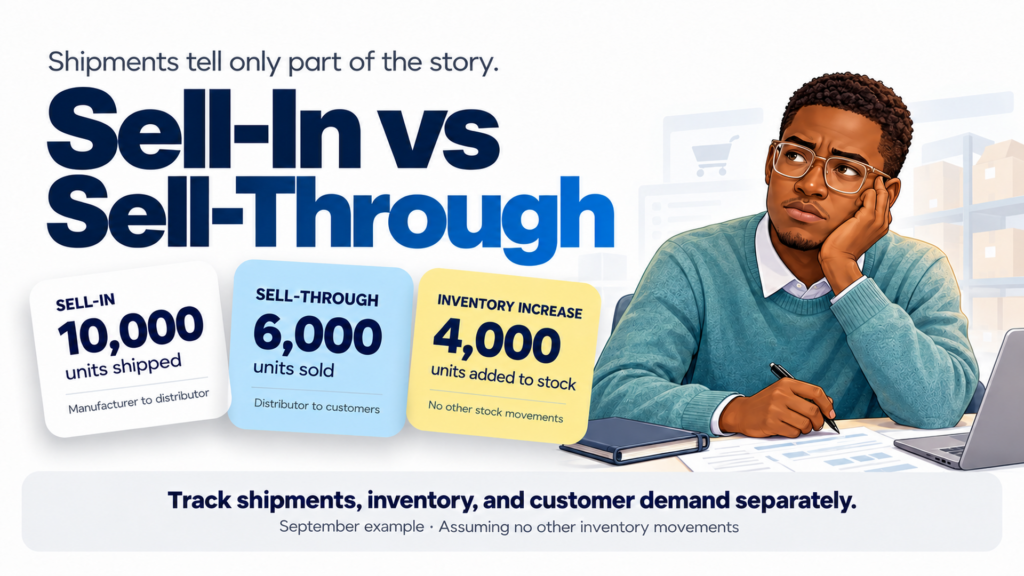
The difference between sell-in and sell-through
One of the most important distinctions in channel sales forecasting is the difference between sell-in and sell-through.
Sell-in refers to products sold by the manufacturer to distributors.
Sell-through refers to products sold by distributors or dealers to their customers.
Suppose a manufacturer ships 10,000 units to a distributor in September. The shipment may appear to indicate strong demand.
However, if the distributor sells only 6,000 units during the same period, its inventory increases by 4,000 units, assuming no other inventory movements.
The manufacturer may interpret the shipment as evidence of growth, even though actual downstream demand is not increasing at the same rate.
A reliable forecasting process needs to distinguish between confirmed manufacturer orders, distributor inventory movements, and genuine end-customer demand.
Salesforce can help bring these different signals into a shared operational view, provided the necessary data is captured or integrated.
2. Five Reasons Traditional Sales Forecasts Fail
2.1 Distributor data arrives too late
Many manufacturers receive distributor reports through spreadsheets, emails, or periodic business reviews. By the time the information reaches the sales operations team, the underlying market conditions may already have changed.
For example, a regional distributor may report declining demand after the manufacturer has already committed to a production schedule.
A connected reporting process can reduce this delay by consolidating distributor orders, inventory information, and relevant sales activities in a central system.
2.2 Pipeline opportunities are confused with product demand
A sales representative may create an opportunity worth ₹50 lakh because a dealer is discussing a large purchase.
However, the opportunity may still depend on technical approval, customer budget confirmation, competitive pricing, or a distributor agreement.
Treating every open opportunity as highly probable revenue creates an optimistic forecast.
Sales teams need consistent opportunity stages, realistic closing dates, documented next steps, and evidence-based probability assessments.
Salesforce Sales Cloud provides opportunity management and forecasting capabilities that can help standardize this process.
2.3 Channel partners use different reporting methods
One distributor may report weekly sales by SKU, another may provide monthly figures by product category, and a third may send only total purchase values.
Comparing these reports is difficult without common definitions and data structures.
A well-designed channel sales forecasting process establishes common reporting standards, including product identifiers, reporting periods, units of measure, inventory definitions, and data ownership.
2.4 Forecast ownership is unclear
When a forecast misses its target, the sales manager may blame the distributor, the distributor may blame market conditions, and the operations team may question the sales assumptions.
The underlying problem is often the absence of clear accountability.
Each forecast should have an identifiable owner, a defined review process, and documented assumptions. Exceptions should be visible before they affect business commitments.
2.5 Historical shipments are treated as future demand
Historical sales are useful, but they do not tell the whole story.
A distributor may place an unusually large order before a price increase. Another may purchase additional inventory before a seasonal peak. A third may experience a temporary decline because a large customer postponed a project.
Forecasting models and sales teams must distinguish these events from sustainable demand patterns.
Historical data should be considered alongside current pipeline information, distributor inventory, market conditions, and known business changes.
3. How Salesforce Sales Cloud Can Improve Forecast Visibility
Salesforce Sales Cloud provides a foundation for managing accounts, contacts, opportunities, activities, sales processes, and forecasting information.
For manufacturers, its value increases when the implementation reflects the structure of the distribution network rather than treating every transaction as an isolated sale.
The following approach illustrates how the platform can support a more connected forecasting process.
Step 1: Build a clear account and distribution hierarchy
The first step is to represent the commercial relationships across the distribution network.
For example:
- Manufacturer: ABC Industrial Products
- National distributor: NorthStar Distribution
- Regional distributor: Western Industrial Supplies
- Dealer: Metro Electrical Traders
- End customer: A manufacturing plant
Salesforce account relationships and appropriate custom fields or objects can help represent these connections. The exact data model depends on the organization’s channel structure and reporting requirements.
The business should be able to answer questions such as:
- Which regional distributors purchase through each national distributor?
- Which dealers serve a particular market?
- Which distributors have high inventory but declining sell-through?
- Which customers or regions are contributing to forecast growth?
A clear hierarchy gives management a better understanding of where expected revenue originates.
Step 2: Standardize opportunity and forecast information
The next step is to establish consistent sales processes.
Each relevant opportunity should contain information such as:
- Expected deal value and product mix
- Opportunity stage
- Expected closing date
- Account and associated channel partner
- Probability or forecast category
- Competitor information, where available
- Next action and responsible sales representative
Salesforce collaborative forecasting can help managers and representatives review forecast categories, pipeline contributions, and expected revenue within a common process.
However, opportunity forecasting and distributor demand forecasting are not the same thing. A distributor replenishment order may be driven by inventory consumption rather than a conventional sales opportunity.
Manufacturers should therefore combine the standard opportunity forecasting process with suitable distributor, order, and inventory data.
Step 3: Integrate distributor orders and inventory data
A forecast becomes more useful when it incorporates information beyond the manufacturer’s own sales pipeline.
Depending on the available systems, relevant information may come from ERP platforms, order management systems, distributor portals, spreadsheets, or partner integrations.
A Salesforce implementation can consolidate selected information through APIs, middleware, scheduled imports, or custom integrations.
Potential data points include:
- Distributor purchase orders
- Confirmed manufacturer shipments
- Distributor inventory by SKU
- Sell-through quantities
- Open backorders
- Returns and cancellations
- Expected replenishment requirements
Not every distributor will provide every data point. The implementation should identify the minimum reliable data required to improve decisions and define how missing information will be handled.
Step 4: Create forecast dashboards for different stakeholders
A sales representative, regional manager, channel head, and operations leader do not need identical views of the forecast.
Salesforce reports and dashboards can present information according to each role’s responsibilities and access permissions.
For example, a regional sales manager might review:
- Forecast revenue by territory
- Pipeline by opportunity stage
- Distributor performance against targets
- Opportunities with overdue next steps
- Accounts with declining order activity
A channel manager might focus on distributor purchase trends, sell-through data, inventory coverage, and replenishment signals.
An operations leader may need a consolidated view of expected product demand, confirmed orders, and potential supply constraints. That view may require ERP or planning-system integration rather than Salesforce alone.
The objective is to make the information relevant to the decisions each team must take.
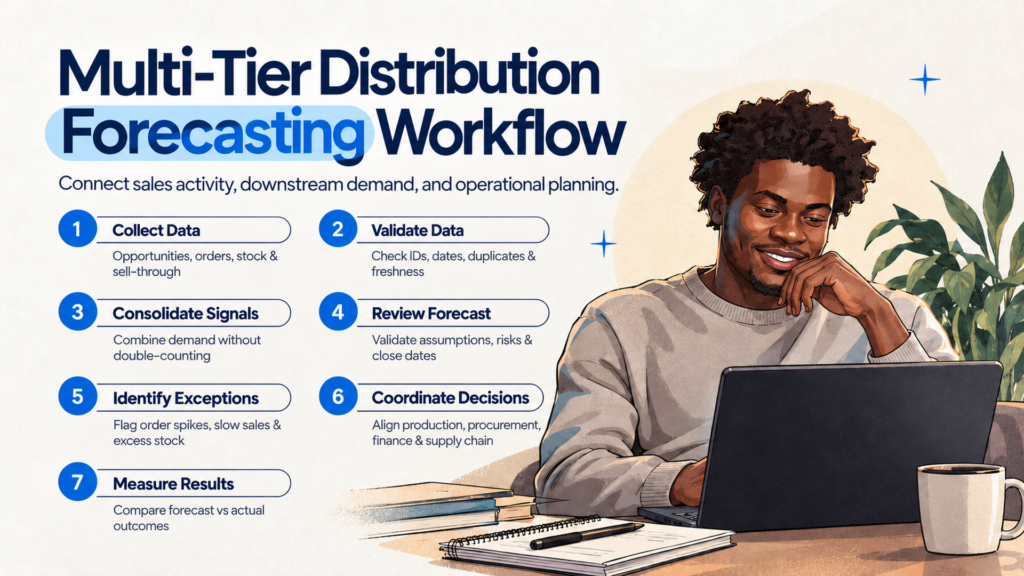
4. A Practical Multi-Tier Distribution Forecasting Workflow
A structured workflow connects commercial activity with downstream demand and operational planning.
The process can follow this sequence:
- Collect data: Gather opportunity updates, distributor orders, inventory information, and available sell-through data.
- Validate data: Check product identifiers, reporting periods, duplicates, missing values, and data freshness.
- Consolidate demand signals: Combine relevant opportunities, confirmed orders, and downstream demand indicators without counting the same demand twice.
- Review the forecast: Sales representatives and managers validate assumptions, changes, risks, and expected closing dates.
- Identify exceptions: Flag unusual order spikes, declining sell-through, excess inventory, and forecast changes.
- Coordinate decisions: Share the appropriate forecast with production, procurement, finance, and supply-chain teams.
- Measure results: Compare forecast values with actual outcomes and investigate significant variances.
This workflow should operate on a defined cadence. Weekly reviews may suit fast-moving products, while slower industrial sales cycles may require a different rhythm.
The important point is consistency: the same definitions, review process, and measurement approach should be used from one forecasting period to the next.
5. Improving Sales Forecast Accuracy With Better Data and Governance
Buying sales forecasting software does not automatically solve forecasting problems. The quality of the process depends on the quality of the data, the reliability of assumptions, and the discipline of the people using it.
Manufacturers should focus on the following areas.
Establish one definition of forecast revenue
Teams must agree on what they are forecasting.
Is the target based on manufacturer revenue, distributor purchases, end-customer sales, or expected product consumption?
These measures serve different purposes. They should be reported separately when necessary rather than combined into a single figure without clear definitions.
Track forecast accuracy over time
A simple measure of absolute forecast error is:
Absolute Forecast Error = |Forecast − Actual|
For a forecast of ₹1 crore and actual revenue of ₹90 lakh, the absolute error is ₹10 lakh.
Forecast error can also be expressed as a percentage of actual revenue when actual values are non-zero and the measure is appropriate for the business.
Organizations should select a consistent methodology, compare equivalent periods, and avoid relying on a single accuracy percentage to explain every forecasting problem.
For multiple products and regions, a weighted measure may be more informative than averaging individual percentage errors.
Monitor changes instead of reviewing only month-end totals
A forecast can look reasonable at month-end while hiding important changes during the month.
Managers should review significant movements, including:
- Large opportunities moved to a later period
- Distributor orders significantly above normal patterns
- Falling sell-through despite increasing shipments
- Unexpected cancellations or returns
- Material changes in expected product mix
The earlier these changes become visible, the more time the business has to respond.
Create a feedback loop
After each forecasting period, compare the forecast with actual outcomes and identify the reasons for material differences.
Were closing dates unrealistic? Did a distributor accumulate excess inventory? Were key opportunities delayed? Did an unexpected customer order change demand?
Use these findings to improve sales processes, data quality, assumptions, and training.
Over time, this feedback loop helps make forecasts more dependable and actionable.
6. The Role of AI in Channel Sales Forecasting
AI can help manufacturers identify patterns and exceptions that may be difficult to detect through manual spreadsheet reviews.
Depending on the available data and the capabilities of the selected tools, potential applications include:
- Identifying unusual order increases or decreases
- Highlighting opportunities with changing close dates
- Detecting inconsistencies between shipments and reported sell-through
- Supporting demand projections using historical patterns
- Summarizing forecast changes for sales managers
- Prioritizing accounts that may need additional attention
However, AI should not be treated as a substitute for reliable source data or business judgment.
A model trained on incomplete distributor reports may produce misleading recommendations. Likewise, a sudden order increase may reflect a legitimate contract rather than an anomaly that requires intervention.
AI capabilities should be selected according to the business problem, data availability, integration requirements, and governance needs. Native Salesforce functionality, additional Salesforce products, or external analytics solutions may be appropriate in different situations.
The best starting point is a specific business question, not the assumption that adding AI will automatically improve forecast accuracy.
7. Common Mistakes to Avoid During Salesforce Sales Cloud Implementation
Manufacturers can invest in Salesforce and still struggle with forecasting if the implementation focuses only on dashboards and opportunity records.
Here are common mistakes to avoid.
Mistake 1: Treating shipments as final demand
Shipments to distributors do not always reflect end-customer consumption. Keep sell-in, sell-through, and inventory measures distinct.
Mistake 2: Expecting every distributor to provide perfect data
Start with a realistic reporting standard. Define required fields, update frequency, validation rules, and the process for handling missing information.
Mistake 3: Customizing everything before defining the process
Document the forecast workflow and reporting requirements first. Use standard Salesforce capabilities where suitable, adding custom objects or integrations only when there is a clear business need.
Mistake 4: Ignoring data quality
Duplicate accounts, inconsistent product codes, outdated opportunities, and incorrect closing dates can undermine the entire forecast. Establish ownership and regular data-quality checks.
Mistake 5: Measuring success only by dashboard availability
A dashboard is a deliverable, not the business outcome. Measure whether teams make earlier decisions, identify risks sooner, improve forecast consistency, and reduce avoidable planning surprises.
Mistake 6: Overlooking adoption
If representatives and channel managers see forecasting as an administrative burden, they may update information inconsistently. Keep workflows practical, explain the benefits, and make forecast reviews part of regular business operations.
8. How to Get Started: A Phased Implementation Approach
A phased approach allows manufacturers to validate their forecasting process before expanding it across the entire distribution network.
Phase 1: Assess the current process
Document how forecasts are currently created, which systems contain the data, where reporting delays occur, and which decisions are affected by inaccurate forecasts.
Identify the highest-impact problem first.
Phase 2: Define the forecasting model
Agree on forecast definitions, account hierarchy, product structure, data ownership, reporting frequency, and required measures.
Decide how opportunity forecasts will interact with distributor orders and demand information.
Phase 3: Configure Salesforce Sales Cloud
Set up relevant account relationships, opportunity stages, forecast categories, reports, dashboards, validation rules, and permissions.
Keep the initial implementation focused on the agreed business requirements.
Phase 4: Integrate priority data sources
Connect the most valuable available information, such as confirmed orders or distributor inventory.
Validate record matching, update frequency, exception handling, and the prevention of duplicate demand calculations.
Phase 5: Pilot with selected distributors
Choose a representative group of distributors or product categories. Compare forecast results with actual outcomes and gather feedback from sales and operations teams.
Phase 6: Refine and scale
Address data gaps, improve reporting, adjust the workflow, and expand to additional regions or distributors when the pilot demonstrates practical value.
This approach reduces unnecessary complexity and helps the organization build confidence in the forecasting process.
9. Choosing the Right Sales Forecasting Software for Manufacturing
When evaluating sales forecasting software, manufacturers should look beyond the ability to generate a revenue chart.
Consider whether the solution can support:
- Account and distributor relationship management
- Opportunity-based forecasting
- Role-based forecast reviews and collaboration
- Integration with ERP and order management systems
- Distributor inventory and sell-through reporting
- Product- and territory-level analysis
- Data validation and exception monitoring
- Security, permissions, and auditability
- Flexible reporting for sales and operations teams
Salesforce Sales Cloud is particularly relevant when the organization wants forecasting connected to its broader sales processes, account management, opportunity pipeline, and customer relationships.
However, organizations with complex production planning or statistical demand-planning requirements may also need an ERP, supply-chain planning platform, or dedicated analytics solution.
The right architecture depends on the company’s distribution model, data maturity, existing systems, and operational requirements.
10. Turning Better Forecasts Into Better Business Decisions
The real benefit of improving distributor sales forecasting is not simply a smaller gap between predicted and actual revenue.
It is the ability to make better decisions earlier.
When a manufacturer identifies excess distributor inventory before placing another production order, it can review replenishment requirements more carefully. When demand increases in a particular region, sales and operations teams can investigate whether the change is sustainable and prepare accordingly.
When a major opportunity moves to the next quarter, management can assess the revenue impact and update its expectations.
Salesforce Sales Cloud can support these decisions by connecting customer and opportunity information with relevant channel data, reporting, and review workflows.
The platform is not a replacement for sound forecasting methods or reliable distributor collaboration. It is an environment in which those practices can become more consistent, visible, and measurable.
For manufacturers operating through multiple distribution tiers, that distinction matters.
Conclusion: Build a More Reliable Forecast Across Your Distribution Network
Multi-tier distribution creates forecasting challenges because the manufacturer rarely has a complete view of demand from a single source. Distributor orders, inventory movements, end-customer consumption, and sales opportunities each tell a different part of the story.
A more dependable forecasting process brings these signals together, establishes common definitions, validates the data, and gives teams a consistent way to review changes and take action.
Salesforce Sales Cloud can provide the foundation for this process through opportunity management, collaborative forecasting, account relationships, reporting, dashboards, and integrations with relevant business systems.
The best results come from combining the right technology with a clearly defined forecasting process and active participation from sales, channel partners, and operations teams.
NSIQ Infotech helps businesses explore Salesforce solutions aligned with their sales processes and operational needs. If your manufacturing organization is struggling with disconnected distributor data, inconsistent forecasts, or limited channel visibility, a Salesforce Sales Cloud assessment can help identify the right starting point.
Review your current forecasting workflow, identify the most important data gaps, and determine how a connected sales platform could support better planning and more informed decisions.
Frequently Asked Questions (FAQs)
1. What is Salesforce sales forecasting?
Salesforce sales forecasting is the process of estimating future sales using information such as opportunities, expected closing dates, forecast categories, historical performance, and sales team input. In manufacturing, it can be complemented with distributor orders, inventory data, and downstream demand information.
2. How can Salesforce Sales Cloud improve sales forecast accuracy?
Salesforce Sales Cloud can improve forecasting consistency by centralizing opportunity information, standardizing sales stages, enabling collaborative forecast reviews, and providing reports and dashboards. Accuracy also depends on reliable source data, appropriate forecasting methods, and regular comparisons between forecasts and actual results.
3. What is Salesforce collaborative forecasting?
Salesforce collaborative forecasting allows sales representatives and managers to review expected sales within a shared forecasting process. Depending on the configuration, teams can analyze forecast categories, expected revenue, and changes in pipeline performance.
4. Why is channel sales forecasting different from traditional sales forecasting?
Traditional sales forecasting often focuses on direct customer opportunities. Channel sales forecasting must also account for distributor purchases, downstream sales, inventory levels, replenishment cycles, and demand signals from multiple organizations.
5. What is distributor sales forecasting?
Distributor sales forecasting estimates future sales or purchasing requirements associated with distributors. It may use historical purchases, current inventory, sell-through information, seasonality, open orders, and known customer demand. The exact method depends on whether the objective is to forecast manufacturer shipments or end-market consumption.
6. Can Salesforce Sales Cloud track distributor inventory?
Salesforce can store and display distributor inventory information when the appropriate data model and integrations are implemented. The information may come from distributor systems, ERP platforms, partner portals, or structured imports. Real-time visibility depends on the integration design and how frequently the source data is updated.
7. Is Salesforce a replacement for ERP-based demand planning?
Not necessarily. Salesforce Sales Cloud focuses on customer relationships, sales processes, and opportunity forecasting. Complex inventory optimization, production scheduling, and material requirements planning may remain in an ERP or dedicated supply-chain planning system. Integrating the platforms can provide a more complete business view.
8. What data is required for accurate multi-tier distribution forecasting?
Useful data includes historical orders, confirmed shipments, product information, distributor inventory, sell-through quantities where available, open opportunities, expected closing dates, cancellations, returns, and seasonal demand patterns. Data completeness and consistent definitions are as important as the number of data points collected.
9. How frequently should manufacturers update sales forecasts?
The appropriate frequency depends on the sales cycle, product movement, distributor reporting practices, and planning requirements. Some businesses benefit from weekly reviews, while others may use monthly forecast cycles with more frequent exception monitoring. The process should be frequent enough to support timely decisions without creating unnecessary administrative work.
10. Can AI help improve distributor sales forecasting?
AI can help identify patterns, highlight unusual changes, and support demand projections when suitable data and models are available. Its usefulness depends on data quality, business context, validation, and the ability of users to interpret the results. AI-generated recommendations should be reviewed against operational realities.
11. What KPIs should manufacturers track for sales forecasting?
Useful measures include forecast error, forecast bias, opportunity conversion rates, pipeline coverage, distributor sell-through, inventory levels, order cancellations, and forecast changes by product or territory. Organizations should select KPIs that reflect their specific forecasting objectives rather than relying on a single metric.
12. How long does it take to implement Salesforce sales forecasting?
The timeline depends on the number of business units, complexity of the distribution network, data quality, required integrations, reporting needs, and approval processes. A focused implementation using existing Salesforce capabilities may be simpler than a project involving multiple ERP integrations and custom distributor data models. A discovery and requirements assessment is the best way to establish a realistic estimate.
13. What should a manufacturer consider before selecting sales forecasting software?
Manufacturers should evaluate integration capabilities, distributor data visibility, opportunity forecasting, reporting flexibility, security, scalability, user adoption, and compatibility with existing ERP and planning systems. The chosen solution should address a clearly defined business problem and fit the organization’s operational processes.
14. How can NSIQ Infotech help with Salesforce Sales Cloud?
NSIQ Infotech can be approached to discuss Salesforce Sales Cloud implementation and configuration requirements, including sales process alignment, forecasting workflows, reporting, dashboards, and integration considerations. The appropriate scope depends on the manufacturer’s existing Salesforce environment and business objectives.