
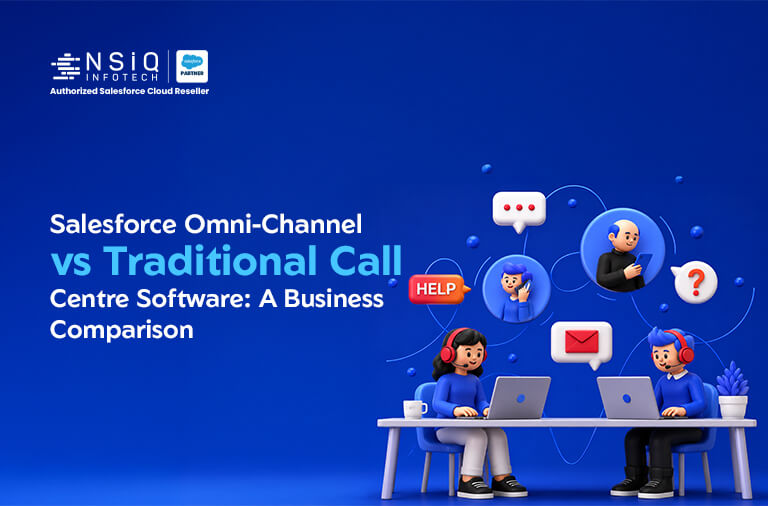
If you’re running a contact centre today, you’ve probably felt this tension: customers expect instant, connected support across every channel, but your current system was built for a world where phone calls were the only thing that mattered. That gap is exactly why so many COOs, CFOs, and Contact Centre Heads are now comparing omni channel call center platforms against their traditional call centre software.
This isn’t just a tech upgrade decision. It’s a business decision that affects your operating costs, your customer retention, and how your team actually spends its day. In this guide, we’ll walk through what separates an omni channel call center software from legacy systems, where the real business impact shows up, and how to decide what’s right for your organisation — without the sales pitch.
By the end, you’ll have a clear, practical framework for evaluating call center alternatives, understanding what an omnichannel call center solution actually delivers, and knowing exactly what questions to ask before you sign a contract.
What Is an Omni Channel Call Center, Really?
Let’s start with the basics, because the terminology gets thrown around loosely.
A traditional call centre is built around one primary channel: the phone. Some systems bolt on email or a basic web form, but each channel typically runs on its own separate system, with its own data, its own queue, and its own reporting. If a customer calls after emailing, the agent usually has no idea the email ever happened.
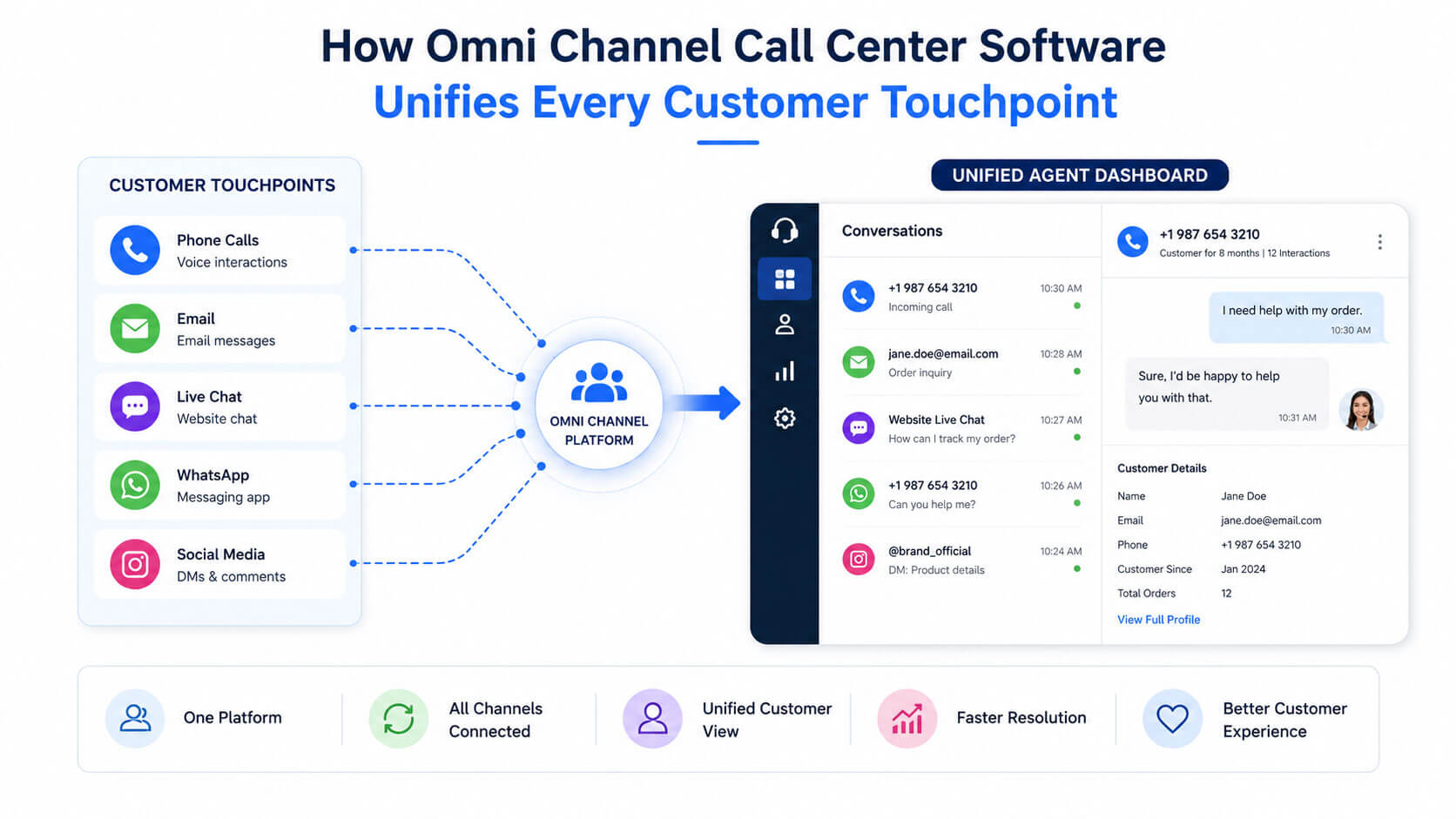
An omni channel call center flips that model. Instead of separate silos, every channel — phone, email, live chat, WhatsApp, SMS, social media, and self-service portals — feeds into a single unified system. The agent sees the entire customer history in one place, regardless of which channel the customer used first, second, or third.
The key word here is “context.” Multichannel means you offer many ways to reach you. Omnichannel means all of those ways are connected. That distinction sounds small on paper, but it changes almost everything about how your contact centre performs.
Why This Distinction Matters for Business Leaders
For a COO, this isn’t an IT detail — it’s an operational efficiency question. When agents don’t have to ask customers to repeat themselves, average handle time drops, first-contact resolution improves, and agent frustration goes down too.
For a CFO, it’s a cost question. Disconnected systems mean duplicate licensing, duplicate reporting tools, and more agent hours spent hunting for information instead of resolving issues.
For a Contact Centre Head, it’s a service-quality question. Consistent, connected experiences are what keep customers from churning to a competitor after one bad interaction.
Traditional Call Centre Software: What It Was Built For (and Where It Falls Short)
Traditional call centre software was designed in an era when phone was king. These systems are usually strong at:
- Call routing and queue management
- Basic IVR (interactive voice response)
- Call recording and compliance logging
- On-premise infrastructure control
That’s not nothing — for pure voice operations, some of these systems are still reliable. The problem is that customer behaviour has moved on. According to Salesforce, the average customer now uses close to nine different channels when engaging with a single company. A phone-first system simply wasn’t designed to keep up with that.
Common Limitations of Traditional Systems
- Channel silos — Each communication channel lives in its own tool, with no shared customer record.
- Manual context transfer — Agents rely on customers repeating information, or on manually copying notes between systems.
- Limited scalability — Adding new channels (like WhatsApp or in-app chat) often means buying and integrating an entirely separate platform.
- Weak reporting across channels — Leadership gets a phone-only view of performance, missing the full picture of customer effort.
- Higher total cost of ownership — Multiple vendors, multiple maintenance contracts, and more IT overhead than most businesses realise until they actually add it up.
None of this means traditional software is “bad.” It means it was built to solve yesterday’s problem, and today’s customer journey has outgrown it.
How Salesforce Omni-Channel Solves the Core Problem
Salesforce’s omni-channel capability, built on Service Cloud, works differently. Rather than treating channels as separate systems that need to be stitched together after the fact, it treats them as different doors into the same room.
Here’s what that looks like in practice:
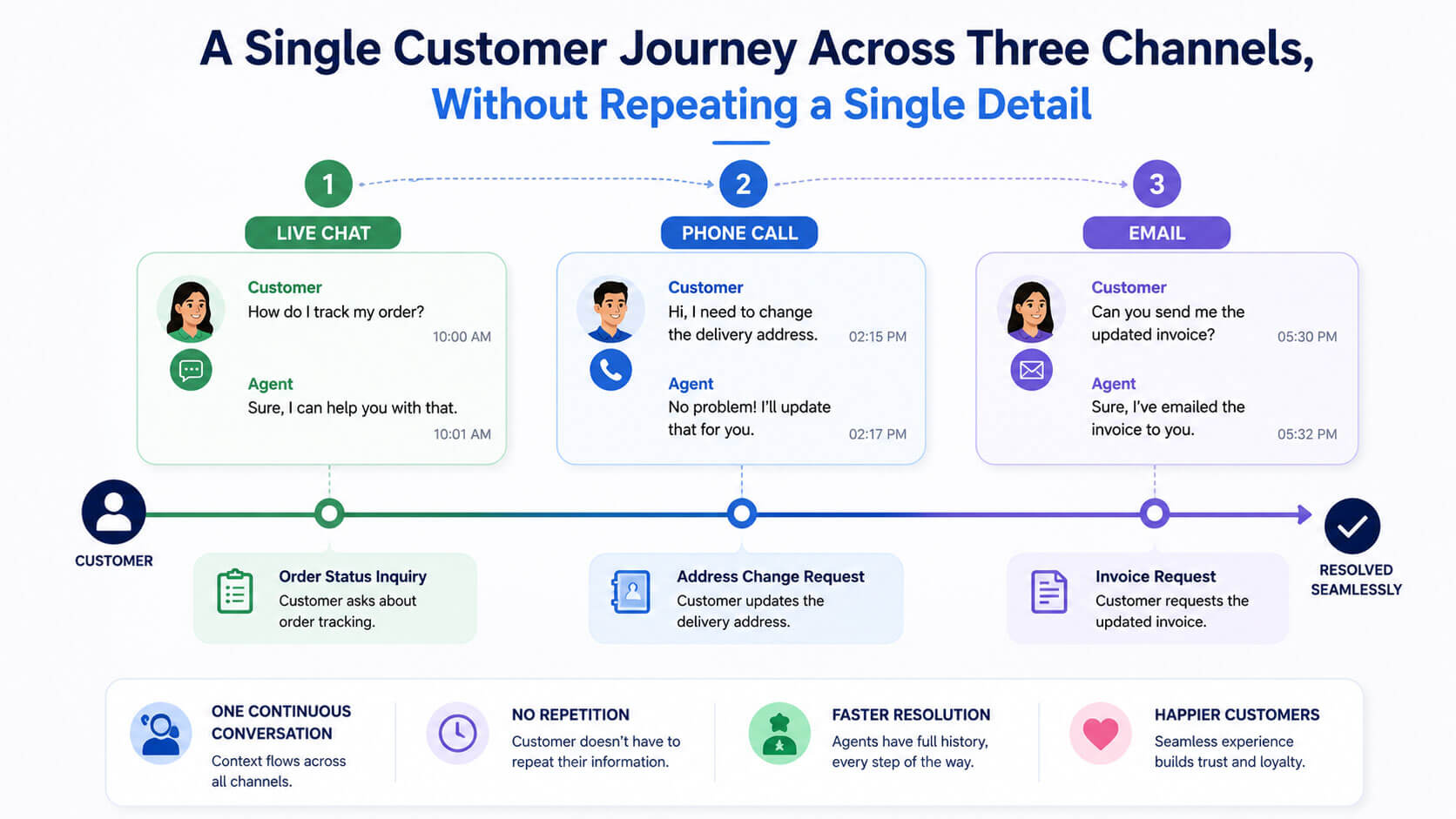
- A customer starts a conversation on live chat about a billing issue.
- They drop off, then follow up by email two hours later.
- The next day, they call in, frustrated, expecting to explain everything again.
- Instead, the agent sees the full thread — chat transcript, email, and now the call — in one screen, with no gaps.
That single change, seemingly small, is what drives measurable business results. Research from Zendesk found that companies using an integrated omnichannel solution saw a 31% reduction in first-resolution times and a 39% decrease in customer wait times compared to businesses operating in channel silos. That’s not a marginal improvement — that’s the difference between a customer who stays and one who leaves a negative review.
Core Capabilities of an Omnichannel Call Center Solution
- Unified agent workspace — One screen, every channel, one customer history
- Smart routing — Cases are automatically assigned based on agent skill, availability, and channel, not just a first-come queue
- Real-time analytics across channels — Leadership sees the full picture, not just phone metrics
- AI-assisted case summaries — Reduces the time agents spend reading through long histories
- Scalable channel addition — Adding WhatsApp, social, or a new self-service bot doesn’t require a new platform
Omni Channel vs Call Center: A Direct Business Comparison
Let’s put both approaches side by side, because this is usually where the decision actually gets made.
Omni Channel vs Traditional Call Centre Software
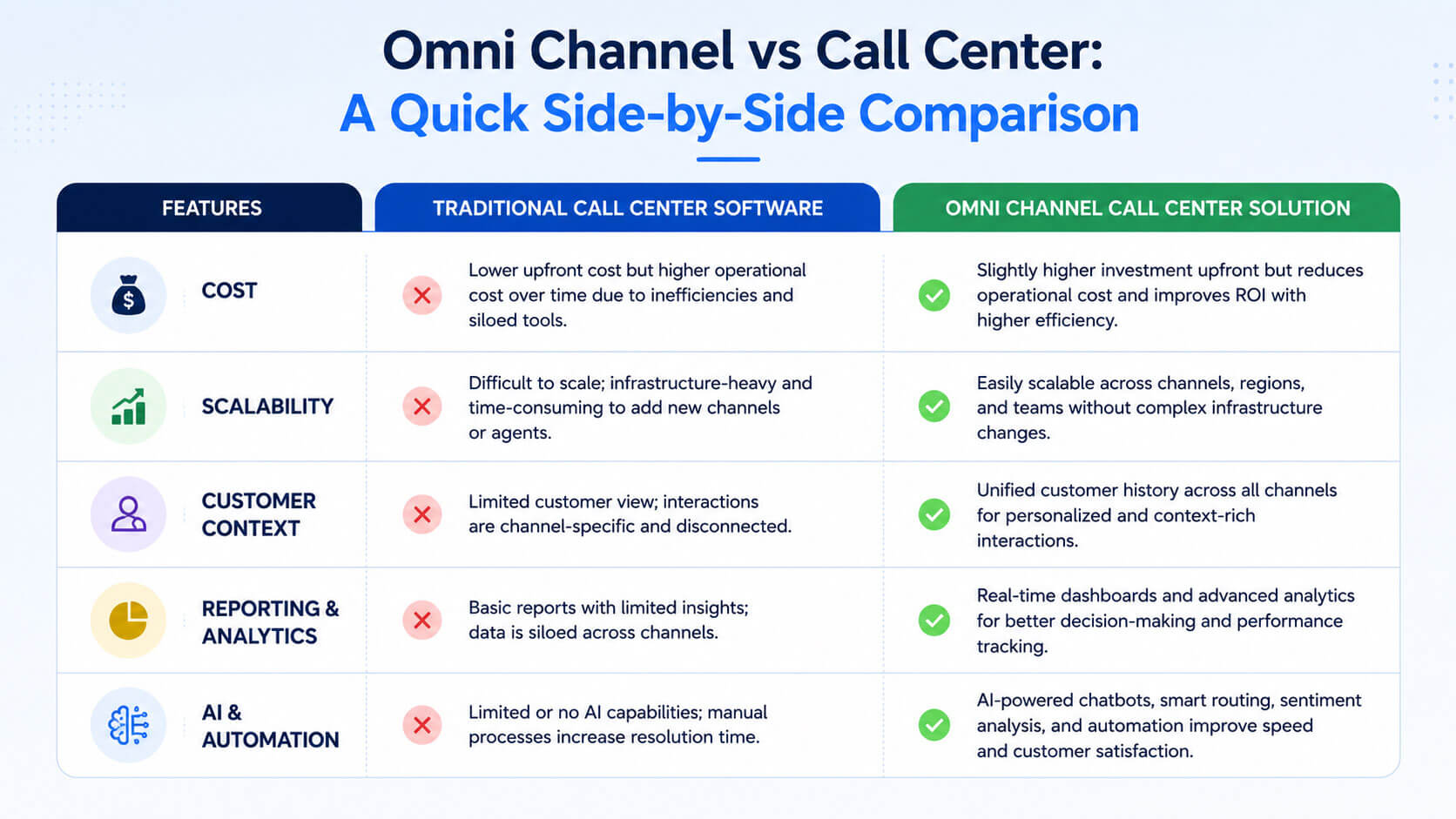
This table alone should tell you most of what you need to know for a first-pass evaluation. But numbers only mean something when you connect them to what happens on the ground, so let’s look at a realistic scenario.
A Realistic Business Scenario: Before and After Omnichannel
Consider a mid-sized insurance company with roughly 120 contact centre agents. Before switching to an omni channel call center solution, their setup looked like this:
- Phone system: a legacy PBX-based platform
- Email support: a separate ticketing tool
- Live chat: a third-party widget with no CRM connection
- Reporting: three different dashboards, manually combined into a monthly spreadsheet
The process problem: A customer filing a claim would often start on chat, get redirected to email for documentation, then call to check status — and each time, they had to re-explain the claim from scratch. Average handle time on calls was inflated because agents spent the first two to three minutes just re-establishing context.
The result after switching to Salesforce Service Cloud with omni-channel routing:
- Average handle time dropped by roughly 20% within the first quarter, mainly because agents no longer needed to manually search for prior interactions
- First-contact resolution improved noticeably, since agents could see the full case history immediately
- Leadership finally had one dashboard instead of three, which cut monthly reporting time from days to hours
- Agent satisfaction improved too — a detail that’s easy to overlook, but burnout and attrition are real costs. Salesforce research has found that a majority of service agents report feeling burned out, largely due to workload complexity and disconnected tools.
The common mistake this company almost made: early in the evaluation, they nearly chose a system based purely on phone-call features, without checking whether it could unify chat and email data too. That would have solved half the problem and left the other half — the part actually driving customer frustration — untouched.
Common Mistakes to Avoid When Evaluating Call Center Alternatives
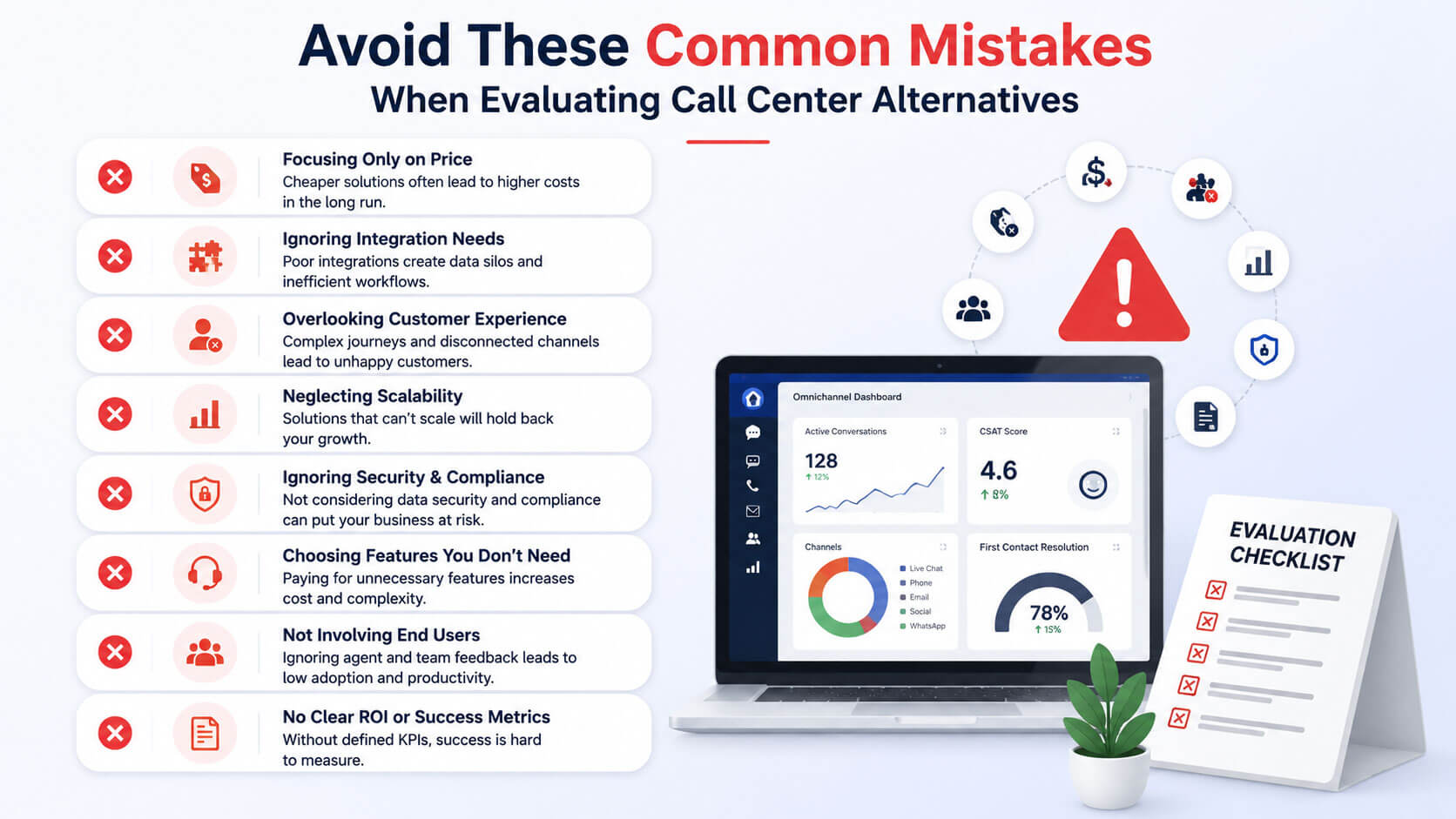
- Focusing only on cost-per-seat, not total cost of ownership. Cheaper software with poor integration often costs more once you add third-party tools and IT hours.
- Ignoring agent experience. If the interface is clunky, adoption will be slow no matter how powerful the backend is.
- Underestimating data migration complexity. Historical customer data needs a clear migration plan, not an afterthought.
- Choosing a platform that can’t scale with new channels. WhatsApp and social support are quickly becoming standard, not optional.
- Skipping a pilot phase. Rolling out to your entire team at once, without testing with a smaller group first, increases the risk of disruption.
Actionable Tips for Making the Switch
If you’re seriously considering a move from traditional software to an omnichannel setup, here’s a practical starting point:
- Audit your current channels first. List every way customers currently contact you, and note which ones are connected versus siloed today.
- Map your highest-friction customer journeys. Look for the interactions where customers most often repeat themselves — that’s usually your biggest opportunity.
- Start with a pilot team. Roll out the new system to one department or region before a full rollout.
- Set clear KPIs before you start. Average handle time, first-contact resolution, and CSAT should all be tracked before and after the switch, so you can measure real impact, not just anecdotes.
- Involve your agents early. The people using the system daily will spot usability issues faster than any executive review.
- Plan your data migration with a clear owner. Assign one person or team to be accountable for customer data accuracy during the switch.
What the Data Tells Us
It’s worth pausing on a few numbers that put this decision in context.
According to research referenced by Salesforce, 88% of customers say the overall experience a company provides matters as much as its actual products or services. That statistic matters here because contact centre interactions are often the most direct, most emotional touchpoint a customer has with your brand. A clunky, disconnected support experience undoes a lot of good marketing and product work.
Separately, McKinsey has found that companies adopting omnichannel strategies can reduce service delivery costs by roughly 3–7%. For a large contact centre operation, that’s not a trivial saving — it directly affects the CFO’s bottom line, not just the customer experience metrics that usually get discussed first.
And as mentioned earlier, Zendesk’s research on integrated omnichannel solutions found a 31% reduction in first-resolution time and a 39% decrease in customer wait time compared to businesses running channel silos. Put together, these numbers paint a consistent picture: connected systems reduce cost and improve service quality at the same time, rather than forcing a trade-off between the two.
Where NSIQ INFOTECH Fits In
Moving from a traditional call centre setup to a true omnichannel model isn’t a simple software swap — it involves data migration, agent training, workflow redesign, and often some organisational change management. This is exactly the kind of transition that benefits from experienced hands guiding the process.
At NSIQ INFOTECH, our team works with contact centre leaders to plan and execute Salesforce Service Cloud implementations that are built around your actual customer journeys, not a generic template. That means we start by understanding where your current friction points are, then design a rollout that minimises disruption to your live operations while your team continues serving customers.
Whether you’re consolidating three disconnected tools into one platform, migrating years of historical customer data, or simply trying to understand whether an omnichannel call center solution makes sense for your business size, having a partner who’s done this before can shorten your timeline considerably and reduce the risk of costly missteps.
Making the Switch: A Practical Migration Roadmap
Here’s a simplified, step-by-step view of how most successful transitions unfold:
- Discovery and audit — Map current channels, systems, and pain points
- Requirements definition — Identify must-have features versus nice-to-haves
- Platform configuration — Set up unified routing, dashboards, and integrations
- Data migration — Move historical customer records with accuracy checks
- Pilot rollout — Test with a small team, gather feedback
- Full deployment — Roll out across the full contact centre
- Post-launch optimisation — Refine routing rules and reporting based on real usage data
This roadmap isn’t rigid — every organisation’s starting point looks different — but skipping steps (especially the pilot phase) is one of the most common reasons transitions run into trouble.
Talk to Our Team
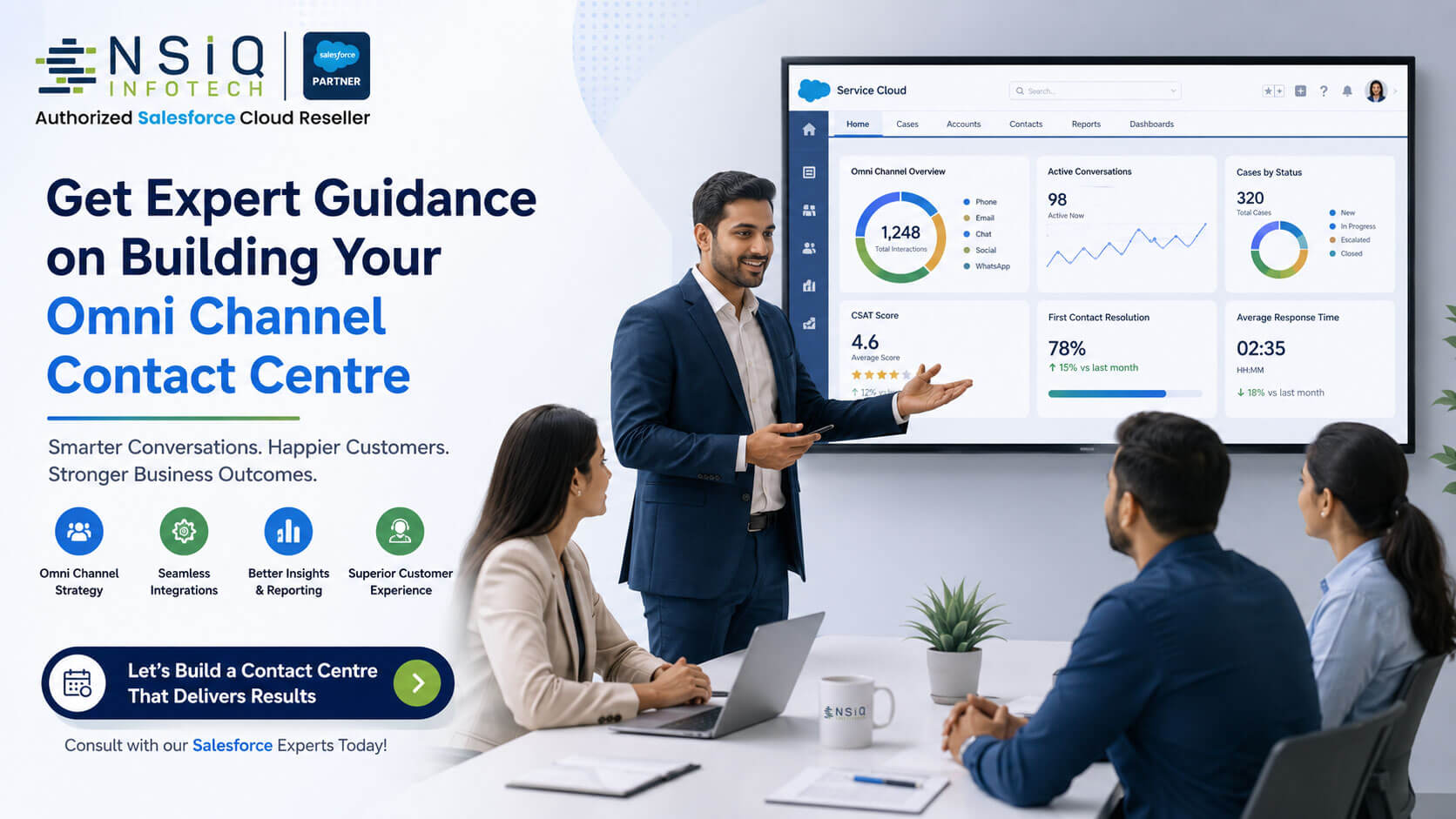
If you’re weighing an omni channel call center software upgrade against sticking with what you already have, the smartest next step isn’t guessing — it’s getting a clear, honest assessment of what would actually change for your specific operation.
Book a consultation with NSIQ INFOTECH and we’ll walk through your current setup, flag where the biggest wins are likely to be, and give you a realistic picture of what a Salesforce Service Cloud implementation would look like for your team. No generic pitch — just a straight conversation about whether this move makes sense for your business right now.
FAQs
What is the difference between an omni channel call center and a traditional call center? A traditional call centre focuses mainly on phone support, with other channels often running as separate, disconnected systems. An omni channel call center connects every channel — phone, email, chat, and social — into one unified view of the customer.
Is omni channel call center software more expensive than traditional systems? Not necessarily. While the upfront investment can vary, an omnichannel call center solution often reduces total cost of ownership by consolidating multiple tools into one platform, cutting down on separate licensing and integration costs.
What are the best call center alternatives to legacy phone-based systems? Cloud-based omnichannel platforms like Salesforce Service Cloud are among the most widely adopted call center alternatives, since they support voice, chat, email, and social channels within a single system.
How long does it take to migrate from traditional call centre software to an omnichannel solution? Timelines vary based on company size and data complexity, but most mid-sized contact centres complete a phased migration, including a pilot rollout, within a few months.
Does omni channel call center software require agents to learn a completely new system? There is a learning curve, but most modern omnichannel platforms are designed with unified, intuitive interfaces that reduce training time compared to juggling multiple disconnected tools.
What industries benefit most from an omnichannel call center solution? Service-heavy industries — including insurance, banking, retail, healthcare, and telecom — see the most benefit, since their customers frequently switch between channels during a single issue.
Can small and mid-sized businesses use Salesforce omni-channel, or is it only for large enterprises? Salesforce Service Cloud scales across business sizes. Mid-sized businesses often see faster ROI since they can standardise processes early, before channel complexity grows further.
What is the biggest risk when switching to omni channel call center software? The most common risk is poor data migration planning, which can lead to lost customer history. A clear migration plan with a dedicated owner significantly reduces this risk.
How does omnichannel call center software improve customer satisfaction? By carrying customer context across every channel, it eliminates the need for customers to repeat themselves, which directly reduces frustration and improves resolution speed.
What metrics should we track when comparing omni channel vs call center systems? Track average handle time, first-contact resolution rate, customer satisfaction (CSAT), and total cost of ownership before and after any system change.
Does an omnichannel call center solution include AI features? Most modern platforms, including Salesforce Service Cloud, include AI-assisted case summaries, smart routing, and predictive insights as native features rather than add-ons.
How do we know if our business actually needs to move away from traditional call centre software? If your agents frequently lack context when customers switch channels, or if your reporting is fragmented across multiple systems, these are strong signs it’s time to evaluate an omnichannel upgrade.
What is the role of a pilot rollout when adopting new call center software? A pilot rollout lets you test the new system with a smaller team first, catching usability or configuration issues before a company-wide launch, which reduces overall disruption risk.
Will switching to omni channel call center software disrupt daily operations? With a phased migration approach and proper planning, disruption can be minimised significantly, especially when a pilot phase is used before full deployment.
How do we get started evaluating an omnichannel call center solution for our business? Start with an audit of your current channels and pain points, then speak with an experienced implementation partner who can map out a realistic transition plan tailored to your operations.
Conclusion
Choosing between an omni channel call center and traditional call centre software isn’t just a technology upgrade — it’s a decision that shapes how efficiently your team operates, how much your service delivery actually costs, and whether your customers stay loyal after a rough interaction. Traditional systems were built for a simpler, phone-first world. Today’s customers move fluidly between chat, email, phone, and social, and they expect your team to keep up without making them repeat themselves.
The data backs this up clearly: companies with connected, omnichannel systems see meaningfully lower resolution times, reduced wait times, and lower long-term service delivery costs. For COOs, CFOs, and Contact Centre Heads evaluating call center alternatives, the question isn’t really “can we afford to switch” — it’s “can we afford to keep running disconnected systems while customer expectations keep rising.”
If you’re ready to explore what an omnichannel call center solution could look like for your specific business, our team at NSIQ INFOTECH is here to walk you through it — honestly, and with your actual operations in mind, not a one-size-fits-all sales pitch.
Ready to see what a connected contact centre could look like for your team? Book a consultation with NSIQ INFOTECH today.