
Introduction
In today’s digital world, business data is often scattered across different systems, creating data silos and a poor customer experience.
Salesforce Data Cloud solves this by bringing all your data together in one place and providing a real-time, complete view of each customer.
In this guide, you’ll learn:
- How Salesforce Data 360 works
- Why it matters for AI
- How it helps grow your business
Understanding the Foundation: What is Salesforce Data 360?
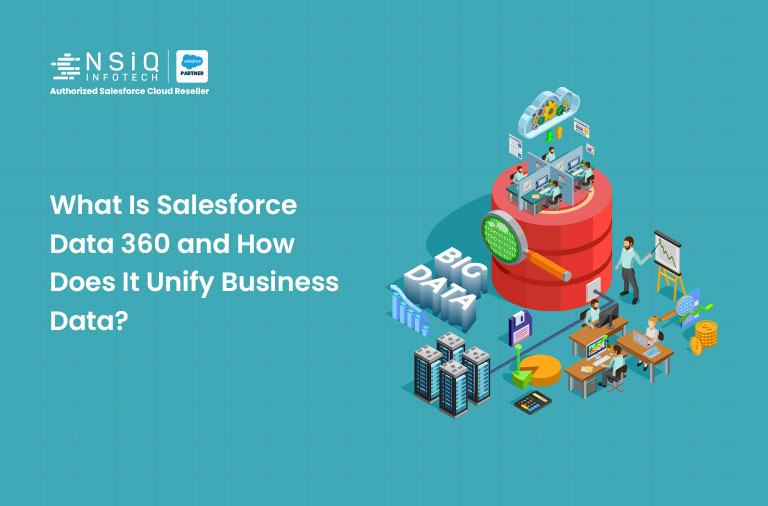
Salesforce Data Cloud is a platform that collects and connects data from across your business in one place.
It takes data from sources such as:
- Website activity
- Sales transactions
- Support tickets
—and combines it into a single, complete customer profile (Customer 360).
This helps all teams:
- Sales
- Marketing
- Service
- Commerce
see the same data and work together more effectively.
Because of this, businesses can deliver more personalised experiences and improve business results.
According to McKinsey & Company
Companies using data effectively for personalization can achieve:
- 10%–30% increase in marketing efficiency
Salesforce Data 360 makes this possible by creating a true Single Source of Truth.
The 4 Pillars of Modern Data Unification
1. Seamless Data Ingestion
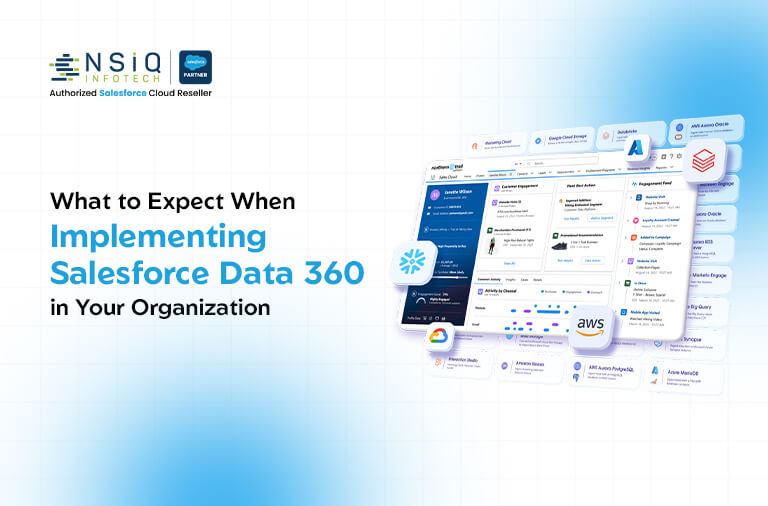
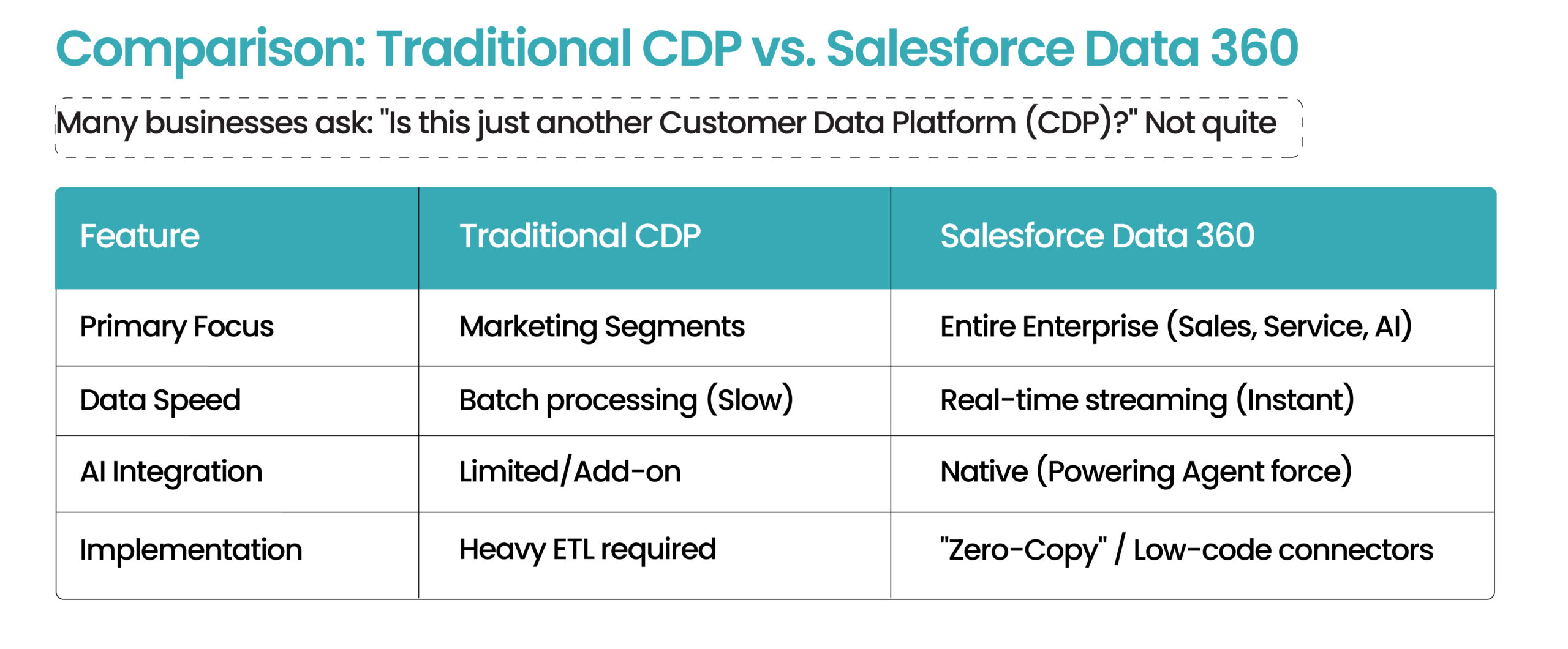
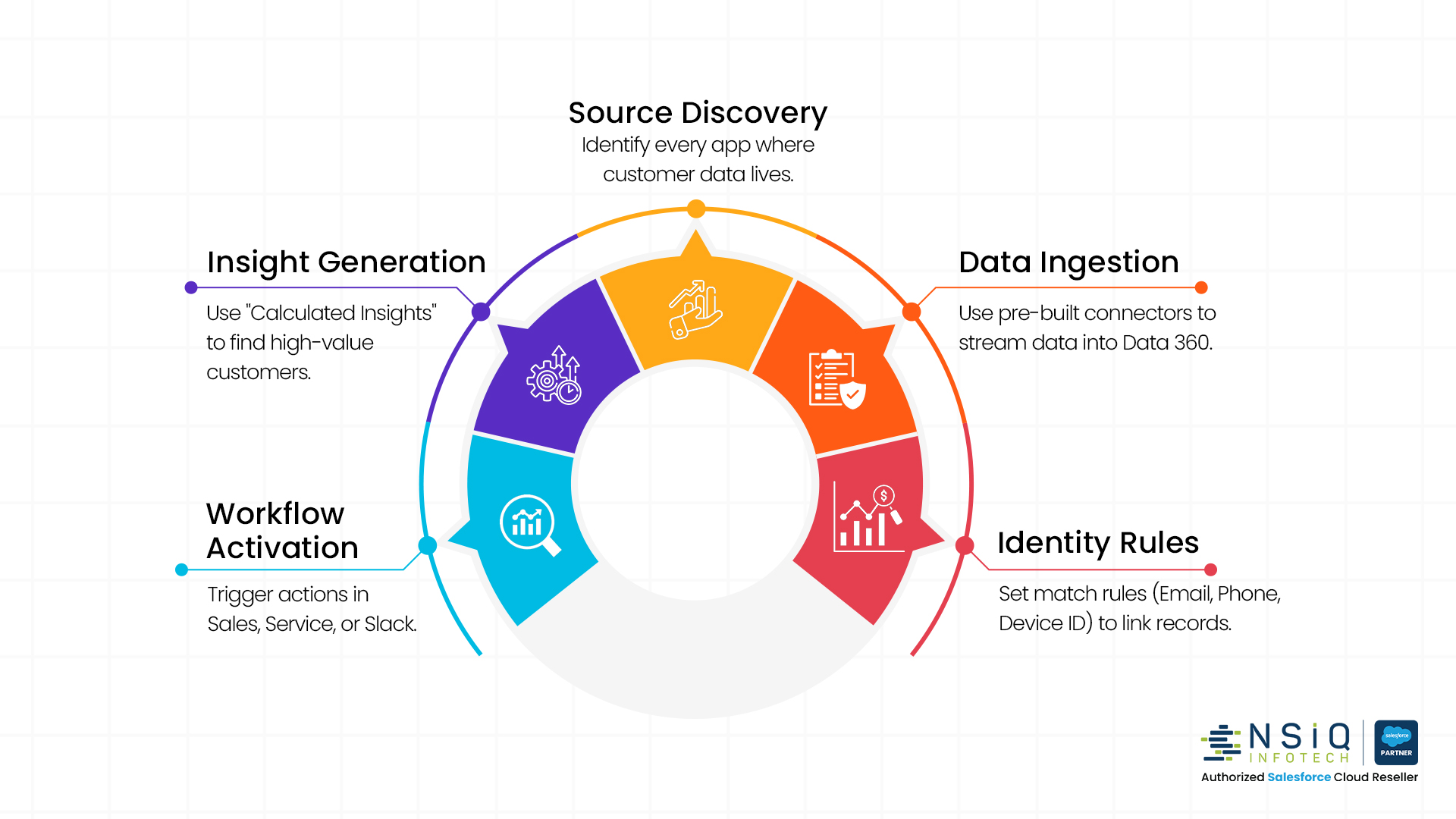
Data 360 uses connectors to pull data from multiple sources.
Examples Include:
- Salesforce native data
- Amazon S3
- Google Cloud
- Snowflake
- Website interactions
- Mobile apps
2. Intelligent Data Harmonisation
Once data is collected, it must become consistent and usable.
Salesforce uses a Customer 360 Data Model to standardize information across systems.
Example
- “Customer ID” in one system
- “Email Address” in another
can both be linked to the same customer.
This removes duplicate or confusing records and improves data quality.
3. Identity Resolution and the “Golden Record”
This is where the platform becomes powerful.
AI-powered identity resolution understands that:
- “Rob Smith”
- “Robert Smith”
may actually be the same person.
The system merges records into one unified profile called a Golden Record.
4. Real-Time Data Activation
Unified data becomes useful when activated inside workflows.
Sales
Reps see full customer activity before calls.
Service
Agents see real-time issues and order problems.
Marketing
AI can trigger campaigns instantly after cart abandonment.
Why Data 360 is Important for Agentforce and AI
Agentforce is Salesforce’s AI platform, but AI is only effective when powered by complete data.
Without Data 360:
- AI lacks customer context
- Responses become generic
- Opportunities are missed
With Data 360:
- AI receives complete customer history
- Recommendations become accurate
- Customer experiences improve
Zero-Copy Integration
Data Cloud supports Zero-Copy Architecture, meaning it can use data directly from:
- Snowflake
- AWS
without moving the data physically.
Benefits include:
- Faster AI performance
- Lower infrastructure costs
- Better scalability
Real-Life Case Study: Retail Transformation
The Challenge
A retail brand called “Urban Style” struggled with duplicate customer records.
Customers were receiving repeated “Welcome” offers even though they were already loyal customers.
The Solution
The company implemented Salesforce Data Cloud to connect:
- Shopify store
- Service Cloud
- Loyalty app
The Results
- 30% reduction in manual data cleanup
- 25% higher email click rates
- 15% fewer support calls
Strategic Statistics to Remember
The “Data Gap”
According to IBM:
- 97% of companies collect data
- Only 24% use it effectively for customer transformation
Revenue Growth
According to Statista:
Data-driven businesses are:
- 23× more likely to acquire customers
How NSIQ INFOTECH Can Help
NSIQ INFOTECH helps businesses implement and optimize Salesforce Data 360 solutions.
Our Expertise Includes:
- Identity resolution setup
- External data integrations
- Customer 360 implementation
- Data strategy consulting
- AI activation support
We ensure your Salesforce investment delivers measurable ROI.
1. Is Salesforce Data 360 the same as Data Cloud?
Yes. Data 360 is the broader framework powering Salesforce Data Cloud.
2. Do I need a data scientist to use Data 360?
No. It is a low-code platform designed for business users and Salesforce teams.
3. Does Data 360 store all external data?
It can, but it also supports Zero-Copy architecture.
4. How does it improve ROI?
By reducing duplicate marketing efforts and improving personalization.
5. Is my data secure?
Yes. Salesforce provides enterprise-grade security and encryption.
6. Can small businesses benefit?
Yes. Even small teams gain automation and better insights.
7. How long does implementation take?
Basic implementation usually takes 4–8 weeks.
8. Does it work with non-Salesforce systems?
Yes, using connectors and MuleSoft.
9. What are Calculated Insights?
Automated metrics such as customer lifetime value or churn risk.
10. How does it help with GDPR?
It centralizes consent and supports privacy requests like “Right to be Forgotten.”
Conclusion
Salesforce Data Cloud is no longer optional for businesses competing in the AI era.
By unifying fragmented data into a single real-time customer profile, businesses can:
- Improve personalization
- Empower teams
- Enable smarter AI decisions
- Increase revenue growth
The path to a true Single Source of Truth starts with one step.
Ready to Transform Your Data Strategy?
Connect with NSIQ INFOTECH for a customized Salesforce Data 360 consultation today.