
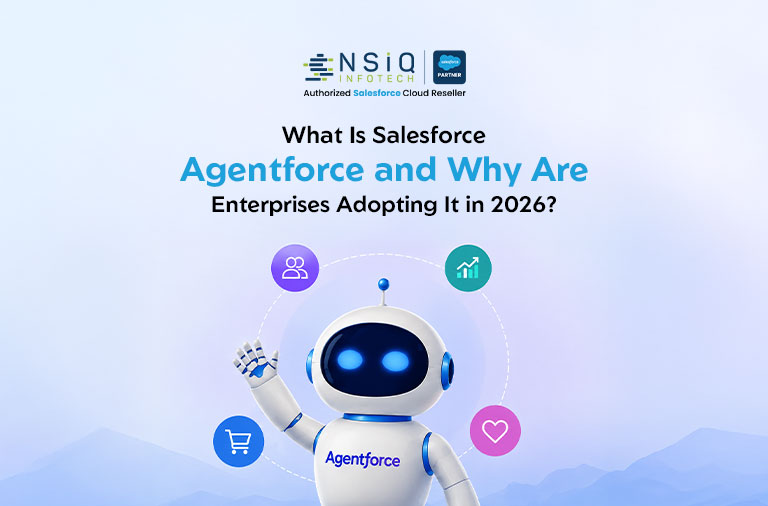
Imagine having a team of intelligent assistants that never sleep, never get overwhelmed, and can handle complex customer interactions, internal workflows, and sales processes — all on their own. That’s not science fiction anymore. That’s Salesforce Agentforce.
In 2026, enterprise leaders — CIOs, Digital Heads, and CEOs — are under constant pressure to do more with less: reduce operational costs, improve customer experience, and scale faster without proportionally scaling headcount. Agentforce is the answer many of them have been waiting for.
This guide breaks down what Agentforce actually is, how it works, what makes it different from everything that came before, and why so many forward-thinking companies are deploying it right now.
What Is Salesforce Agentforce?
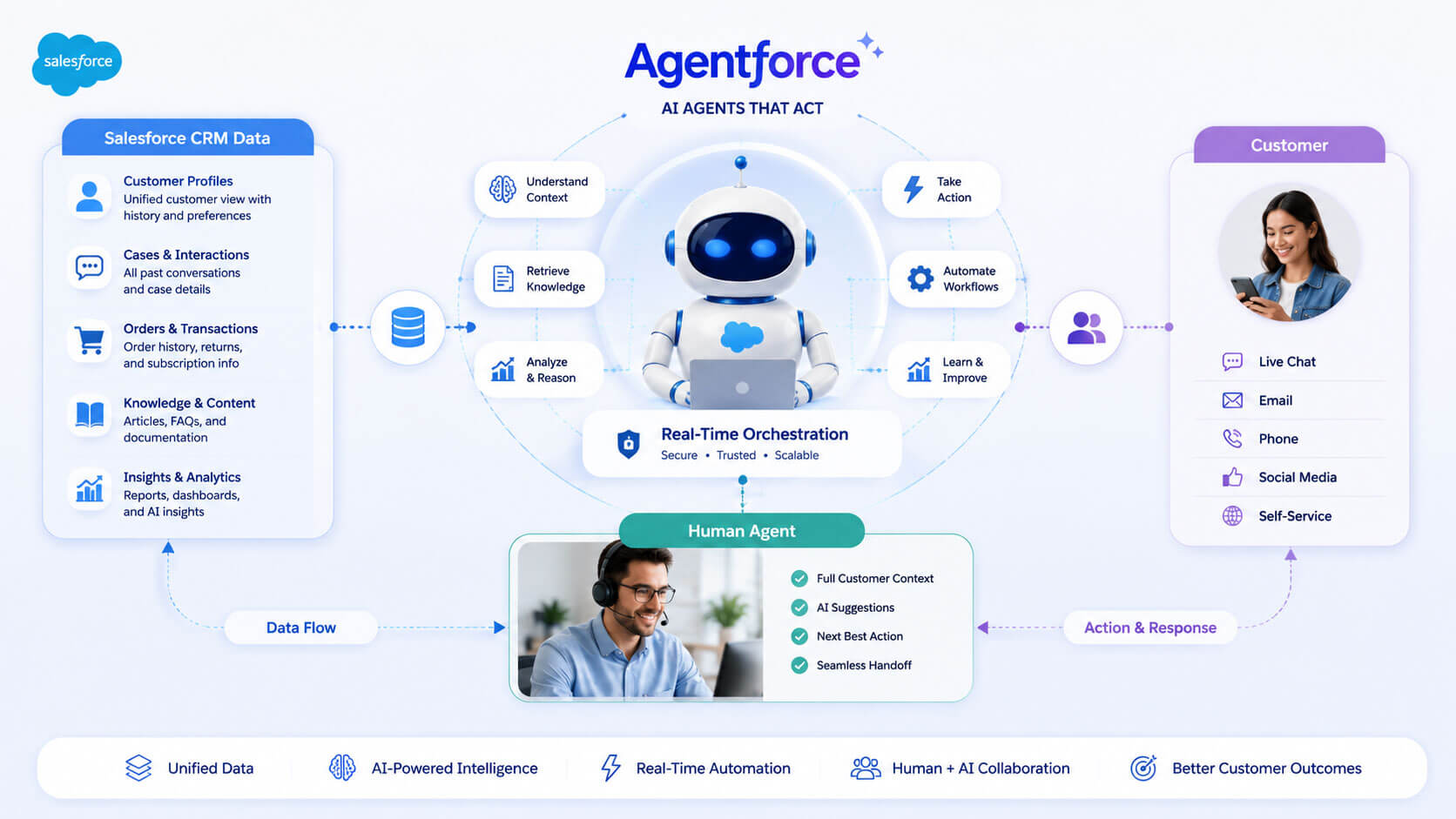
Salesforce Agentforce is an AI-powered platform that lets businesses build, deploy, and manage autonomous AI agents — digital workers that can understand natural language, make decisions, take action, and collaborate with human teams, all within the Salesforce ecosystem.
Unlike simple chatbots or rule-based automation, Agentforce agents don’t just respond to inputs. They reason. They look at available data, decide what the best next action is, and then execute it — whether that’s resolving a customer service case, updating a CRM record, routing a sales opportunity, or escalating a complex issue to a human employee.
Think of it this way: a traditional chatbot follows a script. An Agentforce agent reads the room.
Salesforce officially introduced Agentforce at Dreamforce 2024, and by 2026 it has become one of the most adopted enterprise AI platforms globally, sitting at the center of Salesforce’s broader “agentic enterprise” strategy.
How Does Agentforce Actually Work?
Understanding the architecture behind Agentforce helps explain why it’s so powerful. Here’s how the platform works at a high level.
The Five Core Building Blocks
Role defines what the agent is there to do. Is it a customer service agent? A sales development representative? An IT support assistant? You define the role and the agent focuses on it.
Data is sourced from Salesforce Data Cloud — the unified data layer that pulls in information from CRM, third-party apps, real-time events, and enterprise databases. The agent only acts on real, current, and trusted data.
Actions are the tasks the agent is authorized to perform. This could be sending an email, updating a record, generating a quote, raising a ticket, or triggering a workflow. You control what each agent is allowed to do.
Guardrails define the boundaries. You decide what the agent cannot do — for example, it cannot process a refund above a certain threshold without human approval. This keeps the agent safe and compliant.
The Einstein Trust Layer is Salesforce’s built-in security framework. It ensures that no customer data leaves your trusted environment when interacting with AI models, which is a critical concern for regulated industries like banking, healthcare, and insurance.
All five components work together to create agents that are powerful but controlled — autonomous but accountable.
How Is Agentforce Different from Einstein AI and Traditional Automation?
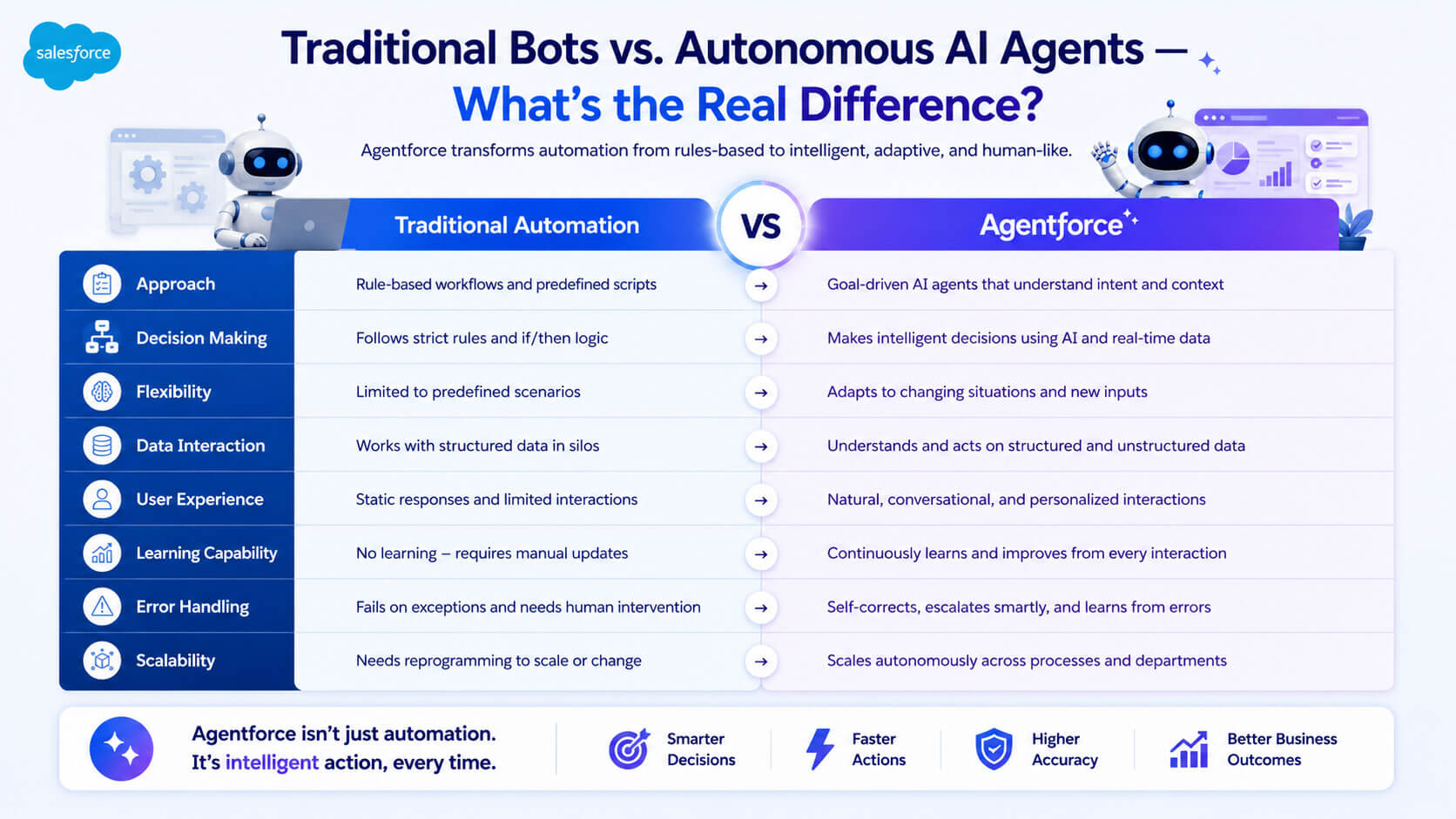
This is one of the most common questions enterprise leaders ask. Here’s a clear answer.
Agentforce vs. Traditional Automation (RPA)
Traditional Robotic Process Automation (RPA) tools follow rigid, pre-defined rules. They’re great for repetitive, structured tasks — like copying data from one system to another. But the moment something unexpected happens, they break.
Agentforce agents don’t follow a script. They understand context, handle ambiguity, and adapt to new situations. If a customer’s case doesn’t fit neatly into a predefined category, the agent doesn’t fail — it reasons through the situation.
Agentforce vs. Salesforce Einstein
Einstein AI (launched years before Agentforce) is embedded intelligence that makes predictions and suggestions within Salesforce. It might suggest the next best action to a sales rep, or score a lead. But a human still has to decide and act.
Agentforce takes the next step: the agent acts. It’s the difference between a GPS giving you directions and a self-driving car that actually takes you there.
Agentforce vs. Basic Chatbots
Chatbots are reactive. They answer questions in a conversation. Agentforce agents are proactive. They can initiate processes, juggle multiple workflows simultaneously, hand off tasks to other agents, and loop in humans when needed — all without being prompted.
Top Agentforce Use Cases Across the Enterprise
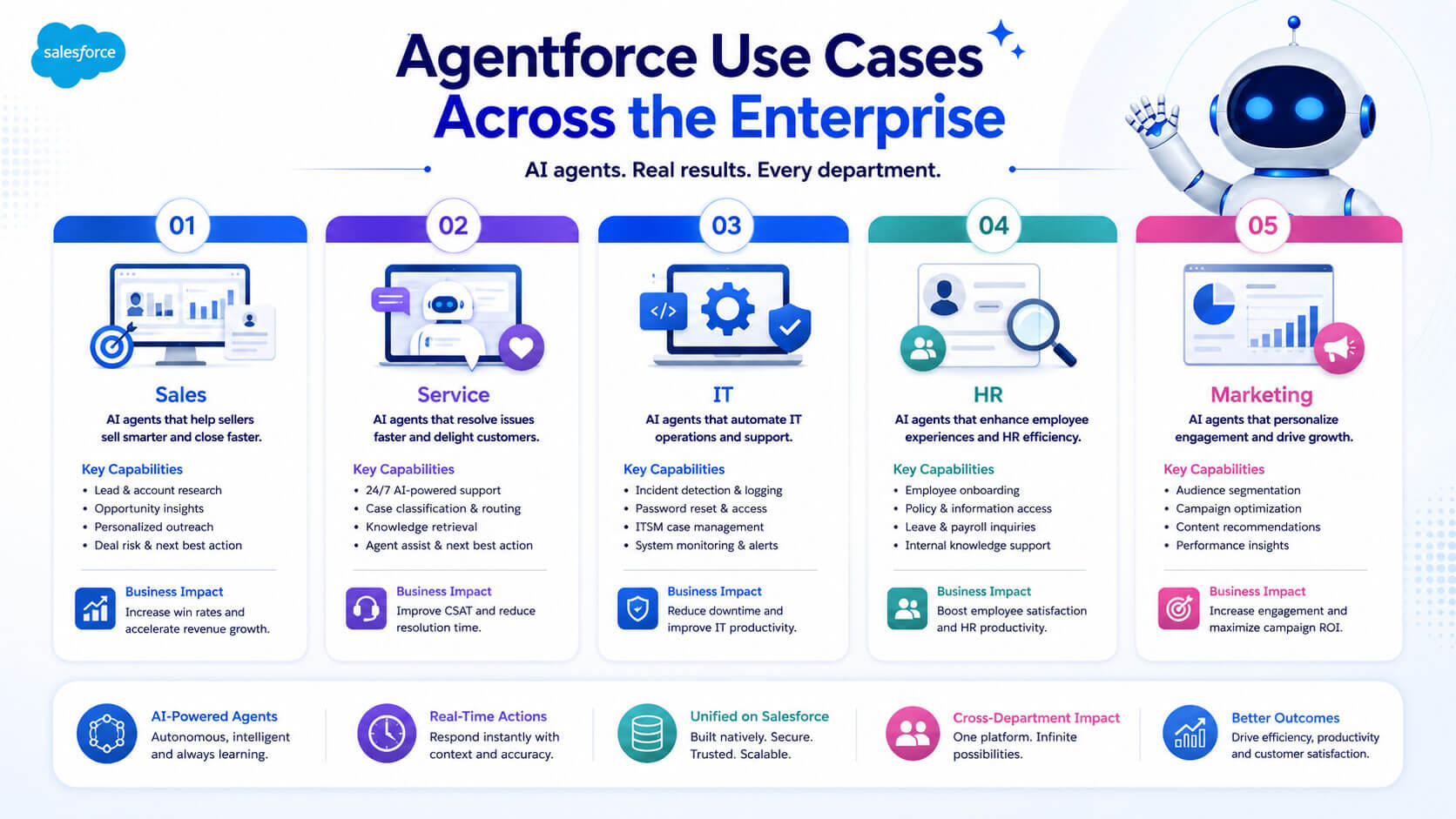
Agentforce isn’t a single-department tool. It’s being deployed across the enterprise. Here are the most impactful use cases being rolled out in 2026.
1. Customer Service: 24/7 Resolution Without Wait Times
A telecom company using Agentforce deployed a service agent that can handle billing disputes, plan changes, and technical troubleshooting without any human involvement for tier-1 issues. The result? A 40% reduction in average handle time and a 25% increase in CSAT scores within the first quarter.
The agent accesses real-time account data, understands the customer’s history, resolves common issues immediately, and escalates only the complex or high-value cases to human agents — with a full summary already prepared.
2. Sales: AI-Powered Pipeline Management
Sales teams lose hours every week on manual CRM updates, follow-up scheduling, and lead research. Agentforce sales agents automate all of this. They enrich lead data, draft personalized outreach emails, update opportunity stages after every interaction, and flag deals at risk of going cold.
One mid-sized B2B software firm reported their sales reps saved an average of 6 hours per week after deploying Agentforce — time that was redirected to actual selling.
3. IT Service Management: Faster Ticket Resolution
IT teams are drowning in service requests. An Agentforce IT agent can triage incoming tickets, auto-resolve password resets, software access requests, and device provisioning — tasks that make up 60–70% of most IT helpdesk queues — without human intervention.
For a global manufacturing company, this reduced Level 1 ticket resolution time from 4 hours to under 15 minutes.
4. HR: Employee Self-Service at Scale
HR teams spend enormous time answering repetitive employee questions: leave balances, policy clarifications, onboarding status, payroll queries. Agentforce HR agents handle all of this through a natural language interface integrated with Slack, Teams, or the employee portal.
The outcome isn’t just time savings for HR. Employees get instant, accurate answers instead of waiting 24–48 hours for a response.
5. Marketing: Personalized Campaigns at Machine Speed
Agentforce marketing agents can segment audiences in real time, generate campaign content variations, route high-intent leads to the right sales team, and adjust messaging based on live engagement data. This makes true 1:1 personalization possible at a scale no human team could match.
Key Statistics Every Enterprise Leader Should Know
Stat 1: According to McKinsey’s State of AI report, organizations that have deployed AI agents report an average of 20–30% reduction in operational costs within the first year of deployment. (Source: McKinsey & Company, 2024) This tells us that the ROI on autonomous AI agents isn’t theoretical — it’s already being measured in real enterprises.
Stat 2: Salesforce reports that Agentforce handled over 1 billion agent interactions in the first six months after its global rollout. (Source: Salesforce Agentforce Launch Data, 2025) This scale of adoption signals that enterprises aren’t just experimenting — they’re deploying Agentforce in production environments at massive scale.
Stat 3: Gartner predicts that by 2028, 33% of enterprise software applications will include agentic AI capabilities, up from less than 1% in 2024. (Source: Gartner, 2024) For CIOs and Digital Heads, this is a clear signal: the agentic enterprise isn’t a future state — it’s the direction the entire market is moving.
Why Are Enterprises Adopting Agentforce in 2026?
The timing of Agentforce’s rise isn’t accidental. Several forces are converging to make 2026 the tipping point for enterprise AI agent adoption.
The CX Expectation Gap Has Reached a Breaking Point
Customers expect instant, personalized, 24/7 service. But hiring enough people to meet that expectation at scale is financially unsustainable. Agentforce bridges this gap without sacrificing quality.
The “Do More With Less” Mandate Is Everywhere
From post-pandemic restructuring to economic pressure, enterprise leaders are being asked to grow revenue and improve efficiency without adding headcount. Autonomous AI agents are one of the few levers that can genuinely move both metrics simultaneously.
The Trust Problem Has Been Solved (Mostly)
Previous enterprise AI tools raised serious concerns around data security, hallucinations, and unpredictable behavior. Salesforce’s Einstein Trust Layer addresses these directly — giving security, compliance, and risk teams enough confidence to approve production deployments.
Salesforce Is Already the System of Record
For most large enterprises, Salesforce already holds the critical data: customer profiles, interaction history, sales pipeline, service cases. Agentforce is built natively on this data. That removes the biggest barrier to AI deployment — the messy, expensive work of data integration.
How NSIQ INFOTECH Helps You Deploy Agentforce the Right Way
Deploying Agentforce isn’t just a technical exercise — it’s a strategic transformation. Getting it right means defining the right use cases for your industry, configuring agents that align with your business processes, setting appropriate guardrails, and training your teams to work alongside AI agents effectively.
At NSIQ INFOTECH, we are a Salesforce implementation partner with deep expertise in AI-driven CRM transformation. Our Agentforce practice covers end-to-end deployment: from discovery and use case design to configuration, integration, testing, and change management.
Whether you’re a CIO looking to build your first AI agent proof-of-concept, or a Digital Head ready to roll out Agentforce across your entire enterprise, our team can get you there — faster and with less risk.
Actionable Tips: How to Get Started with Agentforce Today
You don’t need to transform your entire enterprise overnight. Here are four concrete steps you can take right now.
Step 1 — Identify your highest-volume, lowest-complexity task. Look for a process where your team handles hundreds of repetitive requests per week. This is your best first candidate for an Agentforce pilot.
Step 2 — Audit your Salesforce data quality. Agentforce is only as good as the data it works with. Before deploying, make sure your CRM records are clean, complete, and current.
Step 3 — Define your guardrails before you build. Decide upfront what your agents can and cannot do independently. This isn’t just a safety measure — it’s what gets your legal and compliance teams comfortable with the deployment.
Step 4 — Start with one agent, measure rigorously, then scale. The enterprises seeing the best results from Agentforce aren’t the ones who tried to do everything at once. They started with a tightly scoped pilot, proved the ROI, and then expanded systematically.
Conclusion
Salesforce Agentforce represents one of the most significant shifts in enterprise software since the move to the cloud. It turns Salesforce from a system that records what happened into a platform that actively makes things happen — autonomously, at scale, and within a trusted security framework.
For CIOs and Digital Heads, the strategic case is clear: enterprises that deploy autonomous AI agents in 2026 will operate faster, serve customers better, and outcompete peers still relying on fully human-staffed processes.
The question is no longer whether to adopt Agentforce — it’s how quickly you can do it responsibly and effectively.
At NSIQ INFOTECH, we help you answer that question with confidence. Reach out today to start your Agentforce journey.
Frequently Asked Questions (FAQs)
- What is Salesforce Agentforce in simple terms? Agentforce is a Salesforce platform that lets you create AI agents — autonomous digital workers that can handle tasks like answering customer queries, updating CRM records, and managing workflows without needing a human to do it manually.
- How is Agentforce different from a regular chatbot? Chatbots follow pre-written scripts and respond to questions. Agentforce agents reason through situations, take action on real systems (like updating a case or generating a quote), and work across multiple processes simultaneously.
- What are the main Agentforce use cases? The most common enterprise use cases include customer service automation, AI-assisted sales, IT help desk automation, HR self-service, and marketing personalization.
- Is Agentforce secure for enterprise use? Yes. Salesforce’s Einstein Trust Layer ensures that your data stays within your trusted environment and is never sent to external AI models without proper controls. It’s designed specifically for the security and compliance needs of large enterprises.
- Does Agentforce require custom coding to deploy? Not necessarily. Many Agentforce agents can be configured using Salesforce’s low-code and no-code tools. However, more complex enterprise deployments may require Apex development or API integrations — which is where a Salesforce partner like NSIQ INFOTECH adds value.
- What is the agentic enterprise in the context of Salesforce? The “agentic enterprise” refers to a business model where AI agents handle a significant portion of routine and complex tasks autonomously, allowing human employees to focus on higher-value, judgment-intensive work.
- How do Salesforce autonomous AI agents make decisions? They use data from Salesforce Data Cloud, apply reasoning models (built on large language models), follow the rules and guardrails you’ve configured, and choose from authorized actions to complete a given task.
- What industries are using Agentforce the most in 2026? Financial services, retail, telecommunications, manufacturing, healthcare, and technology companies are among the heaviest adopters, though Agentforce use cases exist across virtually every industry.
- Can Agentforce integrate with non-Salesforce systems? Yes. Through Salesforce’s MuleSoft integration layer and API connectors, Agentforce agents can interact with ERP systems, third-party databases, marketing platforms, and other enterprise tools.
- What is the Einstein Trust Layer in Agentforce? It’s Salesforce’s built-in AI security framework that protects sensitive data when AI agents process it — ensuring data masking, audit logging, zero data retention outside your org, and compliance with enterprise security policies.
- How long does an Agentforce deployment typically take? A focused pilot deployment for a single use case can be completed in 4–8 weeks. A full enterprise rollout across multiple departments typically takes 3–6 months, depending on data readiness and process complexity.
- What is the difference between Agentforce and Salesforce Flow? Salesforce Flow automates structured, rule-based processes triggered by defined events. Agentforce agents handle unstructured, dynamic situations that require natural language understanding and real-time decision-making.
- Do employees lose jobs because of Agentforce? In most enterprise deployments, Agentforce handles repetitive, low-value tasks, freeing employees to focus on more strategic work. Most organizations use it to scale capacity rather than reduce headcount.
- What does it cost to implement Salesforce Agentforce? Pricing varies based on the number of agents, usage volume, and Salesforce edition. Contact NSIQ INFOTECH for a tailored cost estimate based on your specific requirements and scale.
- How can NSIQ INFOTECH help with our Agentforce deployment? NSIQ INFOTECH provides end-to-end Agentforce implementation services — from use case discovery and agent design to configuration, integration, testing, and post-deployment support. We help enterprises get to value faster and with lower risk.
Published by NSIQ INFOTECH | Salesforce Implementation & AI Transformation Partner