
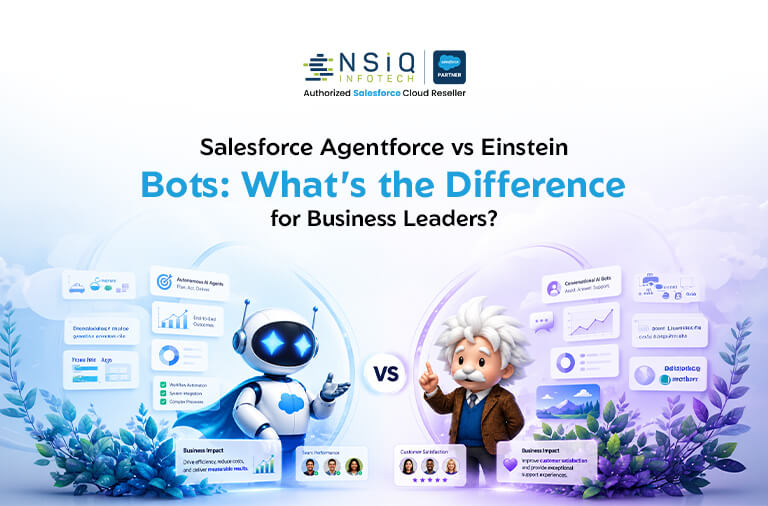
If you’ve spent any time in Salesforce planning meetings over the last year, you’ve probably heard both names thrown around a lot: Agentforce and Einstein. Sometimes they’re used almost interchangeably, which only adds to the confusion. But for CIOs, IT heads, and digital leaders trying to set a realistic AI roadmap, the difference between Salesforce Agentforce vs Einstein isn’t just semantics it directly affects your budget, your timeline, and how much value you actually get out of your CRM investment.
This guide breaks down the Salesforce Agentforce vs Einstein AI comparison in plain language, without the marketing fluff. By the end, you’ll know exactly what each tool does, where they overlap, where they don’t, and how to decide what makes sense for your organization right now not what Salesforce’s sales deck says you need.
A Quick Definition Before We Compare Anything
Let’s start with the basics, because a lot of the confusion comes from people assuming these are two versions of the same product. They’re not.
Einstein Bots
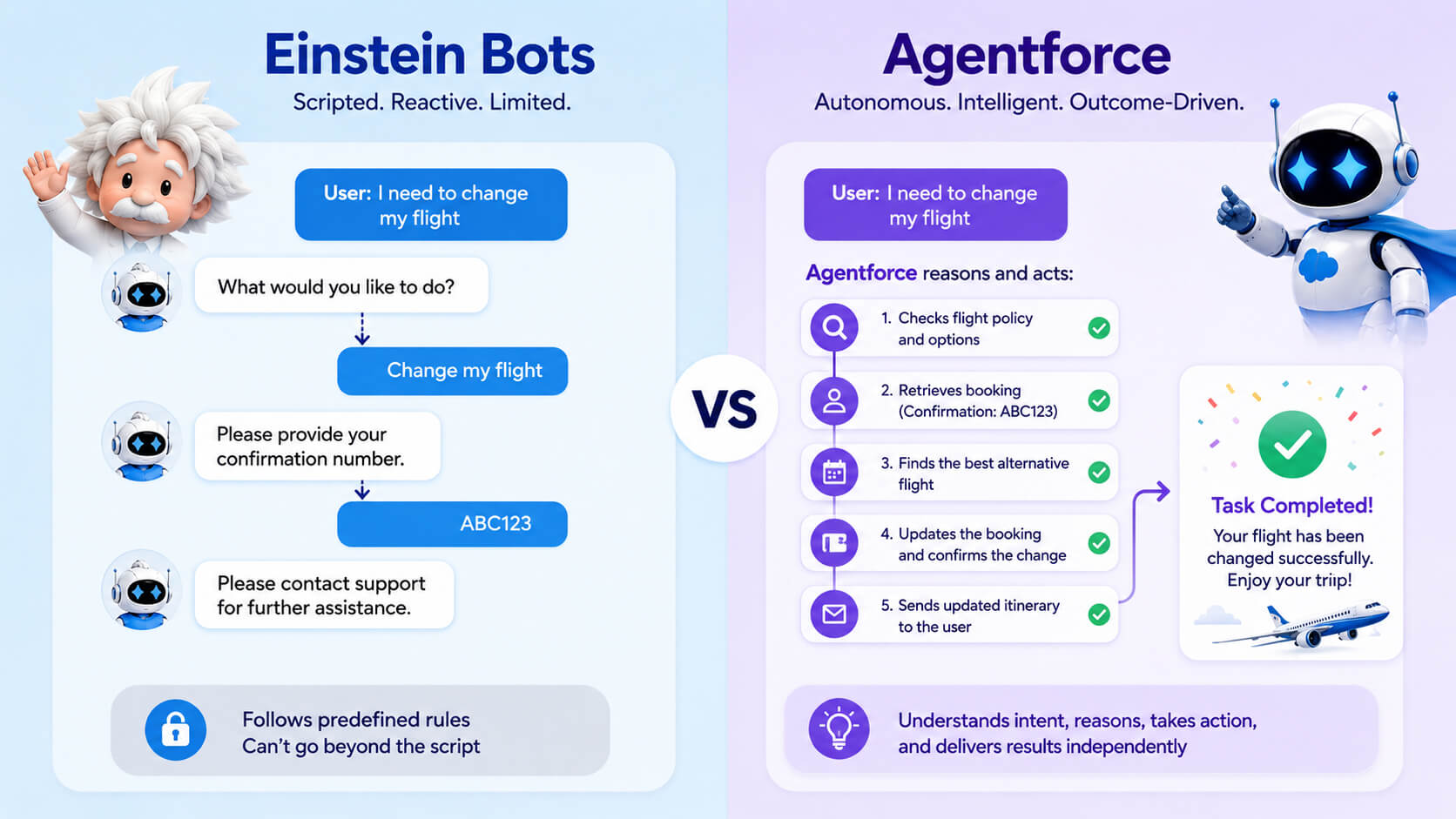
Einstein Bots is Salesforce’s original AI-powered chatbot tool, built primarily for Service Cloud and Experience Cloud.
Think of it as a smart receptionist. It greets customers, answers frequently asked questions, collects case details, and routes the conversation to a human agent when things get too complex for it to handle.
It works off pre-built conversation flows, intents, and decision trees that your team designs in advance.
Agentforce
Agentforce, on the other hand, is Salesforce’s newer, much more ambitious platform for building autonomous AI agents.
Instead of following a script, Agentforce uses large language models (LLMs) combined with your company’s real business data (via Salesforce Data Cloud) to understand context, make decisions, and actually take action updating records, triggering workflows, drafting responses, or escalating to a human when policy requires it.
In short: Einstein Bots talk to customers within a defined path. Agentforce agents reason, decide, and act often without a human in the loop at all.
How Einstein Bots Work (And Where They Still Make Sense)
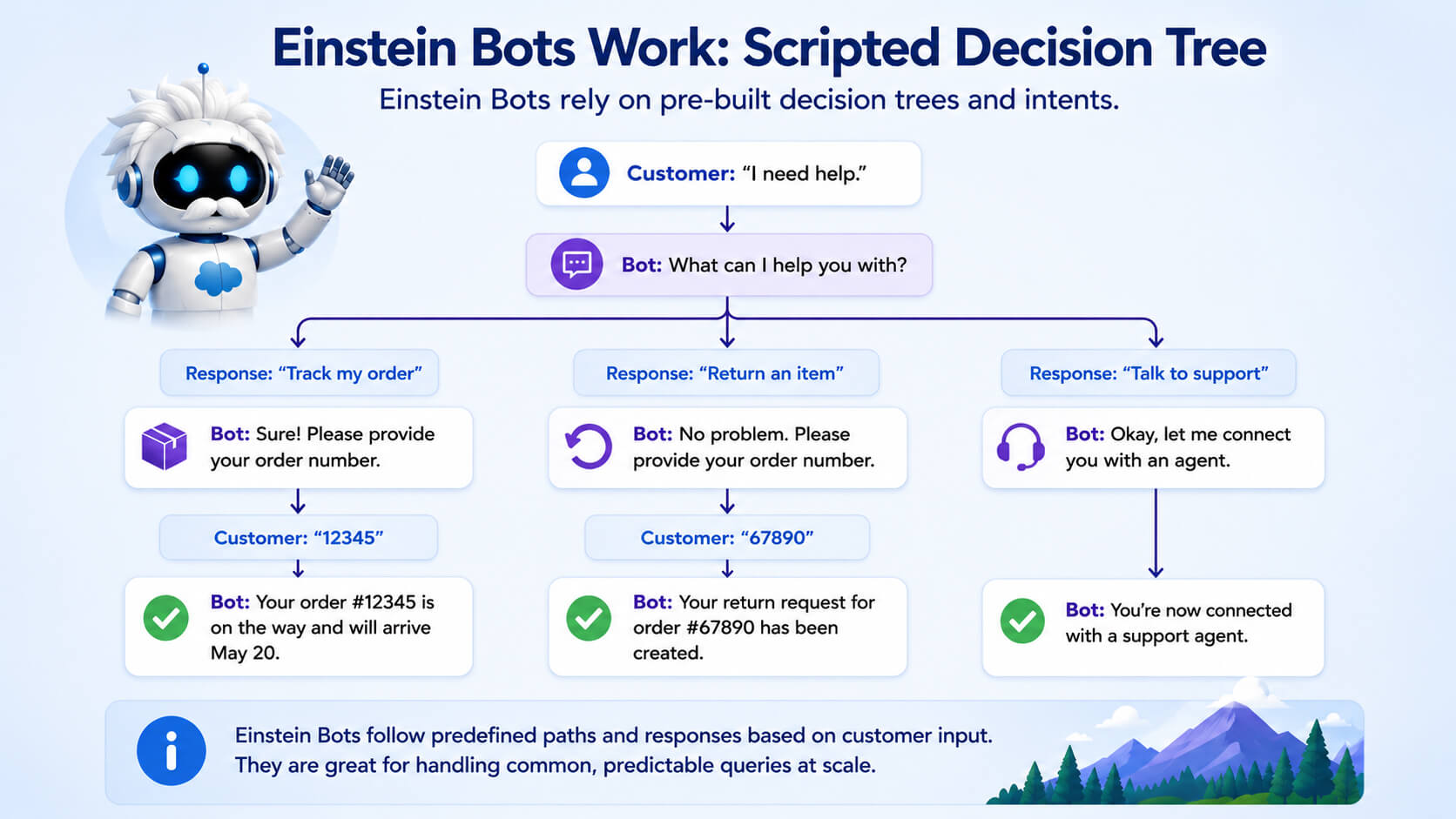
Einstein Bots have been part of the Salesforce ecosystem for years, and for good reason they’re reliable, predictable, and relatively quick to set up.
Typical Workflow
- Your team maps out common customer questions and support scenarios.
- You build conversation flows using Salesforce’s bot builder, defining intents (what the customer wants) and dialogs (how the bot responds).
- The bot uses natural language processing to match customer input to the closest intent.
- If the bot can resolve the issue (password reset, order status, FAQ-type queries), it does so directly.
- If the conversation goes off-script or hits a complexity threshold, it hands off to a live agent with full context.
The key word here is scripted.
Einstein Bots are excellent at handling:
- Order tracking
- Appointment scheduling
- Basic troubleshooting
- FAQ responses
- High-volume repetitive interactions
But if a customer phrases something unexpectedly or asks something outside the defined paths, the bot can struggle and either loop or escalate prematurely.
For many mid-sized businesses, especially those with well-defined support processes and a tight budget, Einstein Bots remain a solid, cost-effective starting point.
How Agentforce Actually Works (And Why It Needs Data Cloud)
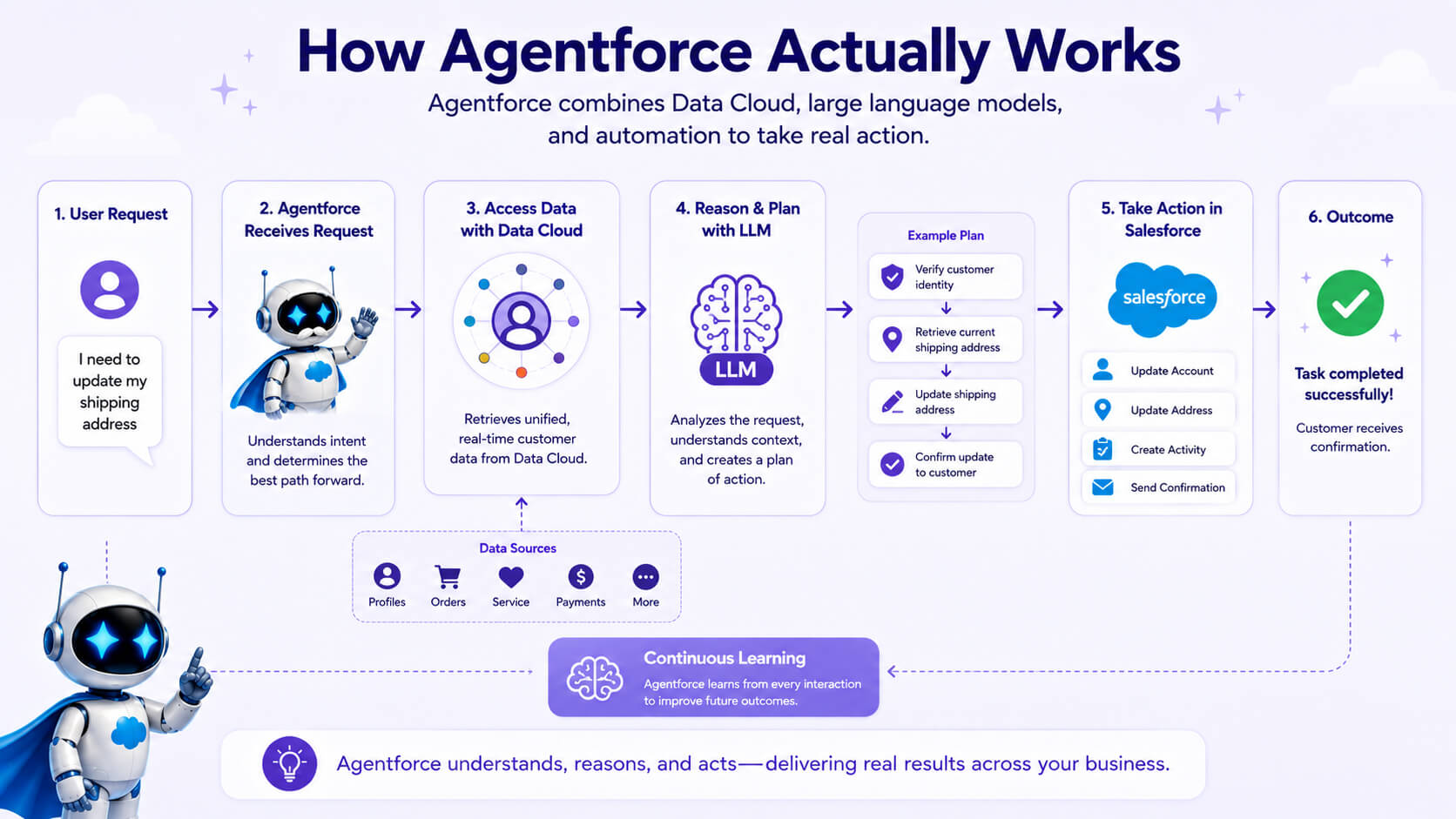
Agentforce represents a genuine shift in how Salesforce thinks about AI moving from “AI that suggests” to “AI that does.”
Under the Hood
1. Data Foundation
Agentforce pulls unified, real-time customer data through Salesforce Data Cloud combining information from:
- CRM
- Support tickets
- Marketing platforms
- External systems
2. Reasoning Layer
A large language model interprets the customer’s or employee’s request, understands intent and context, and plans out the steps needed to resolve it.
3. Action Layer
Using:
- Salesforce Flows
- Apex
- APIs
The agent executes actions such as:
- Updating records
- Issuing refunds
- Rescheduling appointments
- Sending follow-ups
4. Guardrails & Escalation
Policies define:
- What agents can do autonomously
- When they must escalate
- Full audit logging requirements
5. Multi-Agent Orchestration
Multiple specialized agents can work together, including:
- Research agents
- Communication agents
- Case management agents
This architecture is fundamentally different from Einstein Bots.
Agentforce builds AI agents that can:
- Read Salesforce data through Data Cloud
- Take actions through Flows and APIs
- Escalate to humans when required
- Log every action for audit purposes
Why Data Cloud Matters
While Data Cloud isn’t technically mandatory, Agentforce performs significantly better with it because it provides unified, real-time customer data.
Skipping Data Cloud often means skipping the very thing that makes Agentforce valuable.
Why Data Quality Decides Whether Agentforce Succeeds or Fails
This is the part vendors rarely lead with.
Agentforce is only as good as the data it can access.
If your Salesforce org contains:
- Duplicate accounts
- Inconsistent field usage
- Incomplete case histories
- Fragmented departmental data
An autonomous agent won’t solve those problems.
It may amplify them.
An agent confidently taking the wrong action because of bad data is often worse than a bot that simply can’t answer.
Key Statistics
According to a 2026 analysis:
- 77% of B2B Agentforce deployments fail due to data quality issues.
- Only 31% of setups remain active after six months.
The lesson is simple:
Technology isn’t usually the bottleneck. Data quality is.
Before investing in Agentforce, organizations should audit:
- CRM data quality
- Field standardization
- Integration coverage
- Duplicate records
- Governance processes
Real-World Example: What Agentforce Looks Like When It Works
Not every story is cautionary.
When the data foundation is solid and the use case is well-scoped, Agentforce can deliver impressive results.
Reddit’s Agentforce Deployment
Reddit reportedly:
- Reduced resolution times by 84%
- Deflected 46% of customer service cases
Why It Worked
- Clearly defined support use case
- Clean and structured data
- Strong Data Cloud foundation
- Well-defined escalation paths
- Continuous optimization after launch
Key Lesson
Start narrow.
Prove value.
Expand gradually.
Avoid enterprise-wide “big bang” deployments.
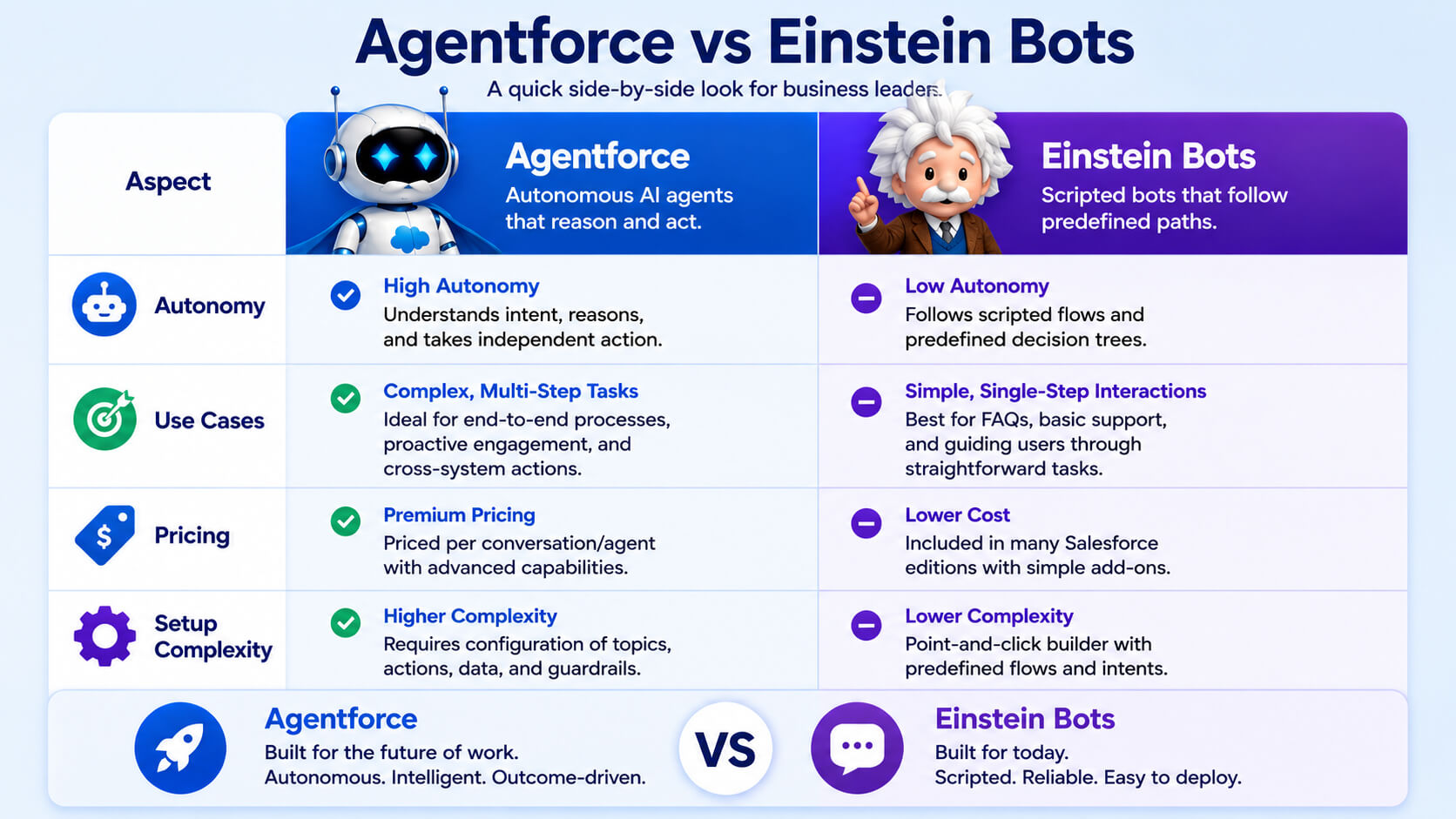
Where Einstein Bots Excel
- High-volume repetitive interactions
- Faster implementation
- Lower cost
- Lower data requirements
- AI beginner organizations
Where Agentforce Excels
- Multi-step workflows
- Cross-functional automation
- Autonomous actions
- Advanced reasoning
- Data-driven decision making
Where They Overlap
- Natural language understanding
- Customer conversations
- Omnichannel deployments
- Dependence on quality data
Common Enterprise Approach
Many organizations use:
Einstein Bots → Front-line support and FAQs
Agentforce → Complex service requests and business process automation
This creates a tiered AI strategy.
Einstein’s Additional Role
Einstein also provides:
- Lead scoring
- Opportunity scoring
- Case classification
- Churn prediction
- Next-best-action recommendations
- Email drafting
- Call summarization
What This Means for Your Budget and Timeline
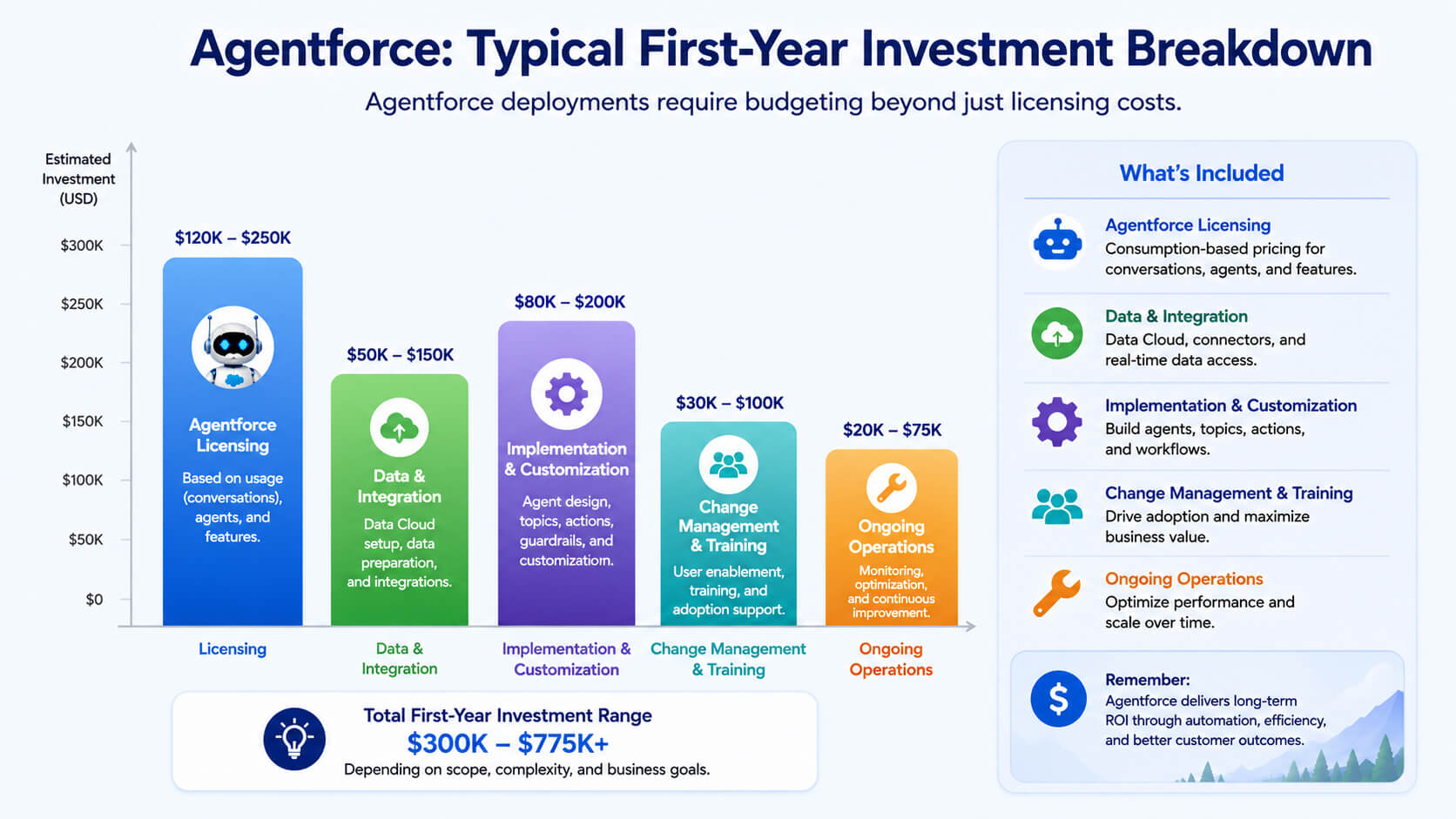
Many AI initiatives fail because budgeting focuses only on licensing.
Agentforce Pricing
- Usage-based pricing
- Starts at $2 per conversation (2026)
Additional Costs
Organizations should also budget for:
- Data Cloud licensing
- Implementation services
- Integration work
- Data cleanup
- Governance and monitoring
Estimated First-Year Cost
A 50,000-conversation deployment can typically reach:
$200,000 – $400,000
when licensing, Data Cloud, implementation, and governance are included.
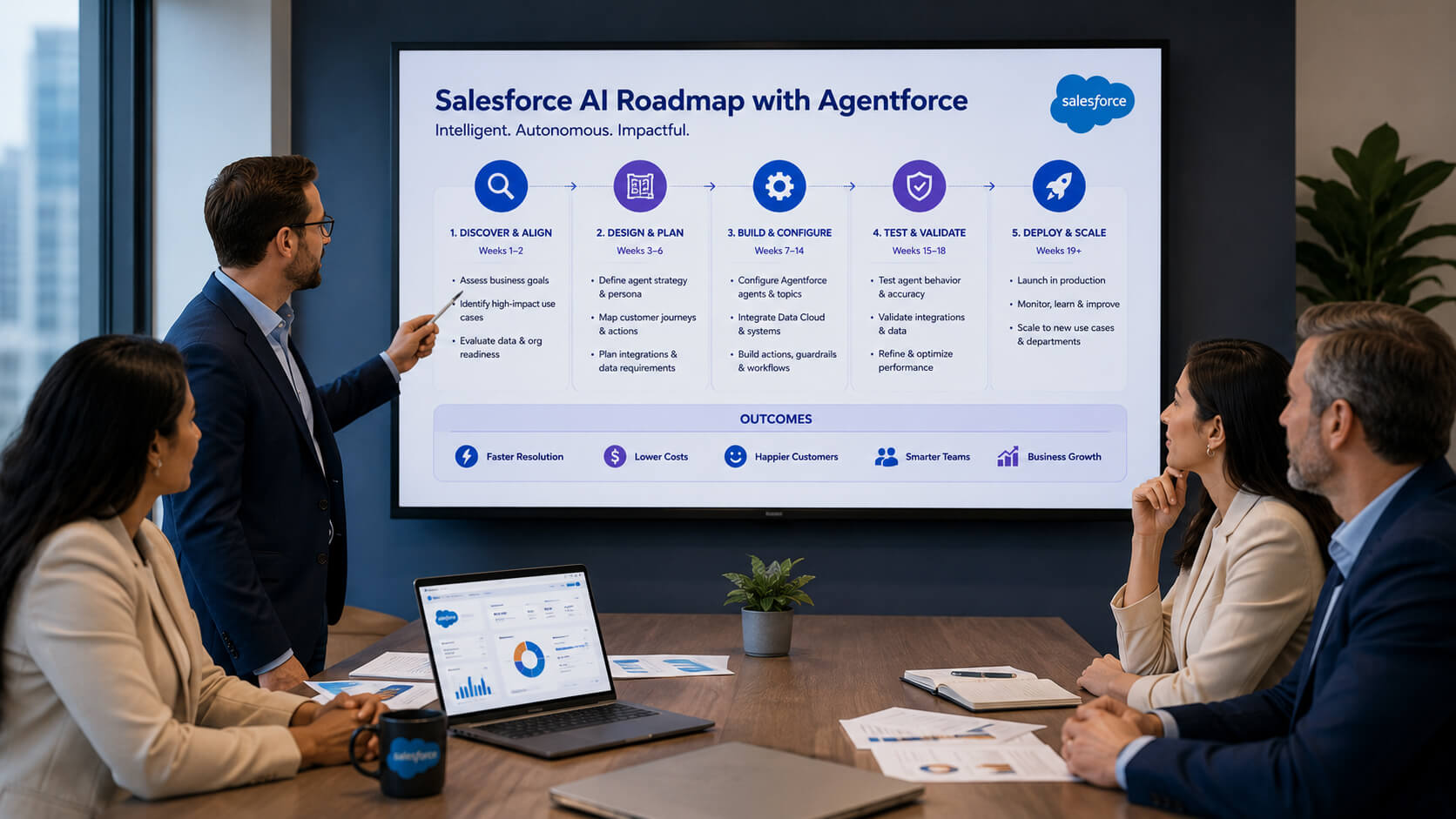
Recommended Rollout Strategy
- Pilot a single use case
- Measure outcomes
- Optimize
- Scale gradually
Salesforce’s Strategic Direction
Salesforce continues investing heavily in Agentforce.
Einstein Bots remain supported, but most future AI innovation is centered around Agentforce.
How NSIQ INFOTECH Helps You Choose and Implement the Right Salesforce AI Strategy
Deciding between Agentforce, Einstein Bots, or a combination of both should be based on:
- Data maturity
- Support volume
- Existing Salesforce architecture
- Business priorities
The right implementation strategy starts with:
Data and Process Audit
Identify:
- Data quality gaps
- Process bottlenecks
- Readiness for Agentforce
- Areas better suited for Einstein Bots
Phased Implementation
A structured rollout helps organizations:
- Minimize risk
- Prove ROI
- Improve adoption
- Scale successfully
Data Cloud Setup
A strong Data Cloud foundation is critical because poor data quality remains the biggest cause of Agentforce underperformance.
Whether you’re evaluating Agentforce for the first time, improving existing Einstein Bots, or planning a broader Salesforce AI roadmap, experienced implementation guidance can significantly reduce project risk.
Final Thoughts on Agentforce vs Einstein: Which Is Better?
So, Agentforce vs Einstein — which is better?
The honest answer is that it depends entirely on where your organization is in its AI journey.
Choose Einstein Bots If:
- You need fast wins
- You have predictable support processes
- Your budget is limited
- Your data maturity is still developing
Choose Agentforce If:
- You have mature, clean data
- You need autonomous actions
- You want AI-driven workflow automation
- You already have strong governance practices
For most enterprises, the smartest approach isn’t choosing one over the other.
It’s sequencing them correctly.
Use Einstein Bots for routine automation today while building the data foundation Agentforce needs tomorrow.
FAQs
Q.1: What is the main difference between Salesforce Agentforce and Einstein Bots?
Einstein Bots follow scripted conversation flows for routine interactions. Agentforce uses AI reasoning and business data to understand context and autonomously take action.
Q.2: Is Agentforce a replacement for Einstein Bots?
Not necessarily. Many organizations use Einstein Bots for simple interactions and Agentforce for complex workflows.
Q.3: Does Agentforce require Salesforce Data Cloud?
Not strictly, but Agentforce performs significantly better with Data Cloud because it provides unified, real-time data.
Q.4: How is Agentforce priced compared to Einstein Bots?
Agentforce uses usage-based pricing starting at $2 per conversation, while Einstein Bots are generally included within Service Cloud licensing tiers.
Q.5: What’s the biggest risk when implementing Agentforce?
Poor data quality, including duplicate records, inconsistent fields, and weak integrations.
Q.6: Is Salesforce Einstein still being developed?
Yes, but Salesforce’s primary AI investment is increasingly focused on Agentforce.
Q.7: Which is better for customer service: Agentforce or Einstein Bots?
Einstein Bots are ideal for simple, repetitive requests. Agentforce is better suited for complex service scenarios requiring reasoning and actions.
Q.8: Can small or mid-sized businesses use Agentforce?
Yes, but most should start with a narrow pilot use case before expanding.
Q.9: What industries benefit most from Agentforce?
Financial services, retail, telecom, manufacturing, and B2B technology organizations often see strong results.
Q.10: How long does an Agentforce implementation typically take?
Implementation timelines vary based on data readiness, integrations, and scope.
Q.11: Do I need to clean up my Salesforce data before deploying Agentforce?
Yes. Data quality should be assessed and improved before implementation.
Q.12: What’s an example of Agentforce working well in practice?
Reddit’s deployment significantly reduced resolution times and automated a large share of customer service cases.
Q.13: Can Agentforce integrate with non-Salesforce systems?
Yes. Agentforce can integrate with external systems through APIs and Data Cloud connectors.
Q.14: Is it expensive to run both Agentforce and Einstein together?
Costs increase when both are deployed, but many enterprises find the combined value worthwhile.
Q.15: How do I decide between Agentforce and Einstein Bots for my organization?
Assess your data quality, workflow complexity, support volume, and AI maturity before deciding.
Conclusion
Choosing between Salesforce Agentforce and Einstein Bots isn’t about selecting the newest technology—it’s about choosing the solution that aligns with your organization’s current goals, data maturity, and operational requirements. Einstein Bots remain a practical and cost-effective option for automating routine customer interactions, while Agentforce introduces a new level of autonomous AI capable of reasoning, making decisions, and executing complex business processes.
For most organizations, the best approach is not an either-or decision. Instead, it’s about building a phased AI strategy that delivers immediate value while preparing for future innovation. Businesses can leverage Einstein Bots to streamline repetitive support tasks today while strengthening their data foundation and governance framework for a successful Agentforce implementation tomorrow.
Ultimately, the success of any Salesforce AI initiative depends less on the technology itself and more on the quality of your data, the clarity of your use cases, and the effectiveness of your implementation strategy. By evaluating your readiness carefully and investing in the right foundation, you can maximize ROI and create a scalable AI roadmap that supports long-term business growth.