
Every hospital gets complaints. A long wait, a miscommunication, a billing confusion — these are not just isolated incidents. They are signals. And how your hospital handles them defines your reputation, your patient retention, and ultimately, your quality of care.
Patient complaint management is not just a back-office function. It is a frontline responsibility that touches patient experience management, hospital operations, and even legal compliance. Yet most hospitals still rely on sticky notes, scattered emails, and fragmented spreadsheets to track complaints — and things fall through the cracks.
This guide is for hospital operations leaders and patient experience teams who want to build a system that actually works: one that captures every complaint, routes it to the right person, closes it on time, and helps the hospital learn from it.
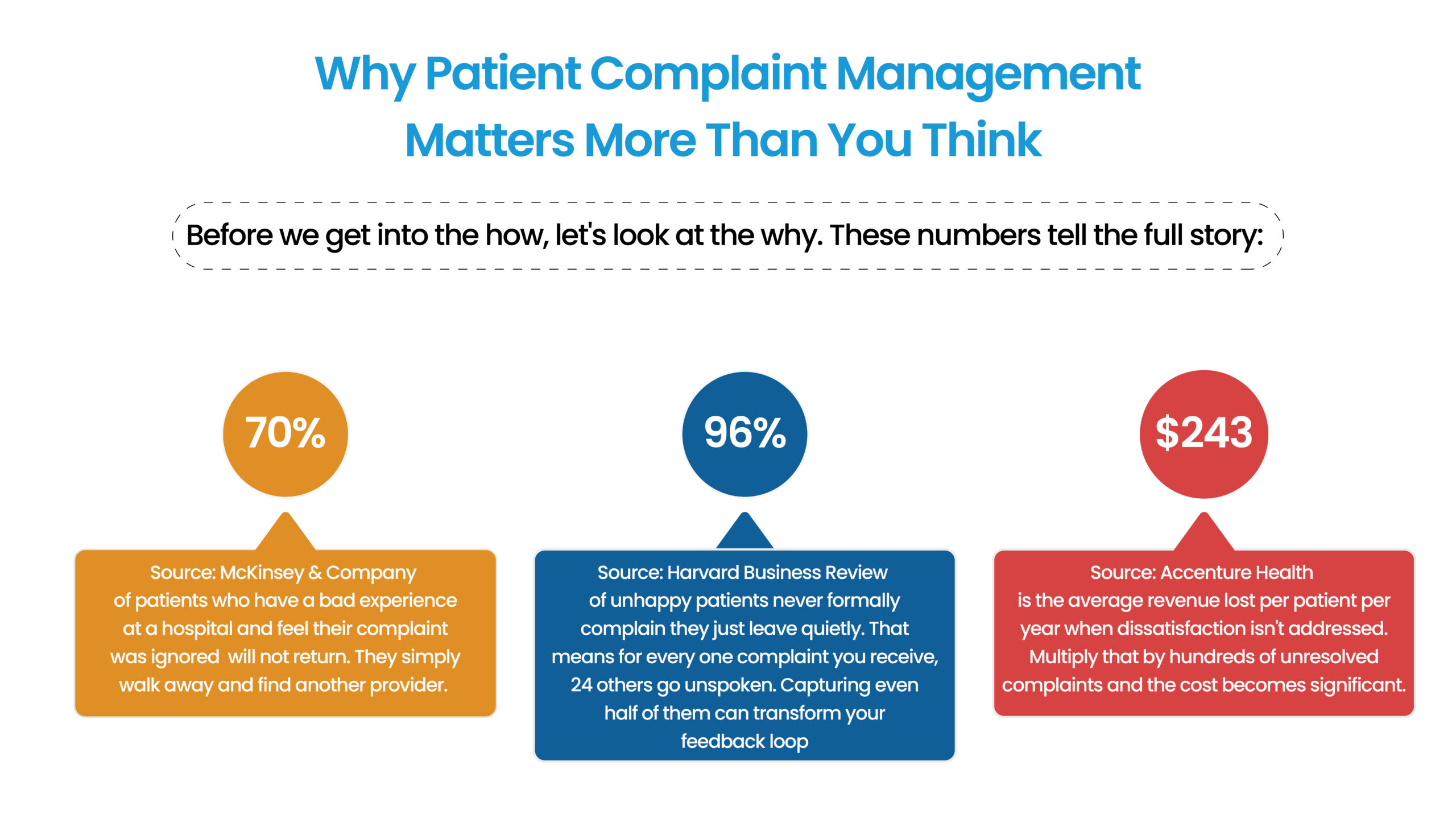
These are not just operational statistics. They are a warning that poor patient complaint management has real financial and reputational consequences.
Where Most Hospitals Go Wrong with Complaint Handling
Understanding the problem is the first step to fixing it. Here are the most common failure points:
- Complaints are received across channels (in-person, phone, email, forms) but never centralised into one place.
- There is no clear ownership — complaints bounce between departments or get assigned to whoever happens to be available.
- inconsistent or simply unknown Response timelines arewn. Some complaints get resolved the same day, others take weeks without explanation.
- Root cause analysis is skipped. Hospitals close the complaint without asking why it happened or how to prevent it.
- Patients are not informed of the outcome. The complainant never hears back, which turns a fixable situation into a lost patient.
Sound familiar? These are not unique problems they are nearly universal in hospitals that haven’t built a structured approach to how to manage patient complaints.

Real-World Example: How One Hospital Cut Complaint Resolution Time by 60%
Consider a mid-sized 300-bed hospital in a tier-2 city. Their patient experience team was overwhelmed complaints came through WhatsApp, a physical register at the front desk, and individual department email inboxes. Nothing was centralised.
After implementing a structured hospital patient management system with a dedicated complaint module:
- Average resolution time dropped from 11 days to 4.3 days within the first quarter.
- Patient follow-up acknowledgements went from 40% to 98%.
- Repeat complaints about the same issue (billing delays) dropped by 70% after a targeted process fix triggered by complaint data.
The biggest change was not technology it was accountability. Every complaint had a named owner, a deadline, and a closure status. Nothing could quietly disappear.
Setting Up the Right Complaint Intake Channels
Patients complain when and how it is convenient for them, not when it is convenient for your team. A good patient complaint management setup gives them multiple, easy options.
1. Digital Complaint Forms
A web-based form on your hospital website or patient portal that submits directly into your system. Keep it short — name, contact, date of visit, department, complaint description. Five fields is enough.
2. In-Person / Front Desk Intake
Train your front desk staff to receive verbal complaints professionally and log them immediately — not on a notepad, but in the system. This is where most complaints originate.
3. Post-Visit Patient Satisfaction Survey
A patient satisfaction survey sent via SMS or email 24–48 hours after discharge is one of the best ways to capture feedback before it becomes a formal complaint. If a patient gives a low score, your system should auto-flag it for follow-up.
4. Phone and WhatsApp
Many patients prefer calling or messaging. Designate a specific number for complaints and train staff to log calls into the system in real time. WhatsApp messages should be assigned to a staff member who documents them formally.
How to Categorise and Prioritise Complaints Effectively
Not all complaints carry equal urgency. A complaint about cold food is different from a complaint about medication error. Your team needs a clear framework.
Suggested Complaint Categories
- Clinical Care: Medication errors, incorrect diagnosis, treatment delays
- Communication: Rude staff, lack of information, poor bedside manner
- Administrative: Billing disputes, appointment issues, discharge delays
- Facilities: Cleanliness, food quality, amenity availability
- Privacy or Ethics: Data sharing, consent issues, discrimination
Priority Tiers
Assign each complaint a priority tier at intake:
- Critical (P1): Clinical safety concerns — resolve within 24 hours
- High (P2): Communication or billing disputes — resolve within 3 days
- Standard (P3): Facility or general service complaints — resolve within 7 days

Manual tracking breaks down fast. Once your hospital handles more than 30–40 complaints per month, spreadsheets and email threads become unmanageable. This is where healthcare management software becomes essential.
A dedicated complaint module within your hospital patient management system gives you:
- A single dashboard showing all open, pending, and resolved complaints with their owners
- Automatic escalation alerts when a complaint exceeds its SLA deadline
- Audit trails so every action taken on a complaint is time-stamped and logged
- Trend reports that surface recurring issues by department, complaint type, or time period
- Integration with your patient satisfaction survey to auto-create complaint records from low scores
Training Your Staff to Handle Complaints Like Professionals
Technology solves the tracking problem. People solve the relationship problem. Your staff — from nurses to billing executives to front desk teams — need to know how to receive and respond to complaints without getting defensive.
The LEARN Framework for Frontline Staff
- Listen: Let the patient speak fully without interrupting
- Empathise: Acknowledge their frustration genuinely — ‘I understand this has been very inconvenient for you’
- Apologise: Express regret for the experience, even if the hospital was not at fault
- Resolve: Share what action you will take or escalate immediately if you cannot resolve on the spot
- Notify: Follow up within the committed timeframe with an update or resolution
Monthly roleplay sessions where staff practice complaint scenarios are far more effective than policy documents alone. Build this into your staff induction and quarterly reviews.
Closing the Loop: The Step Most Hospitals Skip
Here is the single biggest mistake hospitals make in complaint handling: they resolve the complaint but never tell the patient what was done.
Patients want to know two things: that they were heard, and that something changed because of it. Sending a short, personal follow-up message — even a 3-sentence summary of what was investigated and what action was taken — can turn a dissatisfied patient into a loyal one.
If your team resolved a billing complaint by retraining the billing executive, say so. If you investigated a clinical concern and found no issue, explain what was reviewed. Transparency builds trust.
Actionable Template: Dear [Patient Name], thank you for raising this concern. We reviewed [specific issue] thoroughly. As a result, [action taken]. We value your feedback and remain committed to improving your experience. Please do not hesitate to contact us for any further concerns.

At NSIQ INFOTECH, we build hospital patient management systems that make complaint handling structured, visible, and measurable. Our patient experience management module is designed specifically for healthcare operations teams that are tired of losing track.
Whether you are a standalone hospital, a clinic chain, or a healthcare group, our platform gives you:
- Centralised complaint intake across all channels
- Automated routing, escalation, and SLA tracking
- Real-time dashboards for operations and compliance teams
- Built-in patient satisfaction survey triggers and analytics
- Detailed audit logs for regulatory and accreditation purposes
The goal is simple: no complaint should fall through the cracks, and every patient should feel heard.
CTA: Ready to see how it works? Book a free 30-minute product walkthrough with our healthcare team. We will show you exactly how your hospital can go from scattered to structured in 30 days. Visit www.nsiqinfotech.com or write to us at info@nsiqinfotech.com to schedule your demo.

- What is patient complaint management in healthcare?
Patient complaint management is the process of receiving, logging, investigating, resolving, and analysing grievances raised by patients or their families about their hospital experience. It covers clinical, administrative, communication, and facility-related issues.
- Why is patient complaint management important for hospitals?
It directly affects patient retention, care quality, and hospital reputation. Unresolved complaints lead to patient loss, negative reviews, and in some cases, legal or regulatory consequences.
- How can a hospital set up a patient complaint management system?
Start by centralising all complaint channels into one system, define complaint categories and priority tiers, assign ownership to each complaint, set resolution timelines, and create a loop for patient follow-up.
- What is the role of a patient satisfaction survey in complaint management?
A patient satisfaction survey captures feedback before it escalates into a formal complaint. Low survey scores can automatically trigger a follow-up call or complaint record in your system, enabling early intervention.
- What features should a hospital look for in healthcare management software for complaints?
Look for centralised complaint intake, automated escalation, SLA tracking, department-level routing, analytics and trend reporting, and integration with patient satisfaction survey tools.
- How long should a hospital take to resolve apatientcomplaint?
Best practice is to acknowledge within 24 hours and resolve within 3 to 7 days depending on complexity. Clinical safety complaints should be addressed within 24 hours. Each hospital should set and communicate its own SLA.
- How do I train staff to handle patient complaints professionally?
Use structured frameworks like LEARN (Listen, Empathise, Apologise, Resolve, Notify) and run monthly roleplay sessions. Embed complaint handling into staff induction, not just policy documents.
- What are the most common types of patient complaints in hospitals?
The most common complaints include long waiting times, rude or dismissive staff, billing errors, lack of information about treatment, and cleanliness or facility issues.
- How does patient experience management differ from complaint management?
Patient experience management is broader — it covers every touchpoint from admission to discharge. Complaint management is a specific subset focused on resolving dissatisfaction. Both are connected and should be managed together.
- Can healthcare management software reduce patient complaints overall?
Yes. When hospitals identify recurring complaint patterns through data, they can fix the root causes — whether it is a process gap, a staff behaviour issue, or a system inefficiency — which reduces complaint volume over time.
- What should a hospital do when a complaint involves a clinical safety concern?
Treat it as a Priority 1 issue. Involve the Chief Medical Officer or patient safety team immediately, document every step carefully, and respond to the patient within 24 hours with a clear action plan.
- How can I measure the effectiveness of our complaint management process?
Track metrics like average resolution time, complaint closure rate within SLA, percentage of patients who received a follow-up, and number of repeat complaints per issue category.
- What is the connection between complaint management and hospital accreditation?
Most accreditation bodies — including NABH and JCI — require hospitals to have a documented, functioning complaint management process. Audit logs, resolution records, and trend reports are often reviewed during assessments.
- How do I handle a patient complaint received on social media?
Respond promptly and professionally in public, then move the conversation offline. Log it into your complaint management system and treat it the same as any formal complaint — with investigation, resolution, and follow-up.
- What is the best way to prevent patient complaints from escalating?
Acknowledge every complaint quickly, assign it to a named owner, keep the patient updated at every stage, and never go silent. Most escalations happen not because of the original issue, but because the patient felt ignored.
Conclusion
Patient complaint management is not about putting out fires. It is about building a system where fires are spotted early, put out quickly, and the conditions that caused them are permanently fixed.
Hospitals that do this well do not just resolve complaints — they build loyal patients, empowered staff, and a culture of continuous improvement. They use patient satisfaction surveys to catch dissatisfaction early, healthcare management software to track and close every complaint, and data to identify the patterns that matter.
The starting point is simple: stop managing complaints in pieces and start managing them as a system. Every complaint deserves a clear owner, a deadline, a resolution, and a follow-up.
Your patients are not asking for perfection. They are asking to be heard. Build a process that proves you are listening.
Ready to Build Your System? NSIQ INFOTECH can help you implement a structured, software-backed patient complaint management process in your hospital. Book a free demo today at www.nsiqinfotech.com
External References
- McKinsey & Company — The Value of Getting Personalization Right in Healthcare (mckinsey.com)
- Harvard Business Review — Why Companies Should Stop Trying to Delight Their Customers (hbr.org)
- Accenture — Healthcare Consumer Survey on Patient Loyalty and Experience (accenture.com/health)
Image Suggestions Summary :