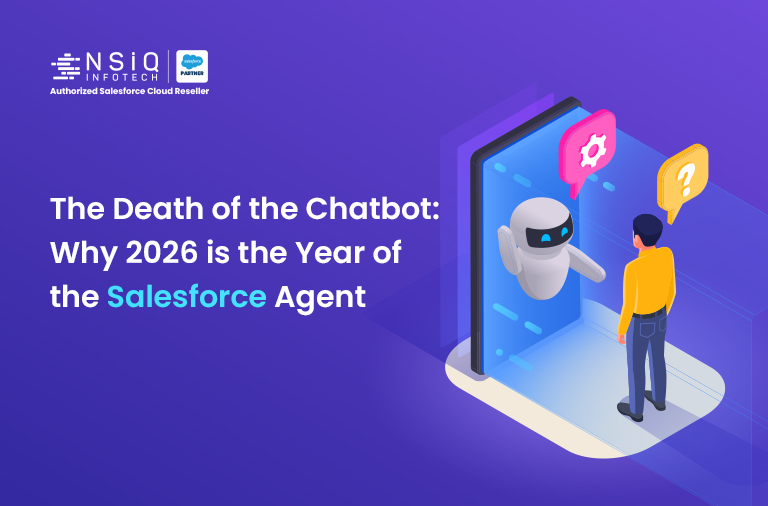
The Death of the Chatbot: Why 2026 is the Year of the Salesforce Agent

The Hook: The End of “I Don’t Understand”
For years, the chatbot promised to revolutionize customer service. Instead, it often delivered a loop of frustration:
With the full-scale rollout of Agentforce, we’re witnessing the end of reactive bots and the rise of Digital Labor autonomous AI agents that can reason, act, and resolve issues without constant human intervention.
This isn’t an incremental upgrade. It’s a fundamental shift in how work gets done.
1. What Changed? Traditional Chatbots vs. Autonomous Agents
To understand why the chatbot is effectively “dead,” we need to look at the transition from assistive tools to autonomous workers.
The Old Way: Chatbots
Traditional chatbots were essentially advanced decision trees built on rigid if/then logic.
-
Worked only within predefined scripts
-
Failed when queries deviated from expected paths
-
Required humans to finish most real tasks
They assisted conversations they didn’t resolve outcomes.
The New Way: Autonomous Agents
Agentforce agents are fundamentally different.
Powered by the Atlas Reasoning Engine, agents don’t just respond they think.
They can:
-
Analyze user intent
-
Retrieve data from multiple systems
-
Decide on the best next action
-
Update records, send emails, and trigger workflows via MuleSoft APIs
Key Insight (2026):
Over 40% of enterprise applications now include task-specific AI agents, shifting ROI from simple productivity gains to full business transformation.
2. Under the Hood: The Atlas Reasoning Engine
The real breakthrough behind autonomous agents is the Atlas Reasoning Engine.
Older AI systems relied on System 1 thinking fast, reactive, and pattern-based. Atlas introduces System 2 thinking, which mirrors human problem-solving.
The Reasoning Loop
When a request enters the system, Atlas:
-
Creates a plan
-
Evaluates available data
-
Executes actions
-
Reviews and refines results
-
Adapts in real time
It doesn’t just answer it reasons.
Why This Matters
-
33% increase in overall accuracy
-
2× improvement in response relevance compared to older Copilot-style models
-
Uses a neuro-symbolic approach, combining neural pattern recognition with rule-based logic
-
Can explain why it made a decision critical for trust and compliance
3. The Engine Room: Unified Data Cloud
Agents are smarter in 2026 because they’re grounded in unified, real-time data.
Chatbots only knew what was in the current conversation. Agents operate with a complete customer context, powered by Data Cloud.
This includes data from:
-
Sales
-
Service
-
Marketing
-
External systems like Snowflake and ERPs
Why Data Quality Is Now Non-Negotiable
Organizations with integrated data report:
-
Up to 32% improvement in sales forecast accuracy
-
Nearly 80% reduction in data errors
For agents, data quality isn’t an enhancement it’s the foundation.
4. Three High-Impact Agent Use Cases for 2026
1. The Proactive Service Agent
Detects shipping delays in the background and proactively sends a personalized apology with a discount code before the customer even checks tracking.
2. The Always-On Sales Development Agent
-
Researches leads 24/7
-
Qualifies based on live intent signals
-
Drafts hyper-personalized outreach
-
Automatically books meetings when leads reply
3. The Zero-Touch Onboarding Agent
In financial or healthcare services, agents now:
-
Collect documentation
-
Validate eligibility
-
Complete discovery without human involvement
5. A Practical 4-Step Roadmap to Agent Implementation
Deploying an agent is less like installing software and more like hiring a new employee.
Step 1: Define the Role & Topics
Clearly define the job (e.g., Lead Qualifier) and the Topics that define its scope.
Step 2: Assign Actions
Connect the agent to Flows, Apex, APIs, or Prompt Templates these are its tools.
Step 3: Set Guardrails & Trust
Activate the Einstein Trust Layer to control what the agent can and cannot do, ensuring security and compliance.
Step 4: Sandbox Validation
Always validate agent reasoning in a sandbox using masked data before going live.
Quick FAQ: Everything You Need to Know
1. Is an Agent just a better chatbot?
No. Chatbots follow scripts. Agents use reasoning.
A chatbot is like a train on a fixed track an agent is a driver who can take detours to reach the destination.
2. What is “Digital Labor”?
Digital Labor refers to AI that works for you, not just with you autonomously handling end-to-end tasks such as resolving cases, qualifying leads, or booking meetings without human involvement.
3. Do I need to code to build an agent?
No. With Agentforce Builder, agents can be created using natural language instructions. You define the agent’s role, the data it can access, and the actions it can perform no coding required.
4. How does the Atlas “brain” work?
It operates using a reasoning loop:
Plan → Retrieve Data → Act → Verify → Respond
This allows the agent to think through problems, validate outcomes, and adapt its actions in real time.
5. Is my data safe?
Yes. The Einstein Trust Layer masks sensitive data and ensures your company information is never used to train public third-party AI models.
Conclusion: Managing the Digital Workforce
In 2026, your competitive advantage won’t come from having a CRM.
It will come from how effectively you manage your Digital Labor workforce.
The “death of the chatbot” isn’t a loss it’s a massive upgrade. Human teams are finally free to stop acting like data-entry clerks and start working as strategic architects of the business.

A QA Tester ensures software quality by designing and executing test cases, identifying defects, and validating functionality to deliver reliable and high-performance applications.
related blog