How STLC Ensures High-Quality Software in Salesforce Projects

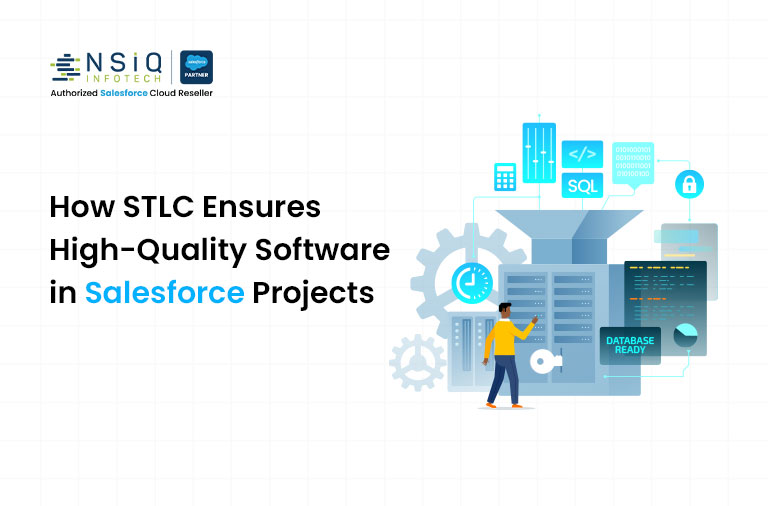
In Salesforce projects, quality is not achieved by testing at the end — it is built step by step throughout the implementation. This is where the Salesforce Testing Life Cycle (STLC) plays a crucial role.
STLC is a structured testing approach followed by QA teams to validate configurations, customizations, integrations, and security before deployment. By following defined phases, it ensures Salesforce solutions are stable, secure, and aligned with business requirements.
Let’s understand how each STLC phase contributes to delivering high-quality software.
1] Requirement Analysis
QA reviews business requirements, user stories, and solution design to identify testable scenarios and potential risks.
This phase helps in understanding object relationships, automation logic, and integration points.
Early clarification reduces confusion, rework, and production defects.
2] Test Planning
Define the testing strategy, scope, timelines, resources, and automation approach.
QA decides regression coverage and identifies high-risk business areas.
A clear plan ensures structured execution and better time management.
3] Test Case Design
Create detailed test cases, prepare test data, and map requirements using a traceability matrix.
Both positive and negative scenarios are covered to ensure complete validation.
Well-written test cases improve clarity and reduce missed defects.
4] Test Environment Setup
Prepare and validate sandbox environments, user roles, permissions, and integration connections.
QA ensures all metadata, configurations, and required data are properly deployed.
A stable environment is essential for accurate and reliable testing results.
5] Test Execution
Execute test cases, validate functionality, and log defects for resolution.
QA verifies automation, security settings, reports, and UI behaviour.
Defects are tracked, retested, and closed once fixed.
6] Regression Testing
Re-test existing features to ensure new changes haven’t impacted current functionality.
Automation scripts are often used to speed up repetitive regression cycles.
This phase is critical in Salesforce due to interconnected workflows and automation.
7] Test Closure Report
In the final phase, QA reviews test results, analyses defect trends, and prepares summary reports.
Lessons learned from each cycle help improve future releases and strengthen overall quality processes.
Quick FAQ: Everything You Need to Know
1. What is STLC in Salesforce?
STLC is a systematic process used to ensures Salesforce works correctly before deployment.
2. Why is STLC important?
It helps identify defects early and ensures the system meets business requirements.
3. What are the main phases of STLC?
Requirement Analysis, Test Planning, Test Case Design, Environment Setup, Test Execution, Regression Testing, and Test Closure.
4. How does STLC improve software quality?
It validates every feature step by step and prevents production issues.
5. Is regression testing necessary in Salesforce?
Yes, it ensures new updates do not impact existing functionality.
6. Can automation be included in STLC?
Yes, automation speeds up testing and improves efficiency, especially during regression cycles.
Conclusion
The Salesforce STLC ensures quality is built into every stage of the project — from requirement analysis to final validation.
By systematically testing configurations, customizations, integrations, and security, STLC minimizes risks and prevents production defects.
When followed correctly, STLC not only improves software stability but also increases user confidence and ensures successful Salesforce deployments aligned with business goals.

A QA Tester ensures software quality by designing and executing test cases, identifying defects, and validating functionality to deliver reliable and high-performance applications.
related blog