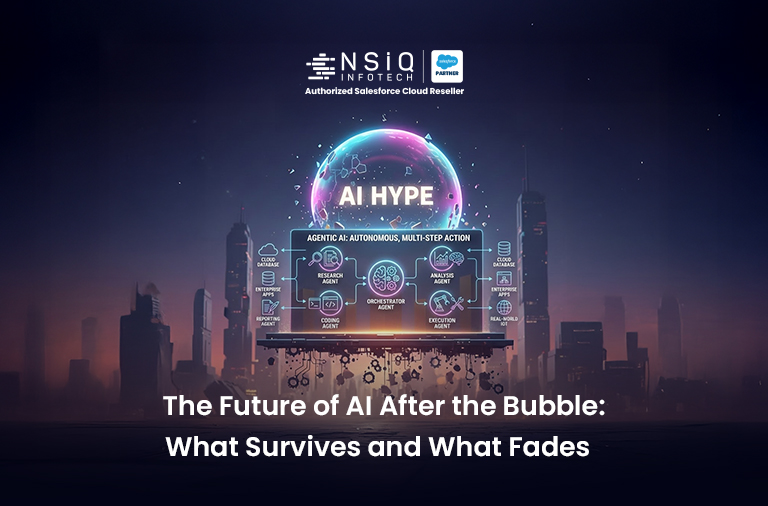
The Future of AI After the Bubble: What Survives and What Fades

Google CEO Sundar Pichai’s Major Warning
Sundar Pichai recently highlighted that the ongoing boom in artificial intelligence may contain elements of irrational excitement. He mentioned that no company – even tech giants like Google – is immune if an AI bubble bursts. His message has grabbed the attention of global tech leaders, investors, and professionals, urging them to evaluate whether the pace of AI growth is sustainable or risky.
AI Investment and Overhyped Valuations
The AI industry has seen massive investment and skyrocketing valuations. Many companies are receiving funding based on future potential rather than current profitability. This trend resembles previous tech bubbles where speculation overshadowed real value. Pichai noted that several firms are investing billions without clear long-term strategies, which increases the risk of a market correction.
No Company Is Immune to the AI Bubble Impact
One of Pichai’s strongest statements was that no company is safe if the AI bubble bursts—not even Google. While Google has strong infrastructure, data, models, and chips, Pichai warned that every tech firm would feel the shock. This message emphasizes that the bubble may impact startups, enterprises, and even global tech leaders.
Salesforce & Enterprise AI: Is the AI Bubble Real?
According to the Apex Hours analysis, companies using platforms like Salesforce are adopting AI tools rapidly, sometimes without defining a clear business objective. Many businesses implement AI because it’s trendy, not because it solves a real problem. This leads to high cost, low ROI, and overdependence on AI features that might not be necessary. The blog warns Salesforce users to be strategic and avoid hype-based decisions.
AI Hype vs Real Use Cases
AI is being marketed as the solution for everything – from automation and customer service to analytics and decision-making. However, many use cases do not actually require complex AI models. Simple automation or rule-based workflows could achieve the same results at lower cost. The danger lies in adopting AI for the sake of appearance rather than value.
AI Is Powerful but Still Prone to Errors
Another key point from the articles is that AI models still hallucinate, produce errors, and behave unpredictably. Over-relying on AI can reduce human judgment and weaken decision-making quality. Whether in business, healthcare, education, or governance, human oversight remains essential.
Why Businesses Must Prepare for a Possible AI Slowdown
If the AI bubble bursts, businesses that built strategies purely around AI hype may face losses. Companies must evaluate real-world needs, measurable ROI, and sustainable AI usage. Using AI as support – not a replacement – ensures long-term stability. Clean data, strong workflows, and proper governance remain just as important as AI adoption.
Conclusion: The Right Approach to AI Adoption
AI is transformative, but it must be used thoughtfully. Pichai’s warning is not to stop innovating, but to be realistic. AI will continue growing, but businesses must embrace it with clarity, not hype. Companies that build real value, maintain human oversight, and prioritize sustainable adoption will thrive even if an AI bubble forms or bursts.

Nihar Sharma is the Co-Founder and CEO, driving innovation, growth, and customer success. With expertise in business strategy and technology, he leads digital transformation and builds scalable solutions, delivering long-term value for clients.
related blog